
Cats pouncing on a flickering shadow, chasing a beam of sunlight across the floor, or lunging at the reflection from a swinging pendant light—these behaviors are common in households with cats. While they may seem random or even comical to human observers, these actions are deeply rooted in a cat’s biology, instincts, and sensory perception. The phenomenon of cats attacking moving light patterns is not just playful mischief; it’s a complex interaction between evolution, visual processing, and predatory drive.
Understanding this behavior requires looking beyond surface-level amusement. It involves examining how cats see the world, what triggers their hunting response, and how domestication has shaped—but not erased—their innate impulses. This article explores the science behind why cats react so strongly to moving lights, offering insight into their minds and practical guidance for pet owners.
The Predatory Instinct Behind the Pounce
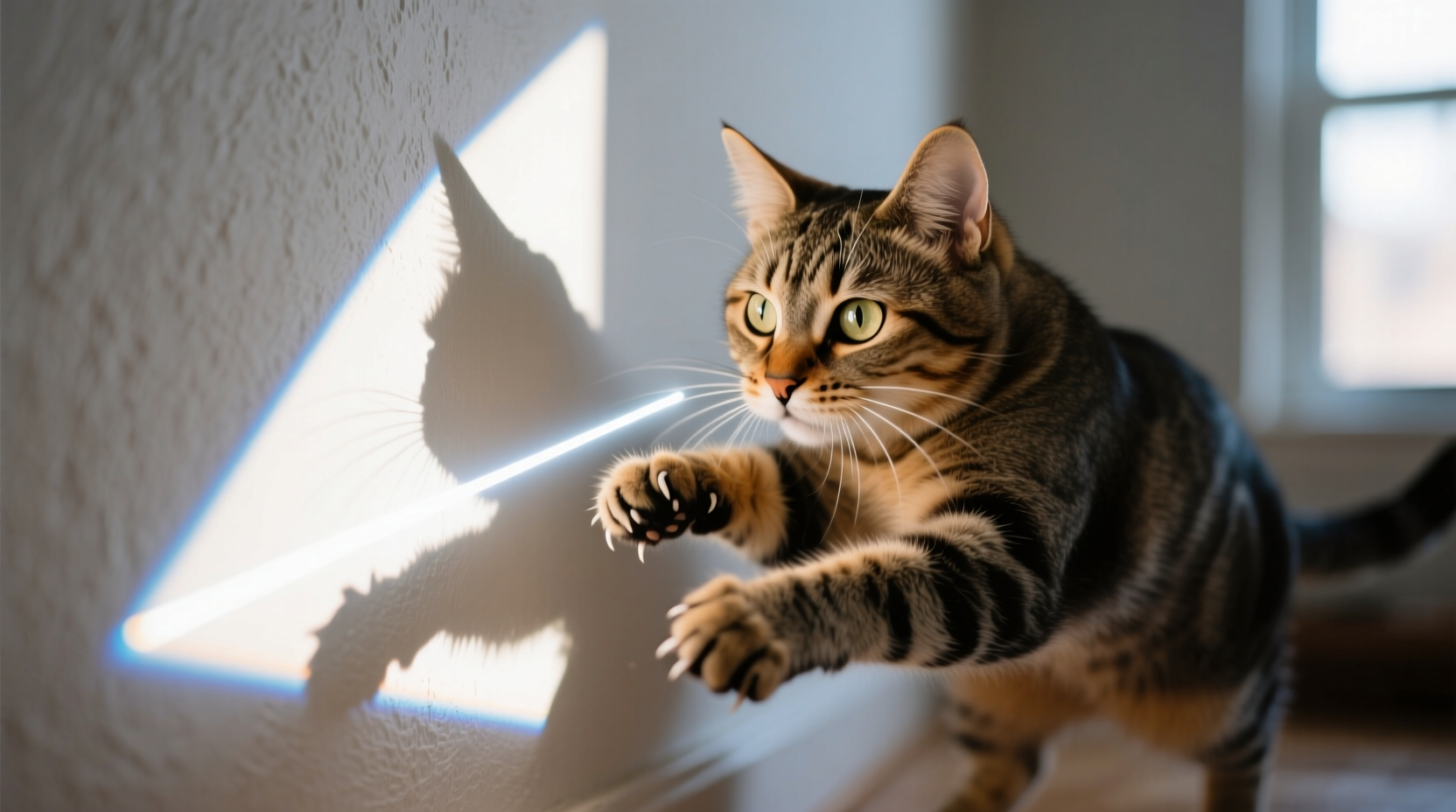
Cats are obligate carnivores and natural-born hunters. Even well-fed domestic cats retain the same neural circuitry that drives wild felines to stalk, chase, and capture prey. In the wild, survival depends on reacting swiftly to small, fast-moving stimuli—such as rodents, birds, or insects. Over millennia, evolution has fine-tuned the cat’s brain to detect motion above all other visual cues.
Moving light patterns—whether from a projector, a phone flashlight, or sunlight reflecting off a mirror—mimic the erratic movements of potential prey. To a cat, a dancing dot on the wall isn’t abstract; it registers as something alive, unpredictable, and worth pursuing. The sudden start-stop motion, changes in direction, and quick disappearances mirror the behavior of real prey, triggering an automatic hunting sequence.
This sequence typically follows a pattern: focus (fixed gaze), stalk (low body posture), chase (rapid movement), and pounce (final lunge). Even when the \"prey\" is intangible, the cat completes the full behavioral loop because the initial stimulus activated its predatory programming.
How Cats See Light and Motion Differently Than Humans
Human and feline vision operate on different principles. While humans have superior color discrimination and visual acuity in bright light, cats excel in low-light conditions and motion detection. Their eyes contain a higher proportion of rod cells—photoreceptors sensitive to dim light and movement—compared to cone cells, which detect color.
A cat’s visual system prioritizes detecting slight shifts in position over recognizing fine details. This makes them exceptionally good at spotting a mouse scurrying along a baseboard but less capable of distinguishing stationary objects at a distance. As a result, a tiny, rapidly moving dot—even one with no substance—becomes highly salient in their field of vision.
Additionally, cats have a reflective layer behind the retina called the *tapetum lucidum*, which enhances night vision by reflecting light back through the photoreceptor cells. This adaptation improves sensitivity to faint light sources but may also amplify reflections and glare, making artificial light patterns appear brighter and more dynamic to cats than they do to us.
It's important to note that cats likely don't perceive laser dots as solid objects. Research suggests they see them as fleeting points of light without depth or form. Yet, because the movement mimics prey-like behavior, the brain still interprets the signal as worth investigating—and attacking.
The Role of Play in Feline Development and Mental Health
Play is not frivolous in cats—it’s essential. Kittens begin stalking and pouncing as early as three weeks old, refining motor skills, coordination, and timing through repetitive practice. These behaviors persist into adulthood because hunting remains a core component of feline identity, regardless of food availability.
Interactive play serves multiple purposes:
- Provides physical exercise to maintain muscle tone and prevent obesity
- Stimulates cognitive function through problem-solving and anticipation
- Reduces stress and prevents boredom-related behaviors like overgrooming or aggression
- Strengthens the bond between cat and owner when shared as a social activity
Chasing light patterns becomes a form of environmental enrichment when structured appropriately. However, if used exclusively, it can lead to frustration. Since the cat never catches the “prey,” it may experience incomplete reward cycles, potentially increasing anxiety or compulsive tendencies over time.
“Cats don’t just play to pass time—they play to survive mentally. Depriving them of successful hunts, even simulated ones, disrupts their psychological balance.” — Dr. Sarah Thompson, Veterinary Ethologist
When Fun Becomes a Problem: Signs of Obsessive Behavior
While occasional chasing of light beams is normal, some cats develop obsessive patterns around moving lights. This is especially true in environments lacking stimulation or outlets for natural behaviors. Signs that light-chasing has become problematic include:
- Fixation on windows or reflective surfaces for extended periods
- Agitation when lights move out of reach
- Self-directed aggression after failing to catch the dot
- Repetitive, trance-like staring at static reflections
In extreme cases, this can evolve into stereotypic behavior—a repetitive, functionless action often linked to stress or confinement. Indoor-only cats with limited access to real prey or varied play experiences are most at risk.
To mitigate this, owners should diversify play routines and ensure every session ends with a tangible reward. Replacing unsatisfying laser games with wand toys, puzzle feeders, or treat-dispensing balls helps fulfill the completion phase of the hunt: capture and consumption.
| Aspect | Healthy Play | Problematic Behavior |
|---|---|---|
| Frequency | Short bursts during scheduled playtime | Constant fixation throughout the day |
| Outcome | Ends with catching a physical object | Never results in capture; ends in frustration |
| Mood Afterward | Relaxed, possibly sleepy | Restless, agitated, or hyper-vigilant |
| Response to Distraction | Easily redirected to food or rest | Difficult to disengage; fixated |
Safe Ways to Engage Your Cat’s Natural Drive: A Step-by-Step Guide
Responsible play supports both physical health and emotional well-being. Follow this step-by-step approach to channel your cat’s instinctive behaviors safely and constructively.
- Assess your cat’s energy level and environment. Choose a quiet space free of breakables. Ensure other pets or loud noises won’t interfere.
- Select the right tools. Use a wand toy with feathers or fur first. Introduce a laser pointer only as part of a broader routine.
- Simulate the full hunt sequence. Begin with slow movements to trigger interest, then increase speed to simulate escape.
- Allow the “capture.” If using a laser, guide the dot onto a physical toy so your cat can pounce and bite it. Immediately follow with praise or a treat.
- End on a positive note. Conclude the session with feeding or grooming to mimic post-hunt relaxation.
- Limited duration. Keep sessions under 10–15 minutes to avoid overstimulation.
Real Example: Luna, the Apartment Cat Who Chased Shadows
Luna, a 3-year-old domestic shorthair living in a high-rise apartment, began showing signs of stress after her owners started working from home. With constant movement around the house—including laptop screens, swaying blinds, and reflected light from glass tables—Luna became increasingly fixated on shifting patterns on the walls.
Her owner noticed she would spend hours crouched near the bookshelf, eyes locked on a shimmer from a decorative vase. She’d lunge repeatedly, sometimes injuring herself by crashing into furniture. Attempts to distract her were ineffective.
A veterinary behaviorist recommended restructuring Luna’s environment: closing blinds during peak sunlight, removing reflective decor, and introducing scheduled interactive play twice daily using a feather wand. Each session ended with a small meal. Within three weeks, Luna’s obsessive behavior decreased significantly. She remained alert and playful but no longer fixated on unattainable lights.
This case illustrates how environmental triggers, combined with insufficient outlets for natural behavior, can escalate benign instincts into problematic habits.
Frequently Asked Questions
Can chasing laser pointers harm my cat?
Occasional use is generally safe, but relying solely on lasers without providing a way to “catch” prey can cause mental frustration. Over time, this may contribute to anxiety or obsessive-compulsive behaviors. Always pair laser play with a physical toy or treat to complete the hunting cycle.
Do all cats react to moving lights?
No. Individual temperament, breed tendencies, age, and early life experiences influence responsiveness. Some cats show little interest, while others—particularly those with high prey drive like Bengals or Abyssinians—are intensely reactive.
Is it okay to let my cat chase headlights or streetlight reflections at night?
It’s best to discourage this. Outdoor light sources through windows can create unpredictable, uncontrollable stimuli that promote fixation. Use blackout curtains or close blinds in the evening to minimize exposure and support better sleep hygiene for both you and your cat.
Final Thoughts: Respecting the Hunter Within
Cats attack moving light patterns not because they’re confused, but because they’re exquisitely adapted to respond to them. Their brains evolved to prioritize motion, their eyes are tuned to detect the slightest shift, and their bodies are built to act on impulse. What looks like a game to us is, to them, a rehearsal of survival.
As caretakers, we must honor that nature—not suppress it. Instead of discouraging natural behaviors outright, we can guide them toward healthy expression. By understanding the why behind the pounce, we foster deeper empathy and build stronger, more enriching relationships with our feline companions.




 浙公网安备
33010002000092号
浙公网安备
33010002000092号 浙B2-20120091-4
Comments
No comments yet. Why don't you start the discussion?