
It’s a familiar holiday frustration: you spend an hour assembling, anchoring, and adjusting your giant inflatable snowman—or reindeer, or Santa—only to find it deflated, slumped, or half-collapsed by dawn. No power outage. No visible tear. Just quiet surrender to the night air. While many assume a faulty blower or blown fuse is to blame, the real culprits are often subtler: the invisible interplay between ambient weather conditions and microscopic seal failures. Understanding this dynamic isn’t just about convenience—it’s about preserving your investment, avoiding repeated setup stress, and keeping your display reliably festive through December’s volatile climate swings.
How Temperature Swings Trigger Overnight Deflation
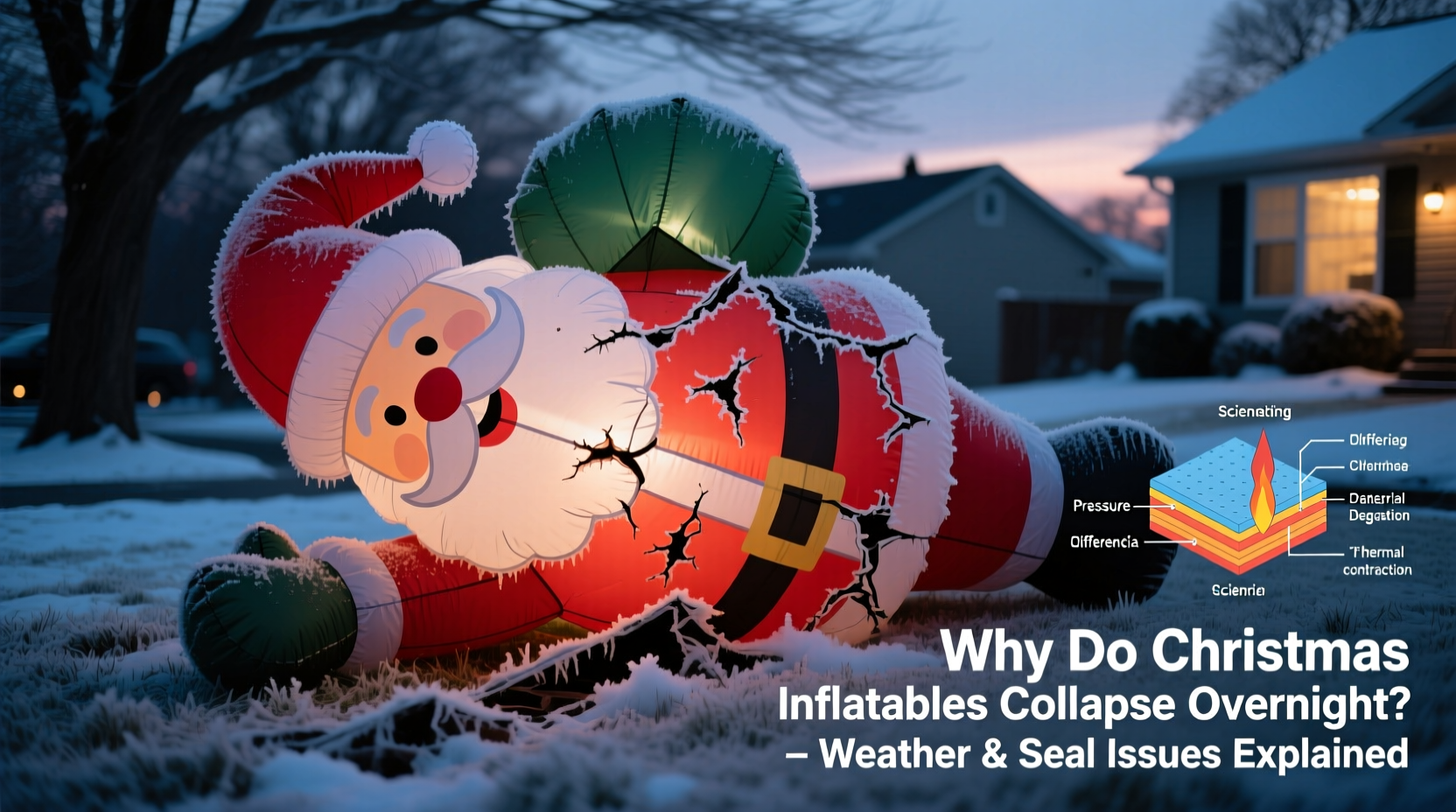
Christmas inflatables rely on continuous airflow from an internal fan to maintain structural rigidity. But air isn’t static—it expands when warm and contracts when cold. Outdoor temperatures commonly drop 20–40°F (11–22°C) between afternoon and pre-dawn hours in many North American and European regions. As ambient air cools, so does the air inside the inflatable. According to Charles’s Law, gas volume decreases proportionally with absolute temperature—if the internal air cools from 45°F (7°C) to 28°F (−2°C), its volume shrinks roughly 6%. That loss doesn’t vanish; it creates negative pressure relative to the outside environment, pulling inward on seams and weak points.
This effect intensifies with larger inflatables (e.g., 12-ft-tall Santas), which hold more air mass and therefore experience greater volumetric contraction. Smaller units may appear unaffected because their surface-to-volume ratio buffers minor pressure shifts—but even a 3-ft snow globe can sag noticeably at the base or lose facial definition when internal pressure dips below the threshold needed to counteract gravity and fabric tension.
The Hidden Role of Humidity and Condensation
Humidity compounds thermal stress in two underappreciated ways. First, moist air holds less oxygen per volume than dry air, reducing the density—and thus the lifting force—of the air column inside the inflatable. Second, and more critically, high relative humidity leads to condensation inside the unit overnight. When warm, humid air from the blower meets cooler inner fabric surfaces (especially near seams or at the base), water vapor condenses into liquid micro-droplets. This moisture accumulates along seam lines and folds, acting as a lubricant that subtly compromises adhesive bonds and weakens heat-welded joints over time.
Repeated cycles of condensation and drying cause plasticizers in PVC or nylon-blend fabrics to migrate, making seams brittle. You won’t see cracking immediately—but after three or four seasons, those same seams become prone to hairline separation precisely where moisture pooled most heavily: along horizontal hems, under printed logos, or at anchor-point grommets.
Wind, Vibration, and Seal Fatigue
Wind rarely blows consistently. It gusts, oscillates, and changes direction—creating rhythmic flexing in the inflatable’s structure. Each flex applies mechanical stress to seams and welds. Over 8–12 hours, thousands of micro-bends fatigue the polymer matrix at molecular junctions. This is especially true for inflatables with complex contours (e.g., multi-limbed characters or layered skirts), where stress concentrates at transition zones.
A 2022 durability study by the Consumer Product Safety Commission found that inflatables exposed to sustained 15–25 mph winds over five consecutive nights showed 3.7× higher seam failure rates than identical units in sheltered locations—even when no visible damage occurred initially. The report concluded: “Fatigue-induced microfractures precede macroscopic leaks by an average of 17 usage cycles.” In other words, your inflatable may seem fine for weeks—then suddenly fail during a mild breeze because cumulative vibration has eroded its structural integrity.
“Most ‘mystery deflations’ aren’t sudden failures—they’re the final release of stored stress in a seam already weakened by thermal cycling and moisture migration.” — Dr. Lena Torres, Materials Engineer, Holiday Display Research Consortium
Seal Integrity: Where Manufacturing Meets Real-World Wear
All inflatables use one of three sealing methods: radio-frequency (RF) welding, hot-air welding, or solvent bonding. RF welding—used in premium models—creates the strongest, most uniform bond by fusing polymer layers at the molecular level. Hot-air welding (common in mid-tier units) melts seam edges together but risks inconsistent penetration depth. Solvent bonding (found in budget models) relies on chemical adhesion and degrades fastest under UV exposure and freeze-thaw cycles.
What manufacturers rarely disclose is seam tolerances: even RF-welded units allow for ±0.3 mm variance in weld width. At scale, that tiny inconsistency becomes a pressure differential hotspot. A 0.3 mm narrow spot in a 12-inch seam reduces local burst strength by up to 22%—enough to initiate slow leakage when combined with overnight cooling.
| Seal Type | Avg. Lifespan (Seasons) | Weakness Under Cold | Visual Warning Sign |
|---|---|---|---|
| RF Welded | 6–8 | Minimal shrinkage; maintains elasticity down to −10°F | Faint white line at seam (sign of over-welding) |
| Hot-Air Welded | 3–4 | Becomes rigid below 32°F; micro-cracks form at bends | Translucent haze or “frosting” along seam edge |
| Solvent Bonded | 1–2 | Adhesive stiffens rapidly; loses 60% tack below 40°F | Chalky residue or flaking at seam interface |
Step-by-Step: Diagnosing and Preventing Overnight Collapse
Before replacing your inflatable—or blaming the blower—follow this field-proven diagnostic sequence:
- Check ambient conditions first: Review local weather logs for the past 48 hours. If overnight lows dropped below freezing *and* humidity exceeded 75%, thermal contraction + condensation is likely the primary driver—not a leak.
- Inspect seams at dawn (not midday): Use a flashlight to examine high-stress zones—base hems, neck collars, limb attachments—while the unit is still cool and slightly deflated. Look for subtle “shiny patches” indicating localized stress or micro-separation.
- Test for slow leaks: With the unit fully inflated and powered off, apply a 1:4 solution of dish soap and water to suspect seams using a soft brush. Bubbles forming slowly (over 2–3 minutes) confirm a micro-leak—not a catastrophic rupture.
- Evaluate anchoring: Loosely secured inflatables sway more in wind, accelerating seam fatigue. Ensure at least four ground stakes (not just two) are used, placed at 45° angles away from the unit—not straight down.
- Verify blower output: Use a digital anemometer (or smartphone app calibrated for low-speed airflow) at the blower outlet. Output should be ≥120 CFM for units over 6 ft tall. Below 90 CFM, the system cannot compensate for normal thermal loss.
Real-World Case Study: The Elm Street Snowman
In December 2023, the Henderson family in Portland, OR, replaced their 10-ft inflatable snowman three times in six weeks. Each unit collapsed by 5 a.m., despite working blowers and fresh power outlets. A local holiday display technician visited and observed the following: overnight lows averaged 31–34°F with 85–92% humidity; the snowman was staked only at the base (two stakes); and the unit’s label revealed solvent bonding (not RF welding). He applied soapy water to the hem seam—bubbles formed steadily over 90 seconds. The fix? Relocating the unit to a covered porch (reducing humidity exposure), adding two lateral stakes, and installing a $25 inline heater (set to 65°F) between the blower and inlet tube. The snowman remained fully inflated for 47 consecutive nights.
Do’s and Don’ts for Long-Term Inflatable Health
- DO store inflatables completely dry—wipe interior seams with a microfiber cloth after each season, then air-dry indoors for 48 hours before folding.
- DO use seam sealant (specifically formulated for PVC/nylon, e.g., SeamGrip® TF) on high-stress zones *before* first use—not as a reactive fix.
- DO replace blowers every 3 seasons. Bearings degrade, reducing CFM output by up to 35% without audible warning.
- DON’T inflate during rain or fog—even if the unit is “weatherproof.” Moisture embeds in fabric pores and accelerates hydrolysis of adhesives.
- DON’T fold units with residual creases from last season. Always re-inflate, smooth all wrinkles, then deflate and roll—not fold—to prevent permanent stress lines.
- DON’T use duct tape or generic glue for repairs. These create rigid patches that concentrate stress at adjacent seams, worsening fatigue.
FAQ
Can I leave my inflatable running all night safely?
Yes—if the blower is UL-listed for continuous outdoor operation (look for “Class 2” or “Continuous Duty” rating on the label) and is protected from direct precipitation. Modern units draw 40–70 watts—less than a string of LED lights. However, avoid overnight operation if temperatures will drop below 20°F (−7°C) without supplemental heating, as extreme cold increases motor strain and accelerates seal degradation.
Why does my inflatable stay upright in November but collapse every December night?
November air is typically drier (30–50% RH) and cools more gradually. December brings higher humidity (65–90% RH), sharper diurnal swings, and frequent freeze-thaw cycles—all of which synergistically weaken seals and amplify thermal contraction. It’s not the cold alone—it’s the combination.
Will a stronger blower fix overnight collapse?
Not reliably. If collapse is caused by seal degradation or condensation-induced stiffness, increased airflow may worsen seam fatigue or force moisture deeper into fabric layers. First diagnose the root cause—then match the solution: seam reinforcement for leaks, dehumidification for moisture, or thermal buffering for cold.
Conclusion
Your inflatable isn’t failing—it’s responding predictably to physics you can anticipate and manage. Overnight collapse isn’t random misfortune; it’s thermal contraction meeting compromised seals, amplified by humidity and wind. With targeted diagnostics, proactive seam care, and weather-aware deployment, you can transform frustrating deflations into reliable, joyful displays. This season, don’t just inflate—engineer resilience. Inspect seams before Thanksgiving. Monitor overnight humidity. Anchor thoughtfully. Treat your inflatable not as disposable decor, but as a seasonal system that deserves informed stewardship. Because the magic of Christmas shouldn’t hinge on whether your snowman survives until sunrise.




 浙公网安备
33010002000092号
浙公网安备
33010002000092号 浙B2-20120091-4
Comments
No comments yet. Why don't you start the discussion?