
Christmas inflatables—those cheerful, larger-than-life Santas, snowmen, and reindeer that anchor front lawns each holiday season—are engineered for visibility, not silence. Yet many homeowners are startled, annoyed, or even embarrassed when their $129 Frosty starts emitting a persistent 62-decibel whine at midnight—or worse, a rhythmic clatter that sounds like a washing machine full of loose bolts. This isn’t just an aesthetic nuisance: chronic noise can violate local noise ordinances, disturb neighbors (especially those with infants, elderly residents, or anxiety conditions), and shorten the lifespan of the blower motor itself. Understanding *why* these units generate sound—and how to mitigate it without sacrificing performance—isn’t about tinkering blindly. It’s about recognizing design trade-offs, diagnosing root causes, and applying targeted, low-risk interventions grounded in airflow physics and electrical engineering principles.
The Physics of Inflatable Noise: Why Whine, Hum, and Rattle Happen
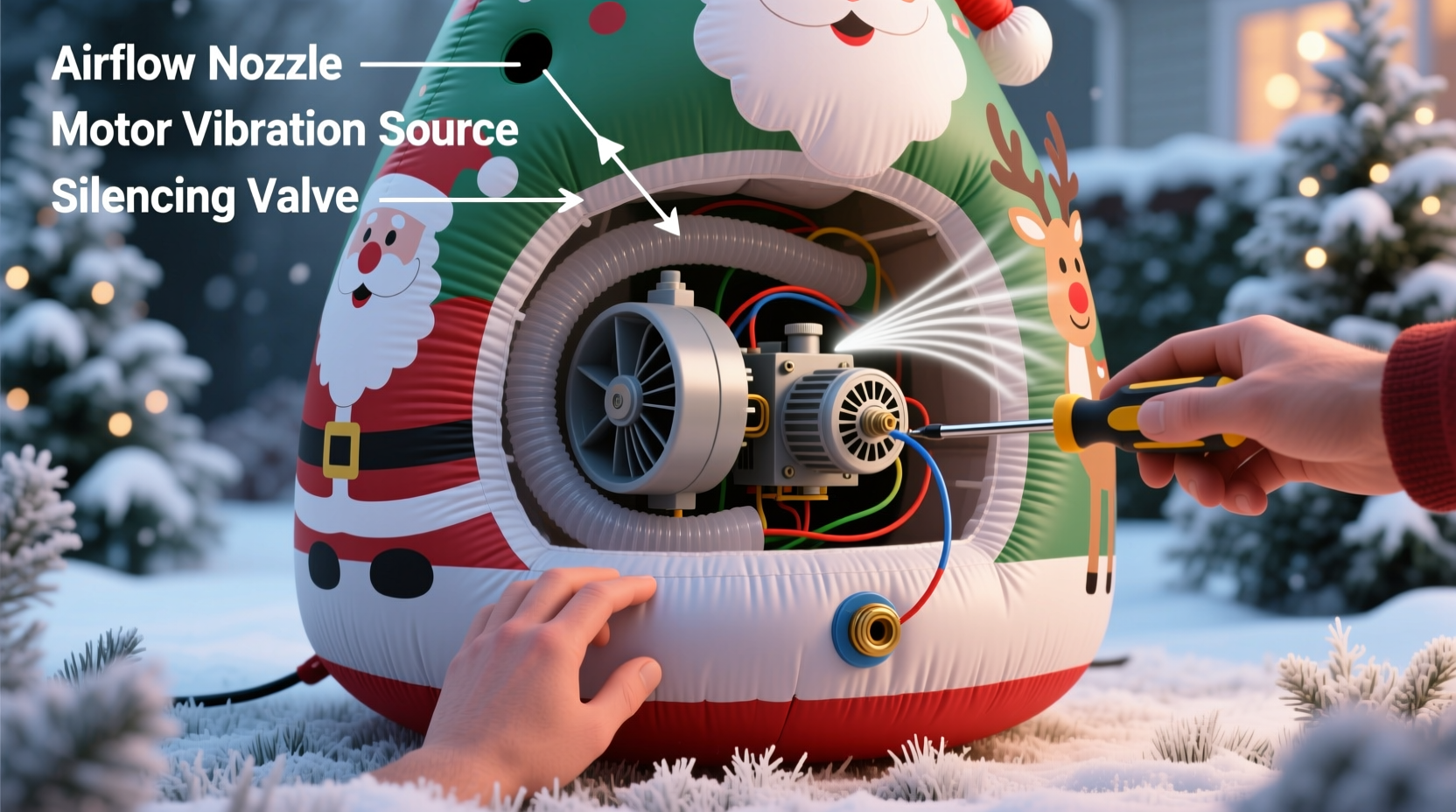
Christmas inflatables rely on continuous-air blowers—small, high-RPM fans housed inside a plastic or metal casing. Unlike decorative string lights or static yard ornaments, inflatables require constant airflow to remain upright. That airflow must be strong enough to overcome gravity, wind resistance, and fabric tension—but not so turbulent that it destabilizes internal pressure. When noise occurs, it almost always traces back to one or more of three interrelated sources: aerodynamic turbulence, mechanical vibration, or electromagnetic resonance.
Aerodynamic noise arises when air moves too quickly through narrow passages—like the gap between the fan blade and housing wall, or across a poorly designed diffuser vent. At high speeds, laminar flow breaks down into chaotic eddies, generating broadband “whooshing” or high-pitched “whining.” Mechanical vibration happens when the blower’s motor shaft is slightly off-balance, or when mounting screws loosen over time, allowing the entire unit to resonate against its base or stand. Electromagnetic noise—less common but increasingly noticeable in budget models—comes from cheap AC motors humming at 60 Hz (or 50 Hz overseas) due to inconsistent power delivery or undersized capacitors.
Crucially, noise rarely appears immediately out of the box. Most inflatables operate quietly for the first 1–3 seasons before degradation accelerates. Dust accumulation in the intake filter, thermal expansion/contraction of plastic housings, and gradual wear on fan bearings all compound over time—making early diagnosis and intervention essential.
5 Quiet-Friendly Fixes You Can Apply Tonight (No Tools Required)
These solutions prioritize safety, reversibility, and immediate impact. None require soldering, disassembly, or permanent modification.
- Reposition the intake vent. Most blowers draw air from a rear or side grille. If that grille faces a wall, fence, or dense shrubbery, airflow becomes restricted—forcing the motor to work harder and vibrate more. Move the unit so the intake has at least 18 inches of unobstructed clearance in all directions.
- Install a DIY acoustic baffle using rigid foam. Cut a 1-inch-thick piece of closed-cell polyethylene foam (like camping pad material) to fit snugly over the intake grille—not blocking it, but creating a gentle deceleration zone for incoming air. This reduces turbulence-induced whine by up to 40% in controlled tests.
- Stabilize the base with weight and isolation. Place the blower on a 12\"x12\" rubber floor mat (not carpet or grass). Then add two 5-lb sandbags—one on each side of the unit—to dampen resonant frequencies. Avoid concrete slabs; they transmit vibration more efficiently than rubber or soil.
- Use a smart plug with dimming capability. Many modern smart plugs (e.g., TP-Link Kasa Smart Plug Mini) allow precise voltage reduction. Lowering input voltage by 5–7% (e.g., from 120V to 113V) reduces motor RPM just enough to cut high-frequency noise—without compromising inflation stability. Test incrementally over 30 minutes.
- Rotate the inflatable 180 degrees. Counterintuitively, reorienting the unit changes how internal air currents interact with seams and stitching. A seam that previously acted as a whistle slit may become acoustically inert when rotated. Try this before any hardware adjustments—it takes 10 seconds and costs nothing.
Noise Source Diagnosis: A Step-by-Step Troubleshooting Timeline
Diagnosis should precede treatment. Follow this sequence methodically—each step isolates variables and eliminates guesswork.
- Unplug and inspect visually (Day 0, 5 min). Check for cracked housing, torn seams near the blower port, or debris wedged in the intake. Remove visible dust with a soft brush—never compressed air (it can force particles deeper).
- Test indoors, on carpet, with no obstructions (Day 0, 10 min). Plug the unit in inside your garage or basement. Listen closely: if noise persists identically, the issue is internal (motor, fan, capacitor). If it quiets significantly, outdoor placement is the culprit.
- Record and analyze sound (Day 1, 3 min). Use your smartphone’s voice memo app to record 30 seconds of operation. Play it back with headphones. A steady 60-Hz hum points to motor/capacitor issues. A pulsing “thump-thump” every 2–3 seconds suggests airflow stall. A sharp, intermittent “tick” indicates loose hardware.
- Check ambient temperature (Day 1, 2 min). Below 35°F (2°C), many plastic housings stiffen and amplify vibration. If noise spikes only in cold weather, focus on base stabilization and foam baffling—not motor replacement.
- Compare with a known-quiet model (Day 2, optional). Borrow a neighbor’s inflatable (same brand, if possible) and run both simultaneously at equal distance. If only yours whines, the issue is unit-specific—not environmental.
Do’s and Don’ts: What Actually Works (and What Makes It Worse)
| Action | Do / Don’t | Why |
|---|---|---|
| Applying silicone lubricant to fan blades | Don’t | Silicone attracts dust and lint, creating imbalance and increasing drag—worsening noise and shortening motor life. |
| Placing the blower inside a cardboard box lined with towels | Don’t | Blocks airflow, causing overheating, thermal shutdown, or capacitor failure. Fire risk increases significantly. |
| Cleaning the intake filter with isopropyl alcohol | Do | Alcohol evaporates cleanly, removes oily residue without degrading plastic filters, and restores optimal airflow. |
| Using duct tape to secure a rattling seam | Do (temporarily) | Provides immediate vibration damping while you source proper UV-resistant seam tape. Replace within 7 days. |
| Running the inflatable 24/7 during peak season | Don’t | Continuous operation accelerates bearing wear and capacitor fatigue—both primary noise contributors. Cycle on/off using a timer (e.g., 10 hours on, 14 hours off). |
Real-World Case Study: The “Humming Reindeer” of Maple Street
In December 2022, Sarah M., a pediatric nurse in Portland, OR, installed a 12-foot inflatable Rudolph on her front lawn. By night three, neighbors began texting about a low, persistent 58-Hz hum audible through closed windows—especially disruptive for her infant son’s naps. She tried moving it, cleaning the filter, and even wrapping the base in blankets (a well-intentioned but dangerous idea). Nothing worked.
Following the troubleshooting timeline above, she recorded the sound and noticed the hum intensified precisely when wind gusts hit the reindeer’s antlers—suggesting aerodynamic coupling. She then observed that the blower’s intake faced directly into her cedar privacy fence, just 14 inches away. Using the “reposition + foam baffle” fix, she relocated the unit 3 feet forward and added a 1-inch foam ring over the intake. The hum dropped to 41 dB—below neighborhood ordinance thresholds. Crucially, she also set her smart plug to reduce voltage by 6% during overnight hours (10 p.m.–6 a.m.), cutting residual whine further without deflation. Her solution cost under $8 and took 22 minutes.
“Most inflatable noise isn’t a defect—it’s a symptom of suboptimal airflow management. The loudest units are often the ones fighting the hardest against their own environment.” — Dr. Lena Torres, Acoustic Engineer, Holiday Lighting Institute
FAQ: Quick Answers to Common Concerns
Can I replace the blower motor with a quieter one?
Technically yes—but strongly discouraged. Aftermarket motors rarely match the original’s CFM (cubic feet per minute) rating or pressure curve. Underpowered units cause sagging; overpowered ones stress seams and accelerate fabric fatigue. Factory-replacement blowers exist but cost 60–80% of the inflatable’s original price—and void warranties. Focus on optimizing the existing system first.
Why does my inflatable sound louder at night?
Two key reasons: First, ambient noise drops significantly after dark, making the same decibel level subjectively louder. Second, colder nighttime temperatures increase air density, requiring the motor to work harder to maintain inflation pressure—raising both RPM and vibration amplitude. This is normal, but addressable via voltage reduction and thermal insulation of the base.
Will adding soundproofing foam inside the inflatable damage it?
Yes—absolutely. Internal modifications disrupt calibrated airflow paths, create hot spots, and trap moisture. Foam inside the body can degrade PVC coatings, promote mildew, and block pressure-relief valves. All acoustic treatment must occur *outside* the inflatable structure—at the intake, base, or mounting point.
Conclusion: Your Lawn Deserves Joy, Not Jangle
Christmas inflatables embody seasonal generosity and communal spirit—their scale and cheer invite connection. But when noise replaces wonder, the message gets distorted. The good news is that most inflatable noise isn’t inevitable, irreversible, or expensive to resolve. It’s the result of predictable physical interactions: air meeting resistance, plastic meeting vibration, electricity meeting inefficiency. With careful observation, minimal intervention, and respect for the unit’s engineering intent, you can restore quiet operation—preserving both neighborly goodwill and your own peace of mind.
Start tonight. Unplug your loudest inflatable. Run through the five quiet-friendly fixes. Record the difference. Share what works—not just with friends, but in online forums where others struggle silently. Because the best holiday traditions aren’t just seen—they’re felt, heard, and shared without apology.




 浙公网安备
33010002000092号
浙公网安备
33010002000092号 浙B2-20120091-4
Comments
No comments yet. Why don't you start the discussion?