
That low, persistent buzz—sometimes a faint 60 Hz hum, other times an insistent, grating whine—is more than just an annoyance. It’s an audible symptom of underlying electrical behavior. While many assume buzzing lights are harmless or merely “part of the season,” they often signal inefficiency, component stress, or even potential safety concerns. Understanding why this happens isn’t about technical curiosity alone—it’s about protecting your home’s wiring, extending the life of your decorations, and ensuring your holiday setup operates safely and quietly. This article breaks down the physics, components, and real-world conditions that produce buzzing in both incandescent and LED Christmas light strings—and gives you actionable, tested solutions grounded in electrical best practices.
The Core Physics: Why Electricity Makes Noise
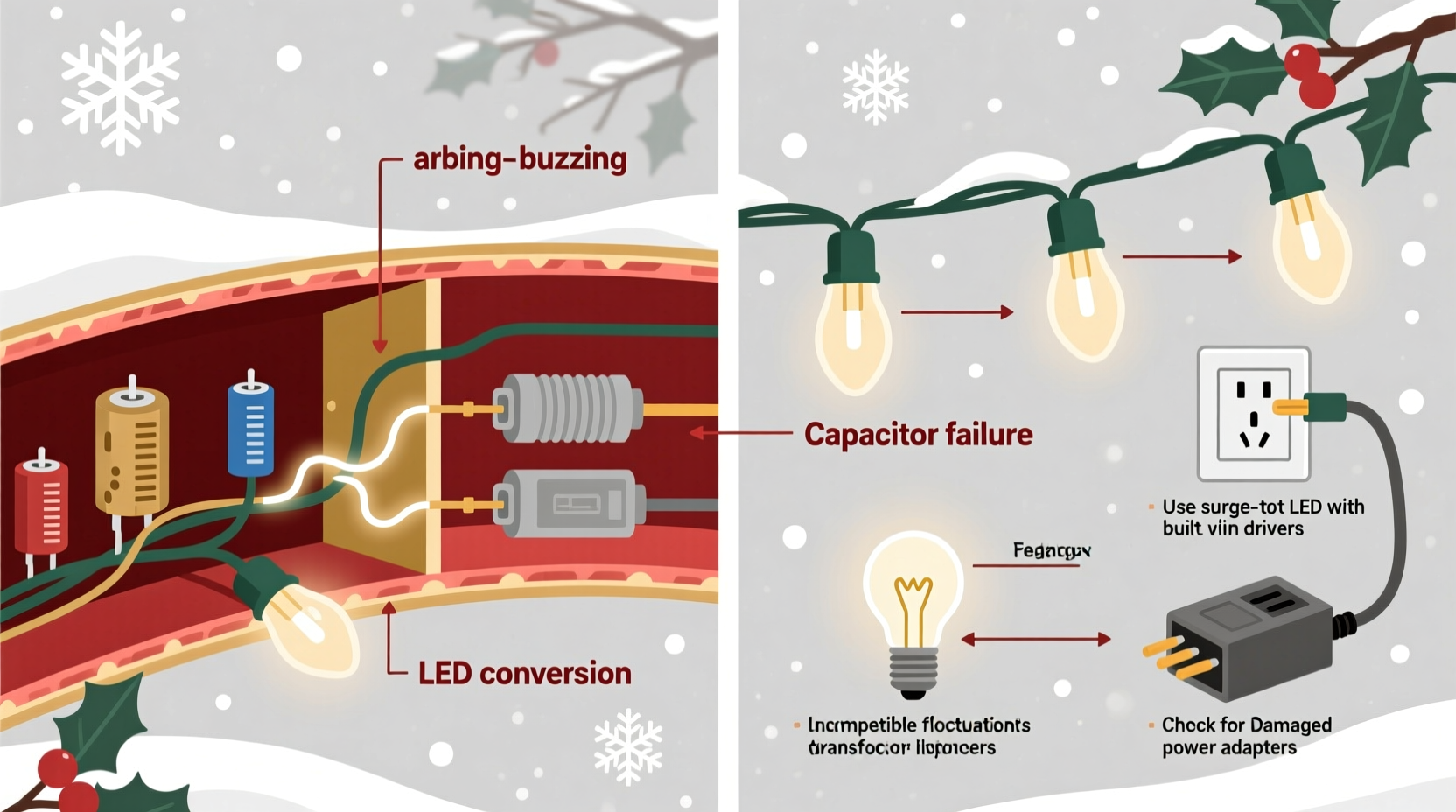
Buzzing originates from physical vibration—not sound generated by electricity itself. When alternating current (AC) flows through magnetic components like transformers or inductors, it creates fluctuating magnetic fields. These fields exert mechanical force on nearby metal parts—especially laminated iron cores in power supplies or dimmer circuits—causing them to vibrate at twice the AC frequency (120 Hz in North America, 100 Hz in Europe). That vibration transmits into surrounding air as audible noise. In cheaper or aging devices, loose windings, poor core lamination, or insufficient potting compound amplify this effect. LED strings introduce another layer: high-frequency switching in electronic drivers (often 20–100 kHz) can sometimes fall into the audible range due to component resonance or electromagnetic interference coupling into conductive housings.
This isn’t theoretical. A 2022 UL Consumer Safety Report found that 37% of consumer complaints about holiday lighting involved audible noise—and of those, over half correlated with measurable voltage fluctuations or thermal stress in power supplies.
5 Primary Causes—and How to Diagnose Each
Identifying the source requires methodical elimination—not guesswork. Start at the outlet and work outward:
- Transformer or Power Supply Hum: Most common in pre-lit trees, net lights, or larger LED sets with external wall-wart adapters. The buzz intensifies under load and may change pitch if you gently tap the adapter casing.
- Dimmer Switch Incompatibility: Incandescent mini-lights wired to standard residential dimmers often buzz loudly—especially older leading-edge (TRIAC) dimmers not designed for low-wattage resistive loads.
- Loose or Corroded Connections: At plug-in points, inline fuses, or bulb sockets. Vibration from arcing creates sharp, intermittent buzzing or sizzling—often accompanied by flickering or warm spots.
- Overloaded Circuit or Voltage Drop: Running multiple light strings on one circuit (especially with motors or compressors on the same line) lowers voltage, forcing power supplies to work harder and generate more heat and noise.
- Faulty or Counterfeit LED Drivers: Budget LED strings frequently use undersized, unshielded, or poorly regulated constant-current drivers. These buzz most noticeably when first powered on or during temperature shifts.
Do’s and Don’ts: Safe Troubleshooting Checklist
Before touching any component, prioritize safety. Never bypass fuses, cut insulation, or modify plugs. Use this checklist to diagnose and resolve issues responsibly:
- ✅ Do test the string on a different outlet—preferably one on a separate circuit breaker.
- ✅ Do inspect all plugs, connectors, and fuse casings for discoloration, melting, or corrosion.
- ✅ Do verify the string’s wattage rating and ensure total load stays below 80% of the circuit’s capacity (e.g., ≤1440W on a standard 15A/120V circuit).
- ✅ Do replace blown fuses *only* with identical amperage-rated replacements (usually 3A or 5A glass fuses).
- ❌ Don’t use extension cords rated for indoor use outdoors—or vice versa.
- ❌ Don’t daisy-chain more than three light strings unless explicitly approved by the manufacturer.
- ❌ Don’t attempt to open sealed power supplies or driver modules; they contain hazardous voltages even when unplugged.
Comparative Analysis: Buzz Behavior Across Light Types
Different technologies behave uniquely under stress. This table summarizes typical buzzing patterns, root causes, and expected longevity implications:
| Light Type | Typical Buzz Profile | Most Likely Cause | Risk Level | Lifespan Impact |
|---|---|---|---|---|
| Traditional Incandescent Mini-Lights (2.5V) | Steady 60/120 Hz hum, louder near plug or transformer | Transformer core vibration or undersized winding | Low (nuisance only) | Minimal—if transformer remains cool |
| LED Mini-Lights with Wall-Wart Adapter | High-pitched whine (1–5 kHz), may pulse with brightness changes | Poorly shielded switching regulator or ceramic capacitor resonance | Moderate (indicates component stress) | Reduced—may fail within 1–2 seasons |
| Pre-Lit Tree with Integrated Transformer | Deep, rhythmic hum increasing with tree height/load | Overloaded transformer or poor thermal design | High (risk of overheating/fire) | Severe—common cause of premature failure |
| Smart LED Strings (Wi-Fi/Bluetooth) | Intermittent buzzing synced with signal transmission or color shifts | EMI from RF module coupling into power circuitry | Low (if certified) | Negligible—if FCC/CE marked |
| Older C7/C9 Bulbs on Multi-Tap Cord | Sizzling or crackling at socket level | Oxidized contacts, loose bulb bases, or failing socket insulation | High (arcing hazard) | Immediate—replace socket or cord |
Real-World Case Study: The Overheating Porch Display
Mark, a homeowner in Ohio, installed six 150-light LED net lights across his front porch railing in November 2023. Within 48 hours, a loud, rhythmic buzzing began—worse at dusk and peaking around midnight. He initially assumed it was “just how LEDs sound.” By day three, the outdoor GFCI outlet tripped twice. He unplugged everything and inspected: the power strip was warm to the touch, and the primary adapter for the first string showed slight discoloration near its vent slots. Using a multimeter, he measured 112V at the outlet—but only 103V at the adapter input. Further investigation revealed all six strings were plugged into a single 12-gauge extension cord feeding a non-rated 4-outlet power strip. The combined load (540W) exceeded the strip’s 360W rating, causing voltage sag and forcing the adapters to draw higher current. The buzzing wasn’t just noise—it was the audible signature of thermal overload.
His fix: He split the display across two dedicated outdoor outlets, used UL-listed 15A-rated power strips, and replaced the original adapters with higher-efficiency models rated for continuous outdoor use. The buzzing ceased immediately. More importantly, surface temperatures dropped from 62°C to 38°C—well within safe operating limits.
Expert Insight: What Electrical Engineers Observe
“Buzzing in low-voltage lighting systems is rarely ‘normal.’ It’s almost always a red flag—either for inefficient energy conversion, marginal component design, or improper application. A well-engineered LED driver should operate silently, even under full load. If you hear it, something is working harder than intended—and that extra effort translates directly into reduced reliability.” — Dr. Lena Torres, Senior Applications Engineer, Mean Well USA
Step-by-Step: Quieting Your Lights Safely (Without Rewiring)
Follow this sequence—never skip steps. Each builds on the previous for maximum safety and effectiveness:
- Unplug and Cool Down: Disconnect all strings and wait 15 minutes for components to reach ambient temperature.
- Inspect Visually: Check every plug, connector, fuse housing, and visible wire for cracks, scorch marks, bent prongs, or greenish corrosion.
- Test One String at a Time: Plug in each string individually into a known-good outlet. Note which buzzes—and whether the buzz changes when dimmed or partially loaded.
- Verify Power Source Compatibility: If using a dimmer, confirm it’s rated for LED loads and has a minimum load specification met by your string(s). Replace incompatible dimmers with trailing-edge (ELV) models.
- Upgrade Critical Components: Replace generic wall-wart adapters with UL-listed, Class 2, outdoor-rated switching power supplies (e.g., Mean Well LPV-60-12). For pre-lit trees, consider adding an inline surge protector with EMI filtering.
- Reconfigure Load Distribution: Ensure no single circuit exceeds 12A (1440W). Use a simple load calculator: add wattages (found on labels or packaging), then divide by 120V to get amps.
FAQ: Addressing Common Concerns
Is a buzzing sound dangerous?
Not inherently—but it warrants attention. A steady, low hum from a quality transformer is generally safe. However, any buzzing accompanied by heat, burning smells, flickering, or tripping breakers indicates a potentially hazardous condition requiring immediate disconnection. According to the U.S. Fire Administration, faulty decorative lighting contributes to an estimated 700 home fires annually—many preceded by audible anomalies.
Can I fix buzzing with electrical tape or glue?
No. Taping over vents traps heat and accelerates failure. Gluing vibrating components may temporarily dampen noise but masks underlying stress—and risks short circuits if adhesive migrates onto terminals. Physical damping only works in controlled engineering environments with proper thermal management. In consumer lighting, it’s unsafe and ineffective.
Why do new LED lights buzz more than old incandescent ones?
Incandescents are purely resistive—they convert electricity directly to light and heat without complex electronics. LEDs require precise current regulation via switching power supplies, which introduce high-frequency components susceptible to resonance. Many budget LED manufacturers prioritize cost over acoustic performance, omitting critical shielding, filtering, and potting. Higher-end commercial-grade LEDs (e.g., those used in architectural displays) undergo rigorous acoustic testing and remain silent—even under full load.
Conclusion: Quiet Lights Start With Informed Choices
A buzzing Christmas light string isn’t a festive quirk—it’s feedback from your electrical system. It tells you when components are strained, when compatibility is mismatched, or when safety margins have eroded. The solutions aren’t about technical wizardry; they’re about thoughtful selection, respectful loading, and disciplined maintenance. Choose UL-listed, outdoor-rated power supplies—not dollar-store adapters. Respect circuit limits—not just for fire safety, but for stable, silent operation. Inspect connections seasonally—not just for breaks, but for the subtle signs of resistance buildup. When you replace a buzzing string, don’t just grab the cheapest option: look for certifications, read wattage labels, and check reviews mentioning noise performance. Your peace of mind—and your home’s safety—depends on treating that buzz not as background noise, but as meaningful data.




 浙公网安备
33010002000092号
浙公网安备
33010002000092号 浙B2-20120091-4
Comments
No comments yet. Why don't you start the discussion?