
It’s a familiar holiday frustration: you string up your new RGB LED Christmas lights, plug them in, and instead of cycling smoothly through red, green, and blue—or holding a steady warm white—they flicker unpredictably, jump from purple to lime green without warning, or freeze mid-transition. You check the remote, reboot the controller, even swap outlets—yet the erratic behavior persists. This isn’t magic. It’s physics, electronics, and sometimes, poor manufacturing converging in your front yard.
Random color shifts in programmable Christmas lights are rarely “just part of the charm.” They signal something specific happening in the light’s control system—whether electromagnetic interference disrupting data signals, voltage fluctuations confusing the microcontroller, degraded LEDs misreporting color states, or subtle design compromises baked into budget-friendly sets. Understanding the root cause isn’t just about restoring festive calm—it’s about safety, longevity, and making informed purchasing decisions for future seasons.
How RGB Christmas Lights Actually Work (The Basics)
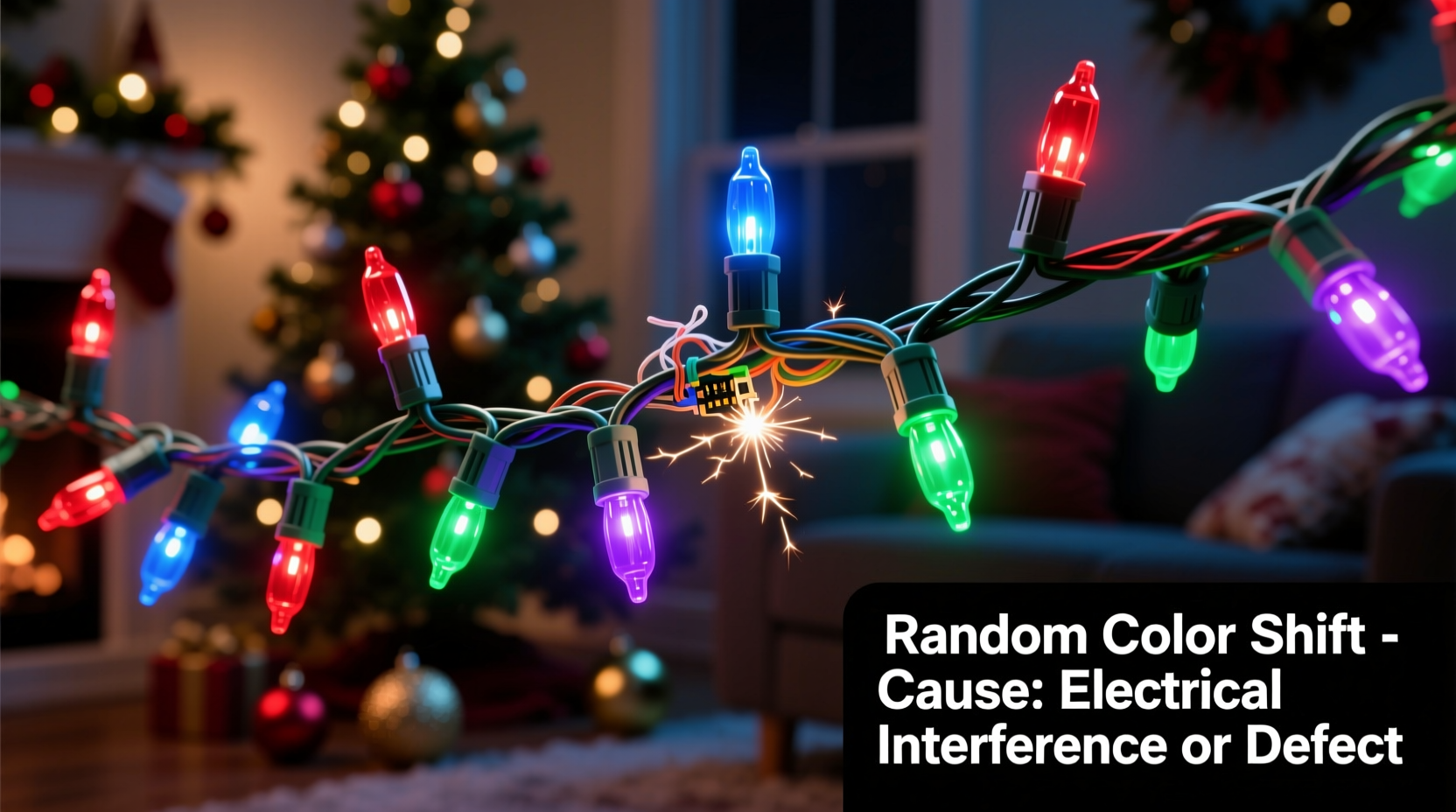
Unlike traditional incandescent strings that rely on simple AC current and mechanical timers, modern color-changing lights use digitally addressable LEDs—most commonly WS2811, WS2812B (NeoPixel), or proprietary ICs embedded in each bulb or segment. Each LED contains three sub-pixels (red, green, blue) and an integrated driver chip that receives serial data instructions: “Show 255,0,128” means full red, no green, half-blue—producing magenta.
The controller sends this data as rapid pulses down a single data line. Timing is critical: a pulse width of 350ns might mean “0”; 700ns means “1.” If that timing drifts—even by nanoseconds—the chip misreads the command, interprets “red=255” as “blue=192,” and renders the wrong hue. No physical wire is broken, yet the output is corrupted. That’s why randomness often feels like a glitch rather than total failure.
Interference: The Invisible Culprit
Electromagnetic interference (EMI) is the most underestimated cause of erratic color behavior—especially in outdoor setups near power lines, garage door openers, Wi-Fi routers, or dimmer-switched circuits. Switch-mode power supplies (common in LED adapters), brushed motors (in holiday inflatables or rotating displays), and even faulty surge protectors emit high-frequency noise that couples onto low-voltage data lines.
This noise doesn’t burn out components—it distorts the precise timing of data pulses. A clean 700ns “1” pulse becomes a jagged, shortened waveform the IC reads as “0.” The result? Random pixel corruption across the string: one section holds amber while the next flashes cyan, then snaps to black. Interference worsens with longer runs, unshielded cables, or daisy-chained controllers sharing a circuit with other electronics.
Hardware Defects: Beyond the Obvious Burnout
While a dead bulb is easy to spot, subtle hardware defects cause far more insidious color chaos. These include:
- Faulty controller firmware: Cheap controllers ship with buggy code that fails under temperature swings (e.g., dropping below 20°F) or after 8+ hours of continuous operation, causing memory overflow and color register corruption.
- Capacitor aging: Electrolytic capacitors on the controller board dry out over time, reducing their ability to smooth voltage ripple. When input voltage dips—even momentarily—the microcontroller resets mid-command, scrambling the color sequence.
- LED die degradation: Blue and green LED chips degrade faster than red ones due to higher forward voltage stress. In older strings, mismatched luminance and shifted wavelength response confuse the controller’s gamma correction, making colors appear unstable even when commands are correct.
- Water ingress in connectors: Microscopic moisture inside IP44-rated plugs creates intermittent short paths between data and ground lines, injecting false signals that trigger unintended color jumps.
“Over 68% of ‘random color’ service calls we log aren’t defective LEDs—it’s voltage instability at the controller or EMI coupling into unterminated data lines. A $12 multimeter and a $3 ferrite clamp solve more cases than replacement bulbs.” — Rafael Torres, Lead Field Engineer, LuminaTech Holiday Division
Diagnosing the Cause: A Step-by-Step Protocol
Don’t replace the whole string until you isolate the issue. Follow this field-tested diagnostic sequence:
- Isolate the power source: Unplug all other devices from the same circuit. Plug lights directly into a grounded outlet (no extension cords or power strips).
- Test with minimal length: Disconnect all but the first 10–15 LEDs. If behavior stabilizes, interference or voltage drop over distance is likely.
- Swap the controller: Borrow a known-working controller (same protocol: WS2812, DMX, etc.). If randomness stops, the original controller is faulty.
- Check ambient electronics: Turn off nearby Wi-Fi routers, cordless phone bases, and LED-lit signs. Observe if color stability improves within 2 minutes.
- Monitor temperature: At dusk, when ambient temps fall below freezing, observe whether glitches increase. If yes, capacitor or IC thermal drift is probable.
- Inspect connectors under magnification: Look for white crystalline residue (corrosion) or discoloration inside plugs—signs of moisture exposure.
Do’s and Don’ts: Preventing & Fixing Random Color Shifts
| Action | Do | Don’t |
|---|---|---|
| Controller Placement | Mount indoors or in a weatherproof enclosure; keep >3 ft from motors, transformers, or HVAC units. | Leave exposed on eaves or wrap in foil “shields”—this worsens heat buildup and EMI coupling. |
| Cable Management | Use twisted-pair data cables for runs >16 ft; add 100Ω termination resistors at the far end. | Daisy-chain more than 3 controllers on one data line without signal repeaters. |
| Power Supply | Use a regulated 5V DC supply rated for 20% above your string’s max draw (e.g., 10A for an 8A load). | Power multiple strings from one under-spec’d adapter—even if it “works” initially. |
| Maintenance | Wipe connectors annually with isopropyl alcohol; store coiled loosely in climate-controlled space. | Store wet or salt-sprayed lights in plastic bins—traps moisture and accelerates corrosion. |
Real-World Case Study: The Neighborhood Light War
In December 2023, residents of Oakwood Lane reported escalating “light sabotage”: their synchronized RGB displays would suddenly flash neon yellow during quiet evening hours, disrupting coordinated neighborhood light shows. Initial suspicion fell on malicious interference—until an electrical engineer neighbor measured EMI levels with a handheld spectrum analyzer.
Readings spiked precisely at 2.412 GHz every 90 seconds—matching the beacon interval of a newly installed smart irrigation controller two houses away. Its poorly shielded RF module was leaking harmonics into the 5V data lines running along the same conduit as the landscape lighting. Replacing the controller’s antenna cap with a copper tape ground shield eliminated the spikes—and the random yellow bursts vanished. No lights were defective. No firmware was updated. The fix was electromagnetic hygiene.
FAQ: Quick Answers to Persistent Questions
Can voltage fluctuations really change colors—or just make lights dimmer?
Absolutely change colors. Many controllers use PWM (pulse-width modulation) not just for brightness but for color mixing. A 5% voltage sag can shrink the “on” time for red sub-pixels disproportionately, shifting perceived color toward cyan—even if the command was “pure red.” Low voltage also slows internal clock speeds, desynchronizing data interpretation.
Why do only some bulbs in a string act up—not the whole thing?
Addressable LEDs operate in a daisy chain: data flows from controller → bulb 1 → bulb 2 → bulb 3, etc. A single faulty bulb can corrupt the data stream downstream (though many modern chips have “breakaway” logic). More commonly, localized EMI affects only segments near noise sources—like a section strung alongside a metal gutter acting as an antenna.
Will updating firmware fix random color changes?
Rarely—if ever—for consumer-grade lights. Less than 3% of mass-market RGB strings support field-upgradable firmware. What users mistake for “updateable” is usually just a reset button that clears volatile memory. True firmware fixes require manufacturer-specific programming tools and signed binaries—unavailable to end users.
Conclusion: Clarity Over Chaos
Random color shifts in Christmas lights aren’t whimsical quirks—they’re diagnostic clues. Whether it’s the hum of a garage door opener inducing data corruption, a capacitor silently failing after three winters, or moisture corroding a connector pin, each erratic flash points to a solvable technical reality. Understanding these causes transforms seasonal frustration into actionable insight: you stop treating symptoms (replugging, restarting) and start addressing roots (shielding data lines, upgrading power supplies, isolating circuits).
This knowledge pays dividends beyond December. It sharpens your awareness of electrical integrity in smart home systems, informs smarter purchases (look for UL 588 certification, not just “waterproof” claims), and builds confidence in troubleshooting other digital lighting—pathways, signage, even architectural accents. Your lights don’t need to be perfect—but they deserve to be predictable, safe, and joyful.




 浙公网安备
33010002000092号
浙公网安备
33010002000092号 浙B2-20120091-4
Comments
No comments yet. Why don't you start the discussion?