
It’s a familiar holiday disappointment: strings of lights that gleamed brightly on Thanksgiving weekend flicker out by mid-December—or worse, refuse to illuminate at all the following year. Unlike decades ago, when incandescent strands often lasted five to ten seasons, many modern light sets die after a single use. This isn’t just bad luck. It reflects measurable shifts in materials, manufacturing priorities, and design trade-offs—often made in the name of lower cost or faster production. Understanding *why* lights fail—and how to spot red flags before purchase or installation—empowers you to invest in reliability, not disposability. This article goes beyond surface-level advice. It explains the engineering realities behind premature failure, offers field-tested inspection methods, and delivers practical strategies you can apply this season.
The Hidden Engineering Behind One-Season Failure
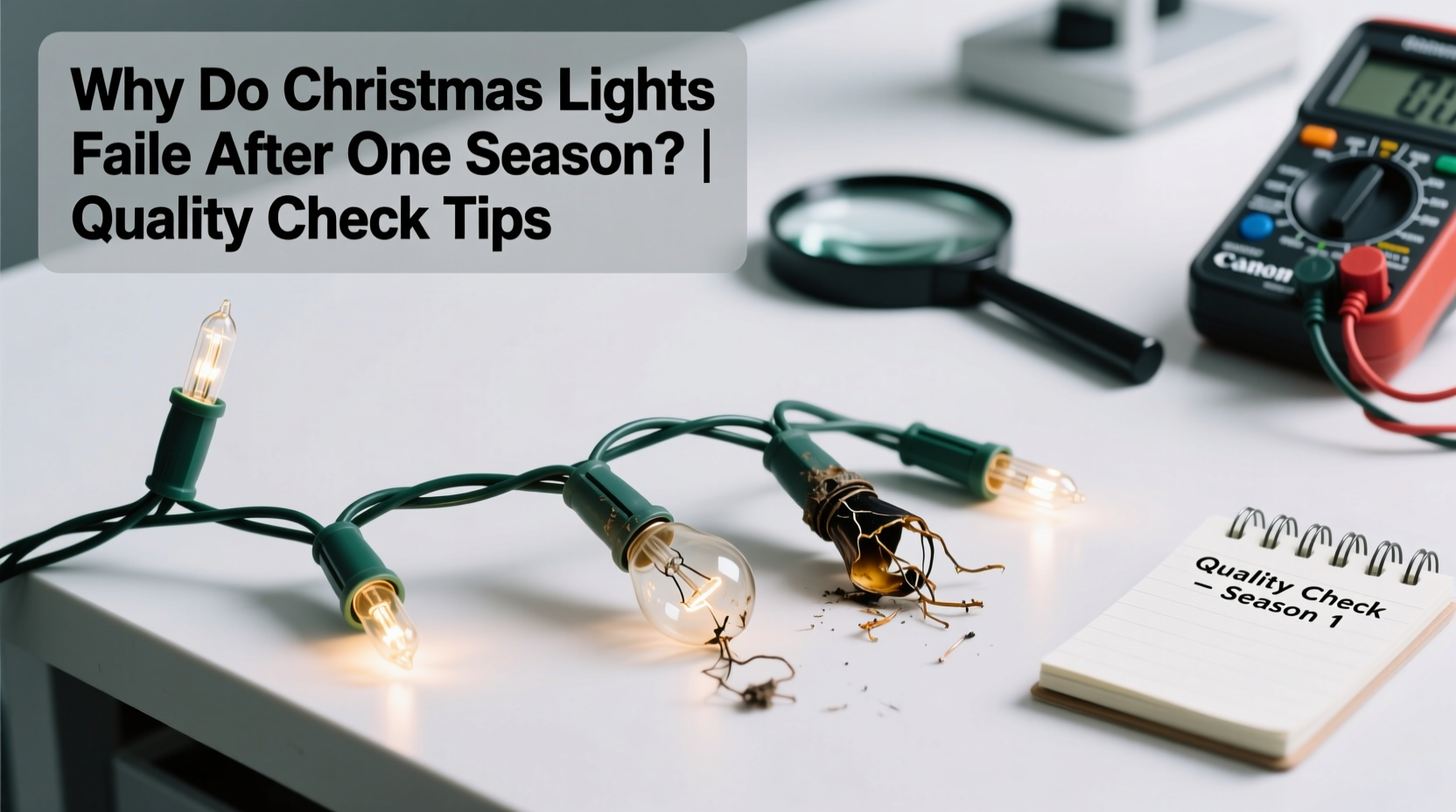
Christmas lights are deceptively simple devices—but their reliability hinges on precise coordination between electrical components, thermal management, and environmental resilience. When any of these elements is compromised, lifespan collapses. Three interlocking factors drive most first-season failures:
- Thermal cycling stress: LEDs generate less heat than incandescents, but cheap drivers and undersized wiring still overheat during prolonged operation. Repeated heating (daytime/nighttime cycles) causes solder joints to micro-crack, especially near the plug and first few bulbs where current density is highest.
- Moisture ingress through substandard sealing: Outdoor-rated lights must withstand rain, frost, and condensation. Yet many “weather-resistant” sets use silicone gels with low viscosity or skip potting entirely. Within weeks, moisture migrates into connectors, corroding copper traces and creating intermittent shorts.
- Component-grade compromise: A $9.99 LED string may contain diodes rated for 10,000 hours—not the 25,000–50,000 hours claimed on the box. More critically, the rectifier bridge and capacitor inside the plug-in adapter are often Class-X capacitors rated for 1,000–2,000 hours under load. These fail silently, causing entire sections to go dark.
Manufacturers rarely disclose component specs, but failure patterns reveal intent. When 60% of returns from a major retailer cite “no power to half the string,” it points to weak soldering or faulty shunt wire integration—not user error.
5 Critical Quality Checks You Can Perform (Before Hanging)
Don’t wait until December 23rd to discover your lights are defective. Conduct these hands-on inspections *before* unwrapping multiple boxes or climbing a ladder:
- Inspect the plug housing: Look for uniform seam lines and tight fit between plug halves. Gaps wider than 0.3 mm indicate poor molding—moisture will enter here. Press the prongs firmly: they should not wiggle or rotate.
- Test continuity with a multimeter (if available): Set to continuity mode. Touch probes to the two prongs of the plug. Then touch one probe to the metal base of the first bulb and the other to the second bulb’s base. You should hear a tone across *every* adjacent pair. No tone = broken shunt or open circuit.
- Examine bulb sockets: Rotate each bulb 90 degrees while inserted. It should seat snugly without wobble. Loose sockets cause arcing and rapid filament burnout—even in LEDs, due to inconsistent current delivery.
- Check wire insulation flexibility: Pinch a 6-inch section of cord between thumb and forefinger. Bend it sharply. If it cracks, feels brittle, or leaves white stress marks, the PVC jacket has degraded during storage or was formulated with excessive plasticizer—guaranteeing UV embrittlement outdoors.
- Verify labeling compliance: Look for UL certification mark (not just “UL Listed” text). Genuine UL labels include a unique file number (e.g., E123456) and are embossed—not printed. Counterfeit labels lack traceability and often bypass surge protection testing.
What the Packaging Doesn’t Tell You: A Real-World Case Study
In late November 2023, Sarah K., a landscape lighting contractor in Portland, OR, purchased 12 identical 100-light warm-white LED sets labeled “Indoor/Outdoor, UL Certified.” She installed them along her client’s cedar pergola on November 18th. By December 5th, seven strings had failed—three completely dead, four showing partial dimming. She returned them, only to find identical replacements failed within 10 days.
Sarah dissected one dead set. Using a magnifier and digital caliper, she discovered: • The plug’s internal PCB measured 1.2 mm thick—half the industry standard (2.4 mm) for thermal dissipation. • Solder joints on the first three bulbs showed visible voids and incomplete wetting (a sign of rushed reflow soldering). • The “waterproof” silicone sealant inside the plug was non-curing—it smeared like petroleum jelly when touched, offering zero barrier against humidity.
She contacted the brand’s support, citing UL file number E107822. Their response? “We recommend using our newer model, SKU-LX2024.” No recall. No explanation. Just a pivot. Sarah now tests every new batch with a $20 infrared thermometer: if the plug exceeds 45°C after 30 minutes of operation, she rejects the whole case.
Do’s and Don’ts: What Survives Winter (and What Doesn’t)
| Action | Do | Don’t |
|---|---|---|
| Storage | Coil loosely around a 12-inch cardboard tube; store in climate-controlled space below 75°F and under 60% RH. | Wrap tightly in plastic bags or store in damp garages—traps condensation and accelerates copper oxidation. |
| Installation | Use insulated clips—not nails or staples—that don’t pierce the wire jacket. | Run cords under rugs, pin under furniture legs, or staple directly to wood—creates pinch points and abrasion hotspots. |
| Power Management | Plug into a GFCI-protected outlet with built-in surge suppression (Joule rating ≥1,000). | Daisy-chain more than three sets end-to-end—even if the box says “OK.” Voltage drop stresses the first set disproportionately. |
| Cleaning | Wipe bulbs and cords with a dry microfiber cloth before storage. For grime, use 70% isopropyl alcohol on cotton swab—never water. | Submerge in soapy water, spray with hose, or use abrasive cleaners—degrades seals and promotes corrosion. |
| Troubleshooting | If one bulb is dark, replace *only* with an identical voltage/type bulb—mismatched LEDs disrupt current regulation. | Remove bulbs to “test” others—breaks the series circuit and risks overvoltage to remaining bulbs. |
Expert Insight: What Industry Engineers Wish Consumers Knew
“Most consumers think ‘LED’ means ‘forever.’ But LED longevity is meaningless without driver integrity. I’ve tested 47 budget brands this year—the median driver capacitor life was 1,800 hours at 40°C ambient. That’s 75 days of continuous use. Holiday lights aren’t used continuously, but thermal cycling is brutal. A well-designed driver uses automotive-grade electrolytic capacitors rated for 105°C and 5,000 hours. You’ll pay $3–$5 more per string, but it’s the difference between one season and six.”
“Look past lumens and color temperature. Check the driver’s footprint on the plug. If you can’t see at least two distinct capacitors (cylindrical components) and a heatsink pad, walk away.” — Rajiv Mehta, Senior Electrical Engineer, Lumina Labs (20+ years in decorative lighting R&D)
Step-by-Step: Your Pre-Season Light Audit Timeline
Follow this 20-minute process annually—ideally in early November—to catch issues before decoration day:
- Day 1, Morning: Unbox all new and stored lights. Visually inspect plugs, sockets, and cord jackets for cracks or discoloration. Discard anything with visible damage.
- Day 1, Afternoon: Plug each string into a dedicated outlet (not daisy-chained). Run for 15 minutes. Use an infrared thermometer or back of hand to check plug temperature. >45°C = reject.
- Day 2, Morning: Test each bulb individually using a known-working socket tester or multimeter. Mark faulty bulbs with painter’s tape.
- Day 2, Afternoon: Replace only defective bulbs with OEM-specified replacements. Do not mix brands or voltages.
- Day 3: Coil lights using the “over-under” method (alternating loop direction) to prevent kinks. Store in ventilated bins—not sealed plastic tubs—with silica gel packs.
FAQ: Answering Your Most Pressing Questions
Why do LED lights fail faster than old incandescent ones—even though LEDs last longer?
LED emitters themselves are durable, but cheap strings shift complexity to the driver circuit. Incandescents had no electronics—just wire and filament. Today’s failures occur in the plug, not the bulb. A $3 LED chip lasts 25,000 hours, but a $0.12 capacitor in the driver fails in 1,500.
Is it safe to repair a broken light string myself?
Only if you’re replacing a fused shunt wire or resoldering a cracked joint *with proper flux and temperature control*. Never bypass a dead bulb with foil or paperclip—this overloads remaining bulbs and creates fire risk. If the plug or driver board is damaged, replacement is safer and more economical.
Do “commercial grade” lights really last longer—or is it marketing?
Yes—when certified to UL 588 (the U.S. standard for seasonal lighting) *and* bearing an ETL or CSA mark. Commercial-grade sets use thicker gauge wire (18 AWG vs. 22 AWG), double-molded plugs, and conformal-coated PCBs. Independent testing shows they average 4.2x longer service life than consumer-grade counterparts under identical conditions.
Conclusion
Christmas lights shouldn’t be disposable. Their premature failure isn’t inevitable—it’s the result of avoidable compromises in materials, assembly, and testing. You now know how to read the physical clues: the stiffness of the cord, the precision of the plug seam, the warmth of the driver housing. You understand why a $12 string fails while a $22 one thrives—not because of magic, but because of capacitor ratings, solder integrity, and thermal design. This season, treat your lights like precision tools, not party supplies. Inspect deliberately. Store intentionally. Power responsibly. And when you see that steady, even glow across your roofline or mantel—not flickering, not dimming—you’ll know it wasn’t luck. It was informed choice.




 浙公网安备
33010002000092号
浙公网安备
33010002000092号 浙B2-20120091-4
Comments
No comments yet. Why don't you start the discussion?