
As the holiday season approaches, twinkling Christmas lights bring warmth and cheer to homes around the world. But nothing disrupts the festive mood faster than a strand of lights that flickers unpredictably—sometimes dimming, sometimes blinking out entirely. While minor flickering might seem like a quirky charm, persistent or worsening behavior often signals underlying electrical issues, poor design, or environmental wear. Understanding the root causes and applying targeted fixes can restore reliability and safety to your display. This guide breaks down the science behind flickering, identifies common culprits, and provides actionable steps to eliminate the problem for good.
The Science Behind Flickering: How Christmas Lights Work
Most traditional Christmas light strands use incandescent bulbs wired in series, meaning electricity flows through each bulb sequentially. If one bulb fails or loosens, the circuit breaks, cutting power to all bulbs downstream. Modern LED strands may use parallel wiring or pulse-width modulation (PWM) for brightness control, which can introduce intentional flicker at high frequency—usually imperceptible to the eye. However, when flickering becomes visible or erratic, it's typically due to an instability in voltage, connection, or component function.
In series-wired incandescent strings, voltage is divided among bulbs. A typical 50-light strand runs on 2.5 volts per bulb from a standard 120V outlet. Any fluctuation in input voltage or resistance changes within the circuit can cause uneven current distribution, leading to inconsistent brightness and flickering. In contrast, LED lights require stable DC voltage, and many cheaper sets lack adequate rectifiers or capacitors to smooth incoming AC power, making them prone to visible flicker.
“Flicker isn’t just annoying—it’s a symptom. Whether it’s a loose contact or incompatible transformer, addressing the root cause prevents further damage and reduces fire risk.” — Dr. Alan Reeves, Electrical Systems Engineer, Northeast Technical Institute
Common Causes of Flickering Christmas Lights
Flickering rarely happens without reason. Identifying the source requires examining both physical components and external conditions. The most frequent causes include:
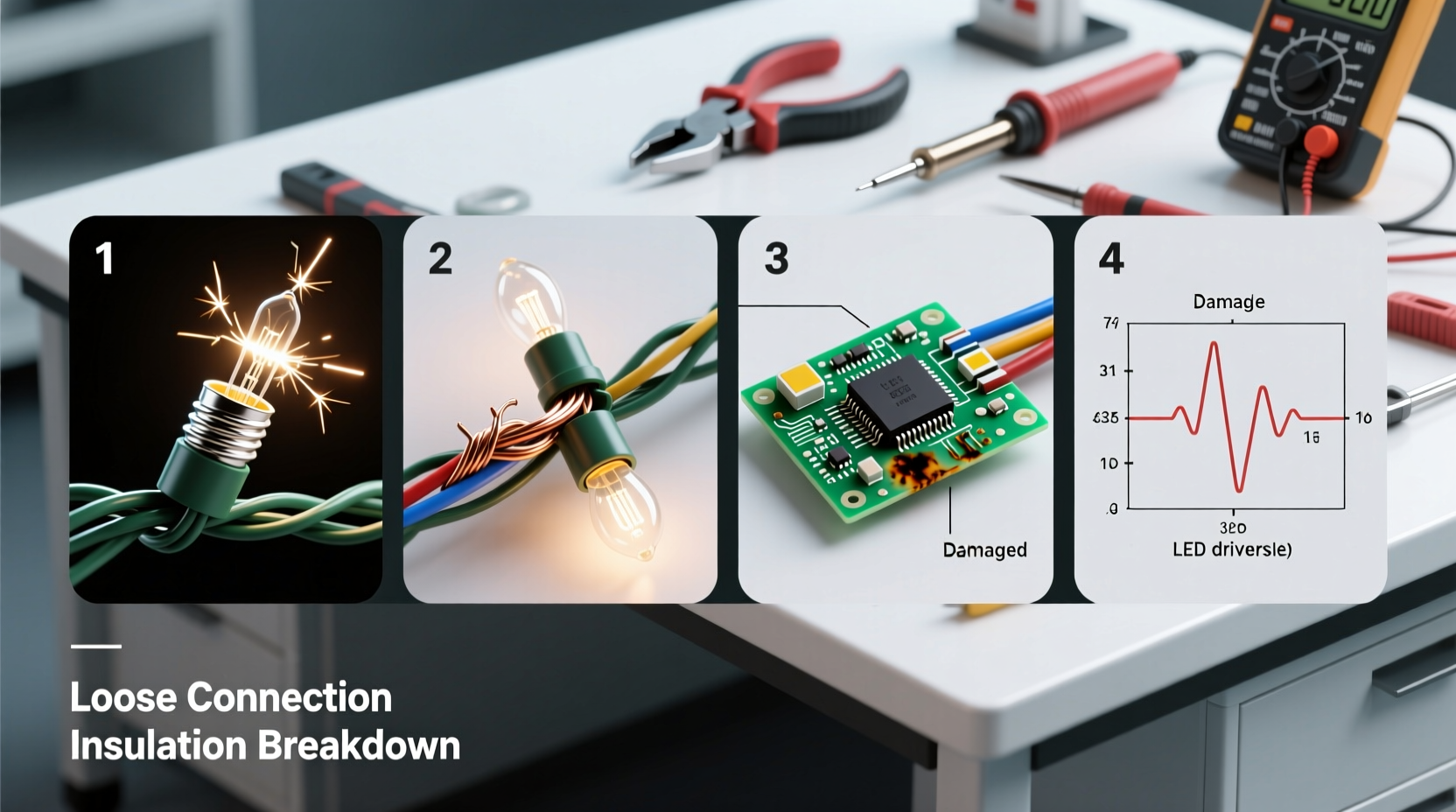
- Loose or corroded bulb connections: Over time, vibrations, weather exposure, or improper handling can loosen bulbs in their sockets, interrupting the circuit intermittently.
- Defective or failing bulbs: Incandescent filaments degrade; LEDs can suffer from internal solder joint cracks. Even one bad bulb can destabilize an entire strand.
- Overloaded circuits: Plugging multiple light strands into a single outlet or extension cord exceeds safe amperage, causing voltage drops and flicker.
- Poor-quality transformers or rectifiers (LEDs): Low-cost LED sets often skimp on driver components, resulting in unstable current and visible flicker.
- Mismatched light types: Mixing old and new strands, or combining different wattages or technologies (e.g., LED with incandescent), creates imbalanced loads.
- Environmental factors: Moisture ingress, extreme temperatures, or rodent damage can compromise wire insulation and conductivity.
- Damaged extension cords or outlets: Frayed wires, worn prongs, or faulty wall sockets introduce resistance and intermittent power delivery.
Step-by-Step Guide to Fix Flickering Lights Permanently
Resolving flicker isn't about quick patches—it's about systematic diagnosis and durable repair. Follow this timeline to restore stability and prevent recurrence.
- Unplug and isolate the affected strand. Disconnect from all power sources to ensure safety during inspection.
- Inspect each bulb visually and by touch. Look for darkened glass (incandescent), cracked lenses (LED), or loose seating. Gently press each bulb to confirm it’s fully seated.
- Test individual bulbs with a multimeter or tester tool. For incandescents, check continuity across the filament. Replace any with infinite resistance. For LEDs, use a diode test setting.
- Examine the wire path for damage. Run fingers along the length to detect cuts, kinks, or chew marks. Pay close attention to plug ends and connector joints.
- Check connectors and male/female ends. Corrosion or bent pins disrupt conductivity. Clean contacts with isopropyl alcohol and a cotton swab.
- Verify power supply compatibility. Ensure the transformer (for LEDs) matches the required voltage and current. Avoid daisy-chaining more than three strands unless rated for it.
- Replace faulty sections or upgrade entire strands. If multiple issues are found, consider retiring older sets. Modern UL-listed LED strings offer better longevity and built-in surge protection.
- Use a dedicated circuit for holiday lighting. Plug lights into an outlet not shared with high-draw appliances like refrigerators or heaters.
- Install a whole-house surge protector. Voltage spikes from grid fluctuations or lightning can degrade sensitive electronics over time.
- Store properly after the season. Coil lights loosely around a cardboard spool, label them, and keep in a dry, temperature-stable location.
Comparison: Common Light Types and Flicker Risk
| Type | Wiring | Flicker Risk | Primary Cause | Lifespan |
|---|---|---|---|---|
| Incandescent (Mini) | Series | High | Bulb failure, loose socket | 1,000–2,000 hours |
| LED (Low-Cost) | Series/Parallel Hybrid | Medium-High | Poor driver circuit | 15,000–25,000 hours |
| LED (Premium) | Parallel with Constant Current | Low | Rare; usually external surge | 30,000–50,000 hours |
| C7/C9 (Vintage Style) | Series or Parallel | Medium | Socket corrosion, outdoor exposure | 3,000–5,000 hours |
| Smart LED (Wi-Fi/Bluetooth) | Parallel with IC Control | Low-Medium | Firmware glitch, signal interference | 20,000–40,000 hours |
Real-World Example: A Homeowner’s Flicker Fix
Sarah Thompson, a homeowner in Portland, Oregon, struggled for years with her rooftop light display. Every winter, half the strands would flicker erratically after a few days. She replaced bulbs annually but saw no lasting improvement. After consulting an electrician, she discovered two key issues: first, she was daisy-chaining 12 strands on a single outdoor outlet, exceeding its 15-amp limit. Second, her garage stored lights wrapped tightly around metal hangers, causing micro-fractures in the wiring insulation.
The solution involved rewiring her setup: installing two additional GFCI-protected outlets on timers, using only UL-rated extension cords, and upgrading to commercial-grade LED strings with shunt-wired bulbs. She also began storing lights on plastic reels. Since the overhaul, her display has run flawlessly for three consecutive seasons—with zero flicker and lower energy bills.
Prevention Checklist: Keep Your Lights Steady Year After Year
Long-term reliability comes from proactive care. Use this checklist each season before installation:
- ✅ Test all strands indoors before hanging
- ✅ Confirm bulb type and compatibility across connected sets
- ✅ Inspect cords and plugs for fraying or brittleness
- ✅ Clean bulb sockets and connectors with isopropyl alcohol
- ✅ Limit daisy-chaining to manufacturer specifications (typically 3–5 strands)
- ✅ Use ground-fault circuit interrupter (GFCI) outlets for outdoor setups
- ✅ Install lights away from snow melt paths and sprinkler zones
- ✅ Label storage boxes by location (e.g., “Front Roof,” “Porch Rails”)
- ✅ Unplug during storms or extended absences
- ✅ Retire strands older than 5 years, especially incandescents
Frequently Asked Questions
Can LED Christmas lights flicker even when they’re new?
Yes. Some budget LED strings flicker due to low-frequency pulse-width modulation used for dimming. This is often imperceptible under normal viewing but may appear in peripheral vision or on camera. Premium LEDs use high-frequency drivers (>200 Hz) to eliminate visible flicker. Check product specs for “flicker-free” certification if sensitivity is a concern.
Is flickering dangerous?
Persistent flickering can indicate loose wiring, overheating, or overloaded circuits—all of which increase fire risk. According to the National Fire Protection Association (NFPA), decorative lighting accounts for an estimated 7% of home Christmas tree fires annually. Address flicker promptly, especially if accompanied by buzzing, heat, or burning smells.
Why do my lights flicker only when it gets cold outside?
Temperature affects material conductivity. In older strands, brittle wires contract in cold weather, creating micro-gaps in connections. Moisture freezing inside sockets can also disrupt contact. Using cold-rated cords (marked “-20°C” or lower) and sealing connections with waterproof tape helps maintain performance in winter conditions.
Expert Tips for Long-Term Lighting Success
Professional installers rely on a few under-the-radar techniques to ensure flawless operation. One is using a “light tester” tool that simulates load and detects open shunts in series circuits. Another is applying dielectric grease to metal connectors before assembly—this prevents oxidation and maintains conductivity in damp environments. For large displays, splitting circuits across multiple breakers avoids overloading and allows segmented control.
Additionally, consider switching to smart lighting systems with auto-diagnostic features. Many modern Wi-Fi-enabled strands can detect voltage drops, report faulty segments via app alerts, and adjust brightness based on ambient light—reducing strain on components.
Conclusion: Shine Bright Without the Flicker
Flickering Christmas lights don’t have to be a seasonal nuisance. With a clear understanding of electrical principles, careful inspection, and strategic upgrades, you can achieve a steady, reliable glow that enhances your holiday spirit for years. The key lies in moving beyond temporary fixes and investing in quality components, proper installation, and preventative maintenance. Whether you're illuminating a small porch or orchestrating a neighborhood spectacle, consistent performance starts with informed choices.




 浙公网安备
33010002000092号
浙公网安备
33010002000092号 浙B2-20120091-4
Comments
No comments yet. Why don't you start the discussion?