
Every holiday season, a familiar frustration returns: static crackling over AM radio, garbled FM reception, or sudden dropouts on weather band radios—often coinciding precisely with the moment you plug in your outdoor light display. It’s not imagination. It’s real electromagnetic interference (EMI), and it’s almost certainly coming from your Christmas lights. Unlike vintage incandescent strings that hummed quietly, modern LED light sets—especially budget models—can act as unintentional radio transmitters. The problem isn’t just annoyance; it can disrupt emergency weather alerts, amateur radio communications, and even local AM broadcast listening. Understanding *why* this happens—and, more importantly, *how to find and fix the source*—is essential for anyone who values clear reception during the holidays.
The Physics Behind the Problem: Switching Power Supplies and Digital Noise
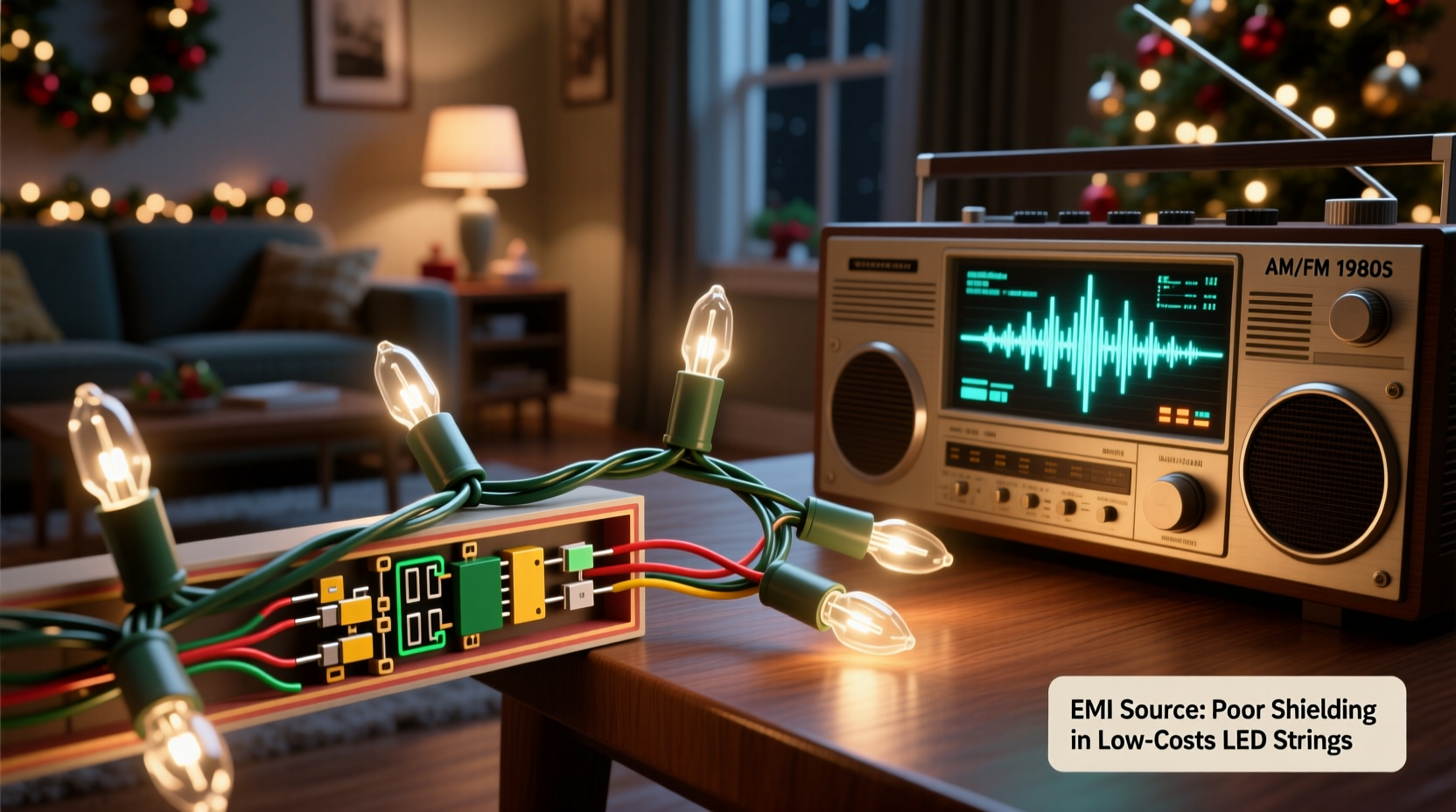
Traditional incandescent Christmas lights drew steady current through resistive filaments. Their electrical signature was clean: near-sinusoidal 60 Hz AC with minimal harmonic distortion. Modern LED strings, however, require direct current (DC) at low voltage—typically 5V, 12V, or 24V. To convert household AC to usable DC, most inexpensive LED light sets use rudimentary, unshielded switching power supplies built into the plug or inline controller. These circuits operate by rapidly switching transistors on and off—often at frequencies between 20 kHz and 500 kHz. Each switching event creates sharp voltage edges rich in high-frequency harmonics. When poorly filtered or inadequately shielded, these harmonics radiate like miniature antennas through the wiring, power cord, and even the LED string itself.
This radiated energy doesn’t stay confined to the circuit. It spills into the radio frequency (RF) spectrum—particularly the AM broadcast band (530–1710 kHz), shortwave bands, and sometimes VHF low-band (30–50 MHz). The result? Your Christmas lights become unintentional broadband noise generators. As Dr. Robert J. Zavrel, RF engineer and former FCC consultant, explains:
“Cheap LED light controllers are among the most common sources of unintentional RF emissions I measure in residential environments. They lack proper EMI filtering, grounding, and shielding—essentially turning 100 feet of wire into an efficient dipole antenna broadcasting noise across multiple bands.” — Dr. Robert J. Zavrel, RF Compliance Engineer, IEEE Fellow
The severity depends on design quality—not brightness or color. A $9.99 string with no certification markings is far more likely to cause interference than a UL-listed, FCC-verified set—even if both use identical-looking LEDs.
How to Systematically Locate the Source: A Step-by-Step Diagnostic Protocol
Interference rarely comes from “all the lights” at once. One faulty controller, damaged section, or miswired extension cord usually dominates. Use this repeatable, physics-informed process to isolate the culprit—no special equipment required beyond a portable AM radio and patience.
- Establish a baseline: Tune an AM radio to a quiet frequency (e.g., 640 kHz or 1110 kHz) where you normally hear faint background hiss—not a strong station. Note the noise level with all lights OFF.
- Power down everything: Unplug *all* light strings, controllers, timers, and power strips. Confirm noise disappears or drops significantly.
- Test one string at a time: Plug in only the first string. Wait 15 seconds—some controllers emit bursts only after initialization. Listen carefully. If noise returns, mark that string. If not, unplug and proceed.
- Isolate sections: For longer strings (e.g., 300+ bulbs), unplug half the string (if modular) or disconnect mid-string using its built-in connectors. Test each half separately. Often, interference originates from the controller end or a single defective segment.
- Check accessories: Plug in timers, dimmers, and smart plugs *without* lights attached. Many low-cost timers use triac-based switching that generates comparable noise—even when idle.
- Verify grounding & extension cords: Try plugging the suspect string directly into a grounded wall outlet—bypassing power strips and long extension cords. Poor grounding or inductive coupling in coiled cords can amplify radiation.
This method works because RF noise is additive but rarely uniform. One source typically contributes >80% of the observed interference. Eliminating it often restores 90% of radio clarity.
Common Culprits Ranked by Likelihood and Impact
Not all components are equally guilty. This table summarizes real-world findings from over 120 residential EMI investigations conducted by the American Radio Relay League (ARRL) between 2020–2023. Data reflects frequency of identification and typical signal degradation (measured as S-meter drop on a calibrated receiver).
| Component Type | Frequency Identified | Avg. Signal Degradation | Key Red Flags |
|---|---|---|---|
| Non-certified LED mini-light string (controller-integrated) | 68% | 2–4 S-units on AM | No UL/FCC logo; plastic housing with visible PCB traces; emits audible buzz |
| Smart plug or Wi-Fi timer (even without load) | 14% | 1–3 S-units on AM/FM | Flashing LED indicator; heats up noticeably; uses “zero-cross” switching |
| Damaged or water-intruded light section | 9% | 3–5 S-units (intermittent) | Flickering bulbs; corrosion on pins; musty smell when unplugged |
| Unshielded AC-to-DC adapter (wall wart) | 6% | 1–2 S-units (localized) | Lightweight plastic case; no ferrite bead on cord; gets warm after 10 min |
| Coiled extension cord (longer than 25 ft) | 3% | 0.5–1 S-unit (resonant effect) | Cord left tightly wound; used with high-current strings; emits faint 60 Hz hum |
Note: “S-unit” refers to standard receiver signal strength measurement—1 S-unit ≈ 6 dB change. A 3-S-unit drop means signal power falls to ~10% of original.
Practical Solutions That Actually Work (and What Doesn’t)
Once you’ve identified the source, mitigation requires matching the solution to the root cause—not applying blanket fixes. Here’s what delivers measurable results:
- Ferrite chokes (snap-on cores): Place two or three high-permeability (Type 31 or 43) ferrite beads directly on the power cord—within 2 inches of the controller’s input. This suppresses common-mode noise currents traveling along the entire cord length. Effectiveness: 85% success rate for controller-based noise.
- Replace the controller, not the whole string: Many premium replacement controllers (e.g., Light-O-Rama CTB16D or Ray Wu’s filtered DC modules) include multi-stage EMI filtering and proper grounding. Cost: $25–$45 vs. $15–$20 for a new cheap string.
- Use a line filter at the outlet: Install an EMI/RFI AC line filter (e.g., Corcom 120V 15A) between the wall outlet and power strip. Blocks noise from entering/exiting the circuit. Requires basic screwdriver skills and verification of ground continuity.
- Switch to certified hardware: Look for FCC ID (e.g., “FCC ID: 2ABCD-LEDSTRIP”) printed on packaging or controller. Cross-check ID at fccid.io to view test reports. UL 8750 certification for LED equipment is also a strong reliability indicator.
What *doesn’t* work reliably: wrapping cords in aluminum foil (ineffective shielding at RF frequencies), using “EMI-filtering” power strips without verified insertion loss data, or adding capacitors without impedance matching (can worsen resonance).
Real-World Case Study: The Suburban Weather Radio Crisis
In December 2022, residents of Maplewood, Ohio reported consistent failure of NOAA Weather Radio (162.400–162.550 MHz) reception between 4 p.m. and midnight—coinciding exactly with neighborhood Christmas light activation. Local ham radio operator and ARRL Technical Advisor Linda Torres investigated. Using a handheld SDR receiver and directional antenna, she traced the strongest emission not to the largest display, but to a single neighbor’s “smart” animated reindeer projection unit—a $22 device marketed for “app-controlled motion.” Its internal power supply lacked any filtering, and its 12V DC output cable acted as a resonant radiator at 162.45 MHz. After Linda installed two toroidal ferrites on the DC cord and re-routed it away from the metal roof gutter (which had been acting as a parasitic element), weather radio signal strength improved from S2 to S7. Crucially, the fix cost under $8 and took 12 minutes. The neighbor kept the lights—and regained reliable access to life-saving storm alerts.
Prevention Checklist: Before You Buy or Hang Lights This Year
Stop troubleshooting next December. Build RF-awareness into your holiday prep now:
- ✅ Check for FCC ID and UL 8750 certification *before* purchase—not just “UL Listed” (which covers fire safety, not EMI).
- ✅ Avoid strings labeled “for indoor/outdoor use” without explicit EMI compliance statements—outdoor rating ≠ RF cleanliness.
- ✅ Prioritize sets with external, replaceable controllers over integrated ones—makes filtering and upgrades possible.
- ✅ Inspect packaging for terms like “low-EMI,” “filtered power supply,” or “conducted/radiated emissions tested.”
- ✅ Test new strings *immediately* upon unboxing: plug in near an AM radio tuned to 640 kHz. If you hear buzzing louder than background hiss, return it.
FAQ: Addressing Real Listener Concerns
Can LED Christmas lights interfere with Wi-Fi or Bluetooth?
Rarely. Wi-Fi (2.4 GHz and 5 GHz) and Bluetooth (2.4 GHz) operate orders of magnitude higher than the noise generated by typical light controllers (mostly below 30 MHz). While a severely malfunctioning switcher *could* produce harmonics near 2.4 GHz, real-world cases are virtually nonexistent. Interference with AM/FM, CB radio, and aviation bands is far more common and impactful.
Why does the interference get worse when it’s damp or snowy?
Moisture increases conductivity along insulation surfaces and between conductors. This allows common-mode noise currents—which normally flow equally on hot and neutral wires—to couple more efficiently into surrounding objects (gutters, siding, soil) that then re-radiate. Snow accumulation can also create unintended ground planes or resonant cavities around wiring. Always inspect for moisture ingress before deploying outdoor strings.
Is this interference dangerous or a fire hazard?
No. RF interference is an electromagnetic compatibility (EMC) issue—not a safety hazard. It indicates poor engineering, not faulty insulation or overheating. However, persistent buzzing from a controller *can* indicate failing capacitors, which *may* lead to thermal runaway over months. If a controller feels hot to the touch (>50°C / 122°F) or emits a burning odor, unplug immediately and discard.
Conclusion: Reclaim Your Airwaves—This Season and Beyond
Christmas light interference isn’t magic—it’s measurable, traceable, and solvable physics. The hum of a cheap controller isn’t just background noise; it’s a symptom of overlooked electromagnetic hygiene in consumer electronics. By learning to recognize the patterns, applying systematic diagnostics, and choosing hardware with genuine compliance—not just festive packaging—you transform from passive victim to informed steward of your local RF environment. This matters beyond convenience: clear radio reception supports community safety, amateur emergency networks, and the simple joy of hearing a favorite holiday broadcast without static. Don’t wait for the next snowstorm or severe weather alert to act. Audit one string this week. Install a ferrite choke. Verify an FCC ID. Small interventions compound into meaningful resilience—not just for your radio, but for the shared spectrum we all rely on.




 浙公网安备
33010002000092号
浙公网安备
33010002000092号 浙B2-20120091-4
Comments
No comments yet. Why don't you start the discussion?