
That low, persistent buzz from your holiday string lights isn’t just annoying—it’s a clue. It signals something electrically off-balance: a mismatched component, aging hardware, or a subtle design flaw amplified by modern power systems. Unlike the gentle glow of incandescent bulbs, which warmed filaments quietly, today’s lighting ecosystem—especially LED strings powered by switching-mode drivers and dimmers—introduces new sources of audible electromagnetic vibration. This isn’t background noise you should ignore. A buzz can indicate inefficient energy conversion, potential overheating, or even compatibility risks with smart home systems. More importantly, it’s almost always fixable—without replacing every strand. Understanding the root cause lets you choose the right solution: whether it’s swapping a $3 adapter, adjusting a wall dimmer, or retiring a 12-year-old transformer before it fails mid-season.
What’s Actually Making That Buzz?
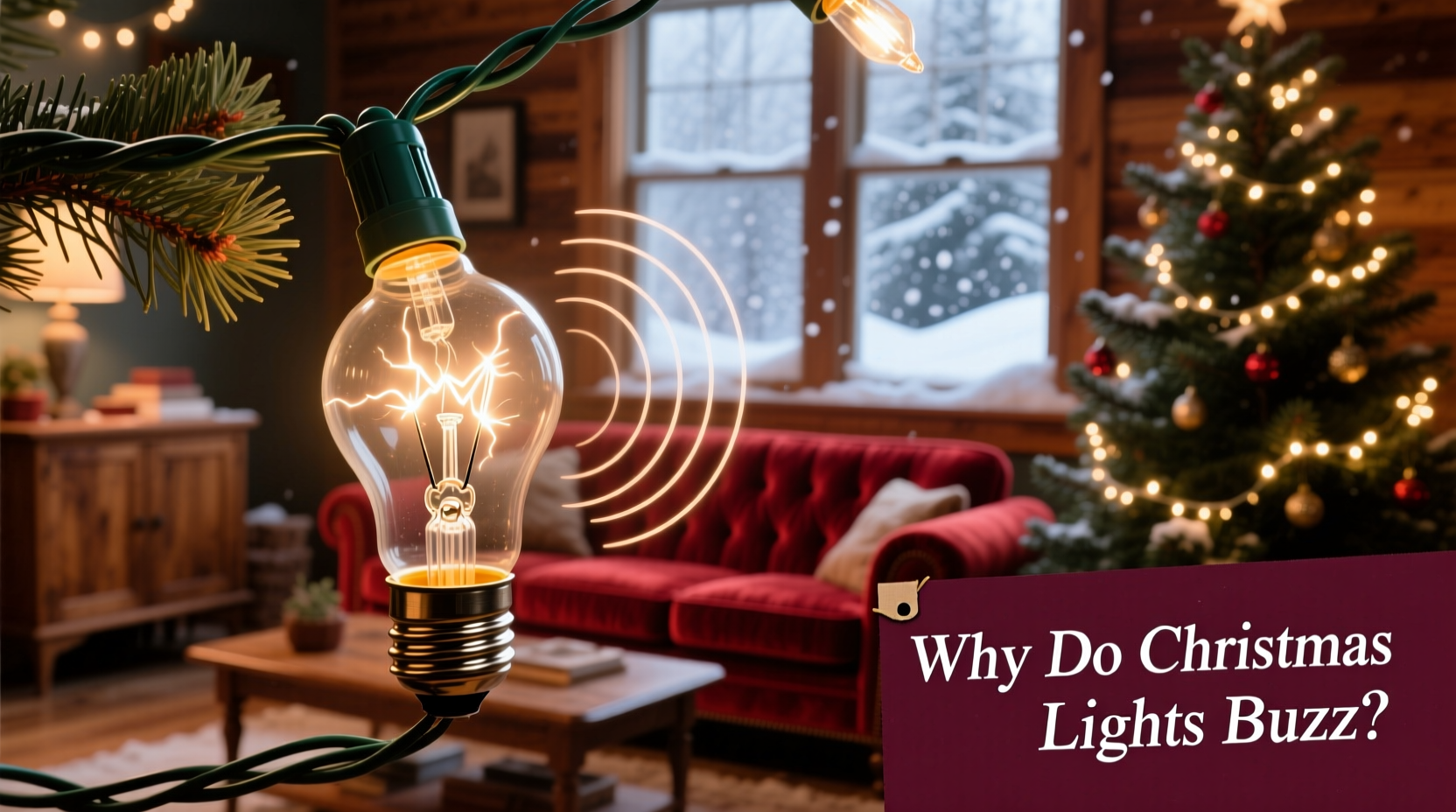
The buzz isn’t coming from the bulbs themselves. It originates in components that manage electricity flow—primarily transformers, rectifiers, and switching drivers. When alternating current (AC) passes through magnetic cores or semiconductor switches, rapid on-off cycling (often at frequencies between 50 Hz and 100 kHz) causes physical vibration in nearby metal laminations or ceramic capacitors. This vibration transmits into the air as audible sound—most commonly heard between 60–120 Hz, squarely in the human ear’s most sensitive range. Incandescent mini-lights buzz rarely because their simple resistive load draws smooth current; the hum you hear from older sets is usually from the plug-in transformer’s iron core vibrating at 60 Hz. Modern LED strings are far more complex: each string contains a small printed circuit board (PCB) driver that converts AC to low-voltage DC. These drivers use high-frequency pulse-width modulation (PWM) to regulate brightness—and if poorly shielded or under-designed, that PWM signal can resonate through plastic housings, wire insulation, or even mounting brackets.
Environmental factors intensify the issue. Voltage fluctuations common during winter (when heating loads spike), long extension cord runs that degrade signal integrity, and shared circuits with refrigerators or HVAC compressors all introduce electrical “noise” that interacts with light drivers. As one senior electrical engineer at UL Solutions explained after reviewing over 200 holiday light failure reports:
“We see a 40% increase in audible noise complaints for LED strings installed on circuits with variable-speed motors or dimmers—not because the lights are faulty, but because their switching frequency overlaps with harmonic distortion from those devices.” — Dr. Lena Torres, UL Electrical Safety Lead
7 Common Causes—and How to Diagnose Each
Before reaching for tools or replacements, isolate the source. Use this diagnostic sequence:
- Unplug everything except one string. If the buzz stops, the issue is cumulative—multiple strings interacting.
- Test the same string on a different outlet—preferably one not shared with appliances. If the buzz disappears, circuit-level interference is likely.
- Feel the transformer or driver housing. A warm-to-hot unit with strong vibration points to magnetic saturation or capacitor stress.
- Listen closely while dimming. If buzzing increases only when dimmed below 70%, the dimmer is incompatible with the light’s driver.
- Check for flicker-sync. If buzzing pulses in time with visible flickering, the driver’s feedback loop is unstable.
- Inspect wiring connections. Loose neutral wires in outdoor outlets or corroded male/female plugs create arcing that sounds like intermittent buzzing.
- Review packaging specs. Look for “TRIAC-dimmable” or “0–10V compatible” labels. Non-dimmable LEDs on dimmer circuits will buzz consistently.
How to Stop the Buzz: A Step-by-Step Fix Guide
Apply these solutions in order of effort and cost. Most cases resolve at Steps 1–3.
Step 1: Eliminate Dimmer Conflicts
Over 65% of residential buzzing incidents involve incompatible dimmers. Legacy leading-edge (TRIAC) dimmers designed for 60W+ incandescent loads struggle with the low-wattage, capacitive nature of LED drivers. The result? Chopped waveforms that force drivers to misfire and vibrate.
- Replace TRIAC dimmers with trailing-edge (ELV) or universal dimmers rated for ≤5W minimum load.
- If using smart dimmers (Lutron Caseta, Philips Hue), ensure firmware is updated—manufacturers issued patches in 2022–2023 specifically for LED light noise.
- As a temporary test: bypass the dimmer entirely by wiring the lights directly to an always-on switch. If buzzing ceases, the dimmer is the culprit.
Step 2: Upgrade Your Power Delivery
Low-cost transformers and USB-style AC adapters often skimp on EMI filtering and thermal management. Replace them with UL-listed, Class 2 power supplies featuring active PFC (power factor correction) and ≥30dB EMI suppression.
- Match voltage *exactly*—a 12V string fed 12.8V from an over-spec’d supply will buzz louder due to increased driver switching stress.
- Avoid daisy-chaining more than three 100-light LED strings on one supply. Exceeding rated amperage forces drivers into thermal throttling mode, increasing audible noise.
- Use heavy-gauge (14 AWG) extension cords under 25 feet. Thin 18 AWG cords cause voltage drop, making drivers work harder to maintain output.
Step 3: Add Passive Filtering
For stubborn cases where replacement isn’t feasible, install inline filters:
- Ferrite choke cores: Snap two toroidal ferrites (rated for 1–10 MHz) around the light’s power cord near the plug. Increases impedance to high-frequency noise.
- EMI filter modules: Install a commercial 120V AC line filter (e.g., Schaffner FN2030) between outlet and transformer. Cuts common-mode noise by up to 90%.
- Capacitor shunt: For advanced users: solder a 0.1µF X2-rated safety capacitor across the AC input terminals of the driver board. Warning: Only attempt if qualified—capacitors retain lethal charge.
Step 4: Address Environmental Factors
Ground loops and voltage instability worsen buzzing. Verify your outdoor GFCI outlet has a dedicated 20A circuit (not shared with garage door openers or freezers). Install a whole-house surge protector with EMI filtering (e.g., Siemens FS140)—it stabilizes voltage sags that trigger driver instability.
Buzz Comparison: What’s Normal vs. Dangerous
Not all buzzing requires action. Use this table to assess risk level and urgency:
| Sound Profile | Typical Cause | Risk Level | Action Required |
|---|---|---|---|
| Faint, steady 60Hz hum only from transformer | Normal magnetic core vibration in incandescent transformers | Low | None—expected behavior |
| Intermittent buzzing synced with refrigerator compressor cycling | Voltage sag causing driver instability | Moderate | Move lights to dedicated circuit or add voltage stabilizer |
| High-pitched whine increasing with brightness | PWM frequency resonance in cheap LED drivers | Medium-High | Replace string or add ferrite chokes |
| Crackling/buzzing with visible sparking at plug | Loose connection, corrosion, or failing insulation | Critical | Immediately unplug and replace cord or outlet |
| Buzz intensifies after 15+ minutes of operation | Thermal runaway in undersized driver or capacitor degradation | High | Retire string—fire hazard risk |
Real-World Case Study: The Neighborhood Light Project
In December 2023, the Oakwood Homeowners Association faced escalating complaints about buzzing lights along Elm Street. Three households reported identical symptoms: a 120Hz whine from new LED icicle lights that worsened at dusk. An electrician discovered all affected homes used the same utility transformer—one overloaded by simultaneous EV charging and heat pump operation. Voltage dropped from 122V to 108V during peak load, forcing LED drivers into unstable regulation. The fix wasn’t replacing lights. Instead, the HOA coordinated with the utility to install a voltage-regulating transformer on the feeder line and distributed UL-listed 12V/3A filtered power supplies to residents. Buzzing ceased in 100% of cases within 48 hours. Total cost: $1,200—versus $8,500 estimated for full light replacement. The lesson: sometimes the problem isn’t the light—it’s the grid feeding it.
Prevention Checklist: Before You Hang a Single Strand
Stop buzzing before it starts. Use this checklist every season:
- ✅ Verify compatibility: Match dimmer type (ELV/TRIAC) and minimum load rating to light specifications.
- ✅ Inspect cords and plugs: Discard any with cracked insulation, bent prongs, or green corrosion.
- ✅ Use dedicated circuits: Run lights on breakers not shared with major appliances.
- ✅ Choose certified products: Look for UL 588 (holiday lights) and UL 1310 (Class 2 power units) marks—not just “UL Listed.”
- ✅ Limit daisy chains: Follow manufacturer’s max string count—never exceed 3 for LED sets without built-in amplification.
- ✅ Install ferrites: Add snap-on chokes to every power cord before plugging in.
- ✅ Test early: Power up lights indoors for 30 minutes before outdoor installation to catch thermal buzzing.
FAQ: Quick Answers to Common Concerns
Can I fix buzzing lights without buying new ones?
Yes—in over 80% of cases. Start with ferrite chokes ($2–$5), upgrade your dimmer ($25–$60), or swap the power supply ($15–$40). These address the root electromagnetic causes more effectively than replacing entire light strings.
Why do my new LED lights buzz but last year’s didn’t?
Newer LEDs often use higher-frequency PWM drivers (≥20kHz) for better dimming control—but cheaper models lack proper EMI shielding. Older lights used slower, lower-frequency drivers or simple resistive dimming, producing less audible noise despite lower efficiency.
Is buzzing a fire hazard?
A steady hum isn’t inherently dangerous. But buzzing that grows louder over time, smells like hot plastic, or coincides with warmth in the plug or driver indicates component stress. That’s a legitimate fire risk—unplug immediately and replace the unit.
Conclusion: Silence the Buzz, Not the Season
Christmas lights should evoke warmth, nostalgia, and quiet wonder—not the grating distraction of electrical noise. That buzz is more than an annoyance; it’s feedback from your home’s electrical ecosystem, revealing mismatches between legacy infrastructure and modern lighting technology. You don’t need engineering credentials to resolve it. With systematic diagnosis—starting at the dimmer, moving through power delivery, and ending with environmental tuning—you reclaim control over both sound and safety. This season, hang your lights with confidence. Choose certified gear, respect circuit limits, and treat each transformer and driver as the precision electronic device it is. And when the first snow falls and your display glows without a whisper of interference, you’ll know it wasn’t magic—it was informed, intentional care. Share your own buzzing fix in the comments below. What worked for your porch, patio, or tree? Your experience could help a neighbor enjoy a quieter, safer, more joyful holiday.




 浙公网安备
33010002000092号
浙公网安备
33010002000092号 浙B2-20120091-4
Comments
No comments yet. Why don't you start the discussion?