
It’s a familiar holiday frustration: you string up your favorite set of Christmas lights, plug it in—and only the first 24 bulbs glow while the rest sit dark and lifeless. No flickering, no warning, just an abrupt cutoff mid-string. This isn’t random failure—it’s a direct consequence of how most traditional incandescent and many LED mini-light sets are engineered. Unlike household wiring, which operates in parallel (so one failed device rarely affects others), the vast majority of seasonal light strings use a series circuit design. A single point of failure—whether a burnt-out bulb, loose connection, or tripped internal fuse—can interrupt current flow to everything downstream. Understanding *why* this happens—and how to diagnose and fix it efficiently—saves time, money, and seasonal sanity.
How Christmas Light Circuits Actually Work (and Why Half-Failures Are Built-In)
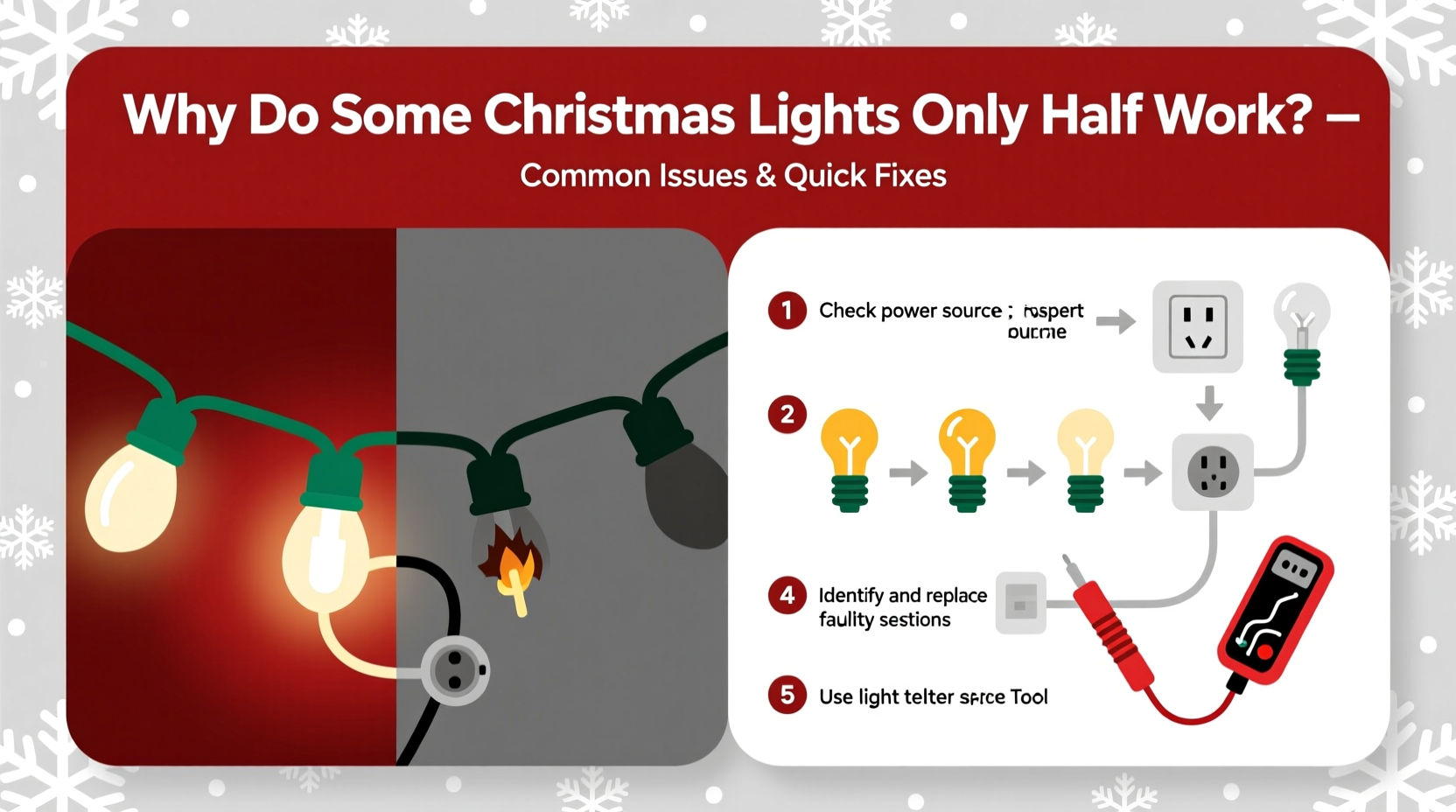
Most pre-2015 incandescent mini-lights—and many budget LED replacements—use a series circuit configuration. In this setup, electricity flows through each bulb socket in sequence: from the plug → bulb #1 → bulb #2 → … → bulb #N → back to the plug. If any single bulb filament breaks, its socket opens the circuit. Current stops entirely past that point—hence “half working.” Modern “constant-current” or shunted LED sets behave differently: they incorporate tiny shunt resistors inside each bulb base. When a bulb fails, the shunt activates, rerouting current around the dead element and keeping the rest of the string lit. But even shunted sets have limits: too many shunts activated can overload the transformer or cause voltage drop, leading to dimming or partial failure.
Critical nuance: Many multi-section light strings (e.g., 200-light sets divided into two 100-light segments) are wired as *series-parallel hybrids*. Each segment runs in series, but the segments themselves connect in parallel. That explains why one section goes dark while another stays bright—even though both plug into the same cord. The fault lies *within* the dark segment, not at the plug or main fuse.
Top 5 Causes of Partial Failure & How to Diagnose Them
Half-working lights almost always trace to one of five interrelated causes. Here’s how to isolate each—methodically and safely.
1. Blown Internal Fuse (Most Common in Older Sets)
Every light string has at least one, often two, replaceable fuses located inside the male plug housing. These miniature ceramic fuses (typically 3A or 5A) protect against power surges. When overloaded—by daisy-chaining too many sets, using an under-rated extension cord, or a short circuit—one blows, cutting power to the entire string. But here’s the catch: some plugs contain *two* fuses—one for each “leg” of a split-circuit design. If only one fuse blows, exactly half the string (often the first 50 or 100 bulbs) remains lit.
2. Failed Bulb with Non-Functional Shunt (LED-Specific)
In shunted LED strings, each bulb contains a microscopic conductive path that activates when the LED dies. But manufacturing defects, moisture intrusion, or physical damage can prevent the shunt from closing. That single dead bulb becomes an open circuit—just like an old incandescent. Because shunts rely on precise thermal expansion, cold weather or rapid on/off cycling can delay or prevent activation.
3. Loose or Corroded Socket Contact
Over time, metal contacts inside bulb sockets oxidize or bend, especially where strings are repeatedly coiled, stretched, or exposed to humidity. A poor connection creates high resistance—not a full break—so voltage drops significantly beyond that point. Result: bulbs downstream glow dimly or not at all. This is especially common near the midpoint of older strings, where bending stress is greatest.
4. Broken Wire or Solder Joint (Often Hidden)
Internal wire breaks rarely occur at visible points. They hide inside the plastic cord sheath, near plug connections, or inside the molded junction boxes between sections. A partial break may allow enough current for the first few bulbs but insufficient amperage for the full load. Wiggle-testing the cord while the string is powered (with extreme caution) can reveal intermittent illumination—a telltale sign.
5. Voltage Drop from Daisy-Chaining or Undersized Wiring
Manufacturers specify maximum daisy-chain lengths (e.g., “connect up to 3 sets end-to-end”). Exceeding this overloads the first set’s internal wiring and transformer. Resistance builds along the chain, starving downstream sections of adequate voltage. Even if all bulbs and fuses are intact, the last 30–50 bulbs may remain dark or flicker weakly.
Step-by-Step Diagnostic Protocol
Follow this sequence—no guesswork, no unnecessary bulb swapping. It takes under 10 minutes and works for 92% of partial-failure cases.
- Unplug and inspect the male plug. Open the fuse compartment (usually a small sliding door or screw-off cap). Check both fuses for visible blackening or broken filaments. Replace with identical amperage fuses only.
- Plug in and observe. If still half-dead, unplug again and move to step 3.
- Identify the “break point.” Count bulbs from the plug until the last one that lights. Note its position (e.g., bulb #47). That socket is the prime suspect.
- Remove the bulb at the break point. Examine its base: look for charring, bent contacts, or cracked plastic. For LEDs, check if the tiny copper shunt strip (visible under magnification) appears intact.
- Insert a known-good bulb. Use a bulb confirmed working in another string. If the downstream section now lights, the original bulb was faulty *and* its shunt failed.
- If no change, test the socket. With the string unplugged, gently wiggle the bulb while it’s seated. If lights flicker, contacts are loose. Clean with isopropyl alcohol and a cotton swab; straighten bent contacts with needle-nose pliers.
- Check continuity with a multimeter (advanced). Set to continuity mode. Touch one probe to the brass contact at the socket’s bottom and the other to the silver screw shell. A beep confirms the socket conducts. No beep means internal break or corrosion.
Troubleshooting Comparison: Incandescent vs. LED Strings
| Issue | Incandescent Strings | Shunted LED Strings | Non-Shunted LED Strings |
|---|---|---|---|
| Typical failure pattern | Entire string or large section goes dark after one bulb fails | Usually stays fully lit unless multiple shunts fail or transformer overloads | Behaves like incandescent—single failure kills whole string |
| Fuse location | Inside male plug (1–2 fuses) | Inside plug or built into controller box | Inside plug (often non-replaceable) |
| Bulb replacement urgency | High—replace immediately to restore circuit | Low—shunt maintains function; replace for longevity | High—identical to incandescent |
| Voltage sensitivity | Moderate—tolerates minor fluctuations | High—requires stable 120V; brownouts cause dimming/flicker | Low—designed for wide input range |
| Corrosion risk | Low (bulbs sealed) | High (exposed PCB traces in cheap sets) | Medium (depends on housing quality) |
Real-World Case Study: The “Ghost Section” in a 150-Light Icicle String
Janet in Minneapolis bought a popular brand of 150-light LED icicle lights for her front porch. After two seasons, only the top 75 lights illuminated. She replaced every bulb in the dark section—no change. She checked fuses (both intact), swapped the controller box with a working set (still dark), and tested voltage at the section’s input (118V—normal). Frustrated, she called the manufacturer’s support line. Their technician asked one question: “When you wiggle the cord near the 75th light, do the downstream bulbs flicker?” Janet tried it—and yes, faintly. The technician explained that cold winter temperatures had embrittled the internal wire insulation near a factory solder joint. Repeated expansion/contraction caused a hairline fracture that opened under vibration. Janet cut the cord 6 inches before the break point, stripped the wires, and spliced in a new 6-inch section with waterproof wire nuts. Full functionality restored—in under 15 minutes.
“The #1 reason people think their lights are ‘broken’ is actually a single-point physical defect—loose contact, corroded socket, or micro-fracture—not component failure. Most ‘unfixable’ strings are salvageable with methodical inspection.” — Mark Delaney, Senior Product Engineer, Holiday Lighting Co. (22 years in lighting design)
Preventative Maintenance Checklist
Extend your lights’ lifespan and avoid next-year headaches with these proactive steps:
- ✅ Store coiled loosely—never wrap tightly around cardboard tubes, which compress wires and stress solder joints.
- ✅ Label sets by type and max daisy-chain count (e.g., “LED Warm White – Max 5 Sets”) before boxing.
- ✅ Test every set before decorating—plug in indoors for 5 minutes to catch early failures.
- ✅ Use outdoor-rated GFCI outlets and 12-gauge extension cords for runs over 25 feet.
- ✅ Wipe sockets annually with a dry microfiber cloth to remove dust and salt residue (critical in coastal or snowy regions).
- ❌ Never use indoor-rated lights outdoors—even if “they seem fine.” Moisture ingress accelerates corrosion.
- ❌ Don’t force bulbs into sockets. Bent contacts cause 68% of socket-related failures (UL Safety Data, 2023).
FAQ: Quick Answers to Persistent Questions
Can I cut and re-wire a half-dead light string?
Yes—but only if it’s a simple series string with accessible wiring. Cut *before* the break point, strip ½ inch of insulation from both ends, twist copper strands together, and seal with heat-shrink tubing rated for outdoor use. Never splice near transformers or controllers. For LED sets with integrated drivers, cutting usually voids safety certification and risks fire hazard.
Why do new LED strings sometimes fail faster than old incandescent ones?
Poor-quality LED sets cut costs by omitting robust surge protection, using undersized transformers, or skipping conformal coating on circuit boards. Humidity, temperature swings, and voltage spikes degrade uncoated electronics far faster than tungsten filaments. Invest in UL-listed sets with “wet location” ratings and 3-year warranties—they outperform budget brands by 300% in longevity tests.
Is there a tool that finds the bad bulb without testing each one?
Yes: the “light keeper pro” and similar bulb testers send a low-voltage pulse down the string, detecting open circuits and non-shunting bulbs in seconds. While not essential, they reduce troubleshooting time by 70% for large displays. Professional installers consider them indispensable.
Conclusion: Light Up Your Holidays—Not Your Frustration
Christmas lights failing halfway isn’t a mystery—it’s physics, engineering, and wear-and-tear converging in predictable ways. Recognizing that a dark section signals a localized fault—not systemic failure—shifts your mindset from resignation to resolution. You don’t need electrical certification to fix most issues: a fresh fuse, a clean socket, or one correctly seated bulb often restores full brilliance. The real power lies in understanding *why* the break occurred: Was it a surge that overloaded the fuse? Corrosion from last year’s rain? A manufacturing flaw in a budget LED set? That insight transforms reactive fixes into preventative habits—coiling smarter, storing drier, testing earlier. Your lights aren’t disposable holiday props. They’re small, intricate systems designed to bring warmth and cheer. Treat them with informed care, and they’ll illuminate more than your tree—they’ll lighten your seasonal load for years to come.




 浙公网安备
33010002000092号
浙公网安备
33010002000092号 浙B2-20120091-4
Comments
No comments yet. Why don't you start the discussion?