
It’s a familiar holiday frustration: you plug in your favorite string of mini lights, and nothing happens—until you try the outlet behind the couch, and suddenly they glow brightly. Or worse, they flicker erratically, grow warm near the plug, or work only when another appliance is turned off. This isn’t just inconvenient—it’s a red flag. Inconsistent operation across outlets points to underlying electrical issues that go far beyond faulty bulbs or tangled wires. Understanding *why* this happens—and acting on it—is critical for preventing overheating, tripped breakers, damaged wiring, or even fire hazards during one of the most electrically demanding times of the year.
Why Some Christmas Lights Only Work in Certain Outlets
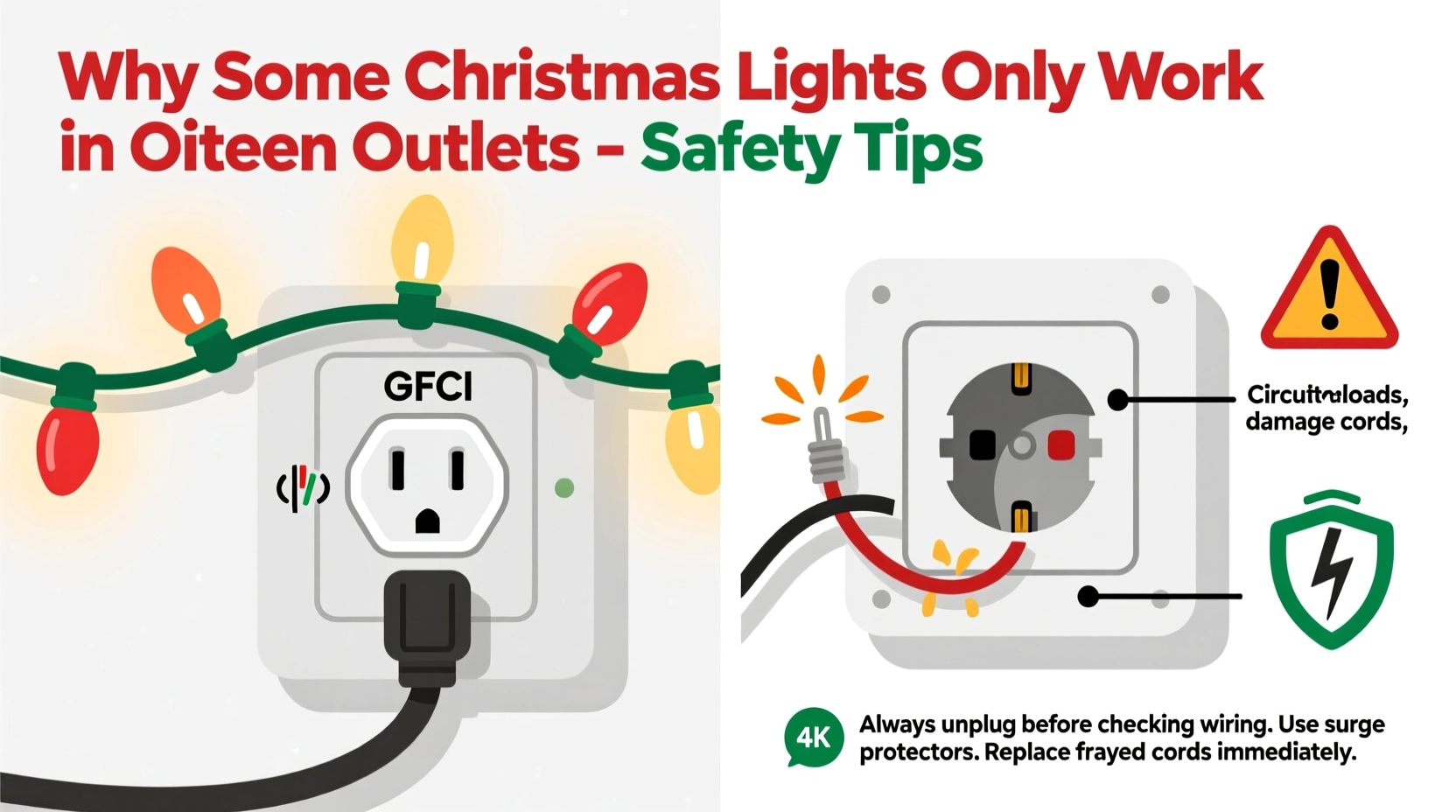
Christmas lights are deceptively simple devices—but their behavior reveals important truths about your home’s electrical system. When lights function reliably in one outlet but fail (or behave unpredictably) in another, the cause almost always lies in one or more of these five interrelated factors:
- Voltage drop: Older homes, long circuit runs, or undersized wiring can cause voltage to fall below the 110–120V standard required by most incandescent and LED light strings. Outlets farther from the main panel—especially at the end of a circuit—often deliver only 102–106V. Many LED controllers and rectifiers won’t activate below 105V, resulting in no illumination despite a live connection.
- Circuit overload: A single 15-amp residential circuit supports up to 1,800 watts. A typical 100-light incandescent string draws 40–50W; a 300-light string can pull 120–150W. Add a space heater, TV, or coffee maker on the same circuit, and the total load may exceed capacity—causing intermittent power or breaker trips. The outlet “working” may simply be on a less-loaded circuit.
- Loose or corroded connections: Outlets degrade over time. Internal contacts loosen, screws oxidize, and backstabbed wiring (common in homes built before 2000) becomes unreliable. A marginal connection may provide enough continuity for a low-draw device like a phone charger but fail under the brief surge current of LED light strings with capacitive drivers.
- GFCI/AFCI interference: Ground Fault Circuit Interrupters (GFCIs) and Arc Fault Circuit Interrupters (AFCIs) are lifesaving—but sensitive. Older or low-quality LED light strings can emit micro-arcing or leakage current during dimming or controller switching. GFCIs may interpret this as a ground fault and cut power. AFCIs may misread rapid LED switching as dangerous arcing, especially on circuits shared with motors (e.g., refrigerators).
- Neutral wire issues: Unlike hot-wire problems, neutral faults are harder to detect but extremely hazardous. A loose neutral at an outlet, junction box, or even the main panel creates unstable voltage distribution across circuits. One outlet may read 130V while another reads 90V—enough to make some lights dim, others overly bright, and many simply nonfunctional.
Hidden Dangers: What Intermittent Operation Really Signals
Intermittent functionality isn’t merely annoying—it’s often the earliest warning sign of a serious hazard. Consider this real-world scenario:
In December 2022, a homeowner in Portland, Oregon, noticed her outdoor lights worked only when the garage door opener was off. She assumed it was “just the way the lights were.” Two days later, the outlet behind the dining room table—used for her tree—began emitting a faint burning odor. An electrician found a loose neutral splice in the attic junction box shared by the kitchen, dining, and garage circuits. Voltage had swung between 98V and 138V across outlets. The LED string’s internal driver had failed repeatedly, overheating its capacitor. The outlet’s plastic housing was discolored and brittle. Had the issue gone unaddressed, thermal runaway could have ignited nearby insulation.
This case underscores a critical truth: inconsistent light operation is rarely about the lights themselves. It’s the electrical system communicating distress. According to the National Fire Protection Association (NFPA), decorative lighting accounts for an estimated 770 home fires annually—nearly half involving electrical distribution or lighting equipment. Most occur not during installation, but during extended operation, when heat buildup compounds pre-existing weaknesses.
Safety-Critical Checklist Before Hanging Any Lights
Before connecting a single bulb, complete this verified checklist. Skipping even one step increases risk significantly:
- ✔ Verify circuit capacity: Identify which outlets share a breaker (flip breakers one at a time and test). Ensure total connected load—including lights, extension cords, and other devices—stays below 80% of circuit rating (e.g., ≤1,440W on a 15A circuit).
- ✔ Inspect every outlet: Check for warmth, discoloration, buzzing sounds, or wobbling plugs. Replace any outlet older than 15 years or showing signs of wear.
- ✔ Test GFCI/AFCI function: Press the “TEST” button on each protected outlet. Power must cut immediately; “RESET” must restore it. If not, replace the device.
- ✔ Use only UL-listed extension cords: For indoor use, choose 16-gauge minimum; outdoors, 14-gauge or heavier. Never daisy-chain more than one cord.
- ✔ Check light string integrity: Look for cracked sockets, exposed wire, melted insulation, or bent pins. Discard any string with damaged wire—even if it “still works.”
- ✔ Confirm outdoor-rated components: Indoor lights used outside—even under eaves—violate NEC Article 410.41 and create shock risks due to moisture ingress into non-sealed sockets.
Do’s and Don’ts: Electrical Safety for Holiday Lighting
Proper practices separate safe, joyful displays from preventable emergencies. This table summarizes field-tested guidance from licensed electricians and the Electrical Safety Foundation International (ESFI):
| Action | Do | Don’t |
|---|---|---|
| Outlet Use | Plug lights into outlets with tight, secure receptacles. Prefer outlets on dedicated circuits (e.g., a spare bedroom circuit unused during holidays). | Force plugs into loose outlets. Use adapters to convert 2-prong to 3-prong without grounding. |
| Extension Cords | Use outdoor-rated cords rated for the total wattage. Keep cords untangled and off walkways. | Run cords under rugs or carpeting. Overload a single cord with multiple light strings. |
| Light Strings | Replace incandescent strings with UL-listed LED versions (75% less heat, 80% less energy). Follow manufacturer’s maximum string-to-string connection limits. | Connect more strings than labeled. Repair damaged wires with tape or wire nuts not rated for outdoor/low-voltage use. |
| Timing & Monitoring | Use timers to limit operation to 6–8 hours daily. Physically check lights for warmth after 30 minutes of operation. | Leave lights on unattended overnight or while away from home. Ignore a faint ozone or “hot plastic” smell. |
Step-by-Step: Diagnosing and Resolving Outlet-Specific Light Issues
When lights behave inconsistently, follow this methodical process—not guesswork—to identify and resolve the root cause:
- Isolate the variable: Unplug all other devices from the problematic outlet and adjacent outlets on the same circuit. Try the lights again. If they now work, the issue is circuit overload—not the outlet itself.
- Measure voltage: Using a digital multimeter, test voltage at the non-working outlet (hot-to-neutral) and a known-good outlet. Record both readings. A difference >5V suggests wiring resistance or a shared neutral problem.
- Check for shared neutrals: Turn off the breaker for the non-working outlet. If other circuits (e.g., hallway lights) also lose power, neutrals are likely tied together—a code violation requiring correction by an electrician.
- Test outlet integrity: Plug a lamp or radio directly into the suspect outlet. If it works reliably, the issue is likely the light string’s compatibility (e.g., GFCI sensitivity). If the lamp flickers or fails, the outlet needs replacement.
- Inspect the string’s plug and first 18 inches: Gently flex the cord near the plug while lights are on. If they blink or die, internal wire breakage has occurred. Discard immediately—do not attempt repair.
- Consult a professional if: You measure voltage outside 110–125V range; outlets feel warm; breakers trip repeatedly; or you discover aluminum wiring, knob-and-tube, or ungrounded systems.
“Holiday lighting failures are rarely random. They’re diagnostic clues—like a check-engine light for your home’s electrical health. Ignoring them doesn’t make the problem disappear; it just delays the moment it becomes urgent.” — Michael Torres, Master Electrician and NFPA Electrical Code Committee Member
FAQ: Addressing Common Concerns
Can I safely plug multiple light strings into one power strip?
No—not without verification. Most consumer power strips are rated for 1,500W maximum. A single 50-foot LED string draws ~25W, but older incandescent strings draw 100–200W each. Four incandescent strings easily exceed the strip’s rating, causing internal overheating and fire risk. Always calculate total wattage: add the “W” rating on each string’s label, then ensure the sum stays below 80% of the strip’s rating (e.g., ≤1,200W for a 1,500W strip). Better yet: use a commercial-grade, UL-listed power distribution unit designed for seasonal lighting.
Why do my LED lights work fine indoors but flicker outdoors?
This usually indicates moisture intrusion or temperature-related component stress. Outdoor-rated LEDs include conformal coating on circuit boards and IP65-rated housings. Indoor-only LEDs lack this protection. When cold (<32°F) or damp, condensation forms on uncoated electronics, creating micro-shorts that disrupt the constant-current driver. The result is flickering, partial illumination, or complete failure. Never substitute indoor lights for outdoor use—even under covered porches.
Is it safe to leave Christmas lights on a timer overnight?
Yes—if—and only if—all components meet strict criteria: (1) All lights are UL-listed LED strings; (2) No extension cords are used, or only heavy-duty outdoor-rated cords are employed; (3) The timer is UL-listed and rated for the total load; (4) Lights are inspected weekly for damage, overheating, or discoloration; and (5) The display is located away from flammable materials (curtains, dried trees, paper decorations). Timers reduce human error but don’t eliminate electrical risk.
Conclusion: Prioritize Safety Over Sparkle
Your holiday lights should evoke warmth and wonder—not worry. The fact that they work in only certain outlets isn’t a quirk of the season; it’s your home’s electrical infrastructure sending a clear, urgent message. Voltage fluctuations, aging outlets, overloaded circuits, and incompatible safety devices aren’t trivial inconveniences—they’re precursors to equipment failure, fire, or electrocution. Taking 20 minutes to verify circuit loads, test outlets, inspect cords, and consult a qualified electrician before decorating isn’t overcautious. It’s responsible stewardship of your home and the people in it. This year, let your lights shine not just with brilliance, but with confidence—knowing every connection is sound, every watt accounted for, and every safety protocol honored. Your peace of mind is the most valuable decoration of all.




 浙公网安备
33010002000092号
浙公网安备
33010002000092号 浙B2-20120091-4
Comments
No comments yet. Why don't you start the discussion?