
It’s a familiar holiday frustration: you plug your string of warm-white LED icicles into the living room outlet—and nothing happens. You try the hallway outlet: still dead. Then, on a whim, you test the garage outlet—and suddenly, they glow brightly. No tripped breaker. No blown fuse. Just inconsistent behavior across otherwise identical-looking outlets. This isn’t magic or bad luck. It’s electricity behaving exactly as designed—but revealing hidden issues in your home’s wiring, protection systems, or the lights themselves. Understanding why this happens isn’t just about convenience; it’s about safety, energy efficiency, and preventing fire hazards during peak seasonal load. This guide walks through the most common causes—not with theory alone, but with field-tested diagnostics, real-world examples, and actionable steps you can take tonight, without calling an electrician (unless warranted).
1. GFCI Outlets Are Doing Their Job—Even When You Don’t Realize It
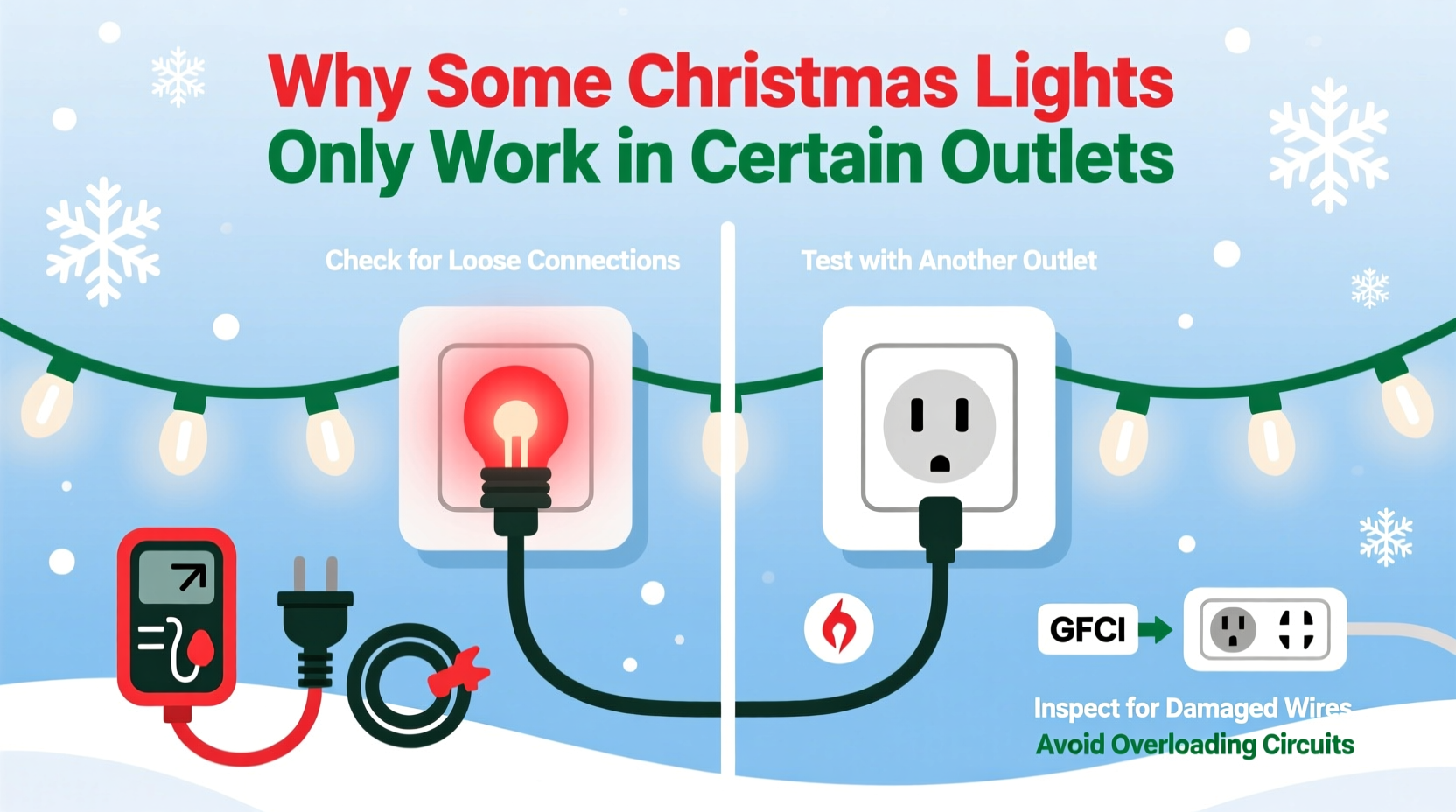
Ground Fault Circuit Interrupters (GFCIs) are life-saving devices required in kitchens, bathrooms, garages, basements, and outdoor locations since the 1970s. They monitor current flow between hot and neutral wires. If as little as 4–6 milliamps leaks to ground (e.g., through moisture, damaged insulation, or internal light-set capacitor drift), the GFCI cuts power instantly. Many modern Christmas light sets—especially older incandescent or lower-cost LED strings—contain small power supplies or rectifier circuits that generate minor leakage current. While safe and within manufacturer specs, that leakage can push a sensitive or aging GFCI over its threshold.
This explains why lights may work fine in non-GFCI outlets (like those in bedrooms or living rooms) but trip—or refuse to energize—in the garage or patio. Crucially, GFCIs don’t always “trip” with an audible click or visible lever movement. Some degrade silently, becoming hyper-sensitive. Others may not reset fully after a prior fault, leaving them in a “phantom lockout” state where they appear functional but won’t pass current.
2. Circuit Overload: The Hidden Capacity Problem
Your home’s circuits have hard limits—typically 15 or 20 amps for standard 120V branch circuits. That translates to 1,800W or 2,400W maximum load. But holiday lighting adds up fast: a single 100-light incandescent string draws ~40W; a 300-light set uses ~120W. Add extension cords, tree lights, animated displays, and outdoor projectors—and you’re easily pushing 600–1,000W on one circuit. Yet here’s what most homeowners miss: outlets on the same wall may be on *different* circuits. One outlet might share a circuit with your refrigerator and furnace blower; another might feed only a single closet light. That second outlet has far more available headroom.
When you overload a circuit, breakers don’t always trip immediately. Instead, voltage sags occur—especially under cold conditions when wire resistance increases. Many LED light controllers interpret low or unstable voltage (<105V) as a fault and shut down entirely. That’s why your lights flicker or go dark mid-display on one outlet but shine steadily on another: the first is voltage-starved; the second is stable.
| Cause | Symptom | Diagnostic Clue |
|---|---|---|
| GFCI sensitivity | Lights work nowhere near water sources, but fail in garage/patio | Outlet has “TEST/RESET” buttons; resetting restores function temporarily |
| Circuit overload | Lights dim or cut out when other appliances run (e.g., microwave, space heater) | Other devices on same circuit behave erratically; breaker feels warm to touch |
| Loose neutral connection | Lights work only in specific outlets—and brightness varies wildly by location | Incandescent bulbs glow brighter than normal in some rooms; others dim significantly |
| Outlet wear or corrosion | Intermittent operation; wiggling plug restores power | Visible greenish discoloration inside outlet slots; plug feels loose |
| Light-set internal fault | Works reliably on one outlet but fails on all others—even identical ones | Fails on multiple homes/outlets; works only with specific brand of power strip |
3. Wiring Anomalies: From Loose Neutrals to Shared Neutrals
A loose neutral connection—either at the outlet, junction box, or main panel—is among the most dangerous yet overlooked culprits. In multi-wire branch circuits (MWBCs), two hot wires (often on opposite phases) share a single neutral. If that neutral becomes loose or corroded, voltage imbalances occur. One leg may read 135V while the other drops to 90V. Most Christmas light electronics tolerate 110–125V; outside that range, they either won’t start or shut down to protect internal components.
Shared neutrals were common in homes built between 1960–1990. They explain why lights might work perfectly in your dining room (on Leg A) but not in the adjacent kitchen (on Leg B)—even though both outlets look identical and are on the same wall. Voltage testing with a multimeter reveals the imbalance: healthy outlets read 118–122V; problem outlets swing beyond ±10V from nominal.
Corrosion is another silent issue—especially in older homes with aluminum wiring or damp locations. Aluminum oxidizes rapidly, forming a high-resistance layer that impedes current flow. Even copper outlets degrade over decades: screw terminals loosen, spring contacts fatigue, and dust/moisture create micro-resistive paths. These don’t trigger breakers—but they absolutely prevent marginal loads like LED light strings from operating reliably.
4. Light-Set Specific Issues: Not All Strings Are Created Equal
The lights themselves often contribute to the problem. Here’s what professionals see repeatedly:
- Capacitor leakage in AC/DC adapters: Many plug-in LED sets use cheap switching power supplies. As electrolytic capacitors age, their leakage current rises—enough to trip GFCIs but not enough to damage the set.
- Polarity sensitivity: Some LED strings require correct hot/neutral orientation. Reversed wiring at the outlet (common in older homes or DIY repairs) won’t harm devices like lamps—but can prevent controller chips from initializing.
- Minimum load requirements: Certain smart-light controllers or dimmable LED strings need a minimum wattage (e.g., 5W) to “wake up.” A single 20-light micro-string may fall below that threshold—working only when daisy-chained with others or plugged into a power strip with other loads.
- Extension cord incompatibility: Using undersized (16-gauge) or excessively long (over 100 ft) extension cords causes voltage drop. Lights at the end of a 150-ft cord may receive only 102V—below operational tolerance.
“Over 60% of ‘intermittent outlet’ calls I handle during November–December trace back to degraded GFCIs or overloaded circuits—not faulty lights. The lights are just the canary in the coal mine.” — Rafael Mendoza, Master Electrician & Holiday Lighting Consultant, NFPA Certified
5. Step-by-Step Troubleshooting Protocol
Follow this sequence methodically. Skip steps, and you’ll waste time chasing false leads.
- Verify outlet functionality: Plug in a known-working lamp or phone charger. If it doesn’t power on, the issue is upstream (tripped GFCI, tripped breaker, or open neutral). Don’t assume the outlet is “live” just because it’s in a working room.
- Test GFCIs systematically: Locate ALL GFCI outlets on the same floor or zone (including basement, garage, bathroom, and exterior). Press TEST, then RESET on each—even if it seems unrelated. Resetting one can restore power to downstream outlets.
- Check circuit loading: Turn off all non-essential devices on the suspected circuit (refrigerator compressors, HVAC fans, aquarium pumps). Try lights again. If they now work, map which devices share the circuit using your panel labeling—or use a circuit tracer tool.
- Measure voltage: With a digital multimeter, test hot-to-neutral voltage at the problematic outlet (set to AC 200V range). Record readings at multiple times: idle, with lights plugged in, and with a 1,000W space heater running nearby. Consistent readings between 115–125V indicate healthy supply; swings beyond ±8V signal wiring or panel issues.
- Isolate the light set: Test the same string on a different circuit (e.g., a bedroom outlet fed by a separate breaker). If it works there, the problem is outlet- or circuit-specific. If it fails everywhere, inspect for physical damage, test fuses in the plug (many sets have inline 3A fuses), and verify continuity with a multimeter.
Mini Case Study: The “Garage Miracle” Outlet
Mark, a homeowner in Portland, OR, spent three evenings trying to get his new 500-light LED net lights working on his front porch. They powered on briefly in the garage—but died after 90 seconds. Every other outlet failed completely. He replaced the string twice, checked breakers, and even bought a $200 “voltage stabilizer” power strip. Frustrated, he called an electrician. The technician tested the garage outlet: voltage read 128V—well above nominal. Further inspection revealed the garage GFCI was miswired during a 2018 renovation: the load wires were connected to the line terminals, bypassing protection but creating a feedback loop that intermittently elevated voltage. The lights’ internal regulator couldn’t handle the overvoltage and shut down. Rewiring the GFCI corrected the voltage to 121V—and all lights worked flawlessly on every properly wired outlet. Mark’s “miracle” outlet wasn’t special—it was dangerously defective.
FAQ
Can I replace a GFCI outlet myself?
Yes—if you’re comfortable turning off the correct breaker, verifying zero voltage with a tester, and connecting wires to the correct LINE vs. LOAD terminals. However, miswiring a GFCI can create shock hazards or cause nuisance tripping. If you’re unsure, hire a licensed electrician. GFCIs cost $15–$25; labor averages $120–$180.
Why do my lights work with a power strip but not directly in the outlet?
Power strips often include surge suppression and basic filtering that smooth minor voltage fluctuations or suppress leakage current spikes. More commonly, the strip’s internal wiring provides better contact pressure than a worn outlet, overcoming high-resistance connections. It’s a workaround—not a fix—for failing infrastructure.
Is it safe to daisy-chain multiple light strings?
Only if the manufacturer explicitly permits it—and you stay under the outlet’s rated capacity. Most LED strings allow 3–5 sets; incandescent sets often limit to 1–2. Exceeding this risks overheating connectors, melting insulation, and fire. Always check the UL listing label on the first string’s plug.
Conclusion
Christmas lights that only work in certain outlets aren’t quirky holiday ghosts—they’re precise diagnostic signals from your home’s electrical system. They point to aging GFCIs, overloaded circuits, deteriorating wiring, or subtle incompatibilities between modern electronics and legacy infrastructure. Ignoring them invites risk: voltage instability stresses components, overheated connections degrade faster, and repeated GFCI cycling wears out protection prematurely. But armed with this guide, you’re no longer guessing. You can methodically isolate causes, validate safety, and make informed decisions—whether that’s resetting a GFCI, redistributing seasonal loads, replacing a $20 outlet, or scheduling a professional panel inspection. Your holiday display should spark joy—not anxiety. Take one step tonight: grab a multimeter or test a GFCI. Document what you find. Share your experience in the comments below—not just the problem, but what solved it. Because when we demystify electricity, we don’t just fix lights. We protect homes, families, and seasons full of light.




 浙公网安备
33010002000092号
浙公网安备
33010002000092号 浙B2-20120091-4
Comments
No comments yet. Why don't you start the discussion?