
Every December, thousands of households transform mantels, shelves, and tabletops into miniature winter wonderlands—tiny cottages with glowing windows, frosted trees, and animated carousels spinning under soft LED light. Yet many hobbyists hit a frustrating wall: their village lights flicker, dim, or go dark entirely after adding just two or three buildings. Others find themselves tangled in a jungle of cords snaking across floors, tripping hazards multiplying with each new structure. The root cause isn’t poor craftsmanship or faulty design—it’s electricity. Specifically, it’s how power is delivered, regulated, and distributed to low-voltage miniature lighting systems. Understanding why some villages demand dedicated transformers—and mastering cord management—isn’t just about convenience. It’s about safety, longevity, visual cohesion, and the quiet satisfaction of a display that works reliably, beautifully, and without compromise.
The Electrical Reality Behind Miniature Lighting
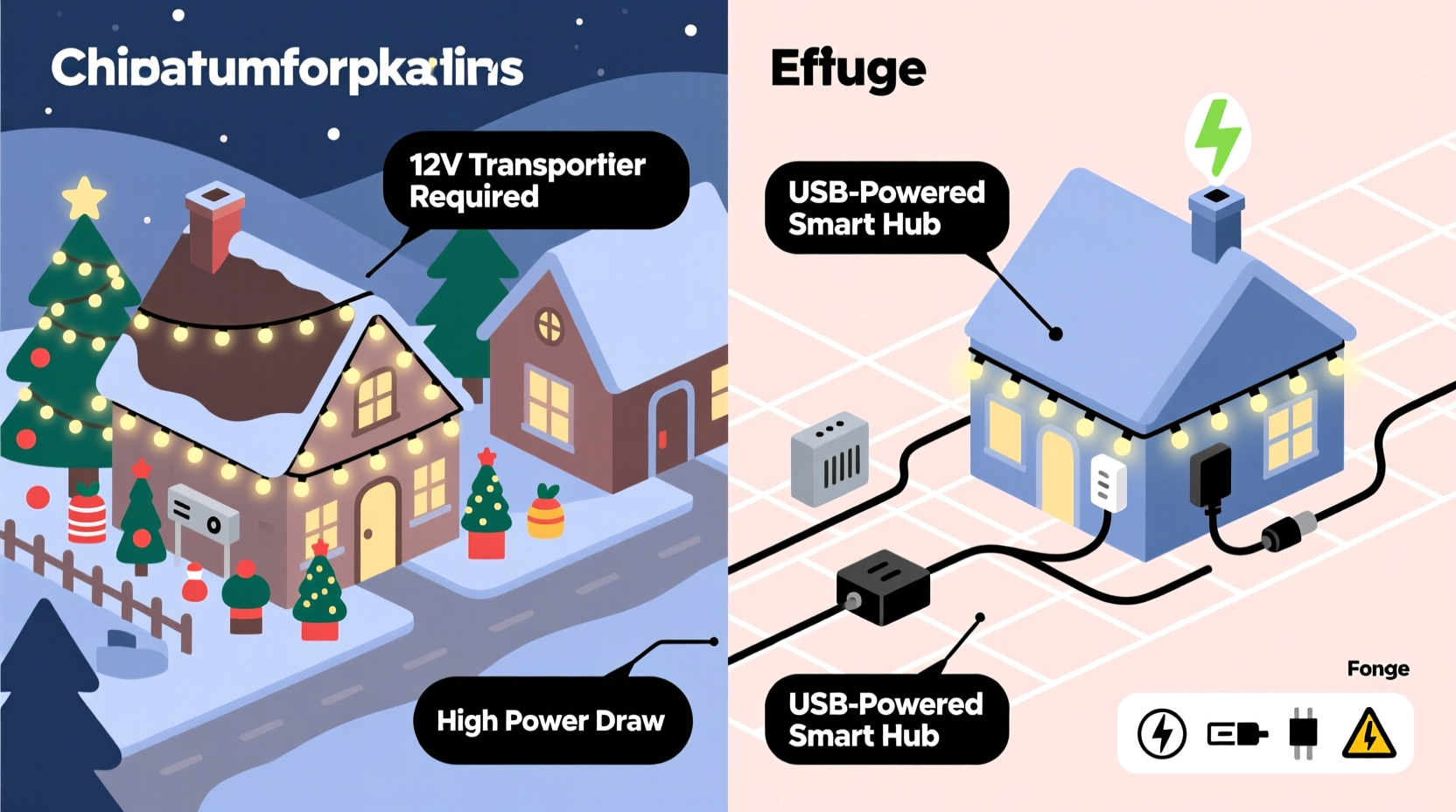
Most modern Christmas villages use 12V or 24V AC or DC LED lighting—far safer and more energy-efficient than standard 120V household current. But this lower voltage doesn’t appear magically. It must be *stepped down* from your home’s main circuit using a transformer (or power supply). Not all villages are created equal in their electrical demands. Entry-level sets often bundle a single, low-wattage transformer—typically 5–10 watts—with a handful of prewired buildings. These work fine for starter layouts: three houses, a stable, and a lamppost. But as collections grow, so does cumulative wattage draw. A single detailed cottage with fiber-optic snowfall, interior window LEDs, and flickering fireplace effects can consume 3–4 watts alone. Add a rotating carousel (2.5W), a working train loop (3W), and a lighted bridge (1.8W), and you’ve already exceeded the capacity of a 10W transformer—causing voltage drop, inconsistent brightness, and premature LED failure.
This is where “separate transformers” enter the picture—not as an arbitrary manufacturer upsell, but as an engineering necessity. Higher-end villages, especially those designed by brands like Department 56, Lemax, or National Tree Company’s premium lines, assume modularity and scalability. Their buildings feature standardized low-voltage inputs (often JST or barrel connectors) and are engineered to operate within specific voltage tolerances (±0.5V). A transformer rated at 30W or 60W doesn’t just deliver more power—it delivers *stable* power across longer cable runs and under variable load conditions. Without it, subtle voltage sag causes warm-white LEDs to shift toward yellow, flicker rates to destabilize, and microcontrollers in animated pieces to reset unexpectedly.
How Transformer Specifications Actually Matter
Not all transformers labeled “12V” are interchangeable. Voltage stability, output type (AC vs. DC), regulation quality, and thermal management determine whether your village glows—or grinds to a halt. Here’s what to inspect before plugging in:
| Specification | Why It Matters | What to Look For |
|---|---|---|
| Voltage Regulation | Poor regulation means voltage drops as load increases—dimming lights when you add a new building. | Look for “regulated” or “switching” power supplies (not unregulated “wall warts”). ±3% tolerance is ideal. |
| Output Type (AC/DC) | Some animated pieces (e.g., rotating Santas or waterfalls) require AC for motor compatibility; most LEDs prefer DC. Mismatch causes failure or noise. | Match the transformer output to your village’s requirements. Check building labels or manuals—many modern sets specify “12V DC” explicitly. |
| Connector Compatibility | Using adapters or forcing mismatched plugs stresses connections and creates intermittent contact. | Prefer transformers with the exact plug size (e.g., 2.1mm x 5.5mm barrel) and polarity (center-positive vs. center-negative) listed in your set’s documentation. |
| Thermal Design | Overheating transformers degrade faster and may shut down mid-season. | Choose models with aluminum heat sinks or passive cooling—not plastic-encased units buried under furniture. |
A common misconception is that “more watts = better.” While headroom is essential, oversizing excessively introduces inefficiency and unnecessary heat. As a rule of thumb: calculate total wattage of *all active elements*, then add 25% buffer. For example: 7 buildings × avg. 2.2W = 15.4W → round up to a 20W regulated transformer. For mixed-use displays (village + tree + garland), consider a multi-output transformer with isolated channels—so a short in one building won’t kill the entire layout.
Step-by-Step: Building a Cord-Managed Village Layout
Cord clutter undermines the magic of a Christmas village. What should feel like a serene alpine hamlet ends up looking like a utility closet. Avoid that fate with this field-tested sequence—designed for both aesthetics and electrical integrity:
- Map Your Power Zones First: Sketch your display area. Group buildings by proximity and function (e.g., “Main Street cluster,” “North Pole annex”). Assign one transformer per zone—never stretch one transformer’s cord across 8 feet of floor to reach a distant cottage.
- Measure & Cut Cords to Exact Length: Use stranded 18 AWG low-voltage wire (rated for in-wall use if routing behind baseboards). Pre-cut lengths—adding only 6 inches beyond needed reach. Avoid coiled excess; it generates heat and inductance.
- Route Under, Not Over: Run wires beneath furniture skirts, inside hollow shelving supports, or along baseboard raceways. Secure with painter’s tape or low-profile adhesive clips—not staples or nails near conductors.
- Use Junction Boxes for Clean Splits: Instead of twisting wires together with electrical tape, install a UL-listed low-voltage junction box. Connect incoming transformer output to screw terminals, then branch to individual buildings with color-coded wires (red = hot, black = neutral).
- Label Everything Relentlessly: Tag each cord end with masking tape and a fine-tip marker: “T1-CHAPEL,” “T2-TRAIN LOOP.” When troubleshooting a dark building in December, 10 seconds of labeling saves 20 minutes of guesswork.
Real-World Example: The Overloaded Mantel Incident
When Sarah R., a librarian and 12-year village collector in Portland, OR, added her seventh Lemax “Winter Wonderland” building to her marble mantel, the entire display blinked out every time she turned on the animated ice-skating rink. She’d replaced the original 10W transformer twice, assuming burnout. An electrician friend visited and measured voltage at the rink’s input: 8.3V—well below the required 12V DC. He traced the issue not to the transformer, but to the 14-foot extension cord Sarah had used to reach an outlet behind her sofa—a thin-gauge, unshielded cord causing 3.7V drop over distance. He replaced it with a single 10-foot run of 16 AWG stranded copper wire, installed a dedicated 30W regulated transformer mounted discreetly inside a hollow shelf cavity, and added a small magnetic cable organizer to hold spare connectors. Result? Zero flicker, consistent color temperature across all 11 buildings, and no more tripping over cords during holiday gatherings. “It wasn’t about buying ‘better’ stuff,” she notes. “It was about matching the infrastructure to the intention.”
Expert Insight: Safety, Stability, and Scalability
“Holiday lighting failures almost never stem from the lights themselves—they’re 90% rooted in undersized transformers, improper wire gauge, or thermal buildup in confined spaces. A transformer isn’t just a power source; it’s the heart of your village’s nervous system. Treat it with the same respect you give your furnace or Wi-Fi router.” — Rafael Mendez, Certified Residential Electrician & Holiday Lighting Consultant, NFPA Member since 2008
Mendez emphasizes that UL 2108 certification isn’t optional—it’s non-negotiable. Many budget transformers skip this testing, risking overheating or short circuits when operated continuously for weeks. He also warns against “voltage stacking”: connecting two 12V transformers in series hoping for 24V. This violates isolation standards and can backfeed dangerous voltages into other circuits. Always use purpose-built multi-output supplies if powering mixed-voltage elements.
FAQ: Troubleshooting Common Village Power Issues
Can I plug multiple village transformers into one surge protector?
Yes—but only if the surge protector is rated for continuous load (look for “UL 1449” and “600+ joules”) and the total amperage stays below 80% of the circuit’s capacity. A standard 15-amp circuit supports ~1,800 watts max. Three 30W transformers draw ~0.75A combined—well within limits. But add a 1,200W space heater? You’ve crossed into trip territory.
Why do some buildings work fine alone but dim when grouped—even with a “big” transformer?
Dimming under load points to either inadequate wire gauge (causing resistance-based voltage drop) or shared ground paths creating ground loops. Upgrade to 16 AWG wire for runs over 6 feet, and ensure all transformers share a single, robust grounding point—not separate outlets with varying ground potentials.
Is it safe to hide transformers inside decorative boxes or under fabric?
No. Transformers generate heat. Enclosing them—even in breathable fabric—traps thermal energy, accelerating capacitor degradation and increasing fire risk. Always mount them in open-air locations with ≥2 inches of clearance on all sides. If concealment is essential, use ventilated wooden enclosures with passive airflow slots, never sealed plastic or cardboard.
Do’s and Don’ts of Village Power Management
- DO test voltage at the farthest building with a multimeter before final installation—aim for 11.5–12.5V DC (or as specified).
- DO use polarized connectors with locking mechanisms (e.g., Molex Micro-Fit) instead of friction-fit barrel jacks.
- DO install a GFCI-protected outlet for any transformer placed on carpet, near moisture, or within 6 feet of a sink or humidifier.
- DON’T use phone or Ethernet cables for power—they lack proper insulation rating and conductor thickness.
- DON’T ignore buzzing sounds from transformers. That’s often coil vibration from unstable input voltage or failing regulation—replace immediately.
- DON’T assume “water-resistant” village buildings mean their power inputs are waterproof. All low-voltage connections remain vulnerable to condensation and spills.
Conclusion
A Christmas village is more than decoration—it’s narrative architecture. Each building tells a story of warmth, tradition, and quiet joy. But stories collapse when the lights falter, when cords snake like caution tape across cherished hardwood, or when the hum of an overloaded transformer drowns out carols playing softly in the background. Understanding why separate transformers aren’t a luxury but a requirement—and committing to disciplined, thoughtful cord management—transforms your display from fragile novelty to enduring heirloom. It’s the difference between a setup you dread powering up and one you look forward to lighting each year with confidence and calm. You don’t need an electrician’s license to get it right. You need awareness, measurement, and respect for the physics humming beneath the snow-dusted rooftops. So this season, pause before plugging in. Check that voltage. Measure that run. Label that cord. Build not just a village—but a legacy of light, safely and serenely sustained.




 浙公网安备
33010002000092号
浙公网安备
33010002000092号 浙B2-20120091-4
Comments
No comments yet. Why don't you start the discussion?