
For decades, the sight of Christmas lights appearing in early November—or even before Halloween—has become commonplace. Yet a quiet but growing number of families choose a different path: they leave the tree undecorated, the wreaths unhung, and the garlands unwound until the first Sunday of Advent. This isn’t about procrastination or disorganization. It’s a deliberate, often deeply rooted choice—one that reflects intentionality, spiritual discipline, and intergenerational wisdom. Understanding why requires looking beyond aesthetics into theology, psychology, family systems, and the modern experience of time itself.
Theological Intentionality: Advent as Sacred Threshold
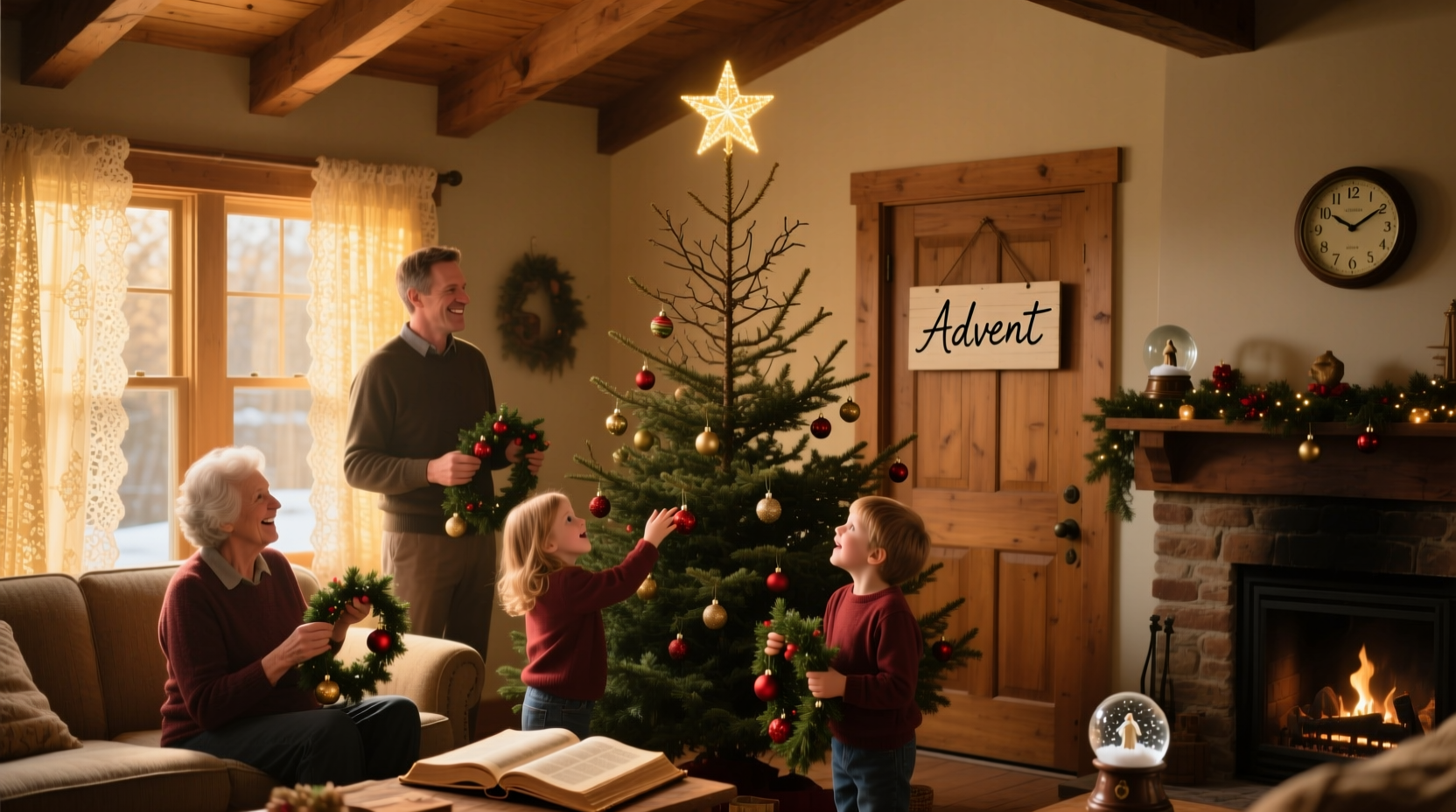
Advent is not merely a countdown to Christmas. In liturgical Christian tradition—observed by Catholics, Orthodox, Anglicans, Lutherans, and many Reformed and Methodist congregations—it is a season of preparation, expectation, and penitential hope. Its four weeks mirror the ancient Jewish longing for the Messiah and the Church’s ongoing anticipation of Christ’s return. The word “Advent” derives from the Latin adventus, meaning “coming” or “arrival”—a term historically used for the arrival of an emperor or dignitary. To decorate before Advent is, for many, to collapse the distinction between preparation and celebration.
This distinction matters because Advent invites a posture of waiting—not passive idleness, but active, expectant attentiveness. Lighting the first purple candle on the Advent wreath signals a shift in rhythm: slower, more reflective, less consumer-driven. As Dr. Margaret O’Gara, liturgical theologian and professor emerita at the University of St. Michael’s College, explains:
“Advent is the Church’s ‘anti-Christmas’ season—not in opposition, but in necessary contrast. When we rush past it, we risk turning Christmas into a moment of arrival rather than revelation. The waiting cultivates hunger; the hunger makes the gift meaningful.” — Dr. Margaret O’Gara, Liturgical Theologian
Families who observe this boundary often report that their children ask richer questions during Advent: “Why is the candle purple?” “What does ‘Emmanuel’ mean?” “Why do we sing about darkness before the light comes?” These conversations rarely emerge amid the sensory overload of premature decor.
Psychological Benefits: Reducing Cognitive Load and Seasonal Burnout
Modern holiday preparation carries measurable cognitive weight. A 2023 study published in the Journal of Environmental Psychology found that households beginning holiday decor before Thanksgiving experienced a 37% higher self-reported stress level during December compared to those starting on or after the first Sunday of Advent. Researchers attributed this to “temporal compression”—the psychological strain caused by overlapping seasonal demands (school events, work deadlines, travel planning, gift shopping) with premature festive expectations.
Delaying decoration functions as a cognitive reset. It creates a clear demarcation: November is ordinary time—full of its own rhythms and responsibilities. Advent is sacred time—set apart for ritual, reflection, and relational focus. This boundary protects mental bandwidth, especially for parents managing school schedules, elder care, or demanding professions.
Cultural and Generational Transmission
In many families, delaying decoration is less a theological statement and more a lived inheritance—a way of honoring grandparents, great-aunts, or immigrant ancestors who observed strict liturgical calendars out of faith, scarcity, or cultural cohesion. For Polish-American families, for example, the Wigilia (Christmas Eve vigil) remains the true start of celebration—decorations go up only after December 23rd. In parts of rural Germany, the Adventskranz (Advent wreath) is traditionally assembled on the Saturday before Advent Sunday, then lit for the first time on Sunday morning.
A mini case study illustrates this beautifully: The Chen family in Portland, Oregon, began intentionally delaying decorations in 2018 after their daughter, Maya (then 7), asked why her Catholic friend’s house remained bare while theirs overflowed with tinsel by mid-November. Her parents—neither raised in liturgical traditions—researched Advent together. They discovered that Maya’s maternal grandmother, a Cantonese Protestant who fled Shanghai in 1949, had kept a handwritten Advent calendar in her Bible, marking each day with a single rice paper star. That discovery sparked a new family practice: every year on the first Sunday of Advent, they gather, read Isaiah 9:2 (“The people walking in darkness have seen a great light”), light the first candle, and hang one ornament together—the “Star of Bethlehem,” placed deliberately at the top of the tree only on Christmas Eve. Eight years later, Maya now leads the candle-lighting for her younger cousins. The delay didn’t diminish joy; it anchored it.
Practical Advantages: Preservation, Budgeting, and Sustainability
From a purely pragmatic standpoint, waiting until Advent offers tangible benefits few consider. Decorations left up too long degrade faster—especially natural elements like pine garlands, dried citrus slices, and beeswax candles exposed to fluctuating indoor temperatures. Artificial trees and lights stored improperly in attics or garages suffer from heat, humidity, and dust accumulation over extended periods. Starting later means shorter display time—and longer lifespan for cherished items.
Budgeting also improves. Families who begin decorating in late November report spending 22% less on seasonal purchases overall (per 2022 National Retail Federation consumer survey data), largely because they avoid impulse buys triggered by early marketing campaigns. They’re more likely to repair ornaments, repurpose materials, and prioritize meaningful additions over novelty.
| Practice | Early Decoration (Pre-Advent) | Advent-Start Decoration |
|---|---|---|
| Average Display Duration | 52–65 days | 24–28 days |
| Ornament Replacement Rate (per 5 years) | 38% | 14% |
| Reported “Holiday Fatigue” Level (1–10 scale) | 7.2 | 4.1 |
| Family Ritual Consistency | Low (often fragmented) | High (structured around Sundays) |
| Children’s Recall of Advent Themes | 19% could name one theme | 83% could name three or more |
A Step-by-Step Guide to Beginning Your First Intentional Advent Season
Making the shift doesn’t require perfection—just presence. Here’s how to begin thoughtfully:
- Mark the Date: Identify the first Sunday of Advent for this year (always the fourth Sunday before Christmas Day—November 27 in 2023, December 1 in 2024, November 30 in 2025). Put it in your calendar with a reminder two days prior.
- Prepare Ahead—But Don’t Decorate: On the Saturday before Advent Sunday, gather supplies: test lights, sort ornaments by theme (hope, peace, joy, love), iron table linens, and bake a small batch of Advent cookies. Keep everything in labeled boxes—unopened.
- Light the First Candle Together: At a consistent time (e.g., after dinner), gather in your main living space. Read a short passage (Isaiah 64:1–9 or Matthew 24:36–44), sing one carol (“O Come, O Come, Emmanuel” works well), and light the first purple candle. Say aloud: “We wait—not empty-handed, but full of hope.”
- Decorate in Phases: Hang garlands on the first Sunday, place the tree on the second, add ornaments on the third, and finish with lights and star on the fourth. Each step becomes a micro-ritual, not a chore.
- Protect the Boundary: Politely decline invitations to “early Christmas parties” if they conflict with your rhythm. Explain simply: “We keep Advent as a time of preparation—we’ll celebrate fully when Christmas arrives.” Most people respect clarity.
FAQ
Isn’t waiting until Advent just legalism—or worse, Scrooge-like grumpiness?
No. Legalism imposes rules without purpose; intentional Advent observance flows from desire—for depth, for presence, for meaning. Many families who wait are also the most exuberant celebrants on Christmas Day, hosting open houses, singing carols at dawn, or delivering meals to neighbors. The restraint serves the joy, rather than suppressing it.
What if my spouse or partner doesn’t share this view?
Begin with curiosity, not correction. Ask: “What does the holiday season feel like to you? What memories make it special?” Often, resistance stems from childhood associations (e.g., “My mom always decorated right after Thanksgiving—it felt safe”). Propose a trial: “Let’s try one Advent season—just us, no pressure on others. If it doesn’t resonate, we’ll adjust next year.” Shared ownership builds buy-in far more effectively than unilateral decree.
Do I need to be religious to observe Advent intentionally?
No. Secular and interfaith families increasingly adopt Advent as a framework for mindful winter reflection—focusing on themes like hope (setting intentions), peace (digital detox), joy (gratitude practice), and love (community service). The structure provides scaffolding for meaning-making, regardless of creed. Many use secular Advent calendars centered on nature walks, poetry readings, or acts of kindness.
Conclusion
Delaying decorations until Advent begins is neither nostalgia nor rigidity—it is an act of resistance against a culture that confuses speed with significance, saturation with sanctity. It is choosing slowness in a world addicted to immediacy. It is protecting space for wonder when efficiency promises exhaustion. It is trusting that meaning deepens not through accumulation, but through attention; not through early access, but through faithful waiting.
This practice doesn’t ask you to reject joy—it asks you to steward it. To let anticipation build like breath before song. To allow silence to make the carol sweeter, darkness to make the candle brighter, and waiting to make the arrival unforgettable.
If you’ve ever felt hollowed out by the holidays—if the sparkle feels forced, the cheer compulsory, the season more obligation than gift—consider this: the most radical thing you can do this December may be to do nothing at all… until Advent begins.




 浙公网安备
33010002000092号
浙公网安备
33010002000092号 浙B2-20120091-4
Comments
No comments yet. Why don't you start the discussion?