
Each December, entire neighborhoods transform into immersive spectacles: driveways pulse with choreographed rhythms, rooftops shimmer in time to holiday classics, and garage doors open not to cars—but to control rooms humming with Raspberry Pis, DMX controllers, and custom-coded sequences. These aren’t just “pretty lights.” They’re meticulously engineered experiences—sometimes spanning 20,000+ LEDs, synced to music down to the millisecond, drawing thousands of visitors over a single season. What drives someone to spend $5,000–$15,000, 300+ hours, and months of planning—not for profit, but for pure communal joy? The answer lies at the intersection of human psychology, evolving technology, neighborhood identity, and a deep-seated desire to create meaning through shared ritual.
The Rise of the Residential Light Show as Cultural Phenomenon
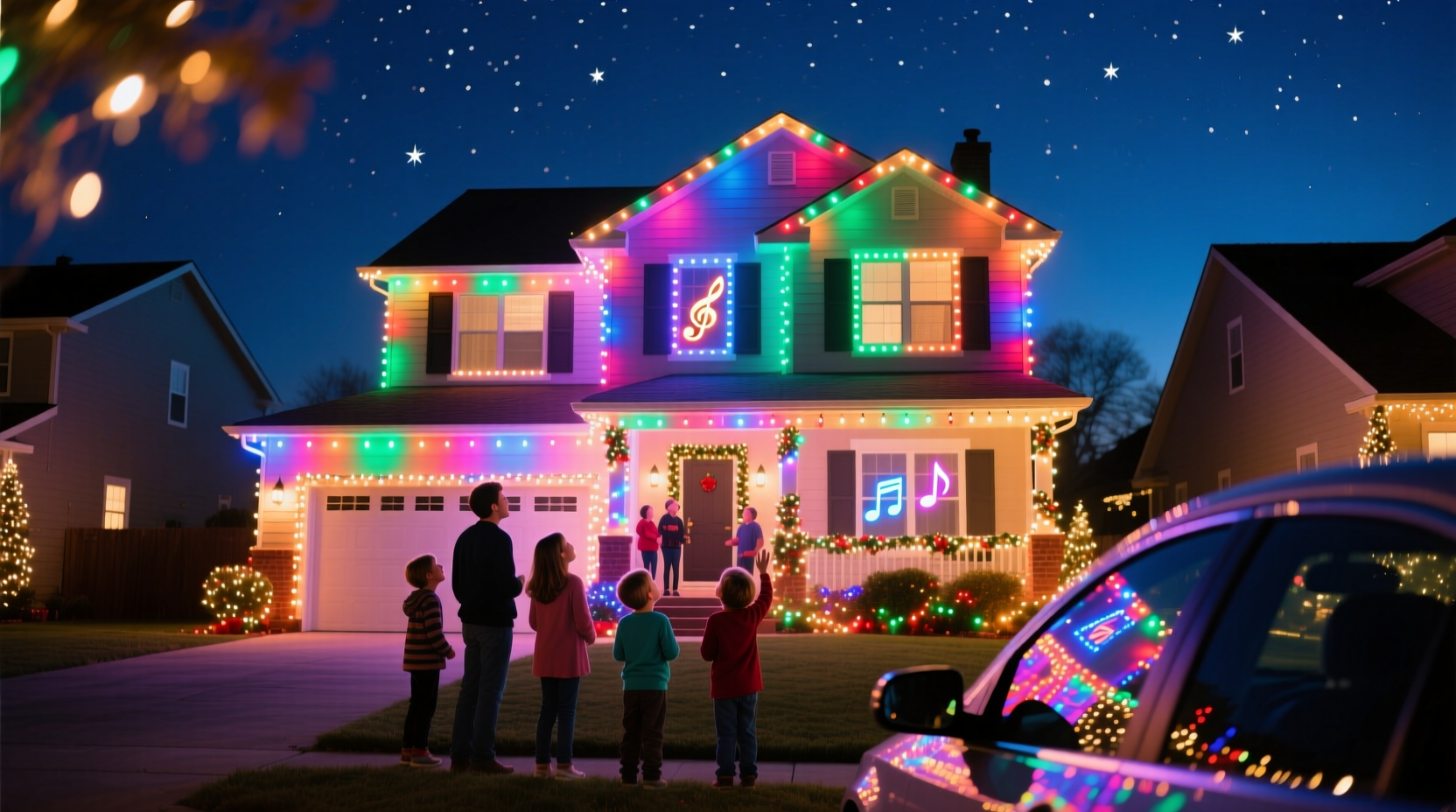
Synchronized residential light displays didn’t emerge overnight. They evolved from modest string-light traditions through distinct technological inflection points. In the 1990s, basic timer-based sequencing (think “on-off-on-off” every 30 seconds) was novel. The early 2000s brought affordable RGB LED strings and rudimentary PC-based software like Light-O-Rama, enabling simple musical timing. But the real acceleration began post-2012: Raspberry Pi microcomputers dropped in price and rose in reliability; open-source firmware like xLights matured; and affordable, weatherproof smart pixels (WS2811/WS2812B) made pixel-perfect control accessible. Suddenly, a hobbyist with electrical know-how and patience could rival professional installations.
This shift coincided with broader cultural trends: the DIY renaissance, the maker movement’s emphasis on hands-on creation, and social media’s hunger for shareable, visually rich moments. A well-timed TikTok clip of a house “dancing” to “Carol of the Bells” can rack up half a million views—turning a private passion project into public celebration. According to the National Retail Federation, U.S. holiday lighting spending hit $2.2 billion in 2023—a figure that includes not just bulbs, but controllers, power supplies, mounting hardware, and software subscriptions. This isn’t nostalgia; it’s participatory artistry scaled to the suburban front yard.
Psychological Drivers: More Than Just Festive Flair
At first glance, extreme light shows appear driven by competition or ego. But interviews with dozens of dedicated display creators reveal more nuanced motivations. Many describe a profound sense of flow—a psychological state where time distorts, focus narrows, and effort feels intrinsically rewarding. Programming a 4-minute sequence for 1,200 lights involves solving hundreds of micro-problems: voltage drop across long runs, timing latency between controller zones, wind-load calculations for arches, and audio waveform analysis to match light intensity to bass hits. For engineers, teachers, nurses, and accountants alike, this is cognitive play—a structured, tangible escape from abstract daily demands.
Equally powerful is the drive toward legacy and intergenerational connection. One creator in Portland, Oregon, began his display after his daughter was diagnosed with a rare genetic disorder. “The first year, we lit up just our porch. She’d sit wrapped in blankets, watching the lights blink while her IV pump hummed,” he shared. “Now she helps pick songs. She’s 12, and she codes simple chase effects on our spare controller. This isn’t about impressing neighbors—it’s how we mark time, measure healing, and build something beautiful together.”
“Synchronized displays are often the most visible form of civic care in low-density neighborhoods. They say: ‘I see you. I’m here. Let’s share wonder.’ That’s emotional infrastructure.” — Dr. Lena Torres, Cultural Anthropologist, University of Michigan
Community Impact: From Curiosity to Collective Identity
When a single home launches a high-fidelity light show, ripple effects extend far beyond its property line. Local schools reroute bus routes to accommodate traffic. Restaurants report 30–40% higher December sales on “light show nights.” Neighborhood associations formalize viewing guidelines—designating parking zones, coordinating trash pickup, even launching volunteer “light ambassadors” to direct pedestrians safely.
More significantly, these displays catalyze unexpected social cohesion. In Aurora, Illinois, the “Maple Street Lights Collective” began when three adjacent homeowners—none previously acquainted—realized their individual shows interfered with each other’s audio. Instead of competing, they formed a Slack channel, pooled resources, and now run a unified 27-house synchronized network. Their annual “Neighborhood Night” draws 2,000+ attendees, features local food trucks, and funds a college scholarship for graduating seniors. As one resident noted, “Before the lights, we waved. Now we troubleshoot power surges together. We know who fixes gutters, who bakes sourdough, who’ll watch your dog. The lights didn’t create community—they revealed it.”
Practical Realities: Cost, Time, and Technical Commitment
Going “all out” isn’t glamorous behind the scenes. It demands serious logistical discipline. Below is a realistic breakdown for a mid-tier residential show (approx. 8,000–12,000 lights, 4–5 minute musical sequence, 5 zones):
| Category | Typical Investment | Key Considerations |
|---|---|---|
| Hardware | $2,800–$5,200 | Includes controllers (3–5), power supplies (8–12), pixel strings (150–250m), extension cords (100+ ft rated for outdoor use), mounting hardware (U-bolts, conduit straps, gutter clips), and surge protection. |
| Software & Licensing | $0–$300 | Open-source xLights is free; premium add-ons (e.g., Beat Detection Pro, advanced visualizers) cost $50–$150/year. Commercial show design services start at $1,500/show. |
| Electricity | $120–$220 (seasonal) | Based on 12 hrs/day @ 1.8 kW average draw. Most displays use 80–90% LED efficiency vs. incandescent, but scale multiplies consumption. |
| Time Commitment | 250–400 hours | Includes design (60–100 hrs), programming (100–150 hrs), physical installation (70–100 hrs), testing/troubleshooting (20–50 hrs). |
| Maintenance | 15–20 hrs pre-season | Testing every pixel, replacing failed nodes, updating firmware, recalibrating audio sync, checking weather seals. |
Crucially, success hinges less on budget than on iterative learning. Top creators emphasize documentation: labeling every circuit, photographing wire runs before closing enclosures, maintaining version-controlled backups of show files. “My biggest failure wasn’t a burnt-out controller—it was losing a week’s programming because I forgot to commit to Git,” admitted a veteran designer in Austin. “Treat your light show like critical infrastructure. Document like your sanity depends on it—because eventually, it will.”
A Mini Case Study: The Henderson Family, Boise, ID
In 2018, Mark Henderson, a retired electrical engineer, installed 300 warm-white C9 bulbs on his roofline—timed to a simple 30-second loop. His wife, Priya, a pediatric occupational therapist, suggested adding motion sensors so lights pulsed when kids walked up the driveway. By 2021, they’d upgraded to addressable pixels and added a 12-foot animated snowman that winked on cue.
The turning point came in December 2022. A local news segment featured their display, highlighting how Priya adapted sequences for children with sensory processing differences—slowing transitions, eliminating strobes, offering “calm mode” (soft blue gradients only). Overnight, families drove from three counties away. The Hendersons responded by installing a heated waiting area with hot cocoa, creating quiet viewing zones, and publishing a sensory map online (“low-stimulus path,” “high-energy zone”).
Today, their “Henderson Holiday Hub” runs 42 days annually, employs two part-time teens for crowd management, partners with a local autism advocacy group for inclusive design workshops, and donates 100% of voluntary donation proceeds ($18,400 in 2023) to adaptive recreation programs. “We didn’t set out to build a nonprofit,” Mark says. “We built a light show. Then people showed us what it could become.”
Getting Started: A Realistic 6-Month Timeline
Launching a synchronized display requires foresight—not just holiday spirit. Here’s how seasoned creators structure their year:
- January–February: Audit last season’s footage. Note technical failures (e.g., “Zone 3 flickered during rain”), audience feedback (“too loud,” “loved the reindeer animation”), and maintenance pain points. Back up all show files and controller configurations.
- March–April: Research new hardware. Compare controller specs (channel count, pixel density support, weather rating). Order replacements *now*—supply chain delays peak August–October. Sketch layout improvements using free tools like Pixel Editor or LightShow Pro’s trial version.
- May–June: Build and test one new element—e.g., a 10-foot arch with new pixel type. Program a 60-second sequence. Stress-test for heat, moisture, and signal integrity. Document every step.
- July–August: Finalize music selection (ensure licensing compliance for public playback). Import audio into xLights. Generate initial beat grid. Begin channel mapping for new elements.
- September–October: Install all hardware. Label every wire, conduit, and controller port. Perform full-system power test. Refine timing maps. Record voiceover announcements if used.
- November: Integrate final sequences. Conduct neighbor walkthroughs to adjust volume/light spill. Train volunteers. Publish viewing guidelines and accessibility notes online.
FAQ: Addressing Common Concerns
Do synchronized light shows increase my homeowner’s insurance premium?
Not inherently—but insurers may require documentation if you exceed standard residential electrical loads. Most displays under 3,000 watts pose no issue. Above that, provide an electrician’s letter confirming proper grounding, GFCI protection, and circuit load calculations. Some insurers offer discounts for documented safety upgrades (e.g., whole-house surge protection).
Can I use my existing Christmas lights?
Standard incandescent or non-addressable LED strings cannot be synchronized to music—they lack per-bulb control. However, many creators repurpose them as static “backdrop” lighting (e.g., roofline borders, tree outlines) while using smart pixels for dynamic zones. Always verify voltage compatibility before mixing systems.
How do I handle negative neighbor feedback?
Proactive communication prevents 90% of issues. Share your plans *before* installation: deliver printed timelines, decibel estimates, and viewing hours. Offer to adjust brightness or audio directionality. Provide contact info for concerns. Most objections stem from uncertainty—not opposition. When handled with empathy, feedback often becomes collaboration (e.g., “Can we coordinate our start times?”).
Conclusion: Beyond the Blink—Why This Matters
Synchronized light shows are rarely about spectacle alone. They’re acts of quiet resistance against fragmentation—against the algorithmic isolation of digital life, against the transactional nature of modern neighborhoods, against the notion that creativity belongs only in studios or galleries. They represent investment: in patience, in craft, in shared attention. They turn electricity into empathy, code into comfort, and December darkness into deliberate, collective light.
You don’t need 10,000 pixels to participate in this tradition. You need curiosity, respect for your neighbors’ experience, and willingness to start small—then learn, adapt, and share what you discover. Whether you program your first chase effect this year or simply pause to watch a neighbor’s snowflake sequence with genuine appreciation, you’re engaging in something ancient and vital: the human impulse to mark time with beauty, to say, “I am here, and I made this—for us.”




 浙公网安备
33010002000092号
浙公网安备
33010002000092号 浙B2-20120091-4
Comments
No comments yet. Why don't you start the discussion?