
Every holiday season, thousands of homeowners report a puzzling phenomenon: their AM radio suddenly fills with buzzing static, their weather band receiver crackles during critical alerts, or their amateur radio transmissions become unintelligible—just as they plug in a new string of LED Christmas lights. This isn’t coincidence or faulty wiring alone. It’s radio frequency (RF) interference caused by poorly designed or uncertified LED lighting. Unlike incandescent bulbs—which operate on simple resistive heating—LED strings rely on electronic switching power supplies that, when inadequately filtered, emit electromagnetic noise across a broad spectrum. That noise doesn’t stay confined to the light string. It radiates through power lines and air, coupling directly into nearby antennas, audio cables, and even the internal circuitry of sensitive receivers. Understanding *why* this occurs—and how to isolate and resolve it—is essential for anyone relying on clear radio communication, whether for weather safety, hobbyist operation, or daily listening.
Why LED Christmas Lights Generate Radio Frequency Interference
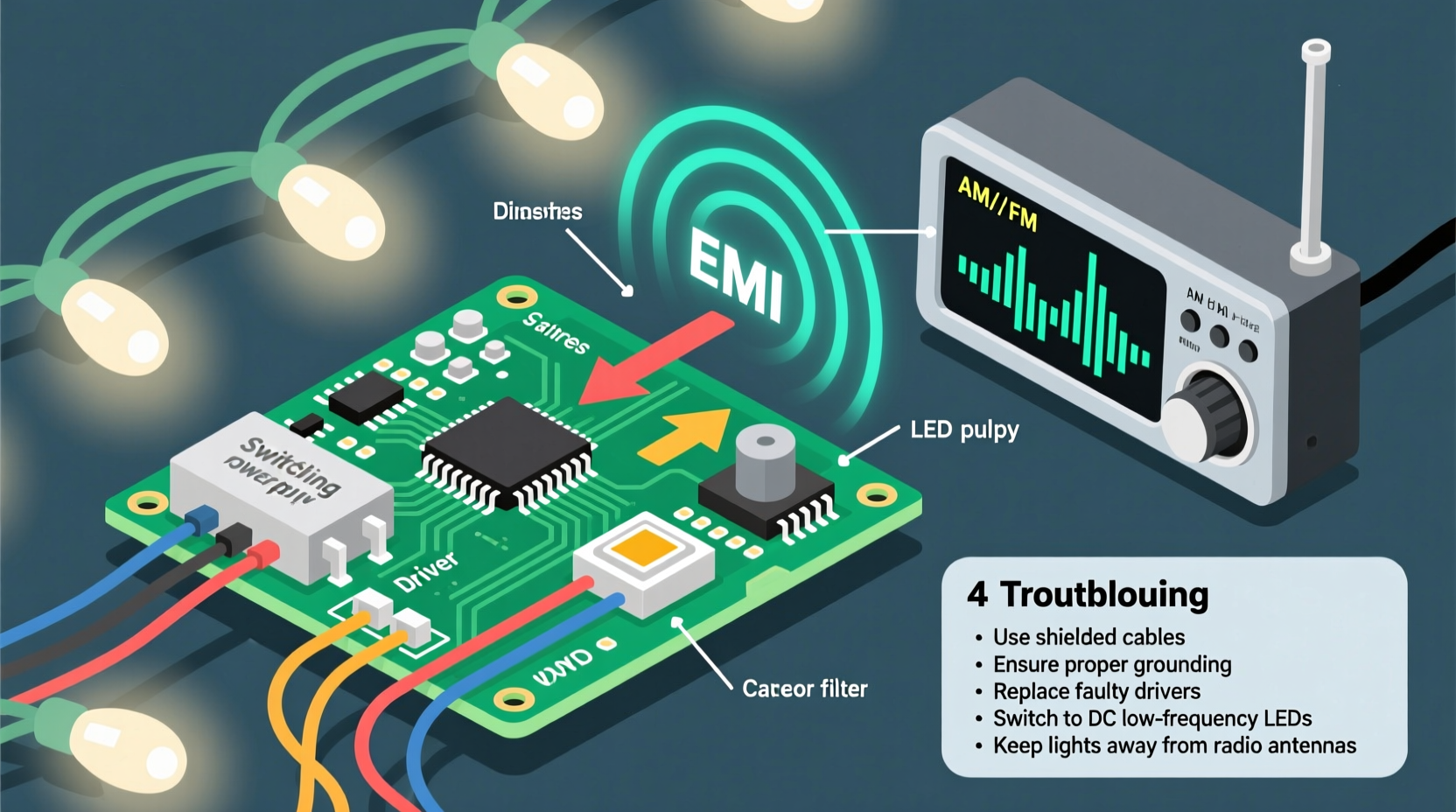
The root cause lies in the fundamental shift from thermal to electronic illumination. Incandescent lights draw smooth, sinusoidal AC current. LED strings, however, require low-voltage DC. To achieve this, nearly all modern LED light sets incorporate miniature switch-mode power supplies (SMPS) or “driver circuits” built into the plug or inline controller. These drivers rapidly switch current on and off—typically at frequencies between 20 kHz and 1 MHz—to step down and regulate voltage. Each switching event creates sharp-edged voltage transients, rich in high-frequency harmonics. When these transients lack proper suppression—such as ferrite chokes, X/Y capacitors, or common-mode filters—they travel back along the power cord like an unintentional antenna, radiating broadband noise from 500 kHz up to 100+ MHz. This energy overlaps heavily with the AM broadcast band (530–1710 kHz), shortwave, aviation VHF (118–137 MHz), and public safety frequencies (e.g., NOAA Weather Radio at 162.4–162.55 MHz).
Crucially, not all LED lights behave the same way. Cheap, non-certified sets—especially those imported without FCC Part 15 compliance testing—are most likely to emit excessive RF. In contrast, UL-listed, FCC-compliant lights undergo rigorous conducted and radiated emissions testing. But compliance doesn’t guarantee immunity: aging components, damaged insulation, or poor grounding in your home’s electrical system can turn even certified lights into intermittent noise sources.
Step-by-Step Troubleshooting Workflow
Effective diagnosis requires methodical elimination—not guesswork. Follow this sequence to identify, confirm, and resolve the source:
- Isolate the suspect string: Turn off all other electronics. Power on one LED string at a time while monitoring your radio on a quiet frequency (e.g., 700 kHz AM). Note which string triggers noise.
- Test location dependency: Plug the problematic string into a different outlet—preferably on another circuit or even a battery-powered inverter. If noise persists, radiation is likely; if it stops, the issue may be coupling via your home’s wiring.
- Check for dimmer or controller interaction: Remove any smart controllers, timers, or dimmers from the circuit. Many use phase-cutting techniques that generate additional harmonics.
- Inspect physical condition: Look for cracked casings, exposed wires, moisture intrusion, or corroded connectors. Even minor damage compromises shielding and filtering.
- Verify grounding integrity: Use a receptacle tester to confirm outlets are properly grounded. Ungrounded outlets allow common-mode noise to flow unimpeded into equipment grounds.
This process typically takes under 15 minutes and avoids unnecessary equipment replacement. Most interference issues are resolved at steps 1–3.
Do’s and Don’ts: Practical Mitigation Strategies
Once confirmed, apply targeted fixes—not blanket solutions. The table below summarizes evidence-based actions based on real-world RF engineering principles and FCC field reports:
| Action | Effectiveness | Notes |
|---|---|---|
| Install a snap-on ferrite choke (Type 31 or 43) on the light string’s power cord, within 2 inches of the plug | High (70–90% reduction) | Use 2–3 turns of the cord through the core. Avoid cheap ceramic beads—they’re ineffective below 30 MHz. |
| Plug lights into a dedicated, filtered AC power strip with EMI/RFI suppression | Moderate (40–60%) | Look for strips rated to suppress noise from 150 kHz–30 MHz. Not all “surge protectors” offer RF filtering. |
| Replace the entire string with FCC-ID certified lights (look for label on packaging) | High (near-complete elimination) | Verify FCC ID in the FCC OET database—don’t trust “FCC compliant” marketing text alone. |
| Wrap the driver housing in aluminum foil and ground it to a cold water pipe | Low–Unreliable | Risk of shock, fire hazard, and inconsistent results. Never recommended. |
| Add a line filter between outlet and string (e.g., Corcom 2000 series) | Very High (90%+) | Professional-grade solution. Requires basic wiring knowledge. Best for permanent installations. |
Real-World Case Study: A Ham Radio Operator’s Holiday Dilemma
In December 2022, Mark R., an ARRL-member amateur radio operator in rural Ohio, experienced severe degradation of his 40-meter HF band reception during evening hours. His 100W transceiver reported S9+20 noise floor—making weak-signal work impossible. He initially suspected power-line noise from a neighbor’s HVAC unit. After weeks of directional antenna sweeps and portable monitoring, he discovered the noise spiked precisely when his wife plugged in her new $12 LED snowflake garland. Using an RF current probe, he measured 42 dBµV of common-mode noise on the light cord at 7.15 MHz—the exact center of the 40m band. He added two Fair-Rite 0431164281 ferrite cores (Type 31) clamped around the cord near the plug, with three tight loops. Noise dropped to S3. He then upgraded to a Tripp Lite ISOBAR6ULTRA, which suppressed residual broadband hash. Within 48 hours, his noise floor returned to baseline. Crucially, he kept the original string—not as decoration, but as a reference for future troubleshooting. “It taught me that RF interference isn’t always ‘out there,’” he noted in a local club newsletter. “Sometimes it’s hanging on your mantel.”
Expert Insight: What Regulatory Standards Actually Require
FCC Part 15 Subpart B governs unintentional radiators—including LED lighting. But compliance thresholds are often misunderstood. As Dr. Lena Torres, Senior EMC Engineer at the National Institute of Standards and Technology (NIST), explains:
“The FCC limits for conducted emissions at 150 kHz–30 MHz are strict—but they’re measured under lab conditions with standardized LISNs (Line Impedance Stabilization Networks). Real homes have variable impedance, shared neutrals, and long branch circuits that amplify noise coupling. A light string passing FCC testing in a lab may still disrupt your radio at home. That’s why mitigation isn’t optional—it’s part of responsible deployment.” — Dr. Lena Torres, NIST Electromagnetic Compatibility Division
She emphasizes that FCC certification confirms *minimum* compliance—not immunity. And crucially, enforcement relies on consumer complaints: fewer than 12% of interference incidents are formally reported to the FCC, meaning many problematic products remain on shelves unchecked.
FAQ: Clearing Common Misconceptions
Can LED lights really affect digital TV or Wi-Fi?
Rarely—modern ATSC 3.0 and Wi-Fi 5/6 operate above 470 MHz and 2.4 GHz respectively, far beyond the typical harmonic reach of LED drivers. Interference is overwhelmingly concentrated in the MF/HF/VHF-Low bands (0.5–150 MHz). If you’re seeing Wi-Fi dropouts, the cause is more likely router overload, channel congestion, or physical obstructions—not your lights.
Does using LED lights on a GFCI outlet reduce interference?
No. GFCI outlets protect against ground faults (current imbalance), not electromagnetic noise. They provide zero RF filtering. In fact, some GFCIs contain internal switching circuits that can *add* noise if poorly designed—though this is uncommon in residential units.
Will replacing my home’s wiring solve this?
Almost never. Residential NM-B cable has no inherent RF shielding. The issue isn’t the wiring itself—it’s the noise *injected* onto it by the light string. Upgrading to shielded MC cable is expensive, overkill, and violates NEC unless installed for specific industrial purposes. Focus on suppressing the source instead.
Proven Prevention Checklist for Next Season
- ✅ Before purchase: Check for a visible FCC ID number on packaging (not just “FCC compliant”) and verify it in the FCC OET Equipment Authorization Search.
- ✅ At unboxing: Inspect the plug and controller housing for robust construction—no visible gaps, thin plastic, or missing labels.
- ✅ During setup: Install a ferrite choke on every LED string’s power cord before plugging in—even if no interference is apparent yet.
- ✅ For permanent displays: Use a dedicated, filtered power conditioner (e.g., Furman PL-8C) instead of daisy-chaining multiple strings to one outlet.
- ✅ Year-end maintenance: Store lights coiled loosely—not tightly wound—to avoid stressing internal wires and solder joints that degrade filtering over time.
Conclusion: Take Control—Not Just Cover Your Ears
Radio interference from LED Christmas lights isn’t a mysterious holiday curse—it’s a predictable, solvable engineering challenge. The buzz in your speaker isn’t a sign that technology has failed; it’s feedback from a system operating outside its design envelope. By understanding the physics behind switching noise, applying targeted suppression like ferrites and certified hardware, and adopting preventive habits before the first bulb glows, you reclaim control over your listening environment. Whether you monitor NOAA weather alerts for storm warnings, coordinate community response on GMRS, or simply enjoy jazz on your vintage tube radio, clean RF space matters. Don’t wait for next December’s static to remind you. Audit your current strings this week. Verify their certifications. Add that ferrite choke. Share what you learn with neighbors—especially those with medical alert radios or elderly relatives relying on weather broadcasts. Clarity isn’t seasonal. It’s a choice you make, one well-filtered cord at a time.




 浙公网安备
33010002000092号
浙公网安备
33010002000092号 浙B2-20120091-4
Comments
No comments yet. Why don't you start the discussion?