
LED lighting has transformed homes and businesses with its energy efficiency, longevity, and environmental benefits. But for all their advantages, some LED lights produce an unexpected annoyance: an audible buzzing or humming noise. This subtle sound can be irritating—especially in quiet spaces like bedrooms, home offices, or reading nooks. While not dangerous, persistent buzzing indicates inefficiency or incompatibility within your lighting system. Understanding the root causes and knowing how to fix them can restore peace and optimize performance.
The good news is that most LED buzzing is preventable or fixable. From incompatible dimmer switches to low-quality drivers, several factors contribute to this issue. By identifying the source and applying targeted solutions, you can eliminate the hum and enjoy the full benefits of modern LED technology.
Understanding Why LED Lights Buzz
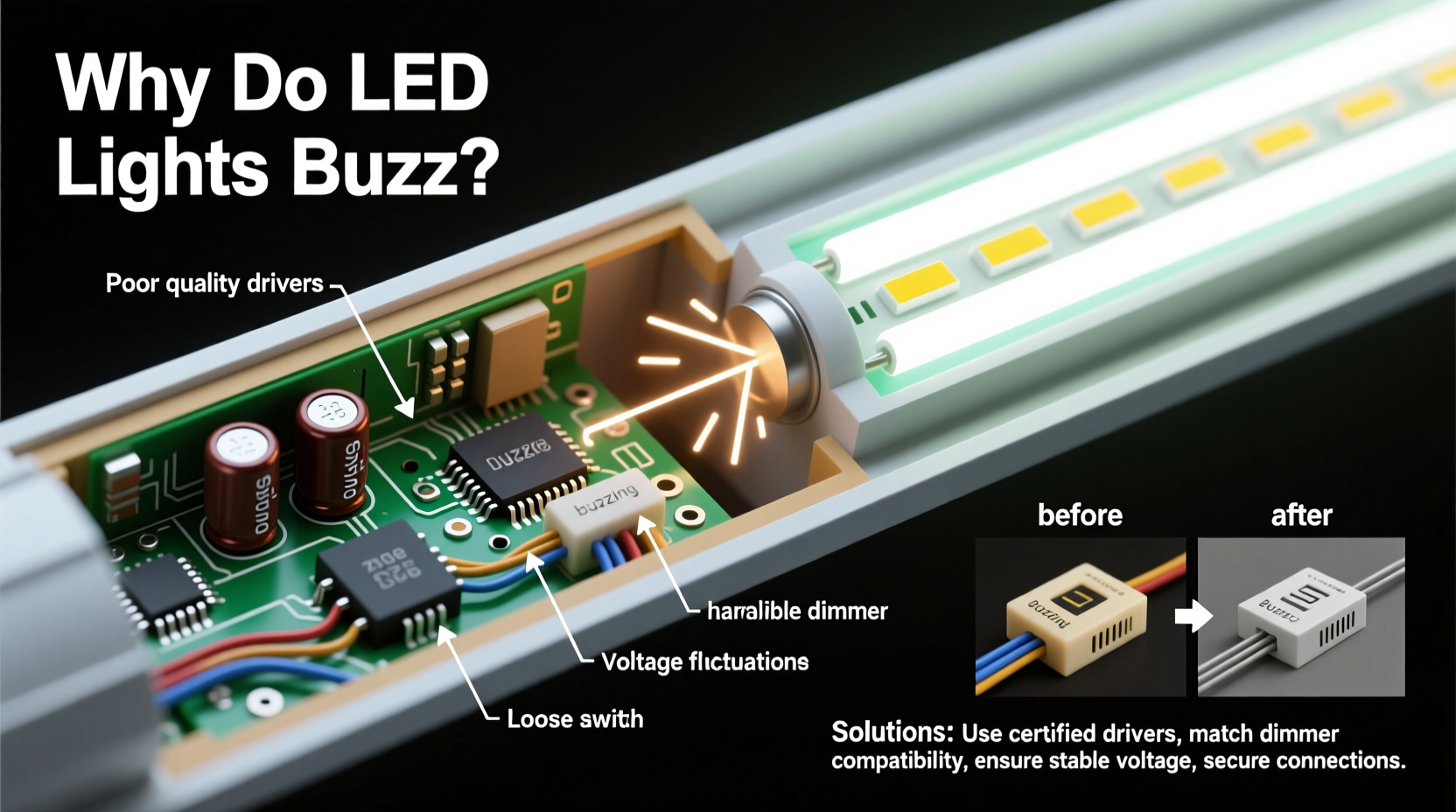
Unlike traditional incandescent bulbs, LEDs operate on direct current (DC) at low voltage. However, household electrical systems supply alternating current (AC) at higher voltages. To bridge this gap, LED bulbs and fixtures use internal or external components called drivers to convert AC to DC. The buzzing typically originates from these electronic parts, especially when they’re under stress or mismatched with other system components.
The most common cause of buzzing is electrical oscillation within the driver or dimmer switch. When current flows unevenly—often due to rapid switching in dimming circuits—it can cause physical vibrations in coils, capacitors, or transformers. These vibrations manifest as audible noise, usually a 50Hz or 60Hz hum depending on your region’s power frequency.
Other contributing factors include poor manufacturing quality, loose components, or electromagnetic interference. In rare cases, buzzing may signal a failing component that could pose a safety risk if left unattended.
“LED buzz is rarely a fire hazard, but it’s a symptom of inefficiency. Fixing it improves both comfort and energy performance.” — Dr. Alan Reyes, Electrical Systems Engineer, Smart Lighting Research Group
Common Causes of LED Buzzing and How to Diagnose Them
Before attempting fixes, pinpoint the source. Here are the top culprits behind buzzing LED lights:
- Incompatible dimmer switches: Traditional dimmers designed for incandescent bulbs often don’t work well with LEDs. They chop the AC waveform in a way that stresses LED drivers, causing vibration and noise.
- Low-quality LED drivers: Cheap or poorly designed drivers lack proper filtering and regulation, making them prone to oscillation and audible hum.
- Overloaded circuits: Connecting too many LEDs to one circuit or dimmer can exceed its capacity, leading to instability and buzzing.
- Poor fixture design: Enclosed or poorly ventilated fixtures trap heat, which degrades driver components and increases noise over time.
- Loose wiring or connections: Vibrations from fluctuating current can amplify if wires aren’t tightly secured, creating mechanical buzzing.
- Electrical interference: Nearby motors, transformers, or appliances can induce current fluctuations in lighting circuits.
How to Test for the Source
Start by swapping the bulb. If the buzz disappears with a different LED, the original bulb likely has a faulty or low-grade driver. Next, check if the noise occurs only when dimmed. If yes, the dimmer switch is the prime suspect. Try setting the dimmer to full brightness—if the buzz stops, compatibility is the issue.
If multiple lights buzz on the same circuit, the problem may lie in the circuit itself—possibly an overloaded neutral wire or shared line with high-draw devices.
Step-by-Step Guide to Stop LED Buzzing
Follow this systematic approach to eliminate buzzing for good:
- Verify dimmer compatibility. Check the dimmer switch model and confirm it supports LED loads. Look for labels like “LED Compatible” or “CL” (for Lutron). If unsure, consult the manufacturer’s compatibility chart.
- Replace outdated dimmers. Install an LED-specific dimmer such as ELV (Electronic Low Voltage), MLV (Magnetic Low Voltage), or trailing-edge dimmer. These provide smoother current control and reduce oscillation.
- Check wattage load. Ensure the total wattage of connected LEDs falls within the dimmer’s minimum and maximum ratings. Many LED dimmers require a minimum load (e.g., 10W) to function properly. Too little load can cause flickering and buzzing.
- Upgrade to high-quality LEDs. Choose bulbs labeled as “dimmable” from reputable brands (e.g., Philips, Cree, Sylvania). Read reviews specifically mentioning quiet operation.
- Inspect fixture ventilation. For enclosed fixtures, ensure adequate airflow. Consider using LEDs rated for enclosed use, which have better thermal management.
- Tighten all connections. Turn off power at the breaker, then inspect wiring in the fixture, switch box, and junction points. Secure any loose wires or screws.
- Install a bypass capacitor (advanced). In rare cases, adding a noise-suppressing capacitor across the circuit can dampen electrical oscillations. This should only be done by a licensed electrician.
When to Call an Electrician
If buzzing persists after trying the above steps—or if you notice flickering, burning smells, or warm switch plates—consult a professional. Persistent noise combined with heat can indicate arcing or grounding issues, which pose fire risks.
Do’s and Don’ts: Quick Reference Table
| Do | Don’t |
|---|---|
| Use LED-rated dimmer switches | Use old incandescent dimmers with LEDs |
| Choose dimmable LEDs for dimmable circuits | Assume all LEDs are dimmable |
| Check total wattage against dimmer specs | Exceed the dimmer’s max or min load |
| Buy bulbs from trusted manufacturers | Buy the cheapest LEDs online without reviews |
| Ensure proper fixture ventilation | Install standard LEDs in sealed enclosures |
| Test one bulb at a time during troubleshooting | Replace everything at once—start small |
Real-World Example: Solving a Bedroom Buzz
Sarah, a remote worker in Portland, noticed a faint buzzing from her bedroom ceiling light every evening. It worsened when she dimmed the lights for relaxation. Initially, she replaced the bulb twice, but the noise returned. Frustrated, she researched the issue and discovered her 20-year-old wall dimmer was designed for 60W incandescent bulbs—not the 9W LEDs she now used.
She checked the dimmer’s label and found no mention of LED compatibility. After consulting an electrician, she installed a new Lutron ELV dimmer and upgraded to Philips Hue dimmable LEDs. The buzzing disappeared instantly. Bonus: her lights now dimmed more smoothly, and her energy bill dropped further.
This case highlights a common scenario: legacy infrastructure clashing with modern technology. A small investment in compatible hardware resolved both comfort and efficiency issues.
Expert Recommendations for Long-Term Quiet Operation
Prevention is key. Once you’ve silenced the buzz, maintain optimal performance with these practices:
- Label your dimmers. Note which switches control LED vs. incandescent circuits to avoid future mismatches.
- Monitor for changes. A previously silent light that starts buzzing may indicate a failing driver or loose connection.
- Use smart lighting systems. Platforms like Lutron Caséta or Philips Hue use digital dimming (pulse-width modulation) that eliminates traditional buzzing entirely.
- Avoid mixing bulb types on one circuit. Combining LEDs with halogens or CFLs on a dimmer creates inconsistent loads and instability.
“Invest in quality controls just as much as you do in bulbs. A $30 dimmer can outperform ten cheap bulbs.” — Maria Lin, Residential Lighting Designer
Smart Dimming vs. Traditional Dimming
Traditional dimmers adjust brightness by cutting parts of the AC waveform—a method known as phase-cutting. This works well for resistive incandescent loads but causes issues with sensitive LED electronics. In contrast, smart dimmers use digital signals or PWM (Pulse Width Modulation) to regulate brightness without altering the power waveform. The result? Silent, flicker-free dimming and greater compatibility.
While smart systems cost more upfront, they offer app control, scheduling, and integration with home automation—making them ideal for tech-savvy homeowners seeking both convenience and quiet.
FAQ: Common Questions About LED Buzzing
Is buzzing from LED lights dangerous?
Occasional, mild buzzing is typically not dangerous and mainly indicates inefficiency or incompatibility. However, loud buzzing accompanied by heat, flickering, or burning smells could signal a serious electrical fault. In such cases, turn off the circuit and consult an electrician immediately.
Can I use an LED bulb with a non-dimmable switch?
Yes, absolutely. Non-dimmable LEDs must never be used on dimmable circuits, but they work perfectly on standard on/off switches. Using a dimmable LED on a non-dimming switch is also safe and common—it just means you won’t be able to adjust brightness.
Why do my new LED bulbs buzz only at certain brightness levels?
This is usually due to dimmer incompatibility. At specific dimming levels, the phase-cut timing interacts poorly with the LED driver, causing resonance. Adjusting the dimmer slightly up or down may eliminate the noise. If not, replacing the dimmer with an LED-compatible model is the best solution.
Checklist: Eliminate LED Buzzing for Good
Use this checklist to systematically resolve buzzing issues:
- ☐ Identify if buzzing occurs only when dimmed
- ☐ Confirm bulbs are labeled “dimmable” (if on a dimmer)
- ☐ Verify dimmer switch is LED-compatible
- ☐ Check total wattage against dimmer specifications
- ☐ Replace bulbs with high-quality, reputable-brand LEDs
- ☐ Inspect fixture for overheating or poor ventilation
- ☐ Tighten all electrical connections safely
- ☐ Consider upgrading to a smart dimming system
- ☐ Consult a licensed electrician if problems persist
Conclusion: Silence the Buzz, Maximize Efficiency
LED buzzing is a solvable problem rooted in compatibility, quality, and electrical design. With the right knowledge, most homeowners can diagnose and fix the issue without major expense. Whether it’s replacing an outdated dimmer, choosing better bulbs, or upgrading to smart lighting, the solutions enhance not just comfort but also long-term savings and safety.
Don’t tolerate constant humming as the price of energy efficiency. Modern LED technology is capable of near-silent, flawless performance—when matched with the right components. Take action today: inspect your fixtures, test your switches, and invest in quality where it matters. Your ears—and your electricity meter—will thank you.




 浙公网安备
33010002000092号
浙公网安备
33010002000092号 浙B2-20120091-4
Comments
No comments yet. Why don't you start the discussion?