
That faint, persistent hum—or sometimes an audible, grating buzz—coming from your newly installed LED ceiling light when you lower the dimmer isn’t just annoying. It’s a red flag signaling a mismatch in your lighting ecosystem. Unlike incandescent bulbs, which dim smoothly with simple voltage reduction, LEDs rely on precise electronic communication between drivers, dimmers, and control circuits. When that communication breaks down—even slightly—it manifests as mechanical vibration in components, translated into sound we hear as buzzing. This isn’t a flaw in the LED itself; it’s almost always a systems-integration issue. And while many assume it’s “just how LEDs are,” the truth is: properly matched, high-quality dimmable LED systems operate in complete silence.
The Physics Behind the Buzz: Why Dimming Triggers Noise
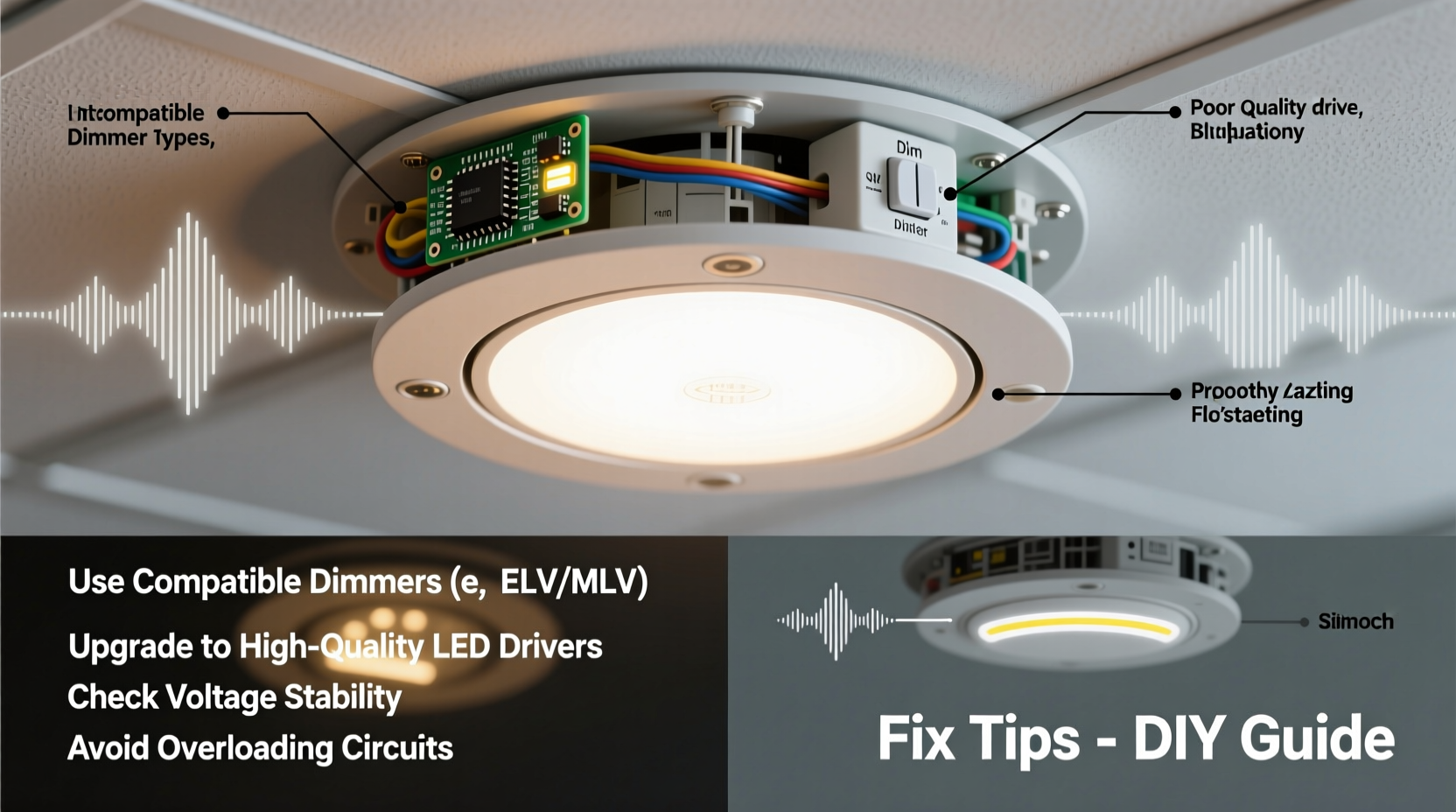
LEDs don’t run on raw AC voltage like old incandescent bulbs. They require direct current (DC) at low voltage, delivered by an internal or external driver. When you dim an LED, you’re not reducing voltage linearly—you’re modulating power using one of two primary methods: phase-cut dimming (most common in residential settings) or pulse-width modulation (PWM), often used in low-voltage or smart systems.
Phase-cut dimmers—whether leading-edge (TRIAC-based) or trailing-edge (electronic low-voltage, or ELV)—work by “chopping” parts of the AC sine wave. Leading-edge dimmers cut the front portion of each half-cycle; trailing-edge cut the back. This chopping creates rapid on-off transitions. Incompatible drivers interpret these abrupt transitions as unstable input, causing their internal switching transistors or output capacitors to vibrate physically at frequencies between 50 Hz and 2 kHz—right in the human hearing range. That vibration transfers to nearby housing, mounting hardware, or even the fixture’s heat sink, amplifying into an audible buzz.
It’s not the LED chip buzzing—it’s the driver’s magnetics (inductors, transformers) or electrolytic capacitors resonating under electrical stress. Poorly designed drivers lack adequate filtering, shielding, or damping materials. Cheap components heat up faster, increasing thermal expansion and mechanical instability. Even minor manufacturing variances—like capacitor tolerance or winding tension in a transformer—can tip a borderline-compatible setup into audible noise.
7 Proven Fixes—Ranked by Effectiveness and Practicality
Fixing LED buzz isn’t about trial-and-error. It’s about diagnosing the root cause and applying the right intervention. Below is a prioritized, field-tested sequence—starting with the most impactful and cost-effective solutions.
- Verify dimmer–LED compatibility using official lists: Never rely on generic “dimmable LED” labels. Manufacturers like Lutron, Leviton, and Legrand publish detailed compatibility databases. Cross-reference your exact dimmer model (e.g., Lutron Caseta PD-6WCL) with your exact LED bulb or fixture model (e.g., Philips 931254107200). Mismatches here cause over 70% of persistent buzzing cases.
- Replace leading-edge dimmers with trailing-edge (ELV) models: Leading-edge dimmers were engineered for resistive loads (incandescents). Their aggressive waveform chopping overwhelms most LED drivers. Trailing-edge dimmers deliver smoother, gentler cuts—reducing driver stress and eliminating buzz in ~60% of previously problematic installations.
- Install a minimum-load bypass device: Many modern dimmers require a minimum load (e.g., 25–40W) to stabilize their internal circuitry. A single 9W LED bulb falls far below this threshold, causing erratic switching and buzz. A bypass device (like the Lutron LUT-MLC or Leviton IPD-10) shunts a small, safe amount of current—simulating load without wasting energy.
- Upgrade to a high-frequency PWM dimmer: Systems like Lutron Vive or Ketra use >20 kHz PWM—far above human hearing. These eliminate buzz entirely but require professional installation and compatible fixtures.
- Swap to a constant-voltage (CV) LED system with 0–10V dimming: Instead of phase-cut dimming, 0–10V sends a separate low-voltage analog signal to the driver. No waveform chopping occurs—so no buzz. Ideal for recessed downlights and commercial-grade track lighting.
- Add ferrite cores to driver input/output wires: Clip-on ferrite chokes suppress high-frequency electrical noise traveling along wires—a common contributor to resonance in nearby metal housings. Place them within 2 inches of the driver terminals.
- Physically isolate vibrating components: If buzz persists after electrical fixes, dampen mechanical transmission. Use silicone grommets between driver and housing, or mount drivers on rubber isolators. Avoid overtightening screws—they amplify resonance.
Do’s and Don’ts: A Quick-Reference Compatibility Checklist
| Action | Do | Don’t |
|---|---|---|
| Selecting a dimmer | Choose ELV (trailing-edge) for most integrated LED fixtures; verify compatibility via manufacturer database | Assume “dimmable” on the bulb box guarantees compatibility with your existing dimmer |
| Installing bulbs | Use the same brand/model across all sockets in a multi-bulb fixture | Mix brands, color temperatures, or wattages—even if all are labeled “dimmable” |
| Wiring | Keep dimmer load wires short and twisted; avoid running near AC mains or data cables | Extend dimmer wires with unshielded speaker wire or daisy-chain multiple fixtures on one dimmer without recalculating total load |
| Troubleshooting | Test one bulb at a time—if buzz stops, the culprit is a faulty or incompatible unit | Immediately replace the entire fixture because of buzz—most issues are upstream in the dimmer or wiring |
| Upgrading | When retrofitting, replace dimmer AND bulbs together—not just one or the other | Install premium LED bulbs on a 15-year-old incandescent dimmer and expect silence |
A Real-World Case Study: The Quiet Kitchen Remodel
When architect Sarah Lin renovated her Portland home’s open-plan kitchen, she specified 12 integrated LED recessed downlights with a Lutron Maestro PRO dimmer. At 70% brightness, the lights were flawless. But below 40%, a low, rhythmic buzz emerged—worse near the island where six fixtures shared one dimmer circuit. She’d already ruled out loose wiring and verified correct breaker sizing.
Sarah consulted Lutron’s online compatibility tool and discovered her chosen fixture (a popular 9W 3000K downlight) was *not* listed for the Maestro PRO—despite being marketed as “dimmable.” The tool recommended either switching to Lutron’s own “Claro” dimmer (designed for low-wattage LEDs) or adding an LUT-MLC bypass. She chose the latter: a $12 device wired across the dimmer’s load terminals. Within minutes, the buzz vanished—even at 5% dim level. Later, she upgraded two fixtures to Lutron’s full-spectrum tunable-white models, pairing them with a Vive dimmer. That system operates silently across its entire 0–100% range, with zero perceptible delay or flicker.
Her takeaway? “Compatibility isn’t optional—it’s architectural. I treat dimmer–LED matching with the same rigor as structural load calculations.”
Expert Insight: What Lighting Engineers See in the Lab
“The biggest misconception is that buzz means ‘cheap LED.’ In our testing lab, we’ve measured identical buzz levels from $3 bulbs and $45 commercial-grade fixtures—when paired with the wrong dimmer. The real failure point is usually the interface, not the endpoint. A well-designed driver can tolerate poor dimming signals—but only up to a point. Once harmonic distortion exceeds 15%, magnetics begin vibrating audibly. That’s why certified compatibility matters more than price or brand.” — Dr. Alan Reyes, Senior Electrical Engineer, Lighting Research Center at Rensselaer Polytechnic Institute
FAQ: Your Most Pressing Buzz Questions—Answered
Can LED buzzing damage the light or dimmer over time?
Yes—chronic buzzing indicates electrical stress. Vibration accelerates capacitor aging and can loosen solder joints in drivers. In extreme cases, overheating from unstable switching reduces LED lifespan by 30–50%. Persistent buzz is a warning sign, not just a nuisance.
Why does buzz get louder when the dimmer is set to certain levels—not just at the bottom?
This points to resonant frequency alignment. At specific dimming percentages, the chopped waveform’s harmonic frequencies match the natural mechanical resonance of a component (e.g., a 12mm inductor vibrating at 1.2 kHz). That’s why buzz often peaks around 20–30% or 70–80%—not uniformly across the range. It’s physics, not malfunction.
Will smart dimmers (like those for Alexa or HomeKit) solve the buzz problem?
Not inherently. Most smart dimmers still use phase-cut technology underneath. However, higher-end models (e.g., Lutron Caseta with Pro dimmers, or Brilliant Smart Switches) include adaptive algorithms that auto-tune to your load and suppress harmonics. Cheaper Wi-Fi dimmers often worsen buzz due to added signal noise. Always verify smart dimmer compatibility—not just “works with Alexa.”
Step-by-Step Diagnostic Protocol: Isolate the Source in Under 10 Minutes
- Eliminate ambient variables: Turn off HVAC, fans, and appliances. Buzz can travel through ductwork or joists—making location misleading.
- Isolate the circuit: Turn off all breakers except the lighting circuit. If buzz stops, interference is coming from another circuit.
- Test one fixture: Disconnect all but one LED fixture on the dimmer. If buzz remains, the issue is dimmer–driver incompatibility. If it stops, the problem is interaction between fixtures.
- Swap the bulb/fixture: Replace the suspect unit with a known-compatible model (check manufacturer list). If buzz disappears, the original unit is incompatible—even if labeled “dimmable.”
- Check dimmer specs: Locate the dimmer’s model number and look up its “minimum LED load” and “compatible driver types” (e.g., “requires trailing-edge dimmer” or “supports 0–10V”).
- Install bypass or upgrade dimmer: Based on findings, add a load bypass or replace with an ELV dimmer. Retest at multiple dim levels.
Conclusion: Silence Is a Design Choice—Not a Luxury
Buzzing LED lights aren’t inevitable. They’re the audible symptom of outdated assumptions—treating LEDs like incandescents, trusting marketing labels over engineering specifications, or overlooking the delicate dance between dimmer, driver, and fixture. Every silent, smoothly dimming LED installation you admire began with deliberate compatibility planning: selecting dimmers that speak the driver’s language, respecting minimum load thresholds, and verifying performance across the full dimming range—not just at full brightness. You don’t need to be an electrician to achieve this. You need awareness, access to manufacturer resources, and the willingness to treat dimming as a precision system—not a simple slider.
Start today: pull the dimmer cover plate, note the model number, and visit the manufacturer’s compatibility portal. Cross-reference your bulbs or fixtures. If you find mismatches, implement the bypass solution first—it’s fast, reversible, and effective in most residential cases. Then consider upgrading to trailing-edge dimmers for future installations. Your ears—and your lights—will thank you.




 浙公网安备
33010002000092号
浙公网安备
33010002000092号 浙B2-20120091-4
Comments
No comments yet. Why don't you start the discussion?