
That faint, persistent hum—or sometimes an irritating, high-pitched whine—coming from your LED ceiling fixture when you lower the dimmer switch isn’t just annoying. It’s a diagnostic signal. Unlike incandescent bulbs, which dim silently by simply reducing voltage across a tungsten filament, LEDs operate on low-voltage DC power and require precise electronic control. When buzzing occurs during dimming, it almost always points to a mismatch between three critical components: the LED light source, the dimmer switch, and the driver circuit inside the bulb or fixture. This isn’t a defect in the LED itself—it’s a systems-level incompatibility rooted in decades-old dimming infrastructure meeting modern solid-state lighting. Understanding why this happens—and how to resolve it—is essential for anyone installing or upgrading residential or commercial lighting.
The Physics Behind the Buzz: How Dimmers and Drivers Interact
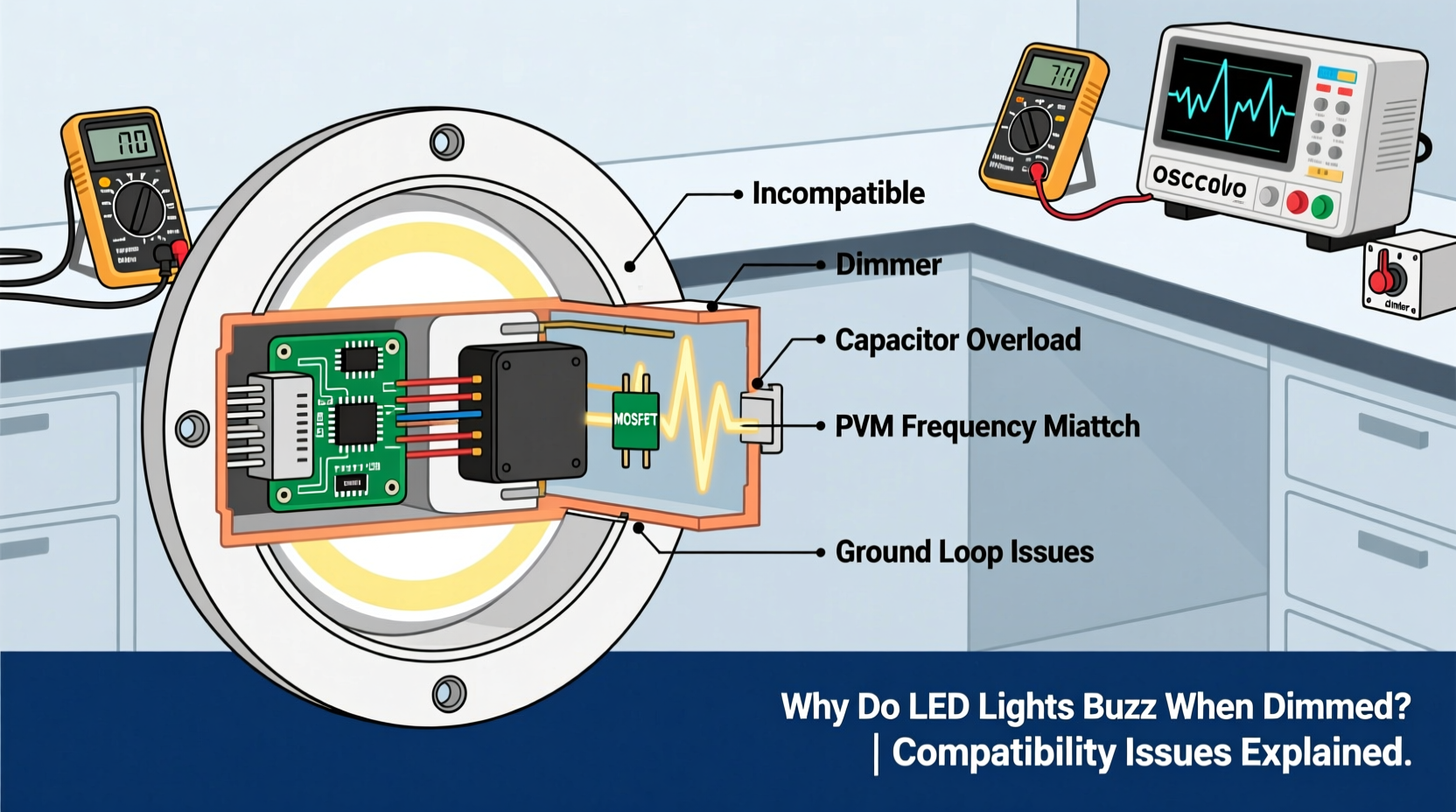
Traditional wall dimmers were engineered for resistive loads—incandescent and halogen bulbs that behave like simple heaters. These dimmers use “phase-cut” technology: they chop off portions of the AC sine wave (either the leading edge or trailing edge) to reduce average power delivered. But LEDs don’t draw current continuously; they rely on internal drivers to convert chopped-up AC into stable, low-voltage DC. When a non-compatible dimmer sends an irregular, fragmented waveform to an LED driver, the driver’s input-stage capacitors and inductors can vibrate physically at frequencies between 50 Hz and 20 kHz. This magnetostriction—the slight expansion and contraction of magnetic core materials under alternating magnetic fields—is what produces audible buzzing. The sound is most pronounced at mid-dimming levels (30–70%), where waveform instability peaks and driver components resonate most strongly.
Crucially, not all dimmers behave the same way. Leading-edge (TRIAC-based) dimmers—common in older homes and budget installations—are especially problematic with LEDs because they generate sharp voltage spikes and high harmonic distortion. Trailing-edge (electronic low-voltage or ELV) dimmers, designed for capacitive loads like LED drivers, deliver smoother transitions and significantly lower electromagnetic noise. Yet even trailing-edge dimmers fail if paired with poorly designed drivers lacking robust filtering or wide dimming-range tolerance.
Five Key Compatibility Failure Points
Buzzing rarely stems from a single flaw. It emerges from the intersection of design choices across the lighting ecosystem. Here are the five most common failure points:
- Dimmer Type Mismatch: Using a leading-edge dimmer with an LED load rated only for trailing-edge operation—or vice versa.
- Driver Inadequacy: Budget LED bulbs often use minimalistic constant-voltage or basic constant-current drivers with insufficient EMI filtering and narrow dimming ranges (e.g., 10–100% instead of 1–100%).
- Minimum Load Requirement Violation: Many dimmers require a minimum wattage (e.g., 25W) to function stably. A single 8W LED bulb may fall far below that threshold, causing erratic switching and audible oscillation.
- Multi-Load Instability: Connecting multiple LED fixtures to one dimmer without verifying total load compatibility can overload the dimmer’s control circuitry, especially if drivers have varying response times.
- Firmware or Protocol Gaps: Smart dimmers using protocols like Zigbee, Z-Wave, or DALI require firmware-matched drivers. An outdated or unqualified driver may misinterpret dimming signals, triggering unstable pulse-width modulation (PWM) frequencies within the audible range.
Real-World Diagnostic: A Residential Retrofit Case Study
In early 2023, a homeowner in Portland replaced six 60W incandescents in their dining room chandelier with ENERGY STAR–certified 9W dimmable LED BR30 bulbs. They retained their existing Lutron Diva DVCL-153P leading-edge dimmer—a unit rated for up to 150W incandescent load. At first, the lights dimmed smoothly. Within three weeks, however, a distinct 120Hz buzz emerged at ~40% brightness. The homeowner assumed the bulbs were faulty and replaced them twice—same result.
A licensed lighting technician visited and performed three quick checks: First, he measured total load (6 × 9W = 54W), well below the dimmer’s 150W rating—but critically, *far above* its 10W minimum LED load requirement. Second, he checked the bulbs’ datasheets: all specified “trailing-edge dimmer required.” Third, he tested with a Lutron Maestro MACL-153M (trailing-edge) dimmer borrowed from another room. The buzz vanished instantly across the full dimming range.
The root cause? The DVCL-153P’s TRIAC circuit couldn’t cleanly manage the rapid on/off cycling demanded by the LED drivers’ input-stage rectifiers. Its firing angle shifted erratically near mid-range, inducing resonance in the drivers’ electrolytic capacitors. The fix wasn’t new bulbs—it was matching the control system to the load’s electrical behavior.
Compatibility Checklist: Before You Buy or Install
Prevent buzzing before it starts. Use this actionable checklist when specifying or purchasing dimmable LED lighting:
- ✅ Verify dimmer type: Confirm whether your existing or planned dimmer is leading-edge (TRIAC) or trailing-edge (ELV/MOSFET). Check the model number on the dimmer faceplate or packaging.
- ✅ Consult official compatibility lists: Go directly to the dimmer manufacturer’s website (e.g., Lutron, Leviton, Legrand) and download their latest LED compatibility tool or spreadsheet. Filter by exact bulb/fixture model—not just “brand + wattage.”
- ✅ Check minimum/maximum load specs: Calculate total wattage of all connected LEDs. Ensure it falls within both the dimmer’s minimum LED wattage and maximum load rating.
- ✅ Review driver specifications: Look for terms like “0–10V,” “DALI,” “Phase-Adaptive,” or “Universal Dimming” on the fixture or bulb datasheet. Avoid drivers labeled only “dimmable” without protocol details.
- ✅ Test before full deployment: Install one fixture or bulb on the dimmer and test across the entire range—from 1% to 100%—for at least 10 minutes. Listen closely at 30%, 50%, and 70%.
Dimmer & LED Compatibility Comparison Table
| Dimmer Type | Best For | Common Buzz Triggers | LED Compatibility Notes |
|---|---|---|---|
| Leading-Edge (TRIAC) | Incandescent, halogen, magnetic low-voltage transformers | Sharp voltage spikes, poor low-load stability, narrow dimming range | Rarely compatible with standard LED bulbs unless explicitly listed. Requires high-quality, TRIAC-optimized drivers. Avoid for premium residential dimming. |
| Trailing-Edge (ELV) | Electronic low-voltage transformers, most quality LED drivers | Overloading (>150W total), undersized wiring, poor grounding | Strongly preferred for LEDs. Supports smoother dimming, deeper low-end, and quieter operation—when matched correctly. |
| Universal / Phase-Adaptive | Both leading- and trailing-edge loads (auto-sensing) | Firmware bugs, outdated calibration, mixed-load installations | Increasingly common in newer smart dimmers. Still requires verification against specific LED models—auto-sensing doesn’t guarantee silence. |
| 0–10V Analog | Commercial troffers, panel lights, architectural fixtures | Poor cable shielding, long wire runs (>30 ft), ground loops | No buzzing from the dimmer itself—but driver must support true 0–10V (not PWM emulation). Requires separate low-voltage control wires. |
Expert Insight: Engineering Perspective on Driver Design
“Buzzing is fundamentally a symptom of energy inefficiency in the driver’s front-end rectification stage. High-quality drivers incorporate multi-stage EMI filters, soft-start circuits, and resonant gate drivers that suppress harmonic vibration. Cheaper drivers skip these—they meet basic safety standards but fail acoustic and stability benchmarks. If your LED fixture buzzes, it’s not ‘working fine at reduced volume.’ It’s operating outside its intended electrical envelope—and that stress accelerates capacitor aging and increases long-term failure risk.” — Dr. Lena Torres, Principal Electrical Engineer, Lighting Systems Group at UL Solutions
Step-by-Step Fix Path: From Buzz to Silence
When buzzing appears, follow this evidence-based resolution sequence:
- Isolate the source: Turn off all other lights on the same circuit. Test each fixture individually with the dimmer. Determine if buzzing occurs with one bulb or only when multiple are active.
- Check load compliance: Add up the actual wattages (not equivalent incandescent ratings) of all connected LEDs. Compare against the dimmer’s published minimum and maximum LED load specs.
- Swap to a known-compatible bulb: Borrow or purchase a bulb explicitly approved for your dimmer model (e.g., Philips LED D24 9.5W on Lutron’s compatibility list). Test thoroughly.
- Upgrade the dimmer: If the existing dimmer lacks LED-specific certification (look for “LED Compatible” or “C.L.” marking), replace it with a trailing-edge or universal model rated for your total load.
- Add a dummy load (last resort): Only if upgrading isn’t feasible: install a Lutron LUT-MLC (minimum load capacitor) in parallel with the fixture. This provides reactive load stabilization—but it’s a band-aid, not a solution. Never use incandescent bulbs as dummy loads; they defeat energy savings and create fire risks.
FAQ: Addressing Common Misconceptions
Can tightening the bulb or fixture eliminate buzzing?
No. Mechanical vibration from loose parts may produce a rattle, but true dimming buzz originates in the driver’s electronic components—not mounting hardware. Tightening won’t resolve electromagnetic resonance in capacitors or inductors.
Does buzzing mean my LED is failing or dangerous?
Not immediately hazardous, but concerning. Persistent buzzing indicates the driver is operating under electrical stress—increasing heat buildup and accelerating electrolytic capacitor degradation. While unlikely to cause fire, it shortens lifespan and may lead to premature flicker or dropout. Treat it as an early warning sign.
Will smart home dimmers (like those for Alexa or HomeKit) solve the problem?
Only if they’re specifically engineered for LED loads and paired with certified drivers. Many “smart” dimmers reuse legacy TRIAC circuitry with added Wi-Fi modules—making them *more* prone to incompatibility. Prioritize certifications (e.g., “Works with Matter,” “Thread Certified”) and verified compatibility over smart features alone.
Conclusion: Prioritize System Integrity Over Component Convenience
Buzzing LED lights are more than an acoustic nuisance—they’re a visible symptom of a fragmented lighting ecosystem. We’ve inherited dimmer switches designed for analog thermal loads and now expect them to orchestrate precision digital electronics. The path to silent, seamless dimming lies not in chasing cheaper bulbs or retrofitting old hardware, but in treating lighting as an integrated system: selecting dimmers and LEDs together, verifying compatibility at the model level, and respecting the physics of power electronics. Every quiet, smoothly dimming LED fixture in your home is the result of intentional engineering alignment—not luck. Start your next lighting upgrade by downloading the compatibility tool from your dimmer manufacturer. Cross-reference every bulb. Test rigorously. Demand silence—not just illumination.




 浙公网安备
33010002000092号
浙公网安备
33010002000092号 浙B2-20120091-4
Comments
No comments yet. Why don't you start the discussion?