
LED lighting has revolutionized energy efficiency and longevity in homes, offices, and industrial spaces. With lifespans often rated at 25,000 to 50,000 hours, LEDs promise years of reliable illumination. Yet many users report a peculiar issue: the appearance of dark spots on their LED bulbs or panels after months—or even just weeks—of use. These spots are more than cosmetic concerns; they can signal underlying degradation that affects performance. Understanding why these dark spots form, whether the fixture can be repaired, and when replacement becomes inevitable is essential for maximizing value and safety.
What Are Dark Spots on LED Lights?
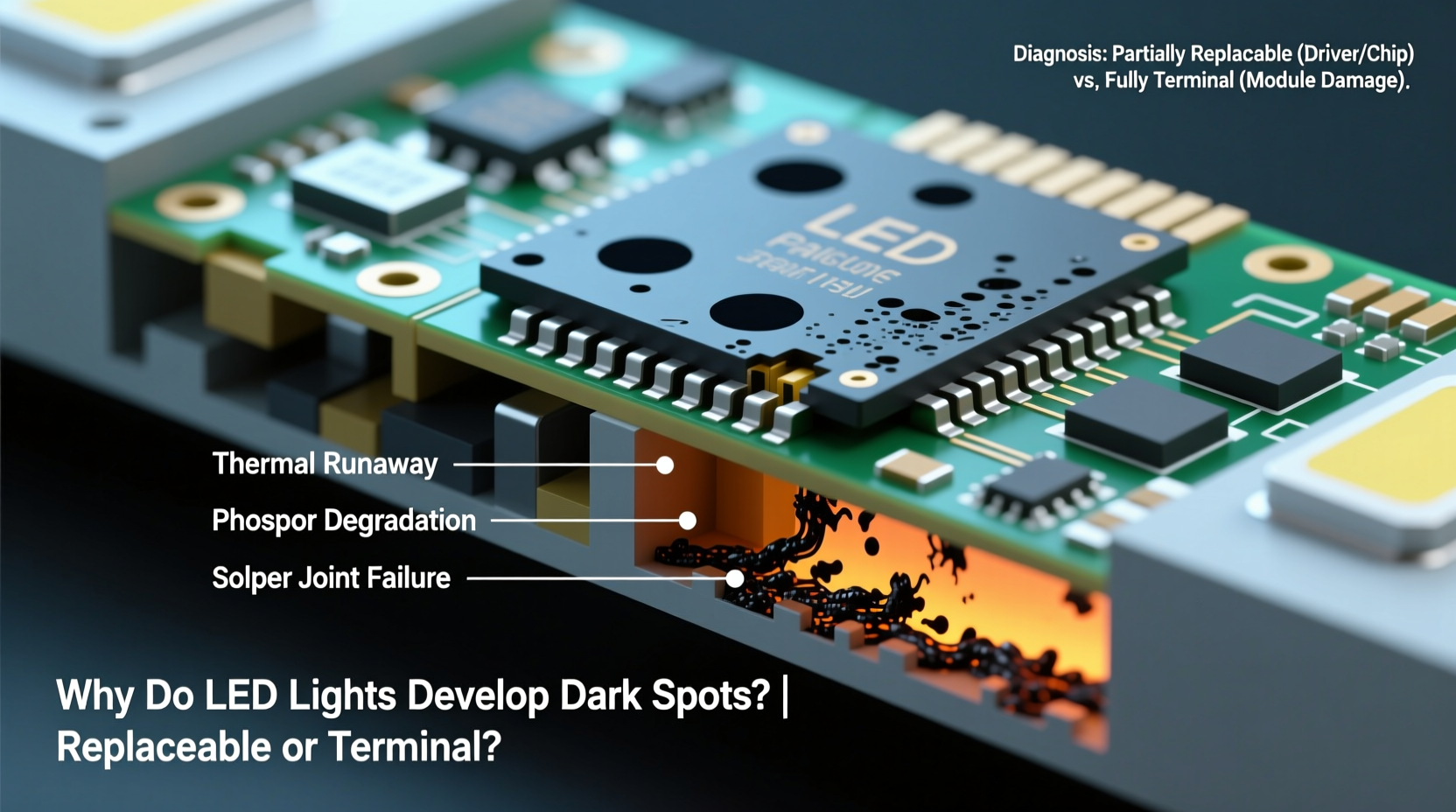
Dark spots typically appear as small, shadowy patches on the surface of an LED bulb, strip, or panel. They may start near the edges or cluster around the central heat sink area. Unlike burnt filaments in incandescent bulbs, which go completely dark, LED dark spots usually indicate partial failure—some diodes still emit light while others have dimmed or stopped working entirely.
These spots are not dirt or external grime. Instead, they reflect internal changes in the LED’s semiconductor components or surrounding materials. The presence of such spots often correlates with reduced brightness, flickering, or inconsistent color temperature across the light source.
The Science Behind LED Degradation and Spot Formation
LEDs generate light through electroluminescence—a process where electrons recombine with electron holes within a semiconductor material, releasing photons. While inherently efficient, this process produces heat concentrated at microscopic junctions inside each diode. Over time, thermal stress, material fatigue, and chemical changes degrade these junctions, leading to non-uniform light output.
The most common causes of dark spot development include:
- Thermal runaway: Poor heat dissipation leads to overheating, accelerating lumen depreciation in specific zones.
- Phosphor layer degradation: White LEDs use blue diodes coated with yellow phosphor. Uneven aging or delamination of this coating creates visible darkening.
- Solder joint failure: Repeated expansion and contraction from heating cycles weaken connections, cutting power to individual diodes.
- Current crowding: Inconsistent current distribution across multiple diodes causes some to work harder—and fail faster—than others.
- Manufacturing defects: Microscopic impurities or poor bonding during production create weak points prone to early failure.
Unlike traditional bulbs, LEDs don’t “burn out” suddenly. Instead, they experience lumen depreciation, gradually losing brightness. However, when this decay is uneven due to localized damage, it manifests visually as dark spots.
“Uneven darkening in LEDs is rarely random—it’s a symptom of design flaws, environmental stress, or substandard materials.” — Dr. Alan Zhou, Solid-State Lighting Researcher, University of Michigan
Is the LED Fixture Replaceable or Terminal?
Once dark spots appear, the natural question arises: Can it be fixed, or must it be replaced? The answer depends on the type of LED product and its construction.
Integrated Fixtures vs. Modular Bulbs
| Type | Repairable? | Replaceable Part | Lifespan Outlook After Spots Appear |
|---|---|---|---|
| Standard LED Bulb (A19, BR30) | No | Entire bulb | Decline likely to accelerate; replace promptly |
| LED Strip Lights | Possibly | Segmented sections or drivers | Localized repair possible if only one zone affected |
| Recessed Downlights (Integrated) | Rarely | Module or entire housing | Usually terminal; full replacement recommended |
| Modular Panel Lights | Yes | Individual LED boards or drivers | Prolonged life with component-level servicing |
| Smart Bulbs | No | Whole unit | Failure expected soon after visual signs appear |
In general, consumer-grade LED bulbs are sealed units with no user-serviceable parts. Once dark spots emerge, especially if accompanied by flickering or buzzing, the unit should be considered functionally degraded and nearing end-of-life.
Commercial or industrial systems, particularly modular troffers or high-bay fixtures, may allow technicians to replace driver units, control gear, or even individual LED arrays. In such cases, targeted repairs can restore performance without replacing the entire fixture.
Can You Replace Just the LED Board?
In certain recessed or flat-panel fixtures, yes. Many modern downlights use plug-in LED modules secured with clips or screws. Manufacturers often sell replacement boards compatible with older housings. This approach reduces waste and cost compared to full fixture replacement.
However, matching color temperature and brightness consistency between old and new modules can be challenging. Mixing aged and fresh LEDs may result in noticeable differences in hue or output.
Step-by-Step Guide: Assessing and Responding to Dark Spots
Follow this structured approach when you first notice dark spots on your LED lighting:
- Observe usage patterns: Note how long the light has been operating daily. Excessive runtime without adequate cooling increases risk.
- Check ambient conditions: Is the fixture installed in an enclosed space, attic, or outdoor location exposed to moisture or temperature swings?
- Inspect for overheating: Turn off the light, let it cool, then turn it back on. After 15 minutes, carefully feel the heat sink. It should be warm but not too hot to touch briefly.
- Test voltage and driver: Use a multimeter to check output from the driver (if accessible). Fluctuating DC voltage indicates driver failure contributing to uneven performance.
- Evaluate dimmer compatibility: Non-dimmable LEDs used with dimmers, or incompatible LED-compatible dimmers, cause stress and premature aging.
- Determine replacement path: For bulbs—replace. For integrated fixtures—consult manufacturer specs for module availability.
- Upgrade proactively: When replacing, choose higher IP-rated, thermally optimized models suited to the environment.
Prevention: How to Extend LED Lifespan and Avoid Dark Spots
While all LEDs eventually degrade, proper selection and installation dramatically delay the onset of visible issues like dark spots.
Choose Quality Over Cost
Budget LEDs often skimp on critical elements: thinner copper traces, undersized heat sinks, low-grade phosphor coatings, and unreliable drivers. Investing in reputable brands (e.g., Philips, Cree, Sylvania) ensures better thermal management and consistent binning of diodes.
Ensure Adequate Ventilation
Enclosed fixtures trap heat. Always verify that your LED bulb is rated for enclosed use. Look for labels like “Enclosed Fixture Rated” or “Suitable for Enclosed Luminaires.” Even then, consider periodic shutdowns in high-heat environments.
Use Compatible Controls
Pair dimmable LEDs only with trailing-edge (ELV) or MLV dimmers designed for low-wattage loads. Mismatches cause flicker, noise, and accelerated wear. Similarly, avoid using LEDs on timers or sensors not rated for electronic loads unless specified.
Install Correctly
Over-tightening bulbs in sockets can crack solder joints or damage internal circuitry. Hand-tighten only. Also, ensure wiring connections are secure—loose neutrals cause arcing and unstable current flow.
“We’ve seen double the field life in LEDs simply by upgrading from $2 bargain bulbs to mid-tier, certified products with proper heat dissipation.” — Maria Tran, Electrical Maintenance Supervisor, Chicago Public Schools
Mini Case Study: Office Ceiling Panels Failing Prematurely
A regional accounting firm installed 48 new LED ceiling panels in their open-plan office. Within 14 months, employees reported uneven lighting and visible dark blotches on several units near HVAC vents.
An electrical audit revealed two key issues: First, the panels were mounted directly above ceiling-mounted diffusers, exposing them to cold air blasts that caused rapid thermal cycling. Second, the driver units were located inside the same housing, trapping heat despite aluminum heat sinks.
The solution involved relocating drivers to remote junction boxes in the plenum space and installing insulation baffles to reduce airflow onto the panels. Replacement modules used enhanced phosphor stability and wider thermal tolerance. Over two years post-upgrade, no further dark spots appeared, and lumen maintenance improved by 37%.
FAQ: Common Questions About LED Dark Spots
Are dark spots dangerous?
Not immediately. However, they indicate component stress that could lead to complete failure, short circuits, or, in rare cases, smoke from overheated electronics. If accompanied by burning smells or discoloration of the fixture housing, disconnect power immediately.
Can cleaning fix dark spots?
No. Dark spots originate internally. Wiping the exterior might remove dust, but it won’t restore lost luminosity or repair failed semiconductors. Attempting to open sealed units voids safety certifications and risks electric shock.
Do all LEDs develop dark spots eventually?
No—if properly engineered and operated within specifications. High-quality LEDs maintained in suitable conditions may reach their rated lifespan without visible degradation. Dark spots are more indicative of poor design, misuse, or manufacturing inconsistency than inherent LED limitations.
Checklist: Protect Your LED Investment
- ✅ Buy ENERGY STAR or DesignLights Consortium (DLC)-certified products
- ✅ Verify enclosed fixture rating before installation
- ✅ Match dimmers and controls to LED specifications
- ✅ Avoid installing LEDs in high-humidity or unventilated areas unless IP65+
- ✅ Monitor for early signs: slight flicker, color shift, or warmth beyond normal
- ✅ Replace failing units promptly to prevent strain on remaining lights
- ✅ Keep records of model numbers and purchase dates for warranty claims
Conclusion: Act Early, Save Long-Term
Dark spots on LED lights are not normal wear—they’re warning signs of compromised performance. While not all affected units can be repaired, recognizing the root causes empowers smarter choices in selection, installation, and maintenance. Whether you're managing household lighting or overseeing a commercial retrofit, prioritizing quality, thermal management, and compatibility pays dividends in reliability and cost savings.
Don’t wait for total failure. Address early symptoms proactively, invest in durable solutions, and treat your LED systems not as disposable items but as long-term assets worth protecting.




 浙公网安备
33010002000092号
浙公网安备
33010002000092号 浙B2-20120091-4
Comments
No comments yet. Why don't you start the discussion?