
Flickering LED lights—especially when dimmed—are more than an annoyance. They signal a fundamental mismatch between legacy electrical infrastructure and modern solid-state lighting. Unlike incandescent bulbs, which respond predictably to reduced voltage, LEDs operate on low-voltage DC power and require precise current regulation. When paired with traditional dimmers designed for resistive loads, instability arises: inconsistent power delivery, insufficient load thresholds, incompatible control signals, and thermal or electronic stress. This article explains the root causes—not just symptoms—and provides actionable, electrically sound solutions grounded in real-world installations, manufacturer specifications, and National Electrical Code (NEC) best practices.
The Core Problem: Dimmers and LEDs Speak Different Electrical Languages
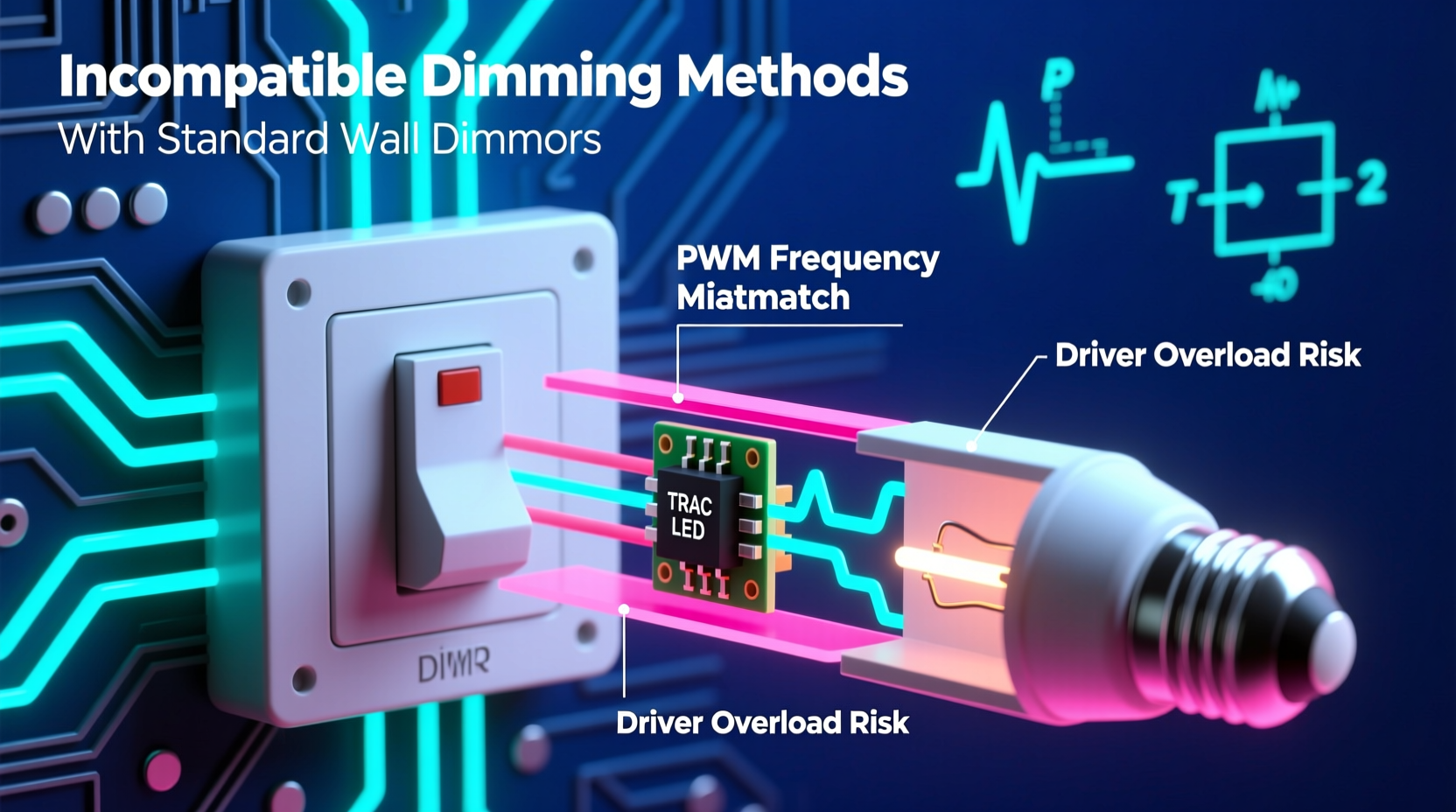
Standard wall dimmers—primarily leading-edge (TRIAC-based) models—were engineered for incandescent and halogen lamps. These bulbs behave like simple resistors: as voltage drops, filament temperature falls, light output dims smoothly, and current draw decreases linearly. LEDs, however, rely on internal drivers to convert 120V AC line voltage into stable, low-voltage DC. That driver must interpret the chopped waveform from a TRIAC dimmer and regulate current accordingly. But many LED drivers lack robust phase-cut detection circuitry. When the dimmer “chops” the AC sine wave early in each half-cycle (as leading-edge dimmers do), the driver may misread the timing, fail to maintain minimum holding current, or enter unstable switching modes—resulting in visible flicker, buzzing, or premature failure.
This isn’t a defect in the LED bulb—it’s a systems integration issue. A high-quality LED lamp may flicker on one dimmer but operate flawlessly on another, even within the same home. The inconsistency stems from variable tolerances across both dimmer electronics (e.g., minimum load requirements, firing angle precision) and LED driver designs (e.g., input capacitance, under-voltage lockout thresholds, PWM frequency).
Four Technical Causes Behind the Flicker
1. Insufficient Load Below Dimmer Minimum Threshold
Most leading-edge dimmers require a minimum load—typically 25W to 60W—to function reliably. A single 9W LED bulb draws less than one-third of that. Without enough current, the TRIAC fails to stay latched during each half-cycle, causing erratic conduction and rapid on-off cycling perceived as flicker. This is especially common in multi-gang switch boxes where only one circuit is loaded with LEDs while others remain empty.
2. Incompatible Dimming Method (Leading-Edge vs. Trailing-Edge)
Leading-edge dimmers chop the front portion of the AC waveform; trailing-edge (electronic low-voltage or ELV) dimmers chop the rear. LED drivers with MOSFET-based or capacitive-input designs often perform better with trailing-edge dimmers, which deliver smoother current transitions and lower electromagnetic interference. Using a leading-edge dimmer with a trailing-edge–optimized driver creates timing conflicts at the zero-crossing point—disrupting the driver’s feedback loop.
3. Poor Driver Design or Cost-Cutting Compromises
Budget LED bulbs frequently use minimalistic constant-voltage drivers without active power factor correction (PFC) or adaptive dimming algorithms. These drivers cannot compensate for waveform distortion, voltage sags, or harmonic noise introduced by older dimmers. High-frequency flicker (often above 100 Hz) may not be visible to the naked eye but can trigger headaches, eye strain, or photosensitive conditions—a serious health consideration overlooked in many residential retrofits.
4. Circuit-Level Interference and Shared Neutrals
Flicker sometimes appears only when other loads activate—like a refrigerator compressor kicking on or HVAC system cycling. This points to neutral wire issues: shared neutrals in multi-wire branch circuits (MWBCs), undersized neutrals, or high-impedance connections. Voltage fluctuations on the neutral line directly affect the reference point for the LED driver’s sensing circuitry. Even minor imbalances—within NEC-allowed limits—can destabilize sensitive electronics.
Do’s and Don’ts: A Practical Compatibility Checklist
| Action | Do | Don’t |
|---|---|---|
| Selecting a Dimmer | Choose an LED-rated trailing-edge (ELV) or universal dimmer certified to UL 1472 and listed for your specific bulb brand (e.g., Lutron CL, Leviton D2L, Legrand Adorne Smart Dimmer) | Install a generic “LED-compatible” dimmer without cross-referencing the manufacturer’s compatibility tool |
| Load Calculation | Calculate total connected wattage—including all bulbs on the circuit—and ensure it exceeds the dimmer’s minimum load (e.g., 10W minimum × 3 bulbs = 30W total) | Rely solely on “watt-equivalent” labeling (e.g., “60W equivalent”)—use actual measured or datasheet wattage |
| Wiring Verification | Confirm dedicated neutral wires (no shared neutrals) and use a multimeter to test neutral-to-ground voltage under load (< 2V AC) | Assume existing wiring is adequate—especially in homes built before 2008 with MWBC configurations |
| Driver Matching | For new construction or whole-home upgrades, specify 0–10V or DALI dimmable fixtures with external drivers—bypassing wall dimmer limitations entirely | Mix bulbs from different manufacturers on the same dimmer circuit—even if all are labeled “dimmable” |
| Troubleshooting | Test one bulb first, then add others incrementally while monitoring for flicker onset or audible buzzing | Use a non-contact voltage tester alone—verify continuity, grounding, and neutral integrity with a digital multimeter |
Real-World Case Study: The Renovated Craftsman Bungalow
In Portland, Oregon, a homeowner renovated a 1920s craftsman bungalow with energy-efficient recessed LED downlights. She selected warm-white 12W dimmable BR30 bulbs and installed Lutron Maestro dimmers—marketed as “LED-ready.” Within weeks, flickering began in the dining room when dimmed below 40%. An electrician discovered three compounding issues: First, the circuit served only four bulbs (48W total), falling just below the dimmer’s 50W minimum load. Second, the home’s original knob-and-tube wiring had been partially updated—but the neutral connection in the ceiling junction box was corroded, introducing intermittent resistance. Third, two of the four bulbs were from competing brands, each using proprietary driver topologies that responded differently to the same phase-cut signal.
The solution involved three coordinated steps: replacing the dimmer with a Lutron Diva DVCL-153P (150W max, 10W minimum load); installing a fifth identical bulb to raise total load to 60W; and re-terminating all neutral splices with antioxidant paste and torque-spec wire nuts. Post-correction, dimming was smooth from 100% to 1%, with no perceptible flicker or buzz—even under video recording at 240 fps. Crucially, the electrician documented the load calculation and neutral voltage readings before and after, providing the homeowner with a baseline for future expansions.
Expert Insight: What Industry Engineers Say
“Flicker isn’t random—it’s diagnostic. If you see it, something in the power delivery chain is violating a fundamental operating parameter: minimum load, waveform fidelity, thermal stability, or grounding integrity. Treating it as ‘just a bulb issue’ misses the system-level responsibility we have as designers and installers.” — Dr. Lena Torres, Principal Electrical Engineer, Lighting Research Center at Rensselaer Polytechnic Institute
“The biggest misconception is that ‘dimmable LED’ means ‘works with any dimmer.’ In reality, dimmability requires co-engineering: the driver must anticipate the dimmer’s behavior, and the dimmer must recognize the driver’s electrical signature. That’s why compatibility lists exist—and why they’re non-negotiable in professional installations.” — Marcus Bell, Director of Product Standards, Illuminating Engineering Society (IES)
Step-by-Step: Diagnosing and Resolving LED Flicker
- Verify the basics: Confirm all bulbs are labeled “dimmable” *and* match the dimmer’s published compatibility list (e.g., Lutron’s Lighting Finder tool). Note exact model numbers—not just “brand X BR30.”
- Measure actual load: Use a Kill-A-Watt meter or clamp ammeter to record total wattage drawn by all bulbs on the circuit at full brightness. Compare against dimmer’s minimum/maximum load specs (found in installation manual—not marketing copy).
- Check neutral integrity: With power ON and load applied, measure voltage between neutral and ground at the dimmer terminal. Readings >2V AC indicate a high-resistance neutral connection requiring inspection and repair.
- Isolate variables: Remove all but one bulb. Test dimming. If flicker disappears, gradually reintroduce bulbs one at a time. Note at which point flicker resumes—this identifies whether the issue is cumulative load or individual bulb incompatibility.
- Swap the dimmer: Temporarily replace with a known-compatible trailing-edge dimmer (e.g., Leviton D2L10-1LZ). If flicker stops, the original dimmer is the culprit—not the bulbs. Retain the old dimmer for non-LED circuits (e.g., garage outlets, exhaust fans).
- Upgrade strategically: For whole-home reliability, consider a 0–10V dimming system with centralized controllers. While higher upfront cost, it eliminates wall-dimmer compatibility concerns entirely and enables preset scenes, scheduling, and integration with smart home platforms.
FAQ
Can I fix flicker by adding a dummy load like a resistor or incandescent bulb?
No—this is unsafe and violates NEC 406.5(D). Adding resistive loads creates fire hazards due to heat buildup in enclosed boxes, wastes energy, and doesn’t address underlying waveform or neutral issues. Modern solutions focus on proper component matching, not workarounds.
Why does my LED flicker only when other appliances run?
This strongly indicates neutral-related problems—either a shared neutral in a multi-wire branch circuit or a loose/corroded neutral connection upstream. Appliance cycling causes momentary current surges that destabilize the reference voltage for LED drivers. A licensed electrician should inspect panel neutrals and junction box terminations.
Are smart dimmers (e.g., Philips Hue, TP-Link Kasa) immune to flicker?
No. Most plug-in or Wi-Fi smart dimmers still use leading-edge TRIAC technology internally. Their “smart” features don’t alter core dimming methodology. True flicker resilience comes from hardware design (trailing-edge, 0–10V, or DALI), not connectivity. Always check compatibility documentation—not app store descriptions.
Conclusion
Flickering LED lights aren’t a quirk of modern technology—they’re a precise, readable symptom of electrical mismatch. Solving it requires moving beyond trial-and-error swaps and embracing systematic verification: validating load calculations, auditing neutral integrity, consulting manufacturer compatibility tools, and selecting components designed to work together—not merely marketed as “compatible.” This isn’t about chasing the latest gadget; it’s about honoring the physics of power delivery and respecting the sophistication embedded in today’s LED drivers. When done right, dimmed LED lighting delivers not just energy savings, but serene, flicker-free ambiance—proven in labs, verified in homes, and essential for visual comfort and long-term reliability.




 浙公网安备
33010002000092号
浙公网安备
33010002000092号 浙B2-20120091-4
Comments
No comments yet. Why don't you start the discussion?