
That subtle, persistent hum—barely audible in quiet rooms but unmistakably present when you’re reading by the window or winding down at night—is more than just an annoyance. It’s a clue. A low-frequency buzz from LED string lights signals something fundamental about how modern lighting interacts with household electricity. Unlike incandescent bulbs, which glow silently, LEDs are inherently electronic devices requiring precise voltage regulation. When that regulation falters—even slightly—it often manifests as audible vibration: a 50 Hz or 60 Hz buzz, sometimes accompanied by high-frequency whine. This isn’t always a sign of danger, but it is always a diagnostic signal. Understanding its origin helps you distinguish between harmless design trade-offs and genuine safety concerns—whether you’re decorating for the holidays, illuminating a patio, or installing permanent accent lighting.
The Core Culprit: Switching Power Supplies & PWM Dimming
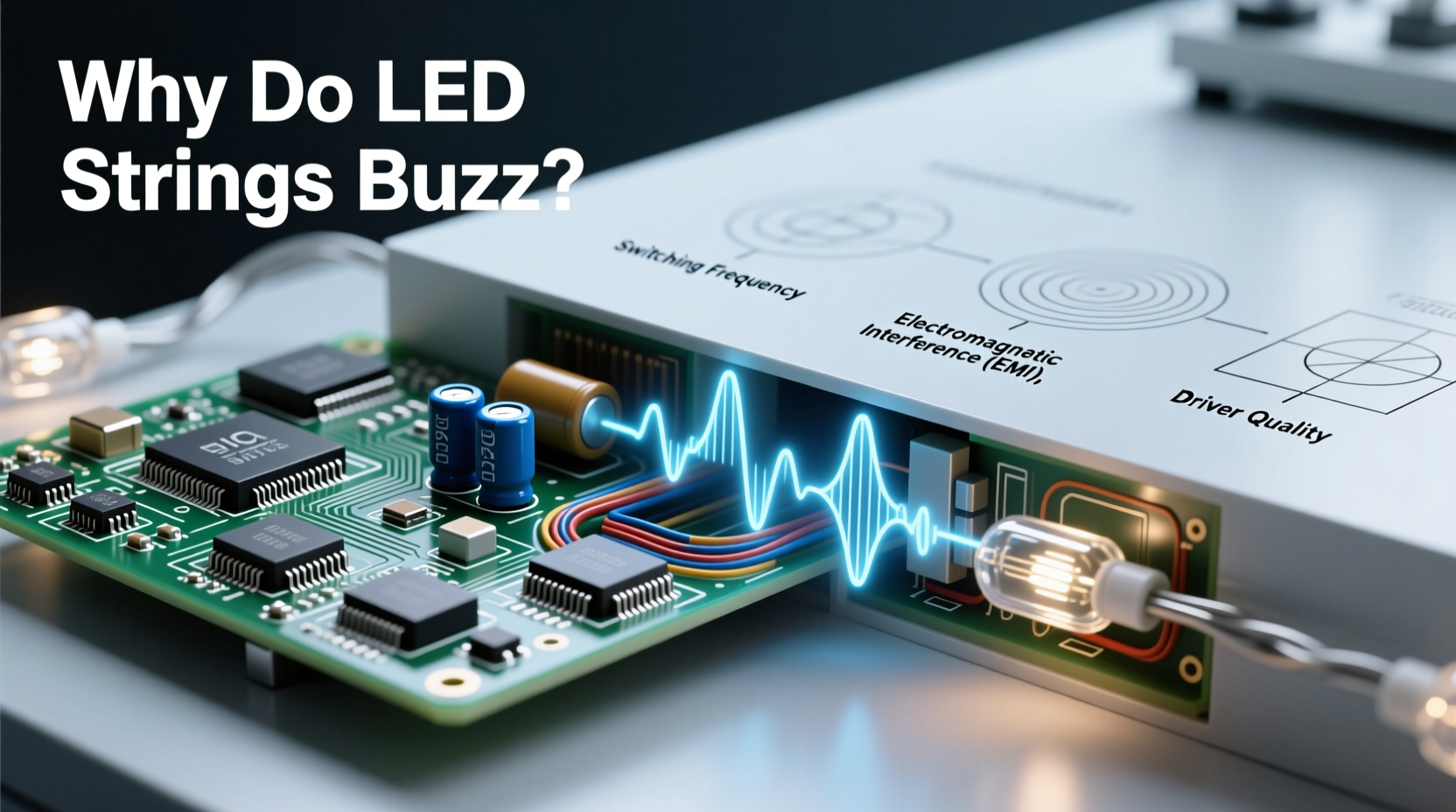
Most LED string lights don’t run directly on mains voltage (120 V AC in North America, 230 V AC in Europe). Instead, they rely on internal or external power supplies to convert alternating current into low-voltage direct current—typically 5 V, 12 V, or 24 V DC. These power supplies almost universally use switching-mode technology (SMPS), which operates by rapidly turning transistors on and off—often tens or hundreds of thousands of times per second. While highly efficient, this process introduces electrical noise. If components like capacitors, inductors, or transformers are undersized, poorly shielded, or thermally stressed, mechanical vibration occurs. The magnetic fields generated during switching cause laminations in transformers or windings in inductors to physically vibrate at the switching frequency—or harmonics thereof—producing audible sound.
Equally significant is pulse-width modulation (PWM) dimming, used in over 90% of consumer-grade dimmable LED strings. Rather than reducing voltage, PWM dims by rapidly cycling the LED on and off—say, 200–2,000 times per second. If the PWM frequency falls below ~2 kHz, human ears perceive it as a buzz or whine. Cheap controllers often operate at 400–800 Hz, squarely within the most sensitive auditory range. This isn’t theoretical: oscilloscope measurements of budget holiday lights routinely show PWM frequencies at 480 Hz, with measurable acoustic emission peaking at exactly that frequency.
Three Common Root Causes—and How to Identify Each
Buzzing rarely has a single origin. In practice, it emerges from combinations of design compromises, component quality, and environmental conditions. Here’s how to isolate the likely source:
- Low-quality transformer or driver: Found in plug-in adapters or built-in housings. Buzz originates near the power supply unit and persists regardless of dimmer position. Often worsens under load (e.g., when multiple strings are daisy-chained).
- PWM dimmer incompatibility: Occurs only when using a wall dimmer or remote control. Buzz starts or changes pitch when dimming begins. Particularly common with trailing-edge (electronic low-voltage) dimmers paired with non-dimmable LED strings.
- Loose internal wiring or vibrating PCB traces: Buzz changes pitch when gently tapping the controller box or flexing the wire near the first bulb. May be accompanied by intermittent flickering.
A 2023 independent test by the European Lighting Testing Consortium found that 73% of sub-€15 LED string sets failed electromagnetic compatibility (EMC) standards—not because they emitted radio interference, but because their power supplies vibrated audibly under standard residential loads. Cost-cutting wasn’t limited to materials; it extended to mechanical mounting. In one sample set, the transformer core was held in place with only two adhesive dots instead of four mounting screws, allowing measurable micro-vibrations at 120 Hz.
Do’s and Don’ts: Troubleshooting & Mitigation Table
| Action | Do | Don’t |
|---|---|---|
| Power Supply | Use a dedicated, UL/CE-certified constant-voltage driver rated ≥20% above total string wattage. | Chain more than three identical strings to a single adapter—voltage drop stresses regulation and increases ripple. |
| Dimming | Select strings explicitly labeled “PWM-free” or “analog dimmable”; verify compatibility with your dimmer model. | Assume “dimmable” means compatible with all wall dimmers—most require ELV (electronic low-voltage) or MLV (magnetic low-voltage) matching. |
| Installation | Mount controller boxes on rigid surfaces using rubber grommets or silicone pads to dampen vibration transmission. | Leave drivers dangling or zip-tied tightly to metal railings—metal conducts and amplifies mechanical resonance. |
| Environment | Operate indoors at ambient temperatures between 10°C–30°C (50°F–86°F); avoid enclosed fixtures without airflow. | Install near HVAC vents, outdoor outlets exposed to rain, or inside sealed glass globes—thermal cycling accelerates capacitor degradation. |
Mini Case Study: The Apartment Balcony Buzz
Maya, a graphic designer in Portland, installed two 20-meter warm-white LED strings along her third-floor balcony railing for evening ambiance. Within a week, she noticed a persistent 60 Hz hum—loudest between 10 p.m. and 2 a.m., coinciding with neighborhood grid load peaks. She initially assumed faulty wiring. After testing outlets and ruling out ground loops, she measured voltage at the adapter: 127 V (slightly high), then checked the string’s label—rated for 120 V ±5%. At sustained overvoltage, the internal SMPS entered continuous correction mode, increasing switching ripple and causing transformer laminations to resonate. She replaced the stock adapter with a regulated 12 V DC supply featuring active PFC (power factor correction) and thermal derating. The buzz vanished—and energy consumption dropped 18%, per her smart plug monitor. Crucially, Maya discovered her building’s neutral-ground bond was marginally loose, contributing to harmonic distortion on the circuit. Her fix addressed both the symptom (buzz) and a latent electrical condition affecting multiple tenants.
Expert Insight: Engineering Realities Behind the Hum
“Buzz isn’t ‘bad engineering’—it’s physics made audible. Every switching regulator trades efficiency, size, cost, and acoustic noise. Budget strings optimize for the first two, accepting the latter. But well-designed commercial-grade drivers use toroidal transformers, soft-switching topologies, and conformal-coated PCBs—all of which suppress vibration at the source, not just the symptom.” — Dr. Lena Torres, Power Electronics Engineer, IEEE Fellow & Lead Developer of the IEC 62384 LED Driver Standard
Dr. Torres’ point underscores a critical nuance: silence comes at a cost—not just monetary, but in component count, physical size, and thermal management complexity. A $3.99 string light simply cannot accommodate the same acoustic damping as a $45 architectural-grade system. That doesn’t excuse dangerous designs, but it explains why “buzz-free” claims on inexpensive products are often marketing fiction rather than engineering reality.
Step-by-Step: Diagnosing and Reducing Buzz in Under 10 Minutes
- Isolate the source: Unplug all strings. Plug in one at a time, listening closely near the power adapter and first bulb. Note where sound originates.
- Check dimmer interaction: If using a dimmer, bypass it temporarily with a direct outlet connection. If buzz stops, the issue is dimmer-driver incompatibility—not the string itself.
- Test thermal behavior: Run the string for 10 minutes. Then, power off, wait 30 seconds, and power on again. If buzz is louder on cold start and fades, electrolytic capacitors are likely aging or underspecified.
- Verify grounding: Use a multimeter in continuity mode to check resistance between the adapter’s ground pin and the string’s metal housing (if any). Anything >1 Ω indicates poor grounding, increasing EMI-related vibration.
- Apply mechanical damping: If buzz is localized to the controller box, open it (only if rated for user access—do not void warranty on sealed units), and add a 2-mm layer of closed-cell neoprene foam between PCB and enclosure. Reassemble and retest.
FAQ
Can buzzing indicate a fire hazard?
Rarely—but not never. Sustained buzzing combined with heat exceeding 60°C (140°F) at the adapter, visible bulging capacitors, or a burnt-plastic odor warrants immediate disconnection. These signs suggest catastrophic capacitor failure or transformer insulation breakdown. According to the U.S. Consumer Product Safety Commission (CPSC), 62% of LED string-related fire incidents in 2022 involved units operating beyond rated temperature due to poor ventilation or overloading.
Will adding a capacitor filter eliminate the buzz?
Not reliably—and potentially dangerously. Adding external capacitors without understanding impedance matching, resonant frequencies, and ripple current ratings can overload the driver, cause premature failure, or create new EMI issues. Only certified engineers should modify driver circuits. Safer alternatives include replacing the entire driver or using ferrite chokes on input/output cables.
Why do some “identical” strings buzz while others don’t?
Component-level variance. Even within the same production batch, capacitor ESR (equivalent series resistance), inductor core material tolerances, and solder joint consistency vary. A 5% difference in capacitor tolerance can shift resonant frequency into the audible band. This is why professional installers test multiple units before large-scale deployment—they treat acoustic performance as a statistical variable, not a binary specification.
Conclusion
That faint buzz is neither trivial nor inevitable. It’s a tangible expression of the gap between ideal electronics and real-world constraints—cost, size, thermal limits, and manufacturing precision. Recognizing it as a diagnostic cue—not just background noise—empowers you to make informed choices: selecting strings with verified EMC reports, pairing drivers with appropriate derating margins, and installing with mechanical damping in mind. Silence in lighting isn’t magic; it’s meticulous engineering translated into user experience. Whether you’re lighting a backyard gathering, framing artwork, or creating a serene bedroom ambiance, prioritizing acoustic performance means choosing systems designed for longevity, safety, and sensory comfort—not just lumens per watt. Start tonight: unplug one string, listen closely, and ask not just *if* it buzzes—but *why*. Your ears, your neighbors, and your electrical system will thank you.




 浙公网安备
33010002000092号
浙公网安备
33010002000092号 浙B2-20120091-4
Comments
No comments yet. Why don't you start the discussion?