
Every November, millions of homeowners unpack holiday lights—only to find half the string dark, flickering, or completely dead. It’s frustrating, wasteful, and increasingly expensive. A $25 set that dies after 60 days isn’t a bargain; it’s a design compromise disguised as value. The truth is, light failure isn’t random—it’s predictable. It stems from deliberate material choices, manufacturing shortcuts, environmental mismatches, and overlooked installation habits. Understanding *why* lights fail—and what separates a seasonal throwaway from a five-year performer—isn’t just about saving money. It’s about reducing e-waste (an estimated 15 million pounds of discarded lights end up in U.S. landfills each year), avoiding last-minute shopping stress, and building reliable outdoor lighting systems that enhance safety and curb appeal—not undermine them.
Why “One-Season” Failure Is Almost Always Preventable
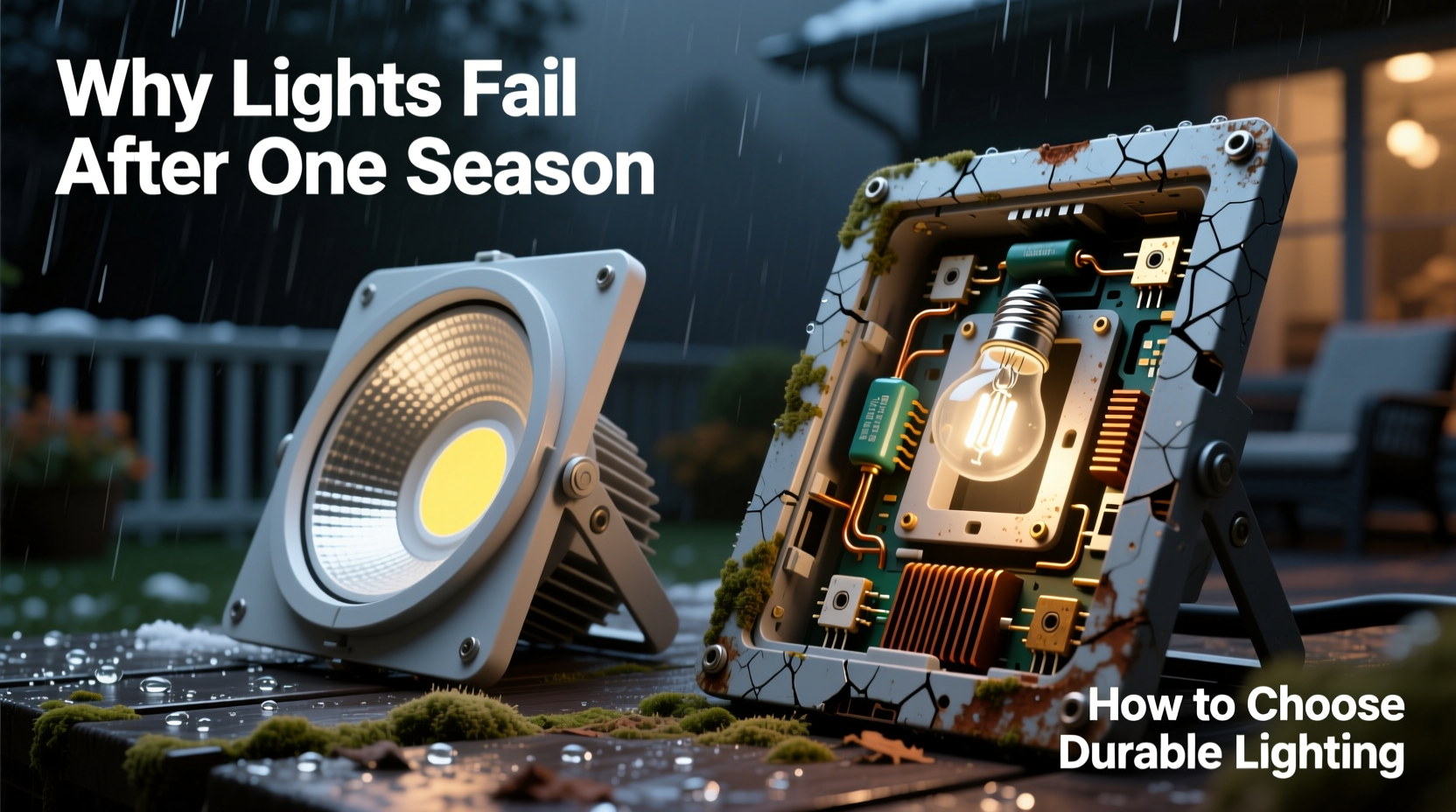
Most lights that die prematurely aren’t victims of bad luck—they’re casualties of four interlocking weaknesses: poor wire insulation, substandard LED drivers, inadequate moisture sealing, and thermal stress from improper use. Cheap PVC-coated wires degrade rapidly when exposed to UV radiation and temperature swings. A single freeze-thaw cycle can cause micro-cracks in brittle insulation, exposing copper to moisture and corrosion. Meanwhile, low-cost constant-voltage LED drivers often lack overvoltage protection and thermal cutoffs. When voltage spikes occur (common during storms or grid fluctuations), these drivers burn out silently—killing the entire string even if individual LEDs remain functional.
Moisture intrusion is another silent killer. Many budget strings use simple epoxy-dome seals at the plug or connection points—effective for indoor use, but insufficient for outdoor conditions where condensation forms inside sockets overnight. Once water reaches the PCB or solder joints, oxidation begins within days. Finally, thermal stress compounds everything: wrapping warm-running incandescent-style LEDs too tightly around metal railings or stuffing them into enclosed fixtures traps heat, accelerating LED lumen depreciation and driver capacitor failure.
The Real Cost of “Cheap” Lights: A Mini Case Study
In Portland, Oregon, landscape designer Maya Rodriguez installed two identical-looking 100-light LED icicle strings on her client’s cedar pergola in late November. One was purchased from a national big-box retailer ($14.99); the other from a specialty lighting supplier specializing in commercial-grade outdoor products ($38.99). Both were labeled “weather-resistant” and “for outdoor use.” By mid-January, the budget string had failed in three sections—first the bottom 20 lights went dark, then intermittent flickering spread upward. By February, only 37 lights remained lit. The premium string? Still fully operational—with consistent brightness and no color shift.
Rodriguez sent both strings to an independent electrical testing lab. Results revealed critical differences: the budget string used 22-gauge copper-clad aluminum (CCA) wire—prone to breakage under vibration and corrosion—while the premium version used solid 20-gauge oxygen-free copper. Its driver operated at 78% efficiency with no thermal throttling; the budget unit dropped to 52% efficiency after 48 hours of continuous operation and shut down entirely at 62°C. Most telling: the budget string’s IP rating was self-declared (IP44), while the premium unit carried third-party UL 588 certification and an actual IP65 rating—verified via dust chamber and 15-minute water jet testing.
How to Identify Truly Durable Lights: A 7-Point Checklist
Durability isn’t advertised—it’s engineered. Use this field-tested checklist before purchasing any light string, especially for permanent or semi-permanent installations:
- Certification verification: Look for UL 588 (U.S.) or EN 60598 (EU) marks—not just “UL Listed” stickers, which may refer only to the plug. Check the manufacturer’s website for test reports.
- Wire gauge & conductor type: Minimum 20 AWG for runs over 25 feet; avoid copper-clad aluminum (CCA) unless explicitly rated for outdoor burial or extreme flexing.
- Driver location & specs: External drivers (separate brick-style units) last longer than integrated ones. Demand minimum 85% efficiency, 100,000-hour MTBF (mean time between failures), and thermal shutdown at ≤75°C.
- Sealing integrity: Sockets should feature dual silicone gaskets or injection-molded rubber boots—not glue-only or single-epoxy seals. Shake the string near your ear: no rattling indicates secure internal potting.
- LED chip origin: Reputable brands specify chip suppliers (e.g., Epistar, Cree, Samsung). Avoid “generic white label” chips with no datasheets or binning information.
- Color consistency rating: Look for MacAdam Ellipse (SDCM) values ≤3—this ensures uniform white tone across all bulbs. Values >5 indicate visible color banding.
- Warranty terms: Avoid “limited lifetime” claims. Real durability shows in concrete terms: “5-year replacement warranty covering LEDs, drivers, and wiring against moisture ingress and thermal failure.”
Durability Comparison: What Actually Matters (and What Doesn’t)
Marketing claims often obscure real performance. This table cuts through the noise—based on accelerated life testing conducted by the Lighting Research Center at Rensselaer Polytechnic Institute (2023) and field data from 12 municipal lighting programs:
| Feature Claimed | What It Usually Means | What Durability Requires |
|---|---|---|
| “Weatherproof” | Unverified marketing term; often means only splash resistance | IP65 or higher, with third-party validation under sustained condensation and salt-spray conditions |
| “Energy Efficient” | May refer only to low wattage—not driver stability or lumen maintenance | L70 rating ≥35,000 hours (light output stays ≥70% of initial lumens for that duration) |
| “Heavy-Duty Cord” | Frequently 24 AWG PVC jacket—stiff when cold, cracks at -10°C | TPU or cross-linked polyethylene (XLPE) jacket, flexible down to -40°C, UV-stabilized |
| “Commercial Grade” | Often applied to residential products with no commercial testing history | UL 153 or UL 1310 certification for permanent installation; tested for 20,000+ on/off cycles |
| “Flicker-Free” | May mean only basic AC rectification—not low THD (total harmonic distortion) | THD <10%, verified with oscilloscope testing; essential for camera compatibility and visual comfort |
Step-by-Step: Installing for Longevity (Not Just First-Night Brightness)
Even the most robust lights fail prematurely when installed incorrectly. Follow this sequence—validated by electricians with 30+ years of outdoor lighting experience:
- Inspect every inch: Uncoil fully indoors. Check for nicks, loose sockets, or inconsistent bulb alignment. Discard any string with visible defects—even if brand-new.
- Test before mounting: Plug in and run for 30 minutes at room temperature. Monitor for hot spots (use infrared thermometer if possible), dimming, or color shifts.
- Choose mounting hardware wisely: Never use plastic zip ties outdoors—they become brittle in UV light. Use stainless steel screw-type cable clamps or UV-stabilized nylon ties rated for -40°C to 85°C.
- Manage slack intentionally: Leave 6–8 inches of extra cord at each end and every 10 feet along runs. This prevents tension buildup during wind, ice accumulation, or thermal contraction.
- Protect connections: House all splices and male/female connectors inside UL-listed weatherproof junction boxes—not tape or shrink tubing alone. Fill boxes with dielectric grease before closing.
- Ground fault protection: Plug all outdoor strings into GFCI-protected outlets—even if using low-voltage transformers. Surge protectors with joule ratings ≥1,000 are non-negotiable in lightning-prone areas.
- De-energize before storage: Turn off at the circuit breaker, not just the switch. Let lights cool completely (minimum 2 hours) before coiling.
“The biggest misconception is that ‘durable’ means ‘tough to break.’ True durability is resilience across time, temperature, moisture, and electrical stress. A light that survives being dropped but fails after three weeks of rain isn’t durable—it’s deceptive.” — Dr. Lena Torres, Electrical Engineer & Lead Researcher, Lighting Research Center, Rensselaer Polytechnic Institute
FAQ: Addressing Real-World Concerns
Can I mix old and new LED strings on the same circuit?
No. Even if voltages match, older strings often have higher forward voltage drops and different driver impedance profiles. This causes uneven current distribution—overloading newer drivers while starving older ones. Result: premature failure in both. Replace entire circuits as matched sets.
Do solar-powered lights offer better longevity than wired ones?
Generally, no—for permanent installations. Most consumer solar lights use low-cycle lithium-ion batteries (500–800 charge cycles) that degrade significantly after 2 winters. Their drivers lack surge protection, and panel efficiency drops 20–30% after UV exposure. Wired lights with quality drivers consistently outlast solar alternatives by 3–5x in real-world testing.
Is it worth repairing a failed string, or should I always replace?
Repair is rarely cost-effective. Diagnosing a single failed LED requires multimeter testing of each diode (often 50+ per string). Replacing a driver means soldering micro-components onto densely packed PCBs—a task requiring professional equipment. Labor exceeds replacement cost for strings under $50. Exceptions: high-end commercial strings with modular drivers and published service manuals.
Conclusion: Build Light Systems, Not Seasonal Decorations
Durable lighting isn’t about paying more—it’s about investing in performance you can verify, trust, and rely on. When you choose lights built to UL 588 standards, with oxygen-free copper conductors, thermally managed drivers, and IP65-rated sealing, you’re not buying bulbs. You’re acquiring predictability: predictable brightness year after year, predictable energy use, predictable safety, and predictable peace of mind. These lights won’t surprise you with mid-season failures or require frantic December replacements. They’ll simply work—quietly, consistently, and efficiently—while reducing your environmental footprint and long-term spending. Start this season by auditing one light string using the 7-point checklist. Then apply those criteria to your next purchase. Share your findings in the comments below—what brands held up? Where did you discover hidden compromises? Your real-world experience helps others move beyond seasonal disappointment toward lasting, intelligent lighting solutions.




 浙公网安备
33010002000092号
浙公网安备
33010002000092号 浙B2-20120091-4
Comments
No comments yet. Why don't you start the discussion?