
Flickering lights are among the most common yet widely misunderstood electrical symptoms in residential buildings. When a light dims or pulses—not randomly, but predictably—each time the refrigerator kicks in, the air conditioner compresses, or the microwave starts heating, it’s not just an annoyance. It’s a diagnostic signal. This precise correlation points directly to underlying circuit-level stress: inadequate wiring capacity, compromised connections, undersized service panels, or shared neutral imbalances. Unlike intermittent flickering caused by failing bulbs or dimmer switches, this synchronized behavior is a red flag that your home’s electrical infrastructure may be operating beyond safe design limits. Ignoring it risks more than energy inefficiency—it invites overheating, accelerated component wear, and, in worst-case scenarios, fire hazards.
How Electrical Circuits Respond to Sudden Load Changes
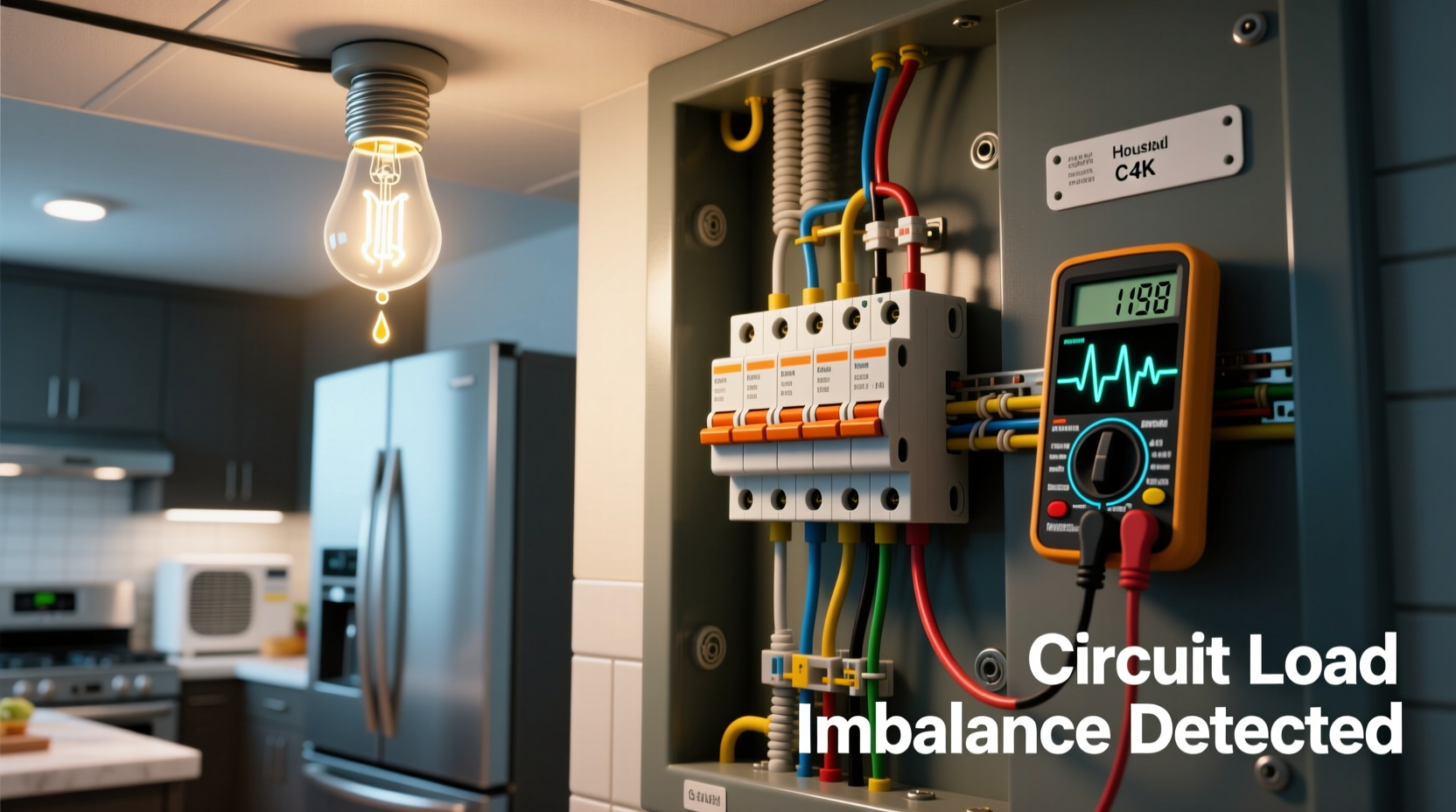
Every circuit in your home operates under Ohm’s Law: voltage (V) equals current (I) multiplied by resistance (R). When a high-wattage appliance—like a 1,500-watt space heater or a 3,000-watt electric dryer—powers on, it draws a large inrush current. That surge momentarily increases the total load on the circuit or shared branch. If the circuit is already near capacity—or if its conductors, connections, or panel bus bars cannot handle the transient demand—voltage at downstream outlets and lighting fixtures drops. Incandescent and halogen bulbs respond visibly to even minor voltage fluctuations; LEDs and CFLs may flicker due to sensitive internal drivers reacting to unstable input. The key insight: flickering *only* during appliance startup isn’t about the light itself—it’s about how the entire circuit path handles dynamic load transitions.
This phenomenon rarely occurs in isolation. It typically reflects one or more of four interrelated conditions: overloaded circuits, loose or corroded connections, undersized wiring (especially in older homes with 14-gauge conductors on 15-amp circuits), or neutral conductor issues in multi-wire branch circuits (MWBCs). Each contributes differently to voltage instability—and each requires distinct diagnostic steps.
Five Common Root Causes—and What They Reveal
Understanding the specific cause behind synchronized flickering helps prioritize response and assess urgency. Below are the five most frequent culprits, ranked by likelihood and risk severity:
- Loose Service Conductors or Panel Connections: Often the most dangerous cause. Loose lugs at the main breaker, neutral bar, or utility meter socket create high-resistance points. Under load, these heat up, causing voltage drop and arcing—evident as rhythmic flickering tied to heavy appliance cycles. This condition can degrade insulation and ignite surrounding materials.
- Overloaded Shared Circuit: A single 15-amp circuit powering both kitchen lighting and countertop outlets may dip below 110 volts when a toaster oven and blender operate simultaneously. Voltage sag triggers visible dimming in incandescent fixtures and erratic behavior in LED drivers.
- Degraded Neutral Connection (in MWBCs): In older homes using multi-wire branch circuits—where two 120V legs share one neutral wire—a loose or broken neutral causes severe voltage imbalance. One leg may spike to 140V (burning out bulbs), while the other drops to 90V (causing deep dimming). Flickering intensifies when large loads shift between legs.
- Undersized Wiring for Modern Loads: Homes wired before 1980 often used 14-gauge wire for general circuits. Today’s combination of LED lighting, smart devices, and high-efficiency appliances creates complex harmonic loads that older conductors and breakers weren’t designed to manage smoothly.
- Failing Utility Transformer or Service Drop: Less common but critical to rule out. If flickering coincides with neighbor complaints or affects multiple homes, the issue may originate upstream—at the transformer or overhead service lines—especially during peak summer demand.
Diagnostic Checklist: What You Can Safely Observe Before Calling an Electrician
Before contacting a licensed professional, gather objective data. These observations help narrow root causes and ensure your electrician arrives prepared—not troubleshooting blindly.
- ✅ Map the pattern: Note exactly which lights flicker—and whether they’re on the same circuit as the triggering appliance (use your breaker panel labels or test by turning off breakers).
- ✅ Time the duration: Is the flicker momentary (under 1 second) or sustained (3+ seconds)? Momentary dips suggest inrush current; sustained dimming indicates chronic overload or poor connections.
- ✅ Check for warmth: Carefully feel faceplates, switch boxes, and outlets near affected lights or appliances. Warmth or buzzing indicates resistance heating—a serious warning sign.
- ✅ Test across circuits: Does flickering occur only on one circuit—or does it affect lights in other rooms? Widespread flickering points to main service or neutral issues.
- ✅ Observe utility equipment: Look for damaged weatherheads, sagging service drops, or corroded meter sockets. Note if flickering worsens during wind or rain—indicating loose aerial connections.
Real-World Case Study: The “Fridge-and-Foyer” Flicker
In a 1958 brick bungalow in Portland, Oregon, the homeowner noticed the foyer chandelier dimmed sharply every time the refrigerator compressor cycled on. Initially dismissed as “old-house quirks,” the issue escalated over six months: LED bulbs began failing prematurely, and a wall switch developed a faint buzzing sound. An electrician’s inspection revealed three compounding problems. First, the refrigerator and foyer lighting shared a single 14-gauge, 15-amp circuit—originally intended for lighting only. Second, the neutral connection at the main panel had corroded, increasing resistance by over 300%. Third, the service entrance cables showed thermal discoloration near the meter base.
The solution wasn’t just adding a dedicated circuit. It required tightening all neutral lugs, replacing the corroded neutral bar, upgrading the service entrance conductors, and relocating the refrigerator to a newly installed 20-amp circuit. Post-repair voltage remained stable within ±2% under full load. Crucially, the electrician discovered the corrosion had begun after a minor lightning strike two years prior—undetected until symptoms accumulated. This case underscores how seemingly isolated flickering can expose latent, system-wide vulnerabilities.
Do’s and Don’ts: Safe Response Protocol
Electrical safety hinges on knowing when action is urgent—and when delay introduces risk. Use this table to guide immediate decisions.
| Action | Do | Don’t |
|---|---|---|
| Initial Observation | Document timing, affected fixtures, and triggering appliances. Take voltage readings (if qualified) at outlets during load events. | Ignore repeated patterns—even if “it’s been happening for years.” Degradation accelerates silently. |
| While Investigating | Unplug non-essential high-wattage devices on suspect circuits. Avoid using space heaters or hair dryers on affected circuits. | Attempt to tighten panel connections yourself unless licensed. Main panel work requires de-energizing by the utility. |
| When Calling Help | Provide your electrician with your diagnostic notes—including photos of panel labeling and any warm devices. | Accept “it’s normal” without explanation. Reputable professionals will describe the physics of the issue and propose measurable solutions. |
| Long-Term Prevention | Install whole-home surge protection and schedule infrared thermography scans every 3–5 years. | Rely solely on LED bulb replacements. Fixing the symptom never resolves the circuit-level cause. |
Expert Insight: Why Voltage Stability Matters More Than Ever
“Modern electronics don’t just tolerate voltage swings—they amplify their consequences. A 5% dip that once made an incandescent bulb glow slightly dimmer now crashes smart home hubs, corrupts SSD firmware, and stresses LED driver capacitors. Flickering isn’t nostalgia; it’s your home’s power quality screaming for attention.” — Carlos Mendez, PE, Senior Power Systems Engineer, National Electrical Contractors Association (NECA)
Mendez’s observation highlights a paradigm shift: today’s homes contain far more voltage-sensitive devices than ever before. Where flickering was once merely aesthetic, it now correlates with measurable equipment degradation. Studies by the IEEE show that sustained voltage fluctuations exceeding ±5% reduce the mean time between failures (MTBF) for LED drivers by up to 40%. Similarly, repeated thermal cycling from load-induced resistance heating shortens the lifespan of circuit breakers and receptacles. This isn’t theoretical—it’s documented failure mode data.
Step-by-Step: How a Licensed Electrician Diagnoses the Issue
A thorough diagnosis follows a logical progression—from broad system checks to localized verification. Here’s what happens during a professional assessment:
- Baseline Measurement: Using a digital multimeter, the electrician records open-circuit voltage at the main panel (should be 120V ±5% per leg) and neutral-to-ground voltage (should be ≤2V).
- Load Simulation: High-wattage loads (e.g., space heater, hair dryer) are strategically applied while monitoring voltage drop across circuits and neutral integrity.
- Infrared Scan: Thermal imaging identifies hot spots at breakers, bus bars, and neutral connections—revealing resistance before catastrophic failure.
- Circuit Mapping & Load Audit: Every outlet, switch, and fixture is traced to its breaker. Total connected load is calculated against NEC ampacity tables (e.g., 14 AWG = 15A max, 12 AWG = 20A max).
- Neutral Integrity Test: For suspected MWBC issues, the electrician measures voltage between legs and neutral under varying load conditions to detect imbalance.
- Recommendation & Scope: Based on findings, the electrician delivers a prioritized list: emergency repairs (loose neutrals), high-value upgrades (dedicated circuits), and long-term investments (panel replacement).
FAQ: Frequently Asked Questions
Can LED bulbs cause flickering when appliances turn on?
No—LED bulbs don’t cause the flickering, but they make it more noticeable. Their electronic drivers are highly responsive to voltage fluctuations. Older incandescent bulbs masked minor sags with gradual thermal inertia; LEDs react instantly. Replacing incandescents with LEDs won’t fix the root cause—and may expose previously undetected circuit stress.
Is it safe to keep using lights that flicker this way?
Not without evaluation. Momentary, mild dimming on a lightly loaded circuit may pose low immediate risk—but sustained or worsening flickering signals progressive deterioration. According to NFPA 70E, any observed heating at connections exceeds safe operational thresholds. Delaying investigation increases fire risk exponentially.
Will adding more circuits solve the problem?
Often—but not always. Dedicated circuits eliminate shared-load conflicts, yet they won’t resolve upstream issues like a failing main neutral or undersized service entrance. A proper solution requires diagnosing the *entire* path: utility feed → meter → main panel → subpanels → branch circuits. Adding circuits without addressing the root cause is like installing new tires on a car with warped axles.
Conclusion
Flickering lights triggered by appliance operation are not benign quirks of aging infrastructure. They are precise, real-time indicators of electrical stress—visible evidence that voltage, current, and resistance are interacting outside safe engineering parameters. Whether rooted in a corroded neutral lug, an overloaded 14-gauge wire, or a compromised utility connection, each instance represents an opportunity to intervene before degradation becomes danger. Modern homes demand modern power quality: stable voltage, balanced loads, and thermally sound connections. Addressing flickering isn’t about restoring ambiance—it’s about ensuring reliability, extending equipment life, and safeguarding your family’s safety.
Don’t wait for the next bulb to burn out or the first outlet to buzz. Gather your observations, consult a licensed electrician who performs load testing and thermal imaging, and treat the symptom as the messenger—not the message. Your home’s electrical system is the silent foundation of comfort, connectivity, and security. Give it the attention its performance—and your peace of mind—deserve.




 浙公网安备
33010002000092号
浙公网安备
33010002000092号 浙B2-20120091-4
Comments
No comments yet. Why don't you start the discussion?