
It’s a subtle but unmistakable phenomenon: as daylight fades and twilight settles in, the same LED streetlight you passed at noon suddenly seems cool—almost icy—casting a faint blue halo on sidewalks and storefronts. Yet by 10 p.m., that same fixture appears noticeably warmer, even amber-tinged, blending more softly into the nocturnal landscape. This isn’t an illusion caused by tired eyes or faulty bulbs. It’s a precise, biologically grounded interaction between light physics, retinal physiology, and environmental context—a convergence of photometry, neuroscience, and urban design that shapes how we experience nighttime spaces.
This perceptual shift matters more than most realize. Municipalities invest billions in LED retrofits for energy savings, yet many report public complaints about “harsh blue glare” at dusk—only to see those same lights praised for their “cozy, welcoming glow” later at night. Understanding why this happens isn’t just academic; it informs smarter lighting specifications, reduces light pollution, improves pedestrian safety, and supports circadian health. Below, we break down the layered mechanisms—and offer actionable insights for designers, planners, and everyday observers.
The Dual-System Reality of Human Vision
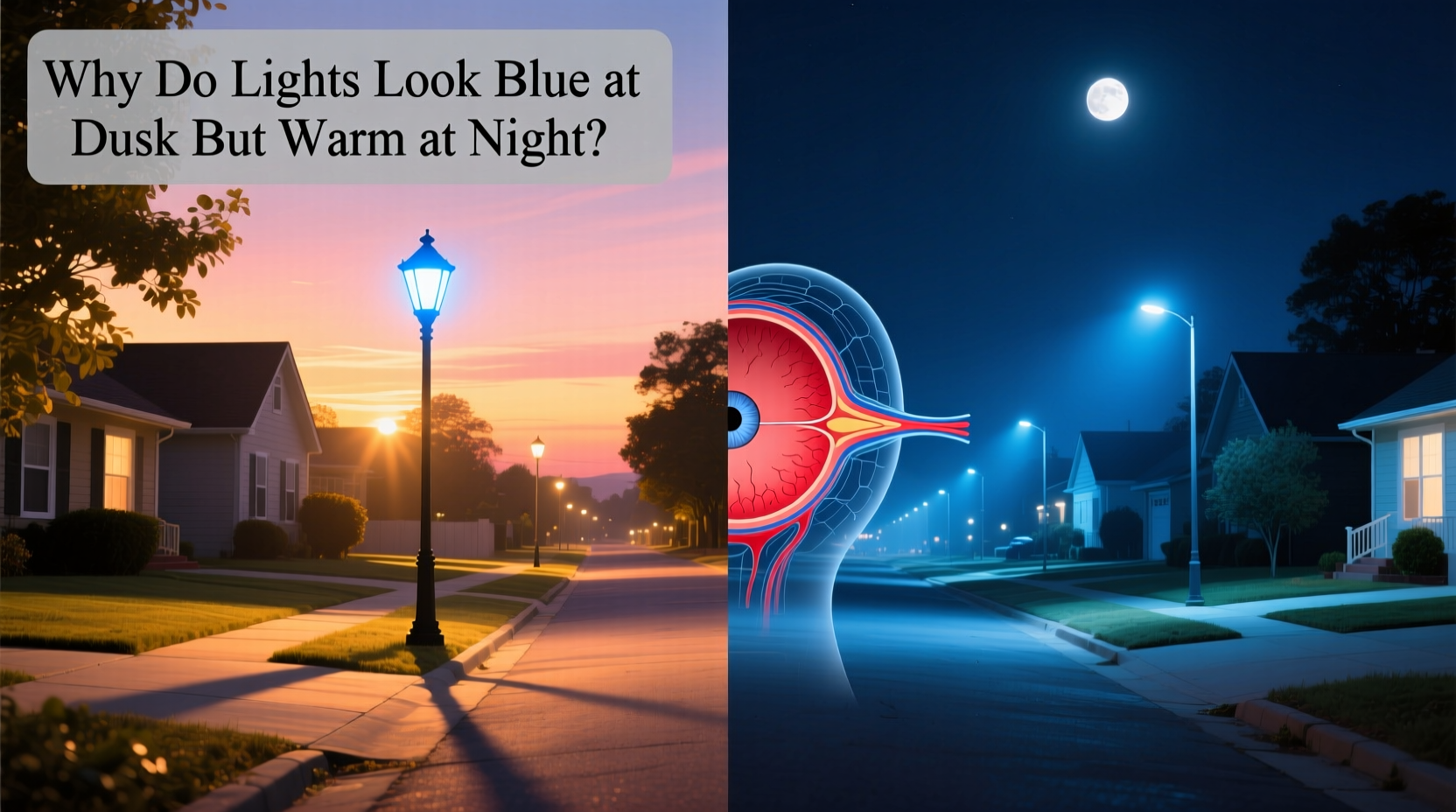
Human vision operates across two distinct physiological modes: photopic (daytime) and scotopic (nighttime), with a transitional mesopic range in between—precisely where dusk and dawn reside. These aren’t arbitrary labels; they reflect which photoreceptors dominate visual processing.
In bright daylight, cone photoreceptors—concentrated in the fovea and sensitive to red, green, and blue wavelengths—drive high-acuity, color-rich vision. But as ambient light drops below ~3 cd/m² (roughly the luminance of a clear twilight sky), rods—far more sensitive to light but color-blind and peak-sensitive around 498 nm (blue-green)—begin contributing significantly. Between 0.001 and 3 cd/m² lies the mesopic zone, where both rods and cones are active, but not equally. Crucially, rods respond more strongly to shorter (bluer) wavelengths than cones do. So when ambient light dims, rod input surges—not uniformly across the spectrum, but preferentially in the blue-green band.
This spectral imbalance creates a perceptual bias: under mesopic conditions, bluer light sources appear disproportionately brighter and more saturated relative to warmer ones. A 4000K LED with strong 450–480 nm emission may register as stark and clinical at dusk—but by midnight, when ambient light has fallen further and rod dominance increases, its blue component is no longer “competing” against daylight’s full spectrum. Instead, it’s interpreted against near-total darkness, where contrast sensitivity shifts and chromatic adaptation recalibrates.
Spectral Power Distribution (SPD) Meets Atmospheric Scattering
The light source itself doesn’t change—but its spectral output interacts dynamically with the environment. At dusk, sunlight still reaches the upper atmosphere, scattering short wavelengths (Rayleigh scattering) and bathing the sky in diffuse blue light. This skylight mixes with artificial light, effectively “cooling” the perceived white point of nearby fixtures. A 3000K LED may appear closer to 4500K when backlit by a vivid twilight sky.
By night, that skylight vanishes. The only illumination comes from the fixture itself and distant, scattered light pollution. Without competing blue skylight, the lamp’s intrinsic SPD dominates perception. Many modern LEDs use phosphor-converted blue chips (450 nm primary) with broad yellow phosphor emission. Their SPD often shows a pronounced blue “spike” followed by a smoother yellow-green hump. In daylight, our visual system normalizes this spike as part of “white.” At night, without reference, the eye perceives the spike’s intensity relative to the broader emission—and because rods amplify that blue region, the spike feels less dominant. The result? A subjectively warmer, more balanced appearance.
This effect is amplified by optical design. Many streetlights use asymmetric optics that direct light downward, minimizing upward spill. At dusk, reflected light from pavement and buildings—rich in longer wavelengths due to surface albedo—adds warmth to the scene. At night, with less ambient reflection and greater reliance on direct fixture output, the light’s inherent balance reasserts itself.
A Real-World Example: The Austin LED Retrofit Study
In 2021, the City of Austin upgraded 37,000 streetlights to 3000K LED fixtures with high CRI (>80) and controlled optical distribution. Initial resident surveys conducted at 7:30 p.m. (civil twilight) reported 62% dissatisfaction with “excessive blue glare,” citing discomfort while walking and difficulty judging pavement texture. However, follow-up interviews at 11 p.m. showed only 14% expressed similar concerns—and 41% described the lighting as “soothing” and “easy on the eyes.”
Researchers from UT Austin’s Lighting Research Group installed spectral radiometers at five intersections to measure actual SPD and illuminance over time. They found that correlated color temperature (CCT) readings remained stable at 3020±15K across all hours—confirming no physical shift in the lamps. What changed was the ratio of direct fixture output to ambient skylight: at dusk, ambient skylight contributed up to 35% of total horizontal illuminance (peaking in the 420–470 nm band); by midnight, that contribution fell to under 2%. Simultaneously, pupil dilation increased by 40%, enhancing rod-mediated sensitivity to the fixture’s full spectral curve—not just its blue peak.
The takeaway wasn’t that the lights were flawed—it was that evaluation timing skewed perception. Austin revised its procurement language to require mesopic photometric modeling and mandated dusk-time field validation for all future lighting projects.
Do’s and Don’ts for Lighting Designers & Municipal Planners
| Action | Why It Works | Risk of Skipping |
|---|---|---|
| Specify tunable-white fixtures with automatic dimming and CCT shift based on astronomical time | Allows gradual transition from 4000K at dusk (supporting visual acuity) to 2700K by midnight (reducing melatonin suppression and improving color rendering in low light) | Static CCT forces compromise: too warm at dusk (poor peripheral detection), too cool at night (circadian disruption) |
| Use spectrally optimized LEDs with reduced 440–460 nm emission (without sacrificing efficacy) | Minimizes rod oversaturation at mesopic levels while maintaining lumen output and color fidelity | Standard “blue-pump” LEDs create perceptual harshness and increase skyglow by 3–5× compared to violet-pump alternatives |
| Require full-spectrum SPD reports—not just CCT and CRI—from manufacturers | CCT alone hides dangerous blue spikes; SPD reveals actual energy distribution across 380–780 nm | Two lamps labeled “3000K” can have radically different mesopic performance—one may appear 500K cooler due to spectral shape |
| Install adaptive controls that reduce vertical illuminance by 30% after 11 p.m. in residential zones | Lowers rod saturation, allowing cones to remain partially engaged—preserving color discrimination and reducing glare | Constant high-output lighting at night degrades dark adaptation, increasing accident risk for pedestrians and drivers alike |
Expert Insight: The Neuroscience of Chromatic Adaptation
“The retina doesn’t ‘see’ absolute color—it computes contrast relative to recent exposure history. At dusk, your cones are still adapted to daylight’s broad spectrum, so a narrow-band LED spike looks unnaturally intense. By midnight, your entire visual system has undergone a 20-minute biochemical recalibration: photopigment regeneration, neural gain adjustments in the lateral geniculate nucleus, and cortical reweighting of chromatic channels. That’s why the same light feels different—not because it changed, but because you did.”
— Dr. Lena Torres, Professor of Visual Neuroscience, University of Pennsylvania
Dr. Torres’ team demonstrated this using fMRI and pupillometry in controlled lab settings. Participants exposed to simulated twilight (5000K + 2000K skylight mix) followed by full darkness showed measurable delays in L-cone recovery—meaning red-sensitive cones took longer to regain sensitivity than M- or S-cones. This temporary imbalance tilts color perception toward yellow-green, making fixed-CCT sources appear warmer than their nominal rating. The effect peaks 45–60 minutes after full darkness onset and persists until morning light triggers photoreceptor reset.
Practical Checklist for Homeowners and Facility Managers
- ✅ Check your exterior fixtures’ SPD data sheet—not just CCT. Look for peak intensity below 455 nm; if >25% of total radiant power falls between 440–460 nm, expect blue-dominant dusk appearance.
- ✅ Install motion-sensing dimmers that reduce output to 30% when no activity is detected—this maintains mesopic adaptation without compromising safety.
- ✅ Use warm-white (2200–2700K) accent lighting near entryways and pathways; these avoid blue spikes entirely and appear consistently warm across all light levels.
- ✅ Plant deciduous trees or install adjustable louvers to block direct line-of-sight to fixture housings at eye level—reducing glare that exaggerates perceived coolness.
- ✅ Replace older “cool-white” (5000K+) fixtures immediately; their excessive blue output disrupts mesopic vision and contributes disproportionately to light pollution.
FAQ
Does this mean my LED bulbs are defective if they look blue at dusk?
No. This is expected behavior for most commercially available LEDs. Defects would manifest as inconsistent color across units, flickering, or rapid color shift over time—not a predictable dusk-to-night transition. If all your fixtures behave identically, it reflects good spectral consistency—not malfunction.
Can I adjust my smart lights to compensate for this shift?
Yes—if your system supports astronomical scheduling and tunable white. Set a gradual CCT ramp: e.g., 4000K at sunset → 3500K at 9 p.m. → 2700K at midnight. Avoid abrupt jumps; the visual system adapts best to changes under 100K/hour. Pair with dimming: reduce intensity by 15% per hour after sunset to support natural dark adaptation.
Why don’t incandescent or halogen lights show this effect?
They do—but far less noticeably. Incandescents emit a smooth, blackbody spectrum with minimal short-wavelength energy. Their SPD has no blue spike to be amplified by rods, and their warm CCT (2700K) changes little perceptually across mesopic transitions. The effect is most pronounced with narrow-spectrum or blue-pump LEDs precisely because their spectral shape creates high contrast with rod sensitivity curves.
Conclusion: Seeing Light as a Dynamic Relationship
The blue-at-dusk, warm-at-night shift isn’t a quirk to be corrected—it’s a reminder that light is never experienced in isolation. It’s a dialogue between photons and photoreceptors, between fixtures and atmosphere, between technology and biology. Recognizing this transforms how we specify, install, and interact with artificial light. For cities, it means investing in adaptive systems rather than static specs. For architects, it means designing façades and materials that complement mesopic spectral behavior—not just photopic aesthetics. For individuals, it means choosing home lighting that respects natural adaptation rhythms instead of fighting them.
You don’t need a spectrometer to start applying this knowledge today. Next time you walk outside at twilight, pause for 90 seconds in the dimming light. Notice how your pupils widen, how colors soften, how shadows deepen—not uniformly, but with a subtle blue emphasis. Then return at midnight. Observe the shift—not in the lamp, but in yourself. That awareness is the first step toward more humane, effective, and sustainable lighting practices.




 浙公网安备
33010002000092号
浙公网安备
33010002000092号 浙B2-20120091-4
Comments
No comments yet. Why don't you start the discussion?