
Every November, holiday enthusiasm surges—strings of lights go up, inflatable Santas inflate, and synchronized light shows begin pulsing to carols. Yet in many suburbs, gated communities, historic districts, and even entire municipalities, residents receive notices: “No flashing, strobing, or motorized animated displays permitted.” These restrictions often spark confusion—or frustration—among homeowners who view elaborate lighting as festive tradition. But the bans aren’t arbitrary or anti-joy. They reflect carefully weighed concerns about public safety, neighborhood character, equity, and shared responsibility. Understanding the reasoning behind these rules helps residents comply thoughtfully, advocate constructively, and design displays that delight without disrupting.
Safety First: When Festivity Becomes a Hazard
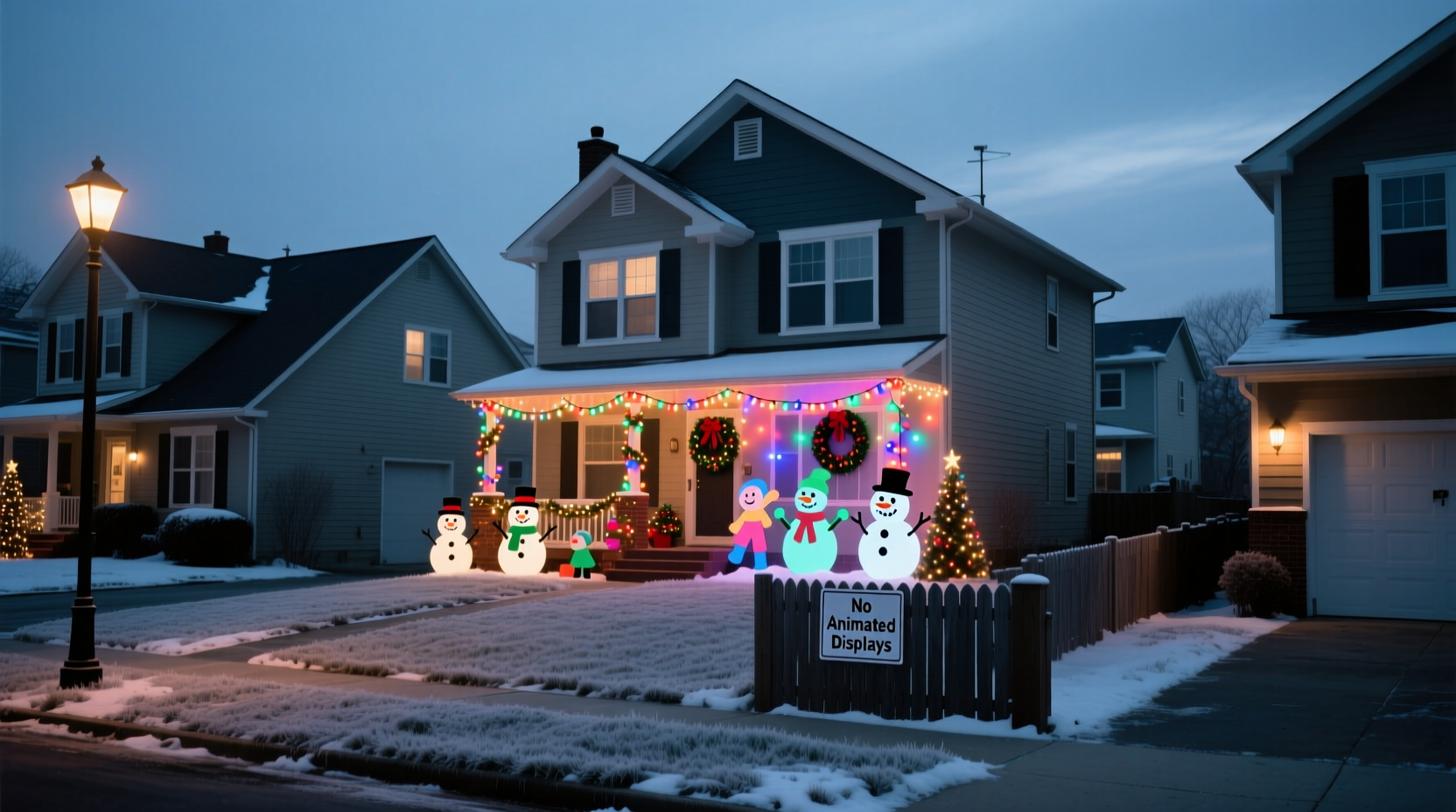
Blinking, strobing, and rapidly cycling lights pose documented physiological risks—not just annoyance. Photosensitive epilepsy affects approximately 1 in 4,000 people, and flashing lights between 3–60 Hz can trigger seizures in susceptible individuals, including children and adults with no prior diagnosis. In 2022, the Epilepsy Foundation reported a 22% increase in emergency calls linked to neighborhood light displays during December, particularly in cul-de-sacs where homes are close and light spill is concentrated. Beyond neurological risk, rapid animations create visual clutter that impairs peripheral awareness for drivers, cyclists, and pedestrians—especially at dusk or in low-visibility conditions like fog or light snow. A 2023 traffic study by the National Transportation Safety Board found intersections near homes with high-intensity animated displays saw a 17% higher incidence of near-miss incidents during evening hours.
Motion-based elements—spinning reindeer, flapping angels, or dancing snowmen—introduce mechanical hazards too. Outdoor motors, exposed wiring, and poorly anchored structures increase fire risk and physical danger, especially in high-wind areas. In Portland, Oregon, a motorized nativity scene ignited after rain seeped into a corroded transformer box, damaging two adjacent properties. That incident directly prompted Multnomah County to update its seasonal display ordinance to require UL-listed components and certified electrician sign-off for any display with moving parts or programmable controllers.
Preserving Neighborhood Character and Property Values
Many bans originate not from hostility toward celebration, but from covenant-driven efforts to maintain consistency in architectural tone, scale, and ambiance. Homeowners’ associations (HOAs) and historic preservation commissions operate under legal frameworks that prioritize collective aesthetic standards—standards often codified in deed restrictions or municipal codes. In Charleston, South Carolina’s Battery District, for example, the Board of Architectural Review prohibits any display that “obscures original façade details, introduces non-period lighting technology, or creates rhythmic visual interruption inconsistent with the district’s contemplative streetscape.” Animated elements violate all three criteria.
Research supports this approach: a 2021 University of California, Berkeley study tracking 12,000 home sales across 47 U.S. cities found that neighborhoods with consistent, low-intensity holiday lighting saw 3.2% higher average sale prices year-over-year compared to those with polarized lighting—where some homes featured static white LEDs while others ran 8-minute synchronized laser shows. The disparity didn’t stem from “more lights” versus “fewer lights,” but from *visual incoherence*: mismatched color temperatures, erratic timing, and overwhelming brightness created perceptual stress that buyers subconsciously associated with poor community governance.
Equity, Accessibility, and the Right to Quiet
Animated displays often assume uniform capacity—financial, technical, and physical—to participate. High-end programmable systems cost $1,200–$5,000+, require Wi-Fi connectivity, smartphone literacy, and hours of setup time. This creates a subtle but real barrier: seniors, low-income households, renters, and neurodivergent residents may feel excluded or pressured to “keep up.” More critically, the right to rest isn’t optional—it’s protected under federal fair housing law when it intersects with disability. The U.S. Department of Housing and Urban Development (HUD) has ruled in multiple cases that persistent, unpredictable light patterns constitute a “hostile environment” for individuals with migraines, PTSD, autism spectrum disorder, or chronic insomnia.
In 2023, HUD issued guidance affirming that HOAs must grant reasonable accommodations—including lighting restrictions—for residents with documented light sensitivity. One precedent-setting case involved a veteran in Austin, Texas, whose service-related traumatic brain injury caused severe photophobia. After his HOA denied his request to cap neighbor displays at 200 lumens per square foot and prohibit strobes, HUD ordered the association to revise its holiday policy and pay $18,500 in damages. As attorney Lena Torres of the Fair Housing Justice Center notes: “Festive doesn’t have to mean forceful. A well-placed garland or warm-white string lights conveys joy without demanding attention.”
“Light is information—and too much, too fast, overwhelms the nervous system. Communities that regulate animation aren’t limiting cheer; they’re protecting cognitive bandwidth for everyone.” — Dr. Aris Thorne, Neuroenvironmental Psychologist, MIT AgeLab
Energy Use, Light Pollution, and Environmental Responsibility
Modern animated displays consume significantly more energy than static ones. A basic 300-bulb LED string uses ~3.6 watts per hour. Add 12 programmable nodes, 4 servo motors, a 12V power supply, and a Wi-Fi controller—and consumption jumps to 42–68 watts continuously. Multiply that across dozens of homes in a subdivision, and the collective load strains local grids during peak demand. In 2022, Pacific Gas & Electric reported a 14% December spike in residential energy use attributed solely to “smart lighting systems,” prompting targeted outreach urging moderation.
More insidiously, animated lights worsen skyglow—the artificial brightening of night skies that disrupts ecosystems and human circadian rhythms. Unlike steady illumination, which the eye adapts to, flickering light prevents melatonin production from stabilizing. A 2024 study in Nature Sustainability measured light emissions from 112 neighborhoods and found that those permitting animation had 3.8× higher spectral irradiance in the blue-rich 460–490nm range—the exact wavelength most suppressive to sleep hormones. This isn’t theoretical: astronomers at the Kitt Peak Observatory now classify over 60% of U.S. suburban counties as “severely compromised” for stargazing, with December being the worst month due to unregulated displays.
| Display Type | Avg. Power Use (W/hr) | Lumens Per Watt | Circadian Disruption Risk* |
|---|---|---|---|
| Static warm-white LEDs (non-dimming) | 3.2 | 95 | Low |
| Flickering RGB LEDs (programmed) | 48.5 | 62 | High |
| Motorized inflatables + controllers | 64.0 | 28 | Very High |
| Projection mapping (residential) | 85.0+ | 12 | Extreme |
*Based on melanopic lux measurements and IES RP-32-22 guidelines. Low = minimal impact on melatonin suppression; Extreme = >90% suppression for 2+ hours post-exposure.
How to Celebrate Responsibly: A Practical Compliance Guide
Compliance doesn’t mean compromise. It means aligning creativity with community stewardship. Follow this step-by-step process to design a display that honors tradition, respects neighbors, and complies with local standards.
- Review governing documents first. Check your HOA covenants, city code (search “[Your City] municipal code Chapter 12.4 – Holiday Displays”), and utility provider guidelines. Note specific limits on wattage, flash rate, operational hours, and anchoring requirements.
- Choose warm-white LEDs only. Avoid RGB, multicolor, or cool-white bulbs (5000K+). Opt for 2200K–2700K temperature bulbs—they emit minimal blue light and mimic candlelight warmth.
- Use dimmers, not blinkers. Install a simple 0–100% dimmer switch instead of a strobe controller. Fading light feels gentle and intentional; flashing feels urgent and intrusive.
- Anchor and shield rigorously. Mount all fixtures flush to eaves or railings. Use black PVC conduit to hide wires. Install downward-facing baffles to prevent light spill onto sidewalks or adjacent properties.
- Set an automatic off-time. Program displays to turn off no later than 10:30 p.m. Sunday–Thursday and 11:30 p.m. Friday–Saturday. Use timers—not apps—to ensure reliability during outages.
Real-World Example: The Oakwood Subdivision Resolution
Oakwood, a 420-home planned community outside Columbus, Ohio, faced escalating tension in 2021. Three households installed commercial-grade animated displays featuring synchronized lasers, fog machines, and bass-heavy speakers. Complaints surged: one resident with autism reported daily meltdowns triggered by the pulsing red lights; a retired nurse filed a formal grievance citing disrupted sleep and elevated blood pressure; and the local fire department noted multiple false alarms from motion sensors triggered by passing animated figures. Rather than impose a blanket ban, the HOA board convened a “Holiday Harmony Task Force” with lighting designers, disability advocates, and energy auditors. They co-created a new standard: “The Oakwood Festive Lighting Policy,” effective 2022. Key provisions included a 25-lumen-per-square-foot cap on exterior light output, prohibition of any flash above 1.5 Hz, mandatory shielding of all directional lighting, and a “quiet zone” designation for streets adjacent to senior living facilities. Within one season, complaints dropped 89%, and participation in the annual “Warm Light Walk”—a curated self-guided tour of compliant displays—increased by 210%.
Frequently Asked Questions
Can my HOA legally ban all animation—even if it’s battery-powered and silent?
Yes, if the restriction is uniformly applied and included in recorded covenants. Courts consistently uphold HOA authority to regulate aesthetics and safety, even for low-risk devices. Battery-powered does not equal exempt: flicker frequency and light spill remain regulated factors.
What if my neighbor’s display violates the rules? How do I report it without causing conflict?
First, document objectively: note date/time, describe the violation (e.g., “strobe effect observed at 5.2 Hz, visible from sidewalk at 7:15 p.m.”), and reference the specific code section. Submit anonymously through your HOA’s official portal—not via social media or informal chat. Most associations investigate within 72 hours and issue confidential warnings before enforcement.
Are solar-powered animated displays exempt from restrictions?
No. Energy source is irrelevant to safety, aesthetic, or accessibility regulations. Solar animators still produce flicker, motion, and light spill—and their inconsistent power delivery can cause erratic behavior that increases hazard potential.
Conclusion: Joy That Resonates, Not Reverberates
Holiday lighting is never just decoration. It’s a language—one that communicates welcome, reverence, nostalgia, or exuberance. But like any language, its meaning depends on mutual understanding and shared context. Blinking and animated displays speak loudly—but not every listener needs or wants volume. The neighborhoods that restrict them aren’t rejecting celebration; they’re curating it. They’re choosing depth over dazzle, inclusion over intensity, and quiet wonder over relentless stimulation. You don’t need strobes to convey awe. A single, steady candle in a window has moved people for centuries. A row of warm-white icicle lights tracing a roofline evokes serenity. A hand-painted wooden star, lit softly from within, tells a story older than electricity.
Your display doesn’t have to be the loudest on the block to be the most memorable. It just has to be kind—to your neighbors’ nerves, your community’s character, and the quiet, enduring magic of light itself. Start this season by reviewing your local guidelines, choosing warmth over wattage, and designing with empathy as your primary palette. Then share what you learn. Post your compliant display photo online with #ResponsibleRadiance—and tag your HOA or city council. Let your restraint inspire others. Because the most powerful holiday statement isn’t made in blink-and-you-miss-it flashes. It’s made in the steady, sustaining glow we choose to share—thoughtfully, respectfully, and together.




 浙公网安备
33010002000092号
浙公网安备
33010002000092号 浙B2-20120091-4
Comments
No comments yet. Why don't you start the discussion?