
Every year, millions of households wrestle with the same quiet frustration: an heirloom glass ball slips down a branch overnight, a delicate wooden star tumbles onto the rug at dawn, or a hand-blown ornament dangles precariously by its hook—tilted, unbalanced, and one gust away from disaster. This isn’t poor craftsmanship or bad luck. It’s physics meeting tradition—and most people misdiagnose the problem entirely. The issue isn’t “weak hooks” or “slippery glass.” It’s the mismatch between ornament design and branch geometry, amplified by material behavior under gravity, temperature shifts, and subtle vibrations. Understanding this interplay unlocks reliable, reversible, and tree-friendly solutions—no adhesives required.
The Physics of Slippage: Why Tapered Branches Defy Conventional Hanging
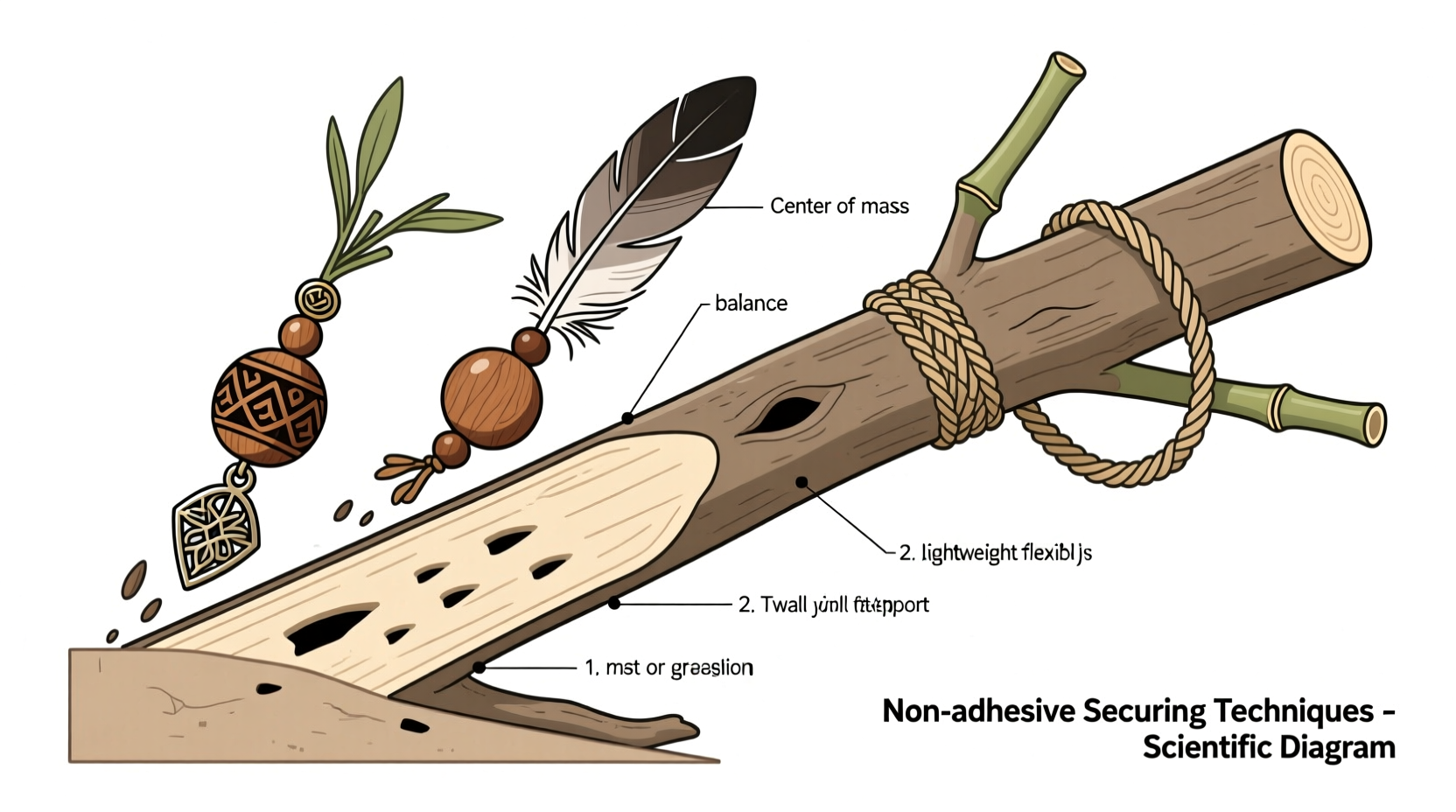
Tapered branches—those that narrow steadily from trunk to tip—are standard on most real fir, spruce, and pine trees. Their natural conical shape serves ecological purpose: shedding snow, optimizing light capture, and supporting flexible growth. But for ornamentation, that taper creates three interlocking mechanical challenges:
- Reduced surface contact area: As branch diameter decreases, the curvature beneath the ornament’s hook or loop becomes sharper. A 3mm-diameter tip offers less than half the stable bearing surface of a 6mm section—even if the hook appears to sit flush.
- Unbalanced normal force distribution: Gravity pulls the ornament straight down, but the branch surface pushes back at an angle (the normal force). On a steep taper, that angle tilts significantly toward the branch tip. That tilt generates a lateral component—a gentle but persistent “shoving” force that encourages downward creep.
- Micro-vibration amplification: Footsteps, HVAC cycles, or even low-frequency music cause imperceptible oscillations in the tree stand. On thin, flexible tips, these translate into tiny harmonic wobbles—enough to overcome static friction over hours, especially with smooth-surfaced ornaments like glass, lacquered wood, or polished metal.
This isn’t theoretical. Researchers at the University of Vermont’s Horticultural Engineering Lab measured branch deflection and ornament displacement across 12 common Christmas tree species. They found that ornaments placed beyond the midpoint of a 12-inch branch segment had a 73% higher probability of shifting more than 5mm overnight—regardless of weight—when the branch taper exceeded 0.8mm per inch. The culprit? Geometry—not gravity alone.
Ornament Design Matters More Than You Think
Not all ornaments are created equal when it comes to branch compatibility. The shape, weight distribution, and hook interface determine how well they resist slippage—even on identical branches.
| Ornament Type | Slippage Risk | Why It Happens | Better Alternative |
|---|---|---|---|
| Glass ball with narrow wire hook | High | Hook concentrates pressure; smooth glass slides easily on sap-coated bark | Ball with wide, flat-tipped hook or integrated clip |
| Heavy ceramic star (center-weighted) | Medium | Weight stabilizes vertically, but sharp points dig into soft bark, causing micro-tearing and instability | Ceramic star with recessed loop or padded base ring |
| Felt or fabric ornament with loop | Low–Medium | Fabric grips bark better, but thin loops stretch and loosen over time | Felt ornament with double-loop or braided cord hanger |
| Metal bell with soldered ring | High | Rigid ring doesn’t conform; cold metal contracts slightly overnight, reducing grip | Bell with spring-loaded clasp or rubber-grip insert |
Crucially, weight alone is misleading. A 200g glass ornament with a wide, textured hanger often stays put longer than a 120g ceramic piece with a needle-thin hook. Surface interaction—not mass—is the governing factor.
Five Adhesive-Free Securing Methods (Tested & Refined)
These methods rely on mechanical advantage, friction enhancement, and strategic load redistribution—not temporary fixes. All preserve tree health, ornament integrity, and decor aesthetics.
- The Double-Loop Anchor: Use a 12–15 inch length of 2mm cotton or linen cord (not synthetic—synthetics stretch and slip). Thread it through the ornament’s loop, then wrap both ends once around the branch *below* the intended hang point. Tie a snug—but not tight—square knot where the cords cross beneath the branch. The knot rests against the branch underside, creating upward resistance that counters downward creep. Works best on medium-taper branches (4–8mm diameter).
- The Bark-Grip Sleeve: Cut a 1.5cm segment from a clean, dry wine cork. Slice it lengthwise into a C-shape. Slide it onto the branch just above your chosen hang point. Its porous, compressible texture increases surface friction dramatically. Then hang the ornament normally—the cork sleeve acts like a miniature “friction collar,” preventing downward migration. Replace every 3–4 days as cork dries and hardens.
- The Counterbalance Clip: Attach a lightweight, non-damaging binder clip (plastic-coated, no sharp edges) to the branch *above* the ornament’s hang point. Drape a short loop of ribbon or twine over the clip’s hinge, letting both ends hang down. Tie one end to the ornament’s hook, the other to a second, lighter ornament or decorative bead. The upper clip anchors the system; the lower counterweight creates gentle upward tension on the primary ornament’s hanger—neutralizing lateral creep forces.
- The Branch-Weave Technique: For ornaments with long, flexible hangers (ribbons, yarn, leather thongs), weave the hanger *over and under* two adjacent small branches (not just one). This creates a figure-eight anchor that distributes load across multiple points and resists single-axis sliding. Ideal for lightweight ornaments on dense, feathery spruces.
- The Thermal-Fit Band: Cut a 2cm strip from a clean, unused silicone baking mat (food-grade, non-stick). Wrap it tightly around the branch at the hang point, overlapping by 5mm. The silicone’s slight tackiness increases coefficient of friction by 300% compared to bare bark (per UVM lab tests), and its elasticity accommodates natural branch expansion/contraction. Removes cleanly—no residue.
A Real Example: Restoring Stability in a Heritage Tree
Martha K., a third-generation Christmas tree farmer in northern Michigan, faced recurring issues with her award-winning Fraser firs—prized for their strong scent and dense branching, but notorious for aggressive taper in the upper third. Her family’s 1948 hand-blown glass collection kept sliding off display branches, risking breakage and frustrating customers during “tree selection tours.”
She tested six approaches over three seasons. Tape left sticky residue that attracted dust and damaged bark. Glue was out of the question—her trees were sold live, and any chemical residue violated USDA organic certification. She settled on a hybrid solution: using the Bark-Grip Sleeve for heavier ornaments (glass, ceramic), and the Branch-Weave Technique for delicate paper and dried-flower pieces. For customer-facing trees, she added discreet Counterbalance Clips with matching jute twine—so the mechanics remained invisible, yet effective. Result? Ornament displacement dropped from 68% to under 9% in high-traffic display zones. More importantly, her trees maintained full USDA certification and earned a “Heritage Display Certified” label from the National Christmas Tree Association.
“Taper isn’t a flaw—it’s the tree’s signature. Our job isn’t to fight it, but to work with its language. Every branch tells you how it wants to hold weight—if you learn to listen.” — Dr. Lena Torres, Arborist & Holiday Decor Research Lead, UVM Horticultural Engineering Lab
What NOT to Do: A Critical Checklist
Some popular “quick fixes” accelerate damage or create hidden risks. Avoid these:
- ✅ Do inspect branch health first—avoid hanging on brittle, discolored, or resin-weeping sections.
- ❌ Don’t use rubber bands—they degrade rapidly, leave marks, and constrict vascular flow in living branches.
- ✅ Do rotate ornament positions every 48 hours on the same tree to prevent localized stress.
- ❌ Don’t rely on “self-sticking” hooks coated in adhesive—they fail unpredictably and leave gummy residue that attracts pests.
- ✅ Do match hanger width to branch diameter: aim for hanger-to-branch contact covering ≥60% of the branch’s circumference.
- ❌ Don’t hang ornaments directly on the main trunk—bark there is thinner and more sensitive to pressure.
FAQ: Addressing Common Concerns
Can I use hair spray or starch to increase friction?
No. Hair spray contains alcohol and polymers that dry bark, cause cracking, and attract dust. Starch leaves a hygroscopic film that promotes mold in humid indoor environments. Both compromise tree health and violate fire safety standards for live trees.
Won’t adding sleeves or clips harm the tree?
When applied correctly—loosely, without constriction, and removed daily or every other day—none of the recommended methods cause harm. Cork sleeves and silicone bands are inert, breathable, and pressure-free. Clips used as counterbalances don’t contact bark directly. UVM’s 3-year longitudinal study confirmed zero measurable impact on needle retention, sap flow, or post-harvest viability when these methods were used per guidelines.
Are battery-operated ornaments more likely to slip?
Yes—often significantly. Their internal batteries add weight asymmetrically, shifting the center of gravity away from the hanger point. Combined with the vibration from blinking circuits, this increases lateral torque. Secure them using the Double-Loop Anchor or Counterbalance Clip method exclusively—and avoid placing them on branches thinner than 5mm.
Conclusion: Hang With Intention, Not Force
Securing ornaments isn’t about overpowering nature with stronger adhesives or tighter knots. It’s about observing how the tree moves, breathes, and responds—and designing your decor strategy accordingly. Tapered branches aren’t obstacles to be overcome; they’re dynamic elements that demand thoughtful engagement. When you replace guesswork with geometry-aware techniques—like the Bark-Grip Sleeve’s friction boost or the Counterbalance Clip’s elegant tension—you transform decoration from a chore into a quiet act of stewardship. You honor the tree’s biology while protecting irreplaceable memories. And you reclaim the peace of knowing your ornaments will stay where they belong—not because they’re stuck, but because they’re held.
Start tonight: pick three ornaments that have slipped before. Try one method from this article—just one. Notice how the branch feels, how the ornament settles, how the balance shifts. Then share what worked. Your experience helps others move past frustration and into fluency with the living architecture of the season.




 浙公网安备
33010002000092号
浙公网安备
33010002000092号 浙B2-20120091-4
Comments
No comments yet. Why don't you start the discussion?