
Autonomous Sensory Meridian Response (ASMR) has surged in popularity over the past decade, with millions tuning into whispering, tapping, crinkling, and soft-spoken videos to relax, sleep, or relieve anxiety. Yet for every person who experiences a soothing \"tingle\" down their spine, there’s another who finds these same sounds grating, irritating, or even physically uncomfortable. This stark contrast raises a compelling question: why do some people hate ASMR sounds while others find them deeply relaxing?
The answer lies at the intersection of neuroscience, personality traits, sensory processing, and emotional associations. What one brain interprets as calming, another may register as intrusive or threatening. Understanding this divergence requires more than just acknowledging personal preference—it demands an exploration of how our brains are wired to respond to sound, touch, and social cues.
The Science Behind ASMR: What Happens in the Brain?
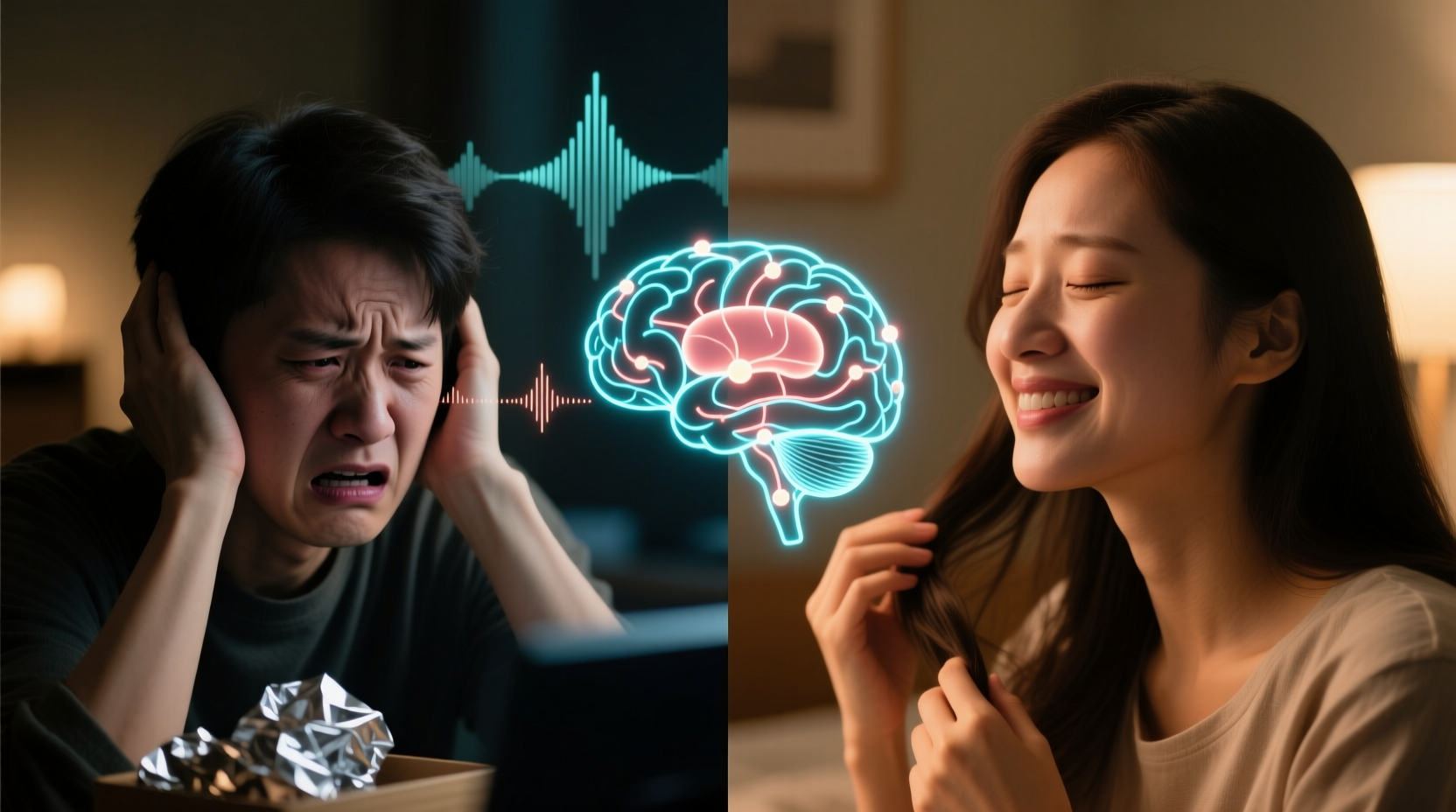
When someone experiences ASMR, they often report a gentle, pleasurable tingling that begins in the scalp and moves down the neck and spine. Functional MRI studies suggest that this sensation is linked to activation in brain regions associated with reward, empathy, and social bonding—particularly the medial prefrontal cortex and the nucleus accumbens.
A 2018 study published in *Social Neuroscience* found that individuals who experience ASMR show increased connectivity between areas involved in emotional regulation and self-awareness. These neural patterns resemble those seen during mindfulness or meditative states, which may explain why ASMR promotes relaxation and reduces heart rate in susceptible listeners.
However, not all brains respond this way. For those who dislike ASMR, the same stimuli can trigger activity in the amygdala—the brain’s threat detection center. Soft whispers might be interpreted as secretive or suspicious; repetitive tapping could feel obsessive or unnerving. The very intimacy that ASMR creators cultivate—close-up eye contact, hushed tones, simulated personal attention—can feel invasive rather than comforting to certain listeners.
“ASMR highlights individual differences in how we process social and sensory information. It’s not about the sound itself, but how the brain assigns meaning to it.” — Dr. Giulia Poerio, Cognitive Psychologist, University of Essex
Sensory Processing Differences: The Role of Personality and Neurology
One of the most significant factors determining whether someone enjoys or dislikes ASMR is their sensory processing sensitivity (SPS). People high in SPS tend to notice subtle environmental changes and react more strongly to stimuli. They’re often described as “highly sensitive persons” (HSPs), and research shows they’re more likely to experience ASMR.
Conversely, individuals with lower sensory thresholds or those on the autism spectrum may find ASMR sounds overwhelming. For them, the quiet rustling of paper or the deliberate smacking of lips can become amplified and distressing—a condition known as misophonia, where specific sounds provoke strong negative emotions like anger or disgust.
Misophonia isn’t simply a dislike of noise; it’s a neurological response. A 2020 study from *Current Biology* revealed that people with misophonia exhibit abnormal activity in the anterior insular cortex when exposed to trigger sounds—many of which overlap with common ASMR triggers (e.g., chewing, breathing, typing).
Psychological and Emotional Associations with Sound
Our relationship with sound is deeply shaped by past experiences. A soft whisper might evoke feelings of comfort for someone who associates it with a parent reading bedtime stories. But for another, that same whisper could recall moments of secrecy, eavesdropping, or manipulation.
Similarly, the intimate nature of many ASMR videos—where creators simulate one-on-one attention, such as giving a haircut or medical exam—can feel nurturing to some and boundary-crossing to others. This perceived violation of personal space, even when fictional, can trigger discomfort or distrust.
Cultural context also plays a role. In societies that value direct communication and clarity, whispered speech may be seen as evasive or untrustworthy. In contrast, cultures that embrace subtlety and nonverbal connection may be more receptive to ASMR’s nuanced audio cues.
Real Example: Two Listeners, One Video
Consider two colleagues, Maya and Jordan, watching the same ASMR video featuring gentle page-turning and whispered affirmations.
Maya closes her eyes, feels a wave of calm, and notices her shoulders dropping. She’s had trouble sleeping and finds the video helps quiet her mind. The soft voice reminds her of her grandmother’s lullabies, creating a sense of safety.
Meanwhile, Jordan grows increasingly agitated. The whispering feels like someone trying to hide something. The slow pace seems inefficient, almost mocking. By the two-minute mark, he turns it off, frustrated and slightly anxious.
This divergence isn’t about right or wrong—it’s about how each person’s brain filters and interprets sensory input based on biology, history, and temperament.
Common ASMR Triggers: A Comparison of Reactions
| ASMR Trigger | Positive Reaction (Relaxation) | Negative Reaction (Irritation/Anxiety) |
|---|---|---|
| Whispering | Feels intimate, calming, private | Seems secretive, manipulative, or hard to hear |
| Tapping | Rhythmic, meditative, grounding | Repetitive, obsessive, distracting |
| Crinkling (plastic, paper) | Textural, nostalgic, soothing | Grating, chaotic, reminiscent of stress triggers |
| Eating sounds (mukbang-style) | Comforting, communal, satisfying | Disgusting, messy, or triggering for misophonia |
| Personal attention (roleplays) | Nurturing, validating, emotionally safe | Invasive, fake, or socially awkward |
How to Navigate ASMR: A Practical Guide
If you're curious about ASMR but unsure where to start—or if you’ve tried it and reacted negatively—here’s a step-by-step approach to exploring it safely and intentionally.
- Start with low-intensity triggers: Choose videos without roleplay or whispering. Try neutral sounds like rain, keyboard typing, or brush strokes.
- Use headphones: ASMR relies heavily on binaural audio. Stereo headphones enhance spatial effects and may improve your experience.
- Limit exposure: Begin with 5–10 minute sessions. Pay attention to your body’s signals—do you feel calmer, or more tense?
- Vary the content: Explore different styles—visual, auditory, roleplay-free—to see what resonates.
- Reflect on your reaction: Journal how you felt before and after. Did your heart rate slow? Did you feel irritated? Use this insight to guide future choices.
- Respect your limits: If a sound consistently bothers you, skip it. There’s no obligation to enjoy ASMR.
Checklist: Is ASMR Right for You?
- ☐ I’m open to experimenting with subtle sounds and slow pacing
- ☐ I don’t have strong negative reactions to whispering or light tapping
- ☐ I’m looking for natural ways to reduce stress or improve sleep
- ☐ I understand that not liking ASMR is completely normal
- ☐ I’m willing to try different creators and styles before deciding
Frequently Asked Questions
Can you develop a tolerance or grow to like ASMR over time?
Some people report becoming more receptive to ASMR after repeated, low-pressure exposure. However, others never develop a positive response—and that’s okay. Forced listening can increase aversion. It’s better to explore casually without expectation.
Is disliking ASMR a sign of a mental health issue?
No. Disliking ASMR is not a disorder or deficit. It reflects normal variation in sensory and emotional processing. However, if certain sounds provoke intense anger or panic, it may be worth discussing with a therapist, especially if symptoms align with misophonia.
Are there benefits to ASMR beyond relaxation?
Yes. Studies suggest ASMR may help reduce chronic pain, ease symptoms of depression and anxiety, and improve sleep quality—for those who experience the response. It’s not a substitute for medical treatment, but it can be a valuable complementary tool.
Conclusion: Embracing Sensory Diversity
The divide between loving and hating ASMR underscores a broader truth: human perception is profoundly individual. What brings peace to one person may unsettle another, and both reactions are biologically valid. Rather than viewing ASMR as a universal remedy or a strange fad, we should see it as a window into the complexity of the human nervous system.
For those who benefit from ASMR, it offers a drug-free path to calm and connection. For those who don’t, understanding the science behind their discomfort can bring validation and relief. The key is not to convert skeptics, but to foster respect for diverse sensory experiences.




 浙公网安备
33010002000092号
浙公网安备
33010002000092号 浙B2-20120091-4
Comments
No comments yet. Why don't you start the discussion?