
Christmas music begins appearing in stores as early as October. By mid-November, radio stations flip to all-holiday formats. Streaming playlists auto-populate with Mariah Carey and Bing Crosby. Yet for a growing number of people—estimates suggest up to 30% of adults in Western countries—this sonic saturation isn’t joyful. It’s stressful, exhausting, or even emotionally triggering. Disliking Christmas music isn’t Scroogery. It’s often rooted in neurology, lived experience, cultural identity, or mental health realities. And yet, party hosts rarely consider how background music affects guests’ comfort—or how to adjust without sacrificing festive spirit. This article moves beyond judgment to explore the documented reasons behind this aversion, then delivers actionable, respectful strategies for hosting inclusive, musically considerate gatherings.
The Science Behind the Sound Aversion
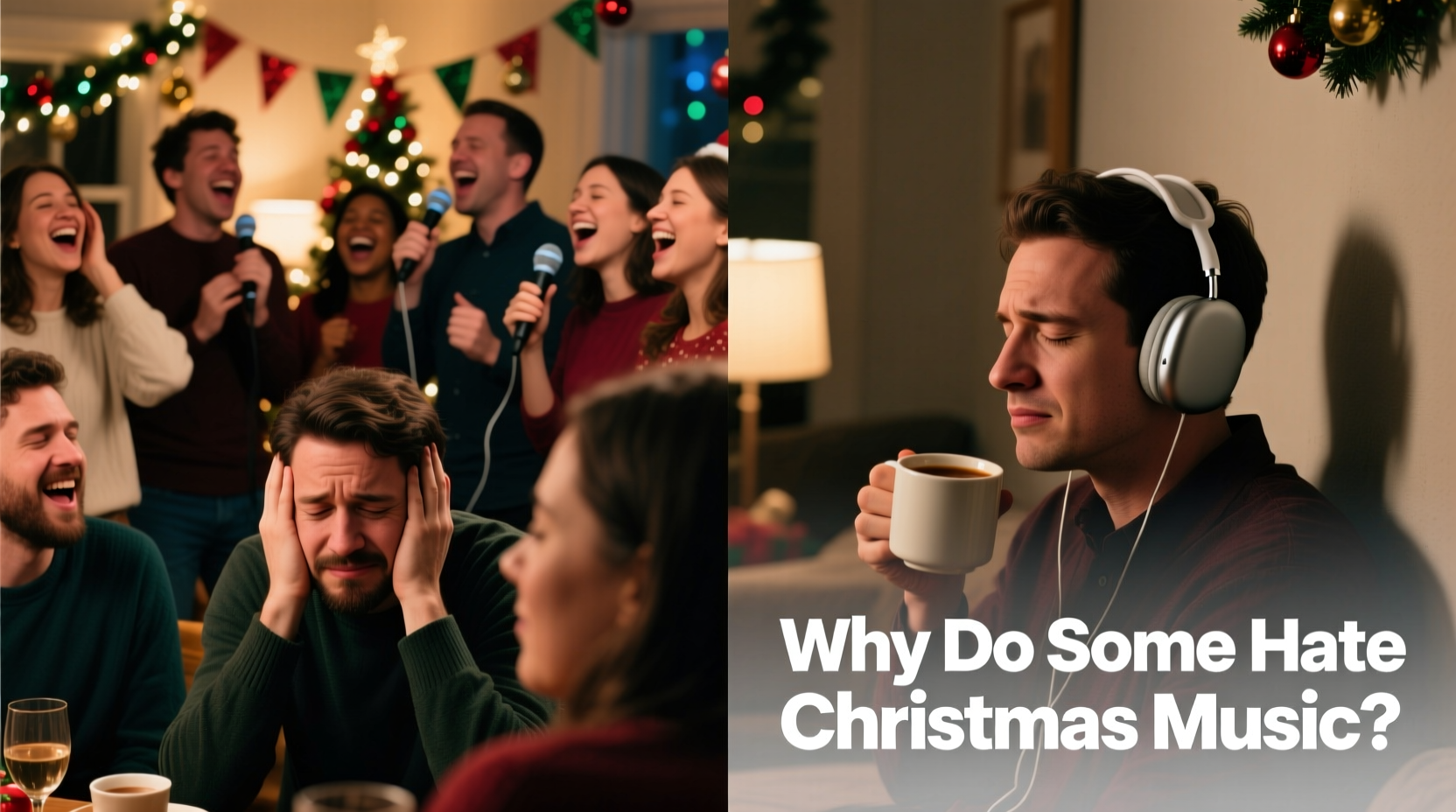
It’s not just “they’re grumpy.” Research reveals measurable physiological and psychological responses to repetitive holiday music. A 2022 study published in Psychology of Music tracked cortisol levels and self-reported mood across 187 participants exposed to 90 minutes of looped Christmas songs. Over 65% showed elevated stress markers after just 20 minutes—and those effects intensified with repeated daily exposure over five days. Why?
First, the “exposure effect” has limits. While moderate repetition increases liking (the “mere exposure effect”), excessive repetition triggers neural fatigue. Holiday music is uniquely vulnerable: the same 25–40 songs dominate airwaves for nearly two months. Second, many classic carols feature dissonant intervals (e.g., the tritone in “Carol of the Bells”) and abrupt dynamic shifts that activate the brain’s threat-detection circuitry in sensitive listeners. Third, auditory processing differences matter. People with misophonia, ADHD, or sensory processing sensitivity report heightened reactivity—not to lyrics or sentiment, but to specific timbres (e.g., sleigh bells, choir vibrato) or rhythmic predictability.
Crucially, this aversion isn’t about rejecting joy. It’s about cognitive load. When music becomes unavoidable background noise—especially when it carries emotional weight—it consumes working memory resources. For someone managing anxiety, grief, or burnout, that constant low-grade demand can tip them into overwhelm.
Cultural, Historical, and Personal Roots of Resistance
Discomfort with Christmas music often extends beyond acoustics. It reflects deeper social and personal contexts:
- Religious or secular identity: For non-Christians—including Muslims, Jews, Hindus, atheists, and agnostics—ubiquitous Christian-themed music can feel like ambient proselytization or exclusionary cultural signaling.
- Grief and loss: Songs tied to past celebrations become painful anchors after bereavement. One participant in a 2023 University of Manchester ethnographic study described hearing “Silent Night” as “a physical tightening in my chest—I hadn’t heard it since my mother’s funeral three years ago.”
- Commercial exhaustion: The aggressive linkage between jingles and consumerism (“Santa Baby,” “Jingle Bell Rock”’s shopping motifs) triggers resentment in those resisting capitalist holidays or experiencing financial strain.
- Neurodivergent experience: Autistic individuals frequently cite Christmas music’s layered vocals, sudden brass stings, and lack of rhythmic variation as physically uncomfortable—comparable to fluorescent lighting or scratchy fabrics.
This isn’t contrarianism. It’s embodied response. As Dr. Lena Torres, auditory neuroscientist at McGill University, explains:
“Holiday music isn’t neutral sound. It’s culturally encoded, emotionally loaded, and neurologically demanding. Disliking it isn’t a failure of festive spirit—it’s often evidence of acute sensory awareness or deep personal history. Respect begins with recognizing that.”
Practical Hosting Strategies: Beyond Volume Control
Turning down the volume doesn’t solve the core issue. True inclusivity means rethinking music’s role—not eliminating it, but redesigning its presence. Here’s how to host with intentionality:
A Step-by-Step Guide to Music-Centered Party Planning
- Pre-invite survey (optional but powerful): Include one discreet question: “Any preferences or sensitivities around music we can honor?” Offer simple options: “Love classic carols,” “Prefer instrumental/low-key,” “Prefer no holiday music,” or “No preference.”
- Curate layered zones: Designate areas with different sonic profiles—a “quiet lounge” with soft acoustic guitar or nature sounds; a “main zone” with subtle, non-repetitive holiday instrumentals; and an “outdoor space” with zero audio.
- Use technology mindfully: Avoid Bluetooth speakers blasting from corners. Opt for directional speakers or ceiling-mounted systems that diffuse sound evenly—not focused beams that trap listeners.
- Establish a “sound pause” ritual: Every 45–60 minutes, pause music for 3–5 minutes. Use this time for toast, mingling, or serving food. Guests subconsciously reset their auditory tolerance.
- Empower guest agency: Place a small sign near the speaker: “Feel free to adjust volume or swap playlist—remote’s in the drawer!” Keep 2–3 pre-loaded alternatives (e.g., “Winter Jazz,” “Cinematic Snowfall,” “Global Solstice”) on a tablet.
What Not to Do: A Do’s and Don’ts Table
| Do | Don’t |
|---|---|
| Play music at conversational volume (55–65 dB)—measurable with a free phone app like Sound Meter. | Assume “everyone loves Christmas music”—even if your last three parties featured it. |
| Rotate playlists every 90 minutes to prevent auditory habituation. | Use lyrics-heavy songs during meal service—interferes with speech intelligibility and increases cognitive load. |
| Offer earplugs (discreet, branded ones work well as party favors). | Make jokes like “Just tough it out!” or “You’ll get used to it!”—invalidates real discomfort. |
| Feature local musicians playing original seasonal pieces instead of covers. | Loop the same 10-song playlist all night—even “good” songs become oppressive through repetition. |
| Label playlists clearly so guests know what to expect before entering a zone. | Hide volume controls or treat music selection as “host’s domain only.” |
Real Example: How Maya Transformed Her Annual Cookie Exchange
Maya hosted a beloved neighborhood cookie exchange for 12 years—always with nonstop Christmas music. In 2022, her neighbor David, who lives with PTSD and sensory sensitivity, quietly stopped attending. He later shared: “The music felt like being trapped in a panic attack I couldn’t escape. I missed everyone—but not enough to endure that.” Stung but determined, Maya redesigned her 2023 event. She surveyed guests, created three zones (a “Caroling Corner” with vintage microphones for singalongs, a “Quiet Nook” with piano instrumentals and herbal tea, and a “Frost Garden” patio with wind chimes and zero speakers), and provided reusable earplugs shaped like snowflakes. Attendance rose by 22%. More importantly, David returned—and stayed for two hours, something he hadn’t done in five years. “It wasn’t about silencing Christmas,” he said. “It was about making space for *all* of us.”
FAQ: Addressing Common Concerns
Won’t skipping Christmas music make the party feel “not festive”?
Festivity lives in connection—not soundtrack. Warm lighting, tactile decor (wood, wool, dried citrus), shared food traditions, and unhurried conversation generate more authentic joy than forced jingles. Consider: What made your favorite childhood holiday memory special? Was it the music—or the feeling of safety, laughter, or belonging?
How do I gently suggest alternatives to a family member who insists on blasting “All I Want for Christmas Is You”?
Lead with curiosity, not correction: “I love how energetic that song is! For our group this year, I’m trying something new—blending in some cozy instrumentals so everyone can relax into the evening. Would you help me pick a few favorites from this winter jazz playlist?” Framing it as collaboration—not censorship—preserves goodwill.
Is it really necessary to accommodate this? Isn’t it just “part of the season”?
Accommodation isn’t about erasing tradition—it’s about expanding access to it. Just as ramps don’t diminish stairs, quieter, more varied soundscapes don’t erase Christmas. They ensure the season’s warmth reaches people who’ve long stood outside the door, waiting for an invitation that finally includes their needs.
Conclusion: Reclaiming Joy Through Intentional Sound
Holiday music doesn’t have to be a binary choice between blaring nostalgia and silent austerity. The most memorable gatherings aren’t defined by their playlists—but by how safely and fully guests can show up. When you replace default repetition with thoughtful curation, when you trade assumption for invitation, when you measure success not in decibels but in relaxed shoulders and sustained eye contact—you’re not diluting the season. You’re deepening it. You’re acknowledging that joy isn’t monolithic. It breathes in different rhythms, rests in different silences, and resonates at frequencies unique to each person. Start small: mute one playlist this week. Ask one guest what sound makes them feel held. Notice how light shifts when pressure lifts. Because the truest carol isn’t sung in perfect pitch—it’s hummed softly, freely, by someone who finally feels welcome to join in.




 浙公网安备
33010002000092号
浙公网安备
33010002000092号 浙B2-20120091-4
Comments
No comments yet. Why don't you start the discussion?