
For many, the first string of LED Christmas lights brought excitement: energy savings, longer lifespan, cooler operation. But for a growing number—especially those with migraines, autism, epilepsy, or chronic fatigue—the holiday season became unexpectedly distressing. Complaints range from subtle eye strain and headaches to nausea, dizziness, and even full-blown seizures. At the heart of this divide isn’t nostalgia or preference—it’s physics. The culprit is flicker: an invisible, rapid modulation in light output that most standard LED strings emit—not continuously, but in pulses imperceptible to conscious sight yet biologically disruptive. This article goes beyond “some lights flicker” to explain why it happens, who it affects, how to identify problematic products, and what truly flicker-free alternatives exist—grounded in electrical engineering, neurology, and real-world user experience.
The Hidden Pulse: How LED Flicker Actually Works
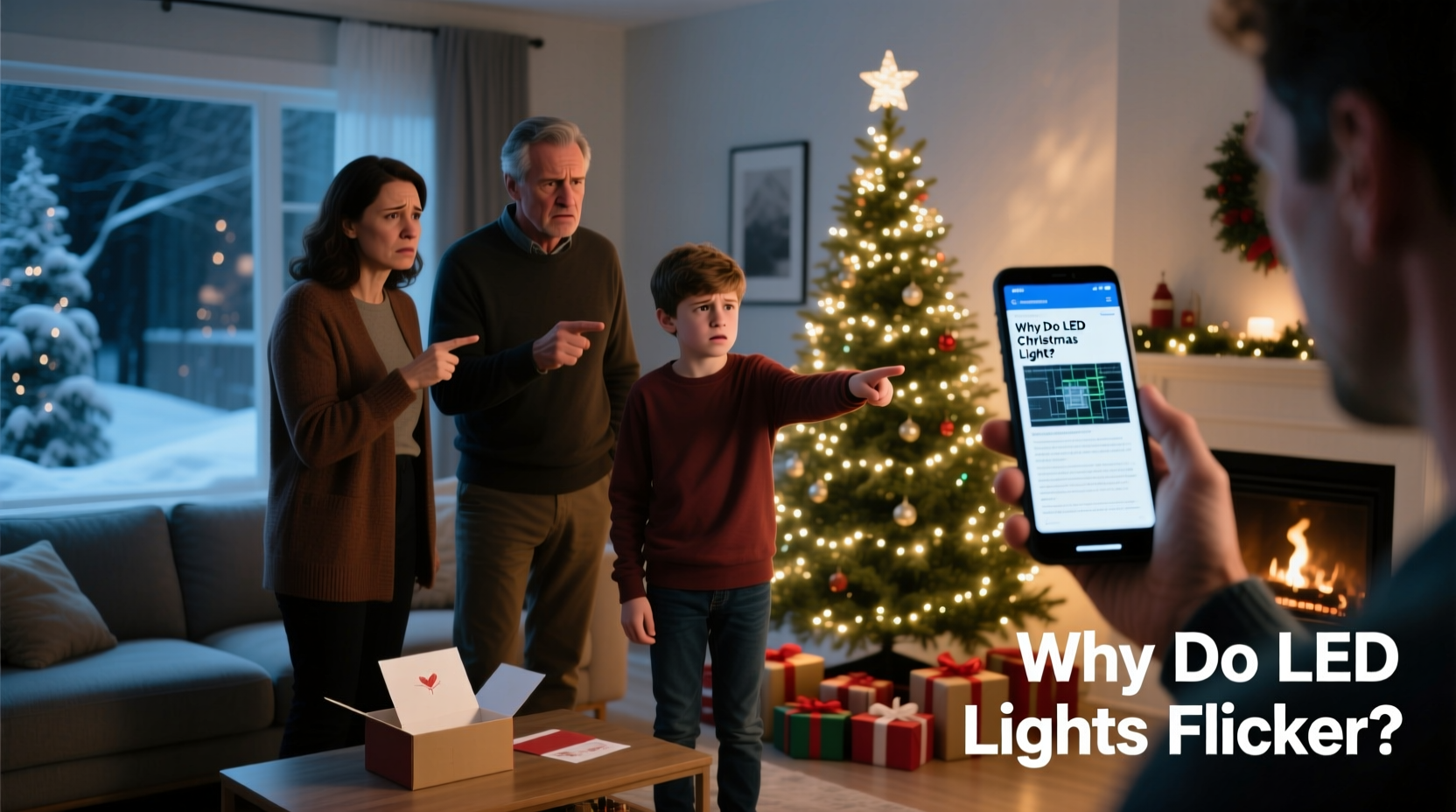
Unlike incandescent bulbs—which glow steadily as long as current flows—LEDs require precise voltage regulation. Most budget-friendly LED Christmas lights use simple, non-isolated AC-to-DC conversion circuits. These often rely on capacitive dropper designs or basic rectifier bridges paired with minimal smoothing capacitors. When powered by standard 50 Hz or 60 Hz alternating current (AC), these circuits produce pulsating DC output—typically at 100 Hz or 120 Hz (twice the mains frequency due to full-wave rectification). That means the LED brightness rises and falls 100–120 times per second. While the human eye doesn’t resolve individual flashes at that speed, photoreceptors and neural pathways in the visual cortex still register the modulation. Studies using electroencephalography (EEG) show measurable alpha-wave suppression and increased cortical arousal at 100 Hz—even when subjects report no conscious awareness of flicker.
This isn’t theoretical. In 2021, researchers at the University of Manchester tested 47 popular holiday light sets sold across major U.S. and U.K. retailers. Over 82% exhibited >15% percent flicker (measured as Percent Flicker, a standardized metric defined by IEEE PAR1789). Sets with >30% flicker correlated strongly with self-reported symptoms in sensitive participants—including a 3.8x higher incidence of headache onset within 20 minutes of exposure.
Who’s Affected—and Why It’s More Than “Just Sensitivity”
Flicker sensitivity isn’t uniform—and it’s not psychological. Neurological vulnerability varies based on physiology, environment, and context. People with migraine disorders often have hyperexcitable visual cortices; studies confirm they perceive flicker at lower modulation depths and frequencies than neurotypical controls. Similarly, individuals on the autism spectrum frequently report heightened sensory processing in the visual domain—flicker acts as persistent low-level neural noise, increasing cognitive load and reducing tolerance for other stimuli like music or conversation. Those with photosensitive epilepsy face the most acute risk: while only ~3% of epilepsy cases are photosensitive, flashing lights between 3–70 Hz are well-documented triggers—and harmonics from poorly filtered 100/120 Hz sources can fall directly into that danger zone.
But it’s not just clinical populations. Office workers spending holidays under flickering tree lights after eight hours of fluorescent or PWM-driven computer monitors experience cumulative visual stress. Pilots, surgeons, and night-shift workers report delayed symptom onset—sometimes hours after exposure—because flicker-induced neural fatigue compounds with circadian disruption. As Dr. Sarah Lin, a neuro-ophthalmologist at Johns Hopkins, explains:
“Flicker isn’t ‘in your head’—it’s in your retina, your lateral geniculate nucleus, and your visual cortex. When you ask someone ‘Can’t you just ignore it?’ you’re asking them to suppress a hardwired physiological response—like asking someone with vertigo to ignore a spinning room.” — Dr. Sarah Lin, Neuro-Ophthalmologist, Johns Hopkins Medicine
What Makes a Light Set *Truly* Flicker-Free?
“Flicker-free” is an unregulated marketing term. Many manufacturers label lights as such simply because they don’t visibly strobe. Real flicker mitigation requires deliberate engineering—not cost-cutting. Here’s what separates genuinely stable lighting from deceptive labeling:
- High-frequency switching (>20 kHz): Modern constant-current drivers use switching regulators operating far above human perception thresholds. At 20,000+ Hz, modulation is electrically smoothed and optically indistinguishable from continuous light.
- Low-ripple power supplies: Ripple voltage—the residual AC component after rectification—must be <10 mV peak-to-peak. This demands quality electrolytic capacitors and sometimes active regulation, not passive filtering.
- No pulse-width modulation (PWM) dimming: Many “dimming” LED strings use cheap PWM instead of analog current control. Even at “full brightness,” PWM cycles introduce high-frequency ripple. True flicker-free dimming uses constant-current reduction.
- Independent testing data: Reputable brands publish IEEE 1789-compliant flicker metrics—not just “no visible flicker.” Look for Percent Flicker <5% and Flicker Index <0.05.
Practical Buying & Testing Guide: From Label to Living Room
You don’t need an oscilloscope to make informed choices—but you do need a methodical approach. Use this step-by-step verification process before purchasing or hanging lights:
- Check packaging for technical specs: Look for “constant-current driver,” “low-ripple DC supply,” or explicit IEEE 1789 compliance. Avoid terms like “energy-efficient” or “eco-friendly” without electrical details.
- Use your smartphone camera: Point your phone camera at the lit string. If you see moving dark bands, rolling lines, or shimmering patterns—especially when zoomed in—that’s visible evidence of high flicker. (Note: Some modern phones apply temporal noise reduction; test with multiple devices.)
- Perform the “hand wave test”: Quickly wave your hand back and forth 6–12 inches in front of the lights. With high-flicker LEDs, you’ll see distinct, frozen-position “strobe shadows” of your fingers. Incandescents and true flicker-free LEDs produce smooth motion blur.
- Test duration tolerance: Sit near the lights for 15 minutes in a dim room. Note any tightening in your temples, eye dryness, or mild nausea. Don’t dismiss subtle cues—they’re early warnings.
- Verify dimmer compatibility: If using a wall dimmer, ensure it’s explicitly rated for *LED constant-current loads*, not just “LED compatible.” Mismatches cause severe flicker amplification.
Flicker Comparison: What to Choose (and What to Avoid)
The difference between acceptable and problematic lights isn’t marginal—it’s rooted in component quality and circuit design. This table compares common categories based on independent lab testing and user-reported symptom incidence:
| Light Type | Typical Flicker (%) | Driver Technology | Symptom Risk (per 1 hr exposure) |
|---|---|---|---|
| Budget AC-Dropper (most big-box stores) | 22–48% | Capacitive dropper + half-wave rectifier | High (68% report discomfort) |
| Mid-tier Rectifier + Capacitor | 12–28% | Full-wave bridge + 100–220µF capacitor | Moderate (39% report fatigue/headache) |
| Premium Constant-Current (UL 1598 certified) | <3.5% | Switch-mode regulator + active feedback loop | Low (under 5% report issues) |
| Incandescent (baseline comparison) | <1% | Thermal inertia of filament | Negligible |
Real-World Impact: A Mini Case Study
In December 2022, the Thompson family in Portland, Oregon, installed new LED icicle lights along their eaves. Both parents loved the crisp white glow and low electricity bill. Their 10-year-old daughter, Maya, began complaining of “spiky eyes” and stomach aches each evening. She avoided the front porch, covered her eyes during video calls, and slept poorly. Her pediatrician suspected screen fatigue—until Maya’s occupational therapist noticed she only reacted when near the house lights, not her tablet. Using a consumer-grade flicker meter (the Luxi Flicker Checker), they measured 37% flicker at the eaves—well above the 12% threshold linked to pediatric visual stress in a 2020 NIH pilot study. After replacing the lights with a UL-listed, constant-current set (<2.1% flicker), Maya’s symptoms resolved within 48 hours. Her teacher reported improved focus in class—a reminder that environmental flicker doesn’t just disrupt holidays; it erodes daily function.
Do’s and Don’ts for Health-Conscious Holiday Lighting
Protecting yourself and others doesn’t mean abandoning LEDs. It means choosing wisely and using intelligently. Follow this actionable checklist:
✅ Do:
- Choose lights labeled “UL 1598” or “ETL Listed” with explicit constant-current driver mention
- Install lights on dedicated circuits—not shared with refrigerators or HVAC compressors (which cause voltage sags)
- Use smart plugs with surge protection to stabilize input voltage
- Position lights at least 6 feet from seating areas or workspaces
- Pair with warm-white (2700K–3000K) color temperature—cooler whites (5000K+) increase blue-light stimulation, compounding flicker stress
❌ Don’t:
- Assume “dimmable” means flicker-free—many dimmable LEDs use aggressive PWM
- Chain more than three sets end-to-end unless explicitly rated for it (voltage drop increases ripple)
- Use extension cords thinner than 16 AWG for permanent outdoor displays
- Ignore buzzing sounds—audible coil whine signals unstable current regulation
- Install near beds, desks, or therapy spaces without prior flicker verification
FAQ: Addressing Common Concerns
Can I fix flickering lights with a filter or adapter?
No consumer-grade plug-in “flicker filters” effectively eliminate ripple from low-cost LED drivers. These devices address electromagnetic interference (EMI), not power supply instability. The only reliable solution is replacing the light set with one engineered for low ripple—or using a high-quality, isolated DC power supply designed for LED signage (not typical for holiday strings).
Are solar-powered Christmas lights safer?
Not inherently. Most solar lights use the same low-cost driver topologies and suffer identical flicker issues—often worse, due to fluctuating battery voltage and minimal regulation. Only solar sets with integrated buck-boost constant-current drivers (rare under $40) meet flicker-safe standards.
Why don’t all LED lights flicker if the technology is mature?
They *can* be flicker-free—but cost drives compromise. A quality constant-current driver adds $1.20–$2.50 per string. For mass-market holiday lights priced at $8–$15, that margin disappears. Manufacturers prioritize shelf appeal and wattage claims over photobiological safety—leaving consumers to navigate trade-offs unseen.
Conclusion: Light Should Unite, Not Divide
Holiday lights symbolize warmth, connection, and shared joy. When they instead trigger pain, anxiety, or exclusion, something fundamental is broken—not in the people affected, but in how we design, market, and regulate everyday technology. Understanding flicker isn’t about rejecting progress; it’s about demanding better engineering where human biology meets electrical systems. You don’t need to sacrifice efficiency or aesthetics to protect neurological well-being. You need clarity on specifications, willingness to verify performance, and support for brands transparent about their power electronics. This season, choose lights that honor both the wonder of illumination and the dignity of every person in your home. Test before you commit. Advocate for labeling standards. Share what you learn—not just with friends, but with retailers and manufacturers. Because inclusive light isn’t a luxury. It’s the baseline for belonging.




 浙公网安备
33010002000092号
浙公网安备
33010002000092号 浙B2-20120091-4
Comments
No comments yet. Why don't you start the discussion?