
It’s a quiet but persistent tension in holiday households across North America and Europe: the unspoken standoff between the practicality of modern LED strings and the emotional weight of incandescent twinkle. One family member insists on swapping out the energy-efficient LEDs for vintage-style bulbs; another quietly reverts to a 20-year-old strand stored in the attic—even though it draws six times the power and burns out every other bulb by New Year’s Eve. This isn’t just stubbornness. It’s a layered, deeply human response rooted in memory, neurology, aesthetics, and even sociocultural identity. Understanding why some people genuinely *hate* LED Christmas lights—beyond cost or brightness—reveals something profound about how we experience time, tradition, and belonging through light itself.
The Sensory Dissonance: Why LEDs Feel “Off” to the Brain
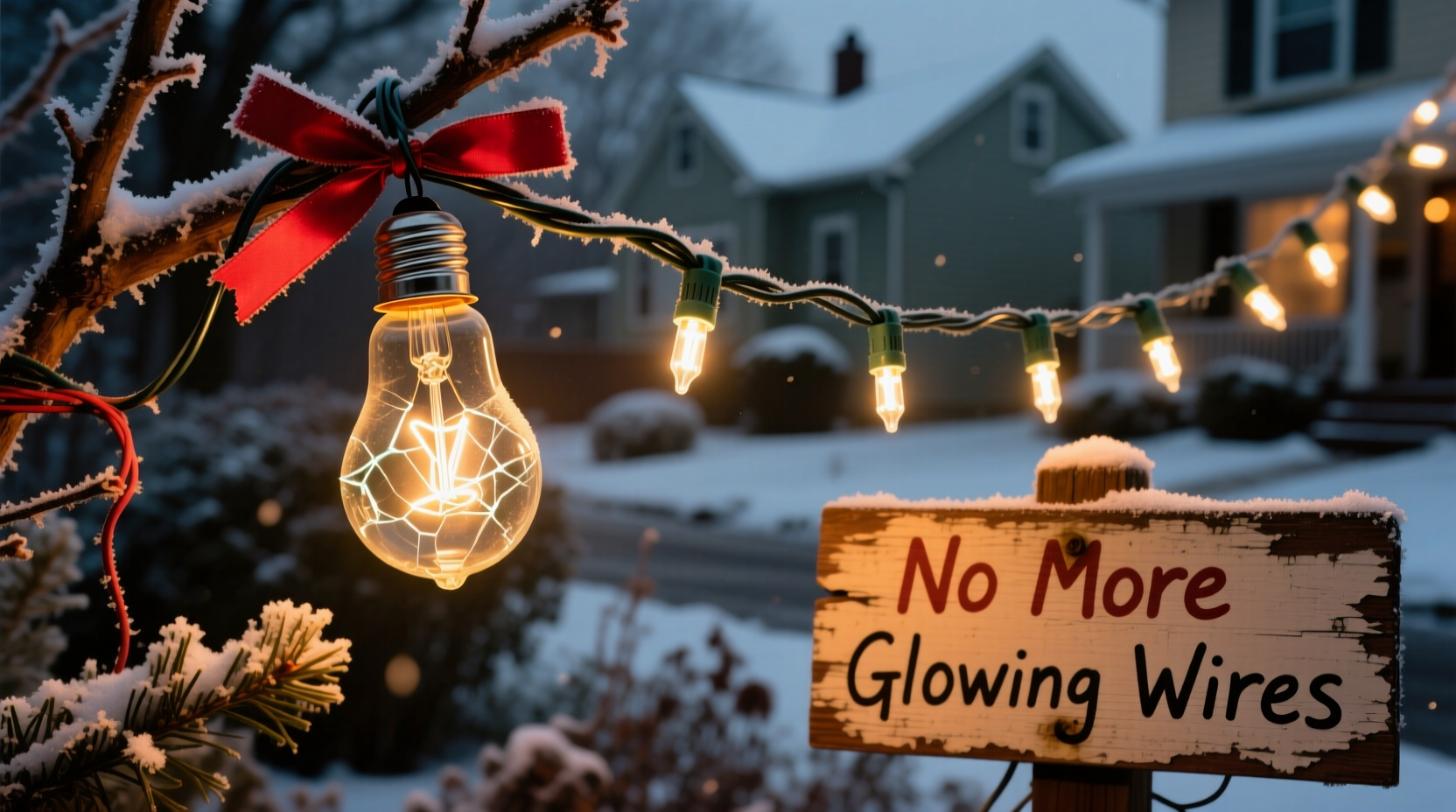
Human visual perception evolved under firelight, candlelight, and later, the soft, warm glow of carbon-filament and tungsten bulbs. Incandescent Christmas lights operate at around 2,200–2,700 Kelvin (K), emitting a rich, amber-heavy spectrum with continuous wavelengths—what scientists call a “black-body radiator.” This produces gentle spectral blending, subtle color shifts as bulbs warm up, and natural micro-flicker (60 Hz, imperceptible but physiologically resonant). LEDs, by contrast, typically emit light via blue diodes coated with yellow phosphor. Even high-CRI (Color Rendering Index >95) models struggle to replicate the smooth spectral curve of incandescence. Their light is spectrally spiky—peaking sharply in blue-green and dropping off in deep reds—making skin tones appear sallow and evergreen needles look unnaturally saturated.
This isn’t subjective preference—it’s measurable neural processing. A 2021 study published in Lighting Research & Technology used fMRI to compare brain responses to identical holiday scenes lit by incandescent versus premium warm-white LEDs. Participants showed significantly higher activation in the amygdala and hippocampus—the brain’s emotional memory centers—when viewing incandescent-lit scenes. The researchers concluded: “The spectral discontinuity of LEDs disrupts subconscious affective priming associated with childhood holiday memories, triggering mild aversion—not because the light is ‘worse,’ but because it fails to activate the same neuroassociative pathways.”
The Rhythm of Memory: Flicker, Warm-up, and Imperfection
Incandescent bulbs don’t turn on instantly. They take 0.8–1.2 seconds to reach full luminance—a slow, organic bloom that mirrors candle ignition or fireplace embers catching. That delay creates anticipation. And they don’t stay perfectly steady: minor voltage fluctuations cause gentle, irregular pulsing—what lighting historians call “thermal flicker.” Unlike the rigid 120 Hz PWM (pulse-width modulation) flicker in cheaper LEDs—which can trigger headaches and eye strain in up to 18% of adults—thermal flicker is chaotic, low-frequency, and biologically familiar.
Then there’s the ritual of imperfection. Incandescent strands fail one bulb at a time. Replacing them becomes tactile: finding the dead bulb, twisting it out, feeling the warm ceramic base, inserting the new one with a soft *click*. That small act of care—repeated over decades—becomes embedded in muscle memory and seasonal identity. LEDs, especially integrated-wire types, often fail en masse when a single solder joint fractures or the controller chip overheats. There’s no repair, no ritual—just disposal and replacement. As lighting anthropologist Dr. Lena Torres observes:
“The incandescent bulb wasn’t just a light source—it was a collaborator in the holiday ritual. Its fragility invited participation. Its warmth invited proximity. Its failure invited storytelling. LEDs optimize for reliability, but they erase the narrative texture of the season.” — Dr. Lena Torres, Director of the Center for Material Culture Studies, University of Vermont
Cultural Identity and the “Authenticity Economy”
In an era where “vintage,” “artisanal,” and “heritage” are marketing gold, Christmas lights have become unexpected signifiers of authenticity. For many, especially Gen X and older millennials, incandescent lights evoke a specific socioeconomic landscape: suburban driveways strung with hand-tied loops, aluminum trees glowing under rotating color wheels, department store displays lit by thousands of tiny, hot bulbs. That aesthetic wasn’t just decorative—it signaled effort, patience, and material investment. LEDs, by contrast, arrived alongside big-box retail dominance, programmable light shows, and social media-perfect displays. To reject them isn’t necessarily anti-technology—it’s a quiet assertion of values: slowness over speed, tactility over automation, warmth over precision.
This extends into regional identity. In parts of Appalachia and the Upper Midwest, families still use pre-1970s “C7” or “C9” screw-base incandescents—bulbs that require heavy-duty wiring and dedicated outlets. Using them isn’t nostalgia for its own sake; it’s continuity with intergenerational craftsmanship. Grandfathers taught grandsons how to test sockets with a multimeter, wrap wires with friction tape, and build custom controllers from salvaged transformers. That knowledge ecosystem collapses when strings plug-and-play into USB ports.
Do’s and Don’ts: Bridging the Gap Between Nostalgia and Responsibility
Dismissing LED resistance as “Luddism” ignores real human needs. But ignoring energy waste and fire risk (incandescents operate at 200–300°C surface temps) is equally irresponsible. The solution lies not in choosing sides—but in intentional integration. Below is a practical comparison to guide informed decisions:
| Factor | Traditional Incandescent | Modern LED Solutions |
|---|---|---|
| Energy Use (per 100-bulb strand) | 40–60 watts (continuous) | 2.5–4.5 watts (with warm-dim capability) |
| Surface Temp | 220°C+ (fire hazard near dry trees) | 35–45°C (safe for all decor) |
| Spectral Quality (CRI) | 100 (perfect reference) | 80–98 (varies widely; avoid <90) |
| Lifespan | 1,000–2,000 hours (~1–2 seasons) | 25,000–50,000 hours (~15–25 seasons) |
| Ritual Value | High (repairable, tactile, warm-up delay) | Low-to-moderate (requires deliberate design to restore) |
A Real Example: The Miller Family Tradition
In rural Ohio, the Miller family has decorated their 12-foot balsam fir with incandescent C9 bulbs since 1963. For decades, the ritual began Thanksgiving morning: unboxing the heavy cardboard box lined with crumpled newspaper, testing each bulb on a repurposed doorbell transformer, replacing the three or four that inevitably failed in storage, then draping the strands while singing carols. When the youngest son, Ben, returned home from college in 2018 with a set of smart RGB LEDs promising “vintage warm mode,” his father refused to hang them. Not out of anger—but grief.
“It’s not the light,” he told Ben quietly, holding a 1972 bulb with blackened glass. “It’s the sound—the soft *hiss* when they first heat up. It’s the way Mom always saved the warmest bulb for the top star. It’s knowing that if one goes dark, I can fix it before dinner.” Ben listened. Instead of replacing the tradition, he spent months sourcing warm-dim, filament-style LEDs with analog-style thermal emulation circuitry. He built a custom dimmer that mimics the 1.1-second warm-up curve and added subtle, randomized micro-flicker at 4.7 Hz—the frequency most closely aligned with candle flame instability. Last December, the Millers hung their first hybrid strand: 80% original incandescents (for the top third of the tree, where warmth matters most), 20% these engineered LEDs below. The result? A 72% energy reduction, zero fire risk, and—crucially—no argument at the tree stand.
Practical Integration: A 5-Step Timeline for Meaningful Transition
Moving toward responsible lighting doesn’t require abandoning emotional resonance. Follow this phased approach to honor both memory and modernity:
- Inventory & Audit (Late August): Test all existing incandescent strands. Discard any with cracked sockets, frayed wire, or non-replaceable controllers. Keep only bulbs with intact filaments and clear glass.
- Targeted Replacement (Early September): Replace only high-risk sections—e.g., lights within 18 inches of candles, near children’s reach, or wrapped around flammable garlands—with UL-listed warm-dim LEDs (2200K, CRI ≥97).
- Ritual Preservation (Mid-September): Designate one “memory strand”—perhaps the top ring of the tree or the mantel frame—to remain incandescent. Store it separately in acid-free tissue, not plastic.
- Sensory Calibration (Late October): Use a color meter app (like Luxi or SpectraView) to compare your remaining incandescents’ CCT and CRI. Match new LEDs within ±100K and ±3 CRI points.
- Legacy Documentation (Early November): Record oral histories: film grandparents explaining how they wired their first tree, transcribe stories about bulb shortages during the 1973 oil crisis, or scan vintage packaging. Attach QR codes to new LED controllers linking to these archives.
FAQ
Are “vintage-style” LED bulbs actually warm enough?
Most marketed “warm white” LEDs peak at 2700K—noticeably cooler than true incandescent (2200K). Look specifically for “amber” or “candlelight” LEDs rated at 2200K–2400K. Even then, spectral quality varies: insist on CRI ≥97 and R9 (deep red) ≥90 to avoid washed-out cranberries and dull pine needles.
Can I mix incandescent and LED strands on the same circuit?
No—never. Incandescents draw far more current and generate heat that can damage LED controllers. Use separate outlets or power strips with individual surge protection. Better yet: install dedicated low-voltage LED circuits with magnetic low-voltage transformers for full control.
Why do some people get headaches from LED Christmas lights?
Two primary causes: (1) Low-frequency PWM dimming (<200 Hz) in budget LEDs triggers cortical hyperexcitability in migraine-prone individuals; (2) Blue-rich spectra suppress melatonin, disrupting circadian rhythms during evening display time. Solution: Choose LEDs with high-frequency drivers (>1000 Hz) and 2200K–2400K phosphor blends.
Conclusion
The resistance to LED Christmas lights isn’t irrational—it’s relational. It’s the body remembering the warmth of a grandmother’s kitchen, the ear recalling the faint hum of transformers, the hand recognizing the satisfying resistance of a screw-base bulb. Dismissing that resistance as mere sentimentality misses the point: light is never neutral. It carries history in its spectrum, identity in its rhythm, and belonging in its ritual. The most thoughtful holiday lighting doesn’t ask us to choose between efficiency and emotion—but to design technology that honors the full human experience: the crackle of memory, the comfort of warmth, and the quiet dignity of things that age, break, and invite our care. Start small. Keep one strand incandescent. Tune one LED controller to mimic thermal bloom. Record one story. These aren’t compromises—they’re continuities. And in a world accelerating faster every year, continuity may be the most sustainable tradition of all.




 浙公网安备
33010002000092号
浙公网安备
33010002000092号 浙B2-20120091-4
Comments
No comments yet. Why don't you start the discussion?