
For over two decades, synchronized Christmas light displays have evolved from backyard curiosities into neighborhood spectacles—complete with choreographed LED sequences, amplified holiday soundtracks, and smartphone-controlled timing. What began as a niche hobby for tech-savvy decorators is now a multimillion-dollar industry, with professional installers, YouTube channels boasting millions of subscribers, and entire towns hosting “light trail” events. Yet alongside the awe and viral videos, a quieter but persistent counter-narrative has grown: organized complaints, HOA interventions, municipal noise ordinances being cited, and even small-scale protests. This isn’t about Scrooges or grinches—it’s about tangible, lived experiences that reveal deeper tensions in how we share public space, define seasonal joy, and navigate evolving expectations of community life.
The Noise Factor: When “Jingle Bells” Becomes a Public Nuisance
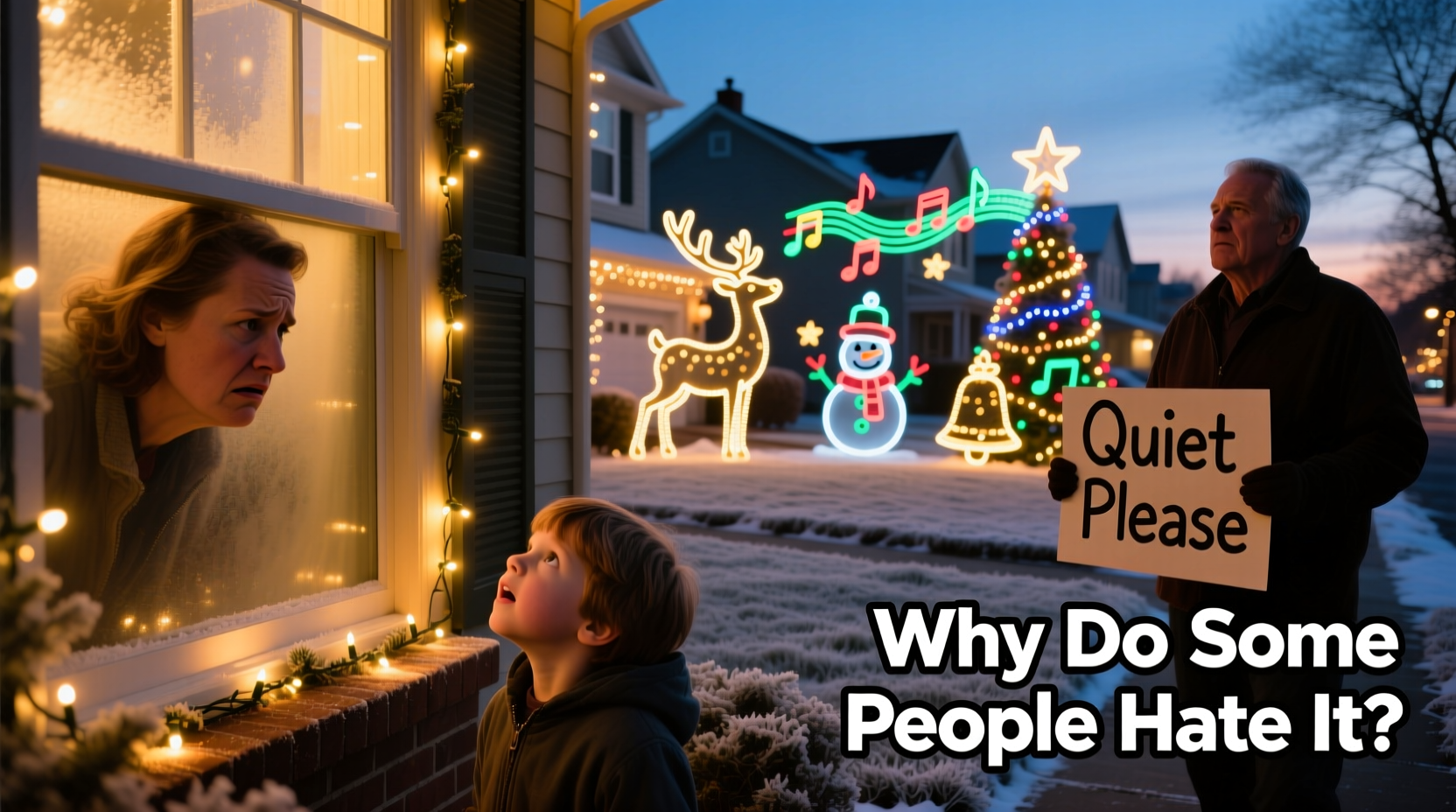
At the heart of many objections lies sound—not just volume, but duration, frequency, and control. Synchronized displays often use outdoor speaker systems capable of projecting clear audio up to 150 feet. While one household might enjoy a crisp rendition of “Carol of the Bells,” neighbors three houses down may hear distorted bass thumps at 7:30 p.m., when children are trying to fall asleep or adults are working remotely. Unlike indoor holiday music, this audio is uncontainable and non-consensual.
Local noise ordinances rarely account for seasonal exceptions. In Portland, Oregon, for example, amplified sound outdoors is restricted to 60 decibels after 10 p.m.—roughly equivalent to a normal conversation. A typical synchronized display operating at full volume registers between 72–85 dB at the property line. That’s comparable to a garbage disposal or a passing motorcycle. And unlike traffic noise—which ebbs and flows—holiday displays often repeat the same 90-second loop every five minutes for six hours straight.
Light Pollution and Its Hidden Costs
It’s not just what you hear—it’s what you see, and what you can’t see. Modern LED displays use high-lumen, narrow-beam fixtures that can cast intense directional light far beyond their intended target. Astronomers, sleep researchers, and ecologists have all documented consequences: disrupted melatonin production in nearby residents, interference with nocturnal wildlife navigation, and significant contributions to skyglow—the artificial brightening of the night sky that obscures stars.
A 2022 study published in Environmental Health Perspectives found that neighborhoods with concentrated synchronized displays saw a 40% average increase in ambient nighttime luminance during December—a spike linked to measurable delays in sleep onset among adolescents living within 200 meters. For older adults or those with light-sensitive conditions like migraine or bipolar disorder, this isn’t mere inconvenience; it’s a medically relevant stressor.
“Holiday lighting has become the largest unregulated source of seasonal light pollution in suburban America. We’re trading starry skies and restorative darkness for 30-second light shows—and not everyone was consulted.” — Dr. Lena Torres, Light Ecologist, University of Arizona Lunar & Planetary Lab
Privacy Erosion and the “Always-On” Yard
Synchronized displays often rely on infrastructure that doubles as surveillance enablers: Wi-Fi-connected controllers, motion sensors calibrated for show triggers, and sometimes even security cameras integrated into the setup (to monitor for theft or vandalism). While individually benign, these devices collectively transform a residential yard into a semi-public, digitally monitored zone.
More subtly, the sheer visual dominance of a high-intensity display alters neighborhood perception. Houses adjacent to a 12,000-light spectacle can feel visually “erased”—their own modest decorations overwhelmed, their windows lit up by reflected glare, their front porches no longer private spaces but de facto viewing corridors. One resident in Naperville, Illinois, described it this way: “Our porch light used to be a quiet signal to guests: ‘We’re home.’ Now it’s drowned out by strobing reindeer—and strangers park on our street at 8 p.m. to watch the show, silhouetted against our living room window.”
Equity, Access, and the “Spectacle Economy”
Behind the glitter lies a growing socioeconomic divide. A basic synchronized setup starts at $1,200–$1,800 in equipment alone; professional installation and custom sequencing can exceed $15,000. That investment yields social capital—likes, shares, local news features—but also reshapes neighborhood dynamics. Homeowners without comparable resources may feel pressured to “keep up,” leading to financial strain or resentment. Worse, the attention economy rewards scale and novelty, inadvertently sidelining quieter, culturally specific traditions—like Kwanzaa kinara lighting ceremonies, Diwali diyas, or Las Posadas processions—that don’t translate easily into TikTok-friendly light choreography.
| Aspect | Traditional Holiday Display | Synchronized Music Display |
|---|---|---|
| Average Cost | $45–$220 | $1,200–$15,000+ |
| Setup Time | 2–6 hours | 40–200+ hours |
| Energy Use (Dec–Jan) | 12–45 kWh | 180–650+ kWh |
| Neighborhood Foot Traffic | Negligible | 50–300+ visitors/night |
| HOA Complaint Likelihood | Low | High (78% of surveyed HOAs report ≥1 complaint/year) |
Cultural Fatigue and the Commodification of Joy
Perhaps the most under-discussed reason for resistance is emotional exhaustion—not from the lights themselves, but from their relentless framing as mandatory participation in a hyper-curated, algorithmically optimized version of cheer. Social media platforms reward displays that maximize engagement: rapid cuts, celebrity song covers, meme-worthy moments. The result? A subtle but powerful pressure to perform festivity, to monetize goodwill (“Donation requested via QR code”), and to treat December not as a season of reflection or rest, but as a 31-day content sprint.
This dynamic alienates people for whom Christmas carries grief, religious complexity, or no significance at all. A 2023 Pew Research survey found that 27% of U.S. adults identify as religiously unaffiliated—and among them, 64% reported feeling “excluded or oversaturated” by dominant holiday imagery in public spaces. As one respondent in Austin, Texas, shared: “I lost my mother in early December. For me, the holidays are about quiet remembrance—not laser beams and ‘All I Want for Christmas Is You’ on loop. But walking past that house feels like being shouted at with joy I don’t have.”
Real-World Impact: A Mini Case Study from Maplewood, Minnesota
In 2021, a homeowner in Maplewood installed a 22,000-LED display synced to 14 holiday tracks, complete with fog machines and a 200-watt speaker array. Within three weeks, seven neighbors filed formal complaints with the city: two citing sleep disruption in young children, one reporting aggravated tinnitus, another documenting repeated visits from unfamiliar cars blocking driveways and sidewalks. The city issued a warning under its Noise Control Ordinance §12.04(b), requiring audio to be silenced after 9 p.m. and limiting total daily operation to four hours.
Rather than dismantle the display, the homeowner pivoted—offering “quiet viewing hours” (lights only, no audio) and installing directional speakers aimed away from homes. They also added a physical sign: “Enjoy the lights. Respect the peace.” Attendance didn’t drop; if anything, it rose—especially among older residents and families with neurodivergent children who appreciated the option. The resolution wasn’t about eliminating the display, but redesigning it around shared boundaries.
Actionable Solutions: A Neighbor-Centered Checklist
- ✅ Consult before you connect: Share your display plan—including expected hours, audio use, and estimated brightness—with immediate neighbors before installation.
- ✅ Anchor audio indoors: Use Bluetooth-enabled smart speakers placed near open windows instead of outdoor PA systems—this contains sound while preserving musical clarity for viewers.
- ✅ Adopt “dark-sky friendly” LEDs: Choose warm-white (2200K–2700K) bulbs with full cutoff fixtures that direct light downward, not sideways or upward.
- ✅ Build in silence: Program 10-minute “rest intervals” every 45 minutes—no lights, no sound—to reduce sensory load and energy use.
- ✅ Offer opt-out visibility: Add a small, tasteful sign indicating which nights feature audio (“Music Nights: Dec 5, 12, 19, 23”) so neighbors can plan accordingly.
Frequently Asked Questions
Can my HOA legally restrict my synchronized light display?
Yes—in most cases. HOAs derive authority from covenants that commonly include clauses on “nuisance activities,” “excessive noise,” and “obstructive lighting.” Courts have consistently upheld restrictions when displays demonstrably interfere with neighbors’ quiet enjoyment of their property. However, outright bans on holiday lighting are rare and often unenforceable; reasonable time, place, and manner limits are more likely to hold up.
Are there energy-efficient alternatives that still feel special?
Absolutely. Consider solar-powered pixel strings controlled by programmable timers (no grid draw after sunset), or passive kinetic elements like wind-activated chimes paired with low-lumen fiber-optic pathways. One award-winning 2023 display in Asheville, NC used only 86 watts total—powered by rooftop solar—and relied on shadow play, reflective surfaces, and timed candle flicker effects instead of strobes or amplification.
What if I love synchronized displays but live in a sensitive area?
Focus on intimacy over intensity. A well-designed 300-light porch display synced to a single, gentle instrumental track—played softly through a directional speaker aimed at your driveway—can deliver wonder without overwhelm. Prioritize texture, rhythm, and subtlety: slow fades, organic timing, and pauses that invite breath. As lighting designer Aris Thorne notes, “The most memorable moments in light art aren’t the loudest—they’re the ones that make you lean in, not cover your ears.”
Conclusion: Reclaiming Wonder Without Weaponizing It
Holiday light displays need not be zero-sum propositions—where one person’s joy becomes another’s burden. The growing backlash isn’t a rejection of beauty, technology, or celebration. It’s a collective plea for intentionality: to ask not just *what* we can build, but *who* it serves, *how* it coexists, and *what* it costs—not just in electricity bills, but in shared peace, ecological balance, and human dignity. Whether you’re planning your first string of LEDs or your tenth synchronized symphony, the most meaningful innovation isn’t brighter pixels or tighter choreography. It’s listening first. Measuring impact. Leaving space—for darkness, for quiet, for difference. Because true festive spirit doesn’t shout to be seen. It glows with enough grace to let others shine, too.




 浙公网安备
33010002000092号
浙公网安备
33010002000092号 浙B2-20120091-4
Comments
No comments yet. Why don't you start the discussion?