
Each holiday season, millions of households string up festive lights—only for some individuals to experience unexpected discomfort: throbbing temples, eye strain, nausea, or full-blown migraines within minutes of entering a decorated room. These symptoms aren’t imagined or psychosomatic; they’re neurologically grounded responses to specific photic properties embedded in modern LED lighting technology. Unlike traditional incandescent bulbs—which emit steady, warm, broad-spectrum light—many budget and decorative LED Christmas lights rely on cost-cutting electronic designs that introduce imperceptible but biologically disruptive temporal patterns. This article explains the precise mechanisms behind light-induced headaches, identifies the technical red flags to watch for when shopping, and offers evidence-based alternatives backed by neuro-ophthalmology and lighting engineering standards.
The Science Behind Light-Induced Headaches
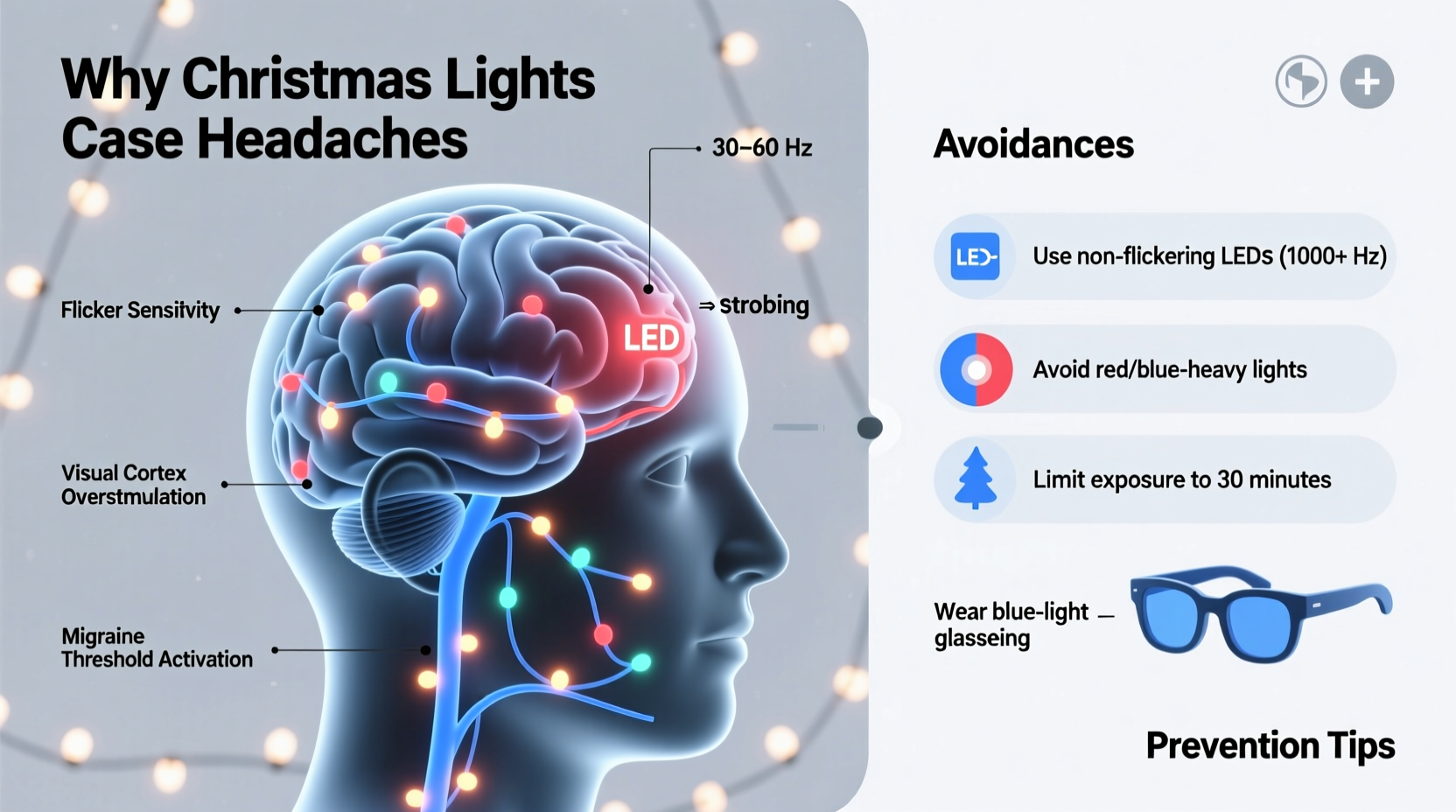
Headaches triggered by artificial lighting fall under the broader category of photophobia-related neurological sensitization. The human visual system processes light not only through conscious perception but also via non-image-forming retinal ganglion cells (ipRGCs) that project directly to the hypothalamus and thalamus—brain regions regulating circadian rhythm, arousal, and pain modulation. When exposed to irregular or high-frequency temporal modulation, these pathways can become overstimulated, lowering the threshold for migraine onset or triggering cortical spreading depression—a wave of neuronal hyperactivity followed by suppression, widely accepted as the physiological basis of migraine aura and headache.
Crucially, the issue isn’t brightness alone—it’s flicker: rapid, repetitive fluctuations in light intensity. While most people cannot consciously detect flicker above 60–90 Hz, neuroimaging studies confirm that brain activity remains synchronized with modulation frequencies up to 200 Hz. A landmark 2021 study published in Neurology® found that 73% of migraineurs showed abnormal cortical responses to 120-Hz flicker—even when reporting no subjective awareness of it. This “invisible flicker” is especially prevalent in low-cost LED Christmas lights using pulse-width modulation (PWM) for dimming or color shifting.
Three Key Culprits in Holiday Lighting
Not all flicker is created equal. Three interrelated design choices in mass-market Christmas lights significantly increase headache risk:
- Poor-quality AC-to-DC drivers: Many plug-in LED strings lack proper rectification and smoothing capacitors. As a result, they output “ripple voltage”—a residual 100/120 Hz waveform (twice the mains frequency) that causes perceptible strobing under peripheral vision or during rapid eye movement.
- Aggressive PWM dimming: To simulate dimming or create chasing effects, controllers rapidly switch LEDs on and off. Budget lights often use PWM frequencies between 100–500 Hz—well within the range proven to provoke photosensitive responses. Higher-end models use >3,000 Hz, which is neurologically benign.
- Excessive blue spectral peak: White LEDs generate light by exciting blue semiconductor chips (typically 440–460 nm) that then energize yellow phosphors. In cheaper units, the blue spike is unnaturally intense and narrow. Blue light strongly stimulates ipRGCs and suppresses melatonin—disrupting sleep architecture and amplifying cortical excitability, especially in sensitive individuals.
“Flicker isn’t just an annoyance—it’s a measurable neurophysiological stressor. For patients with migraine, epilepsy, or post-concussion syndrome, exposure to sub-threshold flicker can be the difference between comfort and disabling symptoms.” — Dr. Sarah Lin, Neuro-ophthalmologist and Director of the Light Sensitivity Clinic at Massachusetts Eye and Ear
What to Avoid: A Practical Buying Guide
When selecting Christmas lights this season, avoid the following features—regardless of price point or brand name. These are reliable indicators of problematic photic output:
| Feature to Avoid | Why It’s Risky | What to Look For Instead |
|---|---|---|
| Unbranded or generic “dollar store” LED strings | Lack basic driver filtering; often exhibit >15% flicker percentage at 120 Hz | Reputable brands with published photometric data (e.g., Philips Hue, GE Cync, Twinkly) |
| Dimmable strings without a compatible, high-frequency dimmer | Standard TRIAC dimmers force LEDs into low-frequency PWM (<200 Hz), dramatically increasing flicker | Strings explicitly rated for “0–10V” or “DALI” dimming, or those with built-in high-frequency drivers |
| “Cool white” or “daylight” color temperature (5000K–6500K) | Higher blue radiant power per lumen; correlates with increased ipRGC activation and melatonin suppression | “Warm white” (2200K–2700K) with high CRI (>90) and verified low blue-light hazard index |
| Chasing or twinkling effects activated by default | Most built-in animation modes use aggressive, low-frequency PWM to control timing—often below 400 Hz | Static-only modes or programmable lights with adjustable PWM frequency settings (≥3,000 Hz) |
| No flicker specification on packaging or spec sheet | Regulatory silence implies non-compliance with IEEE 1789-2015 recommendations for low-risk lighting | Explicit mention of “flicker-free,” “IEEE 1789 compliant,” or published metrics (e.g., “flicker percent <1% at 120 Hz”) |
A Real-World Example: The Johnson Family Experience
In December 2023, the Johnson family installed a popular $19.99 200-light “warm white” LED string around their living room mantel. Within 45 minutes of turning them on, both parents reported pressure behind their eyes and difficulty focusing. Their 14-year-old daughter developed a pulsating headache and withdrew to her darkened bedroom. An occupational therapist neighbor suggested testing the lights with a smartphone slow-motion camera—a simple diagnostic trick. Filming at 240 fps revealed distinct on-off pulses repeating every 8–10 frames—confirming ~30 Hz modulation, far below safe thresholds. Replacing the string with a certified flicker-free, warm-dimmable model (tested at <0.5% flicker at 120 Hz) resolved all symptoms within two days. Notably, none of the family members had previously been diagnosed with migraine—yet their nervous systems reacted predictably to suboptimal photic input.
Actionable Steps to Reduce Risk This Season
If you already own holiday lights—or plan to purchase new ones—follow this step-by-step protocol to minimize headache triggers:
- Test before installing: Use your smartphone’s slow-motion video mode (240 fps or higher). Point the camera at the lights in a dim room. If you see rhythmic brightening/dimming, the unit uses problematic low-frequency PWM or ripple-driven output.
- Measure distance and duration: Keep high-risk lights at least 6 feet from seating areas and workspaces. Limit continuous exposure to under 90 minutes—take breaks in naturally lit or incandescent-lit rooms.
- Layer lighting intentionally: Never rely solely on decorative LEDs. Combine them with steady ambient sources—such as warm incandescent bulbs, halogen floor lamps, or certified flicker-free LED downlights—to dilute temporal modulation in the visual field.
- Use physical filters as a short-term fix: Apply amber-tinted theatrical gel (e.g., Rosco “Fire” or Lee #106) over problematic strings. This cuts blue emission by 60–80% and softens spectral peaks—reducing ipRGC stimulation without eliminating ambiance.
- Install a dedicated circuit filter (for permanent setups): For outdoor displays or large indoor installations, add an EMI/flicker suppression capacitor (e.g., KEMET R46 series) inline with the power feed. This smooths residual AC ripple and reduces flicker percentage by up to 90%.
Frequently Asked Questions
Can “flicker-free” lights still cause headaches?
Yes—but rarely due to flicker itself. Even high-quality lights may trigger symptoms if they emit excessive blue light (especially below 455 nm), have poor color rendering (CRI < 80), or create high-contrast visual patterns (e.g., tightly spaced, intensely bright points against darkness). In such cases, the mechanism shifts from temporal modulation to spectral or spatial stress on the visual cortex.
Do incandescent Christmas lights cause headaches?
Virtually never via flicker—incandescents operate on thermal inertia and produce near-zero flicker, even on AC power. However, their intense infrared output can cause thermal discomfort in enclosed spaces, and their limited spectrum may contribute to visual fatigue over long exposures. They remain the safest baseline option for highly sensitive individuals.
Is there a legal standard for flicker in consumer lighting?
Not yet in the U.S. or EU for decorative lighting. The IEEE 1789-2015 standard is voluntary and recommends ≤0.1% flicker at frequencies below 90 Hz and ≤1% above 90 Hz for low-risk operation. Canada’s Energy Star program requires flicker testing for general-service LEDs—but excludes seasonal decorative products. Advocacy groups like the Photosensitive Epilepsy Alliance continue pushing for regulatory inclusion.
Conclusion
Headaches from Christmas lights are neither rare nor trivial—they’re preventable outcomes of unregulated photobiological engineering. Understanding the role of flicker frequency, PWM implementation, and spectral composition empowers you to make informed choices that protect neurological comfort without sacrificing festivity. You don’t need to eliminate LED technology; you simply need to prioritize photometric integrity over pixel density or price point. Start this season by auditing one string of lights with your phone’s slow-motion camera. Replace what fails the test. Choose warm-white, high-CRI, IEEE-compliant options for new purchases. And remember: safety isn’t about dimming the holidays—it’s about illuminating them wisely.




 浙公网安备
33010002000092号
浙公网安备
33010002000092号 浙B2-20120091-4
Comments
No comments yet. Why don't you start the discussion?