
Have you ever tilted your head back on a clear day, gazing into the bright blue sky, only to notice tiny specks, strings, or cobweb-like shapes drifting slowly across your vision? These are eye floaters—common visual phenomena that many people experience, especially against high-contrast backgrounds like the sky or a white wall. While often harmless, their sudden appearance can be unsettling. Understanding why floaters appear, particularly in bright conditions, helps demystify this experience and distinguish normal aging from potential eye health concerns.
What Are Eye Floaters?
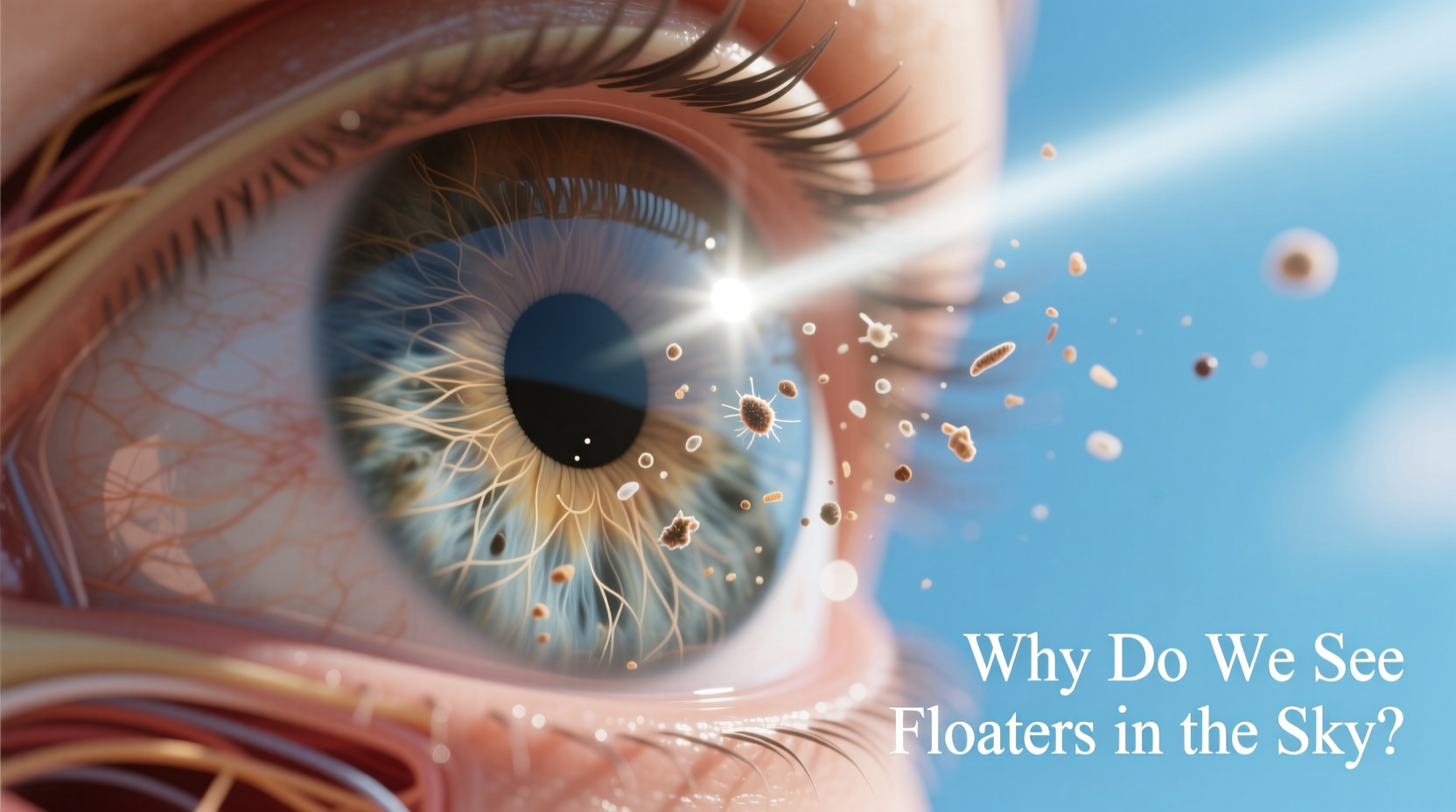
Eye floaters are small, shadowy shapes that drift through your field of vision. They may appear as dots, squiggles, thread-like strands, or even ring-shaped blobs. Unlike external objects, floaters move with your eyes—they seem to dart away when you try to focus directly on them. This occurs because floaters are not on the surface of the eye but within it, suspended in the vitreous humor—the gel-like substance that fills the space between the lens and the retina.
The visual effect is caused by microscopic clumps of protein or cells inside the vitreous casting shadows onto the retina. When light enters the eye—especially abundant light from the sky—these shadows become more visible. The contrast makes the floaters stand out, much like dust particles become noticeable in a sunlit room.
The Role of the Vitreous Humor in Floater Formation
The vitreous humor is 99% water, with the remaining 1% composed of collagen fibers, hyaluronic acid, and soluble proteins. In youth, this gel is firm and transparent, maintaining the eye’s spherical shape and optical clarity. But as we age, the vitreous begins to liquefy—a process called vitreous syneresis. During this change, collagen fibers collapse and clump together, forming small, opaque masses that cast shadows on the retina.
This structural transformation explains why floaters become more common with age. Most adults over 50 experience some degree of vitreous degeneration. However, younger individuals can also develop floaters due to nearsightedness (myopia), eye trauma, inflammation, or prior eye surgery.
“Floaters are typically benign, especially when they’ve been present for months or years. But a sudden shower of new floaters should never be ignored—it could signal a retinal tear.” — Dr. Lena Patel, Retina Specialist, Massachusetts Eye Institute
Why the Sky Makes Floaters More Visible
Floaters aren’t always noticeable. They tend to emerge most clearly under specific visual conditions—particularly when looking at bright, uniform backgrounds such as the open sky, a white ceiling, or a computer screen. Several factors contribute to this:
- High Contrast: The bright background enhances the contrast between the translucent vitreous and the denser floaters, making shadows easier to detect.
- Lack of Visual Anchors: Without defined edges or patterns, the brain has fewer reference points, so moving shadows stand out more.
- Light Intensity: Bright ambient light increases the amount of light passing through the vitreous, amplifying the visibility of internal obstructions.
- Eyelid Position: Looking upward often widens the eyelid aperture slightly, allowing more light in and increasing retinal stimulation.
In essence, the sky acts like a natural projection screen, illuminating the inner structures of the eye. This is why many people first notice floaters while lying on a beach or walking outdoors on a sunny day.
Common Conditions That Increase Floater Visibility
| Condition | How It Affects Floaters | Typical Age Group Affected |
|---|---|---|
| Posterior Vitreous Detachment (PVD) | Vitreous gel pulls away from retina, creating large, mobile floaters | 50+ |
| Myopia (Nearsightedness) | Longer eyeball stretches vitreous, accelerating degeneration | Teens to 30s |
| Uveitis | Inflammation introduces cells into vitreous, forming new floaters | All ages |
| Diabetic Retinopathy | Bleeding into vitreous produces sudden, dense floaters | Adults with diabetes |
| Ocular Trauma | Physical injury disrupts vitreous structure | All ages |
When Floaters Signal a Serious Problem
While most floaters are harmless and stabilize over time, certain symptoms warrant immediate medical evaluation. A sudden increase in floaters, especially when paired with flashes of light or a dark curtain moving across the vision, can indicate a retinal tear or detachment—conditions that require urgent treatment to prevent permanent vision loss.
Retinal tears occur when the shrinking vitreous tugs too hard on the retina during posterior vitreous detachment. If fluid seeps through the tear, it can lift the retina off the back wall of the eye, leading to detachment. Time is critical: treatment within 24–48 hours can often preserve vision.
Red Flags: Symptoms Requiring Immediate Attention
- Sudden onset of hundreds of new floaters (\"shower of floaters\")
- Flashes of light in peripheral vision (photopsia)
- A dark shadow or \"curtain\" spreading across the visual field
- Loss of peripheral or central vision
- Pain or redness accompanying visual changes
If any of these occur, seek emergency eye care. An ophthalmologist will perform a dilated fundus exam to inspect the retina thoroughly.
Real-Life Example: A Sudden Change in Vision
Mark, a 58-year-old teacher, noticed something unusual one morning while driving. As he glanced up at the sky, he saw dozens of new specks swirling in his right eye. Within hours, he began seeing brief flashes of light in his side vision, like camera flashes in a dark room. By evening, a gray shadow had crept into his lower visual field.
He visited an eye clinic the next day. After dilation, the ophthalmologist diagnosed a retinal tear caused by posterior vitreous detachment. Mark underwent laser photocoagulation within 24 hours to seal the tear and prevent detachment. Follow-up exams confirmed the retina remained attached, and his vision stabilized. His doctor emphasized that delaying care could have led to blindness in that eye.
Mark’s case illustrates how seemingly minor visual disturbances—like increased floaters—can be early warnings of serious conditions. Prompt recognition and action saved his sight.
Managing Floaters: What You Can Do
For most people, floaters fade into the background over time. The brain adapts through a process called neural adaptation, learning to ignore persistent visual noise. However, several strategies can help minimize their impact:
Step-by-Step Guide to Coping with Floaters
- Monitor Changes: Keep track of when floaters appear, how many there are, and whether they’re changing. Note any associated symptoms like flashes or vision loss.
- Use Eye Movements: Quick shifts of the gaze—up and down or side to side—can temporarily move floaters out of the central vision by disturbing the vitreous fluid.
- Adjust Lighting: Avoid prolonged exposure to very bright, featureless surfaces. Use tinted lenses outdoors if the sky triggers discomfort.
- Stay Hydrated: Though not scientifically proven, some practitioners suggest optimal hydration supports vitreous health.
- Reduce Eye Strain: Take breaks during screen work to prevent fatigue, which may heighten awareness of floaters.
In severe cases where floaters significantly impair quality of life, medical interventions exist:
- Vitrectomy: Surgical removal of the vitreous gel and replacement with saline. Effective but carries risks like cataracts or retinal detachment.
- Laser Floater Treatment (LFT): Uses YAG lasers to break up large floaters. Controversial due to limited evidence and potential retinal damage; not widely recommended.
Most eye care professionals advise conservative management unless complications arise.
Frequently Asked Questions
Can floaters go away on their own?
Yes, many floaters become less noticeable over time. The brain learns to filter them out, and gravity may pull some clumps out of the central line of sight. However, they rarely disappear completely. Small, stable floaters often become part of normal vision.
Are floaters a sign of blindness?
Not usually. Most floaters are benign and don’t affect long-term vision. However, if they result from a retinal tear or detachment, untreated progression can lead to partial or complete vision loss. The key is recognizing warning signs and acting quickly.
Do younger people get floaters?
Yes. While more common in older adults, younger individuals—especially those who are highly myopic—can develop floaters due to accelerated vitreous changes. Eye injuries or inflammation can also cause floaters at any age.
Prevention and Long-Term Eye Health Checklist
While aging-related floaters can’t always be prevented, protecting your eyes reduces the risk of complications. Follow this checklist to maintain ocular health:
- ✅ Schedule annual eye exams, especially after age 50
- ✅ Wear UV-protective sunglasses outdoors to reduce oxidative stress
- ✅ Manage systemic conditions like diabetes and hypertension
- ✅ Avoid eye trauma by using protective gear during sports
- ✅ Report sudden vision changes immediately to an eye specialist
- ✅ Limit steroid use unless medically supervised (linked to cataracts and glaucoma)
“The eye is a window to both the world and your overall health. Paying attention to subtle changes—like new floaters—can catch problems early.” — Dr. Carlos Mendez, Ophthalmologist and Public Health Advocate
Conclusion: Seeing Clearly Beyond the Floaters
Seeing floaters when you look at the sky is a common experience rooted in the biology of the aging eye. While usually harmless, they serve as a reminder of the delicate structures within our eyes and the importance of proactive care. Understanding the difference between normal aging and warning signs empowers you to respond wisely.
Don’t ignore sudden changes in vision. At the same time, avoid anxiety over stable, long-standing floaters—your brain will likely adapt. With regular checkups, smart habits, and prompt action when needed, you can maintain healthy vision for years to come.




 浙公网安备
33010002000092号
浙公网安备
33010002000092号 浙B2-20120091-4
Comments
No comments yet. Why don't you start the discussion?