
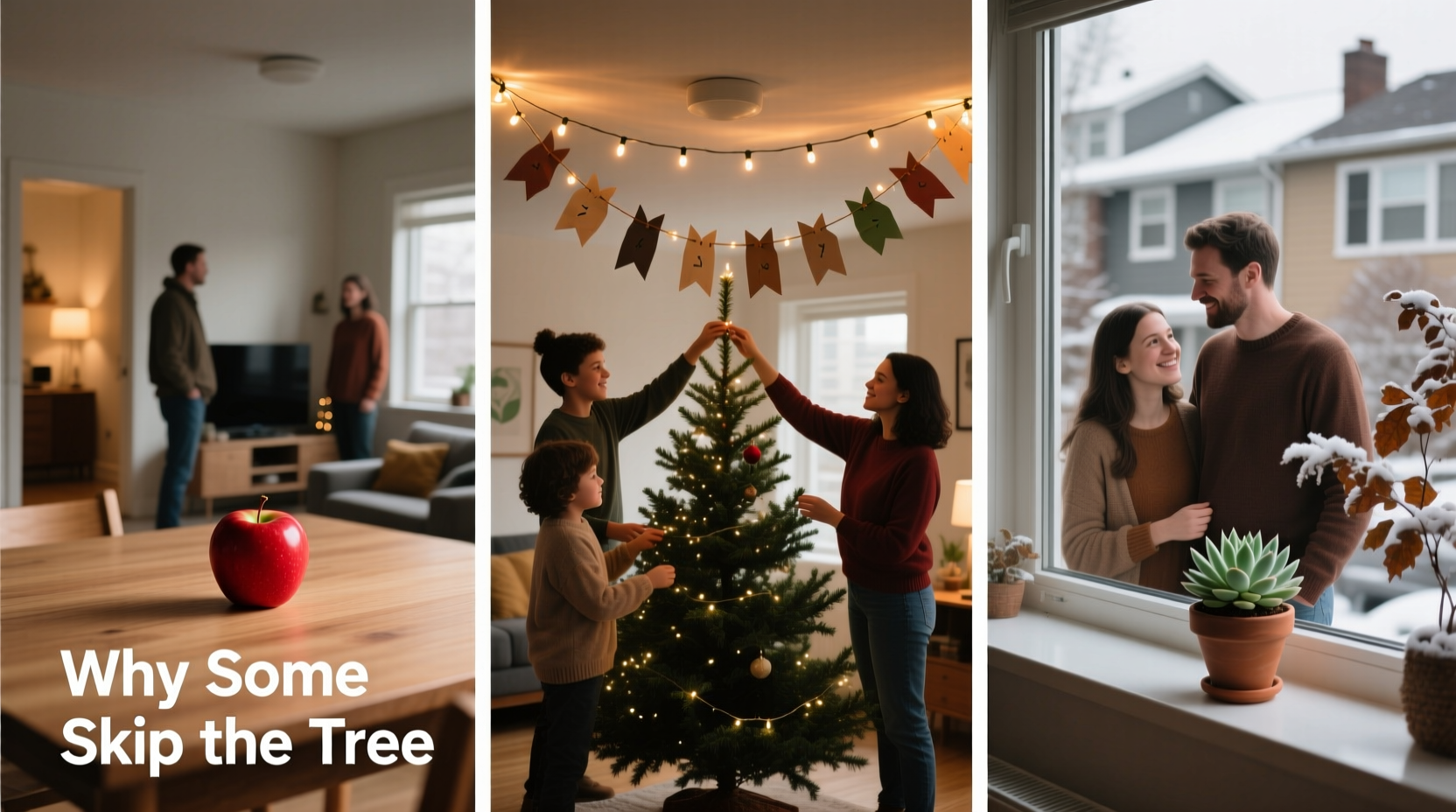
For generations, the Christmas tree has anchored holiday decor—a living symbol of light, resilience, and tradition in winter’s darkest weeks. Yet in recent years, a quiet but steady shift has taken root: more households are choosing not to bring a tree indoors at all. This isn’t about apathy or diminished celebration—it’s a deliberate, values-driven reimagining of what the season means. People are stepping away from pine-scented convention for reasons that span environmental ethics, cultural identity, spiritual authenticity, accessibility needs, and even aesthetic intentionality. What replaces the tree is rarely an afterthought; it’s often a more thoughtful, personal, and deeply considered focal point. Understanding this movement reveals how holiday traditions evolve—not by erasure, but by expansion.
Environmental and Ethical Concerns Drive the Shift
A growing number of individuals cite ecological responsibility as their primary reason for skipping the Christmas tree. The annual U.S. demand for 25–30 million real trees involves significant land use, pesticide application, diesel-powered harvesting and transport, and post-holiday landfill waste—only 45% of cut trees are recycled, according to the National Christmas Tree Association. Meanwhile, artificial trees—often made from non-recyclable PVC and petroleum-based plastics—typically last just six to nine years before disposal, with an estimated carbon footprint three times higher than a locally sourced, composted real tree over its lifecycle (a 2021 study published in Environmental Science & Technology).
Beyond emissions, many object to industrialized tree farming’s impact on biodiversity. Monoculture plantations displace native flora and fauna, while “tree farms” frequently rely on herbicides like glyphosate to suppress undergrowth—chemicals linked to soil degradation and pollinator decline. For eco-conscious consumers, purchasing a tree can feel like participating in a system at odds with their broader sustainability commitments.
Cultural, Religious, and Spiritual Alternatives
Not every household observes Christmas as a Christian religious holiday—and even among Christians, theological interpretations vary widely. Some denominations—including certain branches of Quakerism, Jehovah’s Witnesses, and conservative Anabaptist communities—avoid Christmas trees due to perceived pagan origins or concerns about commercialization overshadowing sacred meaning. Others embrace pluralistic or secular humanist frameworks where the solstice, rather than the Nativity, anchors seasonal reflection.
This opens space for symbols rooted in deeper or broader traditions. Scandinavian families may center a Julbord (Yule table) adorned with candles, lingonberries, and hand-carved wooden figures. Japanese-American households sometimes blend Shinto-inspired kadomatsu (gate pine arrangements) with paper cranes and origami ornaments. In interfaith homes, a “harmony tree” might hold symbols representing multiple traditions: a crescent moon, a Star of David, a lotus, and a dove—all coexisting without hierarchy.
“Ritual objects gain power when they reflect who we are—not just what we’ve inherited. A family displaying handmade clay stars alongside pressed autumn leaves isn’t rejecting tradition; they’re translating it into their own language.” — Dr. Lena Torres, Cultural Anthropologist and author of Seasonal Belonging: Ritual in Modern Life
Accessibility, Health, and Practical Realities
For many, the decision to forgo a tree is grounded in daily lived experience—not ideology. People with severe allergies or asthma often find pine resin, mold spores on cut trees, or dust accumulation on artificial ones trigger debilitating respiratory episodes. Pet owners face real risks: curious cats climb unstable trees; dogs chew toxic needles or ingest ornament hooks and tinsel. Families with young children navigate constant vigilance against tipping hazards, electrical cord exposure, and breakable decorations.
Physical limitations also play a role. Setting up, watering, and later disposing of a full-size tree demands strength, mobility, and time—resources not equally available. Renters face restrictions: many leases prohibit live trees or mandate fire-retardant certifications for fakes. Urban dwellers contend with narrow stairwells, elevator limits, and no curbside pickup for disposal. These aren’t minor inconveniences—they’re structural barriers that make traditional trees functionally inaccessible.
| Challenge | Common Tree-Related Risk | Practical Alternative |
|---|---|---|
| Allergies/Asthma | Mold spores on cut trees; dust on stored fakes | Dried lavender wreaths; silk eucalyptus garlands; ceramic pinecone displays |
| Pet Safety | Needle ingestion; chewing cords/ornaments | Wall-mounted wooden “tree” silhouettes with removable felt ornaments; tabletop terrariums with air plants |
| Small Spaces | Footprint, height, storage bulk | Folding accordion-style paper trees; vertical wall “branches” with hanging ornaments; minimalist shelf displays |
| Rental Restrictions | Lease violations; security deposit risks | Magnetic ornament boards; LED-light string art; framed botanical prints with seasonal themes |
Intentional Minimalism and Aesthetic Reclamation
In contrast to the maximalist “more is more” approach often associated with holiday decor, a rising cohort embraces intentional minimalism—not as austerity, but as clarity. They view the Christmas tree not as essential, but as optional—a decorative element that must earn its place. When space, budget, or attention is limited, energy flows toward elements that resonate more deeply: a single heirloom candleholder lit each evening, a curated shelf of vintage storybooks, or a rotating display of seasonal textiles (a woolen runner, embroidered napkins, hand-thrown mugs).
This mindset treats decoration as curation, not accumulation. Instead of a towering centerpiece demanding visual dominance, these households favor layered subtlety: a low wooden stump base draped with moss and fairy lights; a brass tray holding three pillar candles and dried orange slices; or a floor-to-ceiling window framed with ivy garlands and amber glass baubles. The effect is quieter, more contemplative—and paradoxically, more memorable.
Mini Case Study: The Chen Family, Portland, OR
The Chens stopped buying Christmas trees eight years ago after their daughter was diagnosed with severe mold-induced asthma. Her symptoms flared every December—coughing fits, emergency inhaler use, missed school days. Initially, they tried high-end air purifiers and hypoallergenic fakes, but nothing fully resolved the issue. Then, inspired by Japanese wabi-sabi aesthetics, they redesigned their holiday focus around impermanence and texture.
Each year, they build a “Winter Altar” on their entryway console: a slab of reclaimed Douglas fir, smoothed but left raw; three hand-thrown stoneware vessels holding dried lotus pods, river stones, and cinnamon sticks; battery-operated tea-light candles nestled in hollowed-out apples. Ornaments are limited to five—each handmade by family members: a child’s clay star, a grandmother’s embroidered linen square, a father’s forged iron hook. Guests comment not on absence, but on presence—the warmth, the intention, the calm. “We don’t miss the tree,” says Mei Chen. “We gained space—for breath, for creativity, for what actually matters.”
What People Display Instead: A Thoughtful Catalog
The alternatives to Christmas trees are as diverse as the reasons for choosing them. Below is a practical overview of the most common, meaningful replacements—grouped by intent and execution:
- The Living Branch Display: A single, elegant branch (birch, willow, or cherry) placed in a tall vase, decorated with dried citrus, feathers, beeswax candles, or hand-dipped pinecones. Low maintenance, biodegradable, and evokes forest stillness.
- The Story Shelf: A dedicated floating shelf or sideboard styled with meaningful objects: vintage travel souvenirs, photos from past winters, handwritten notes of gratitude, small books of poetry or folklore. Celebrates memory and continuity over ornamentation.
- The Light Sculpture: Geometric frames (wood, metal, or bent willow) wrapped in warm-white LED strings. Can be wall-mounted, freestanding, or suspended—offering luminosity without foliage.
- The Fabric Tree: A fabric “tree” cut from wool, linen, or felt, pinned to a wall or mounted on a frame. Ornaments become tactile—embroidered birds, wooden buttons, fabric-wrapped acorns. Washable, portable, and infinitely customizable.
- The Solstice Wheel: A circular wooden or woven hoop hung vertically, divided into four quadrants representing the seasons. Adorned with natural materials tied to each: wheat sheaves (harvest), oak leaves (strength), holly berries (resilience), and white feathers (rest). Rooted in pre-Christian European observance but widely adopted by secular and spiritual-but-not-religious households.
Step-by-Step: Creating a Meaningful Non-Tree Holiday Centerpiece
- Clarify your “why”: Write down your top 2–3 priorities (e.g., “low allergen,” “reflects our multicultural roots,” “uses only existing materials”). Let this guide all subsequent choices.
- Select your anchor form: Choose one structural element—branch, hoop, shelf, frame, or stump. Prioritize natural, repurposed, or long-lasting materials.
- Gather symbolic elements: Collect 3–7 items that carry personal resonance: a seashell from a family trip, a child’s drawing, a sprig of homegrown rosemary, a smooth stone from a hike.
- Introduce light intentionally: Use battery-operated LEDs (warm white or amber) rather than candles near flammable materials. Place lights to highlight texture—not overwhelm.
- Add ritual function: Designate one action tied to the display—lighting a candle each evening, adding a written note to a jar, rotating one object weekly. This transforms decor into practice.
FAQ
Is skipping the Christmas tree seen as “not celebrating enough”?
No—increasingly, it’s recognized as a sign of deeper engagement. Sociologists tracking holiday practices note that non-tree households spend more time on experiential traditions: cooking together, volunteering, letter-writing, or nature walks. The emphasis shifts from consumption to connection.
Won’t kids miss out on the “magic” without a tree?
Research in developmental psychology suggests children derive wonder from consistency, participation, and sensory richness—not specific objects. Families using alternative displays report children often engage more actively—designing ornaments for a fabric tree, arranging a solstice wheel, or helping gather branches—because the ritual feels co-created, not prescribed.
Can I mix traditions—like having a small tree *and* another display?
Absolutely. Hybrid approaches are increasingly common. A tabletop mini-fir beside a story shelf, or a potted evergreen on the porch paired with an indoor light sculpture, honors both continuity and evolution. The key is alignment—not purity.
Conclusion
Choosing not to have a Christmas tree is never simply about omission. It’s an act of discernment—an invitation to ask what truly nourishes your spirit, supports your loved ones, honors your values, and reflects your world. Whether motivated by ecology, health, heritage, aesthetics, or simple pragmatism, the alternatives people choose reveal a richer, more textured understanding of celebration: one that prioritizes meaning over momentum, presence over performance, and care over convention.
There is no single “right” way to mark this season—only authentic ways. Your home doesn’t need a tree to hold light. It doesn’t require pine scent to evoke peace. What it does need is intention. So this year, consider what you’d place at the heart of your home—not because it’s expected, but because it’s true.




 浙公网安备
33010002000092号
浙公网安备
33010002000092号 浙B2-20120091-4
Comments
No comments yet. Why don't you start the discussion?