
For generations, the star atop the Christmas tree has symbolized the Star of Bethlehem—the celestial guide that led the Magi to the newborn Christ. It’s a fixture in holiday iconography, appearing in cards, carols, and department store displays. Yet in living rooms across North America, Europe, and Australia, that star is conspicuously absent. Instead, homeowners choose angels, birds, lanterns, origami cranes, minimalist orbs, or even nothing at all. This isn’t carelessness or oversight—it’s intentional. The decision to omit the traditional star reflects deeper shifts in how people understand tradition, spirituality, aesthetics, and inclusivity. What appears to be a small decorative choice is, in fact, a quiet act of personal curation: a way to align ritual with identity.
The Historical Weight—and Modern Distance—of the Star
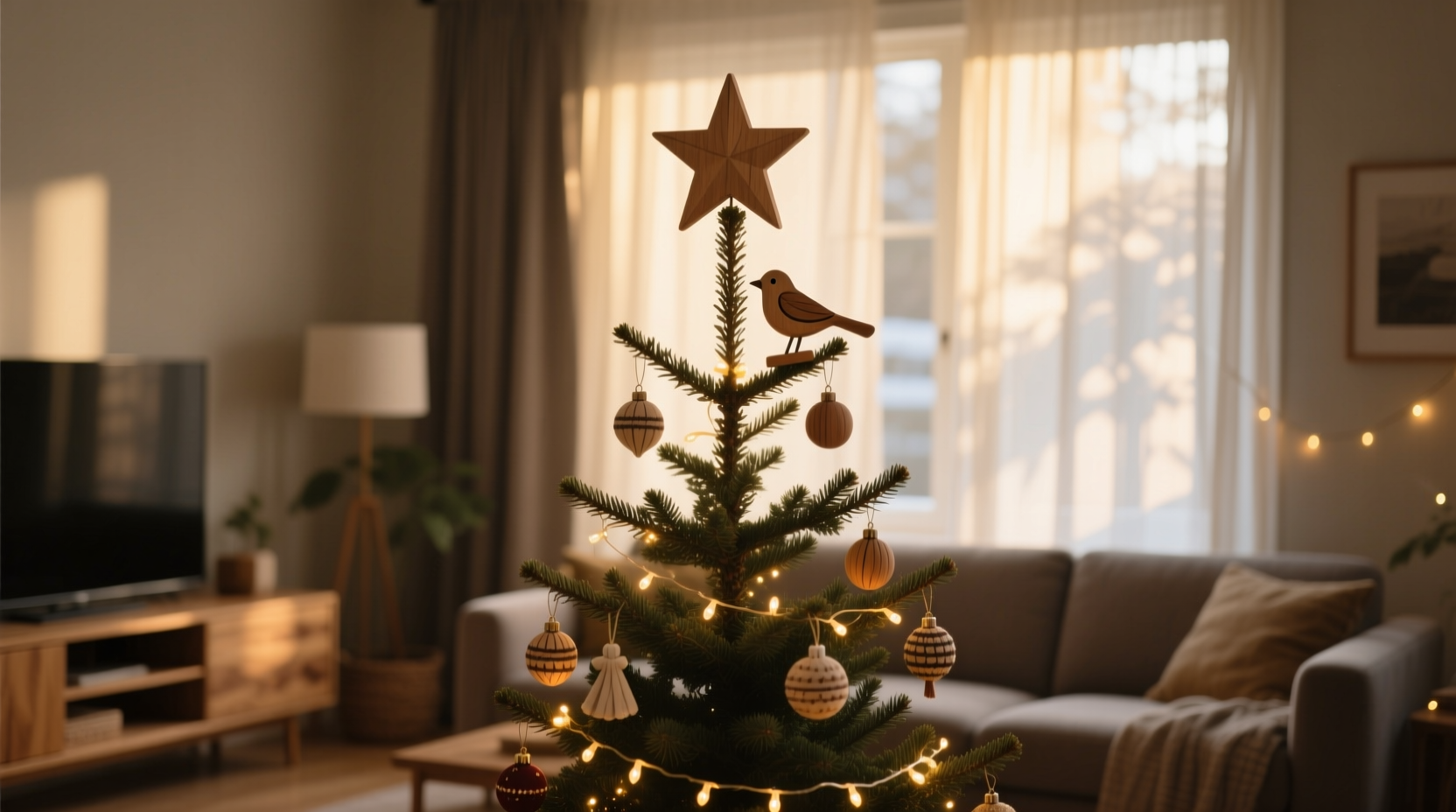
The star’s dominance in Western Christmas decor stems from its theological centrality in the Nativity narrative. By the 19th century, as Christmas trees gained popularity in Germany and later Britain and the U.S., the star became the standard finial—not only for its symbolism but also because it offered visual balance: a bright, pointed apex that drew the eye upward and anchored the tree’s silhouette. Yet this convention assumed shared religious literacy and cultural consensus—conditions that no longer hold universally.
Sociologist Dr. Lena Torres, who studies secular ritual formation at the University of Edinburgh, observes:
“When a symbol becomes so ubiquitous, its meaning can hollow out through repetition—or conversely, deepen through reinterpretation. For many, the star no longer signifies biblical revelation; it signals ‘expected decor.’ Skipping it isn’t rejection—it’s reclamation.”
This distinction matters. Omitting the star isn’t necessarily about rejecting Christianity—it may signal a desire to foreground other values: ecological responsibility, interfaith respect, minimalist design principles, or family-specific memories. The absence itself becomes expressive.
Five Practical & Meaningful Alternatives (and Why They Resonate)
Below are five widely adopted alternatives to the star—with real-world context for each choice:
- The Angel: Still rooted in Christian tradition (Luke 2:9–14), but emphasizes presence, protection, and announcement over celestial guidance. Often chosen by families with young children, as angels feel more approachable and nurturing than a distant star.
- The Dove: A universal peace symbol across faiths—including Christianity, Islam, Judaism, and secular humanism. Its soft curves contrast with the star’s sharp geometry, offering visual warmth and thematic openness.
- The Lantern or Candle Holder: Evokes light-as-hope motifs common in winter solstice traditions worldwide. Popular among those who observe both Christian and pagan-influenced seasonal customs—or who simply appreciate the metaphor of light in darkness without doctrinal specificity.
- The Minimalist Orb or Geometric Topper: Reflects contemporary design sensibilities—clean lines, monochrome palettes, tactile materials like matte brass or frosted glass. Chosen by interior designers and homeowners seeking cohesion with year-round décor, not seasonal clutter.
- No Topper at All: A deliberate embrace of negative space and organic form. The tree’s natural apex becomes the focal point—celebrating asymmetry, imperfection, and the living quality of the fir or spruce itself. Common among eco-conscious households and those practicing “slow holiday” philosophies.
A Real Example: The Chen Family’s Tree Evolution
In Portland, Oregon, the Chen family has decorated a live Douglas fir every December for 17 years. For the first decade, they used a vintage gold star passed down from Maria’s grandmother—a Catholic immigrant from the Philippines. But after their daughter Mei began asking questions about Hanukkah (through her Jewish partner’s family) and their son Leo started learning about Indigenous winter storytelling traditions at school, the star felt increasingly singular.
“We didn’t want to erase Grandma’s star,” says Maria, “but we wanted our tree to say something broader about who we are now.” In year 11, they replaced it with a hand-blown glass dove—blue, translucent, catching light differently each hour. Last year, they added three small wooden ornaments beneath it: a menorah, a cedar bough, and a paper crane—each placed by a family member. The star remains in a velvet box, displayed beside the fireplace. “It’s not gone,” Maria explains. “It’s contextualized.”
Their story illustrates a key insight: skipping the star isn’t always about removal—it’s about making room for layered meaning.
Do’s and Don’ts: Choosing a Topper with Intention
Selecting a tree topper is more than decoration—it’s an opportunity to reinforce values. Use this table to guide your choice thoughtfully:
| Action | Do | Don’t |
|---|---|---|
| Considering Symbolism | Ask: “What does this object mean *to us*, not just in general?” | Assume a symbol carries the same weight for everyone in your household or guest list. |
| Evaluating Materials | Choose sustainable, repairable, or heirloom-quality items (e.g., ceramic, wood, recycled glass). | Purchase single-use plastic toppers—even if “festive”—that will be discarded in January. |
| Matching Aesthetics | Ensure the topper complements your lighting scheme (e.g., warm white LEDs pair well with brass; cool white suits crystal or silver). | Let trend-driven colors (like millennial pink or neon green) override harmony with your existing décor palette. |
| Involving Others | Invite children or elders to help craft or select the topper—making it a collaborative ritual. | Delegate the decision entirely to one person without discussion, especially in blended or multi-generational households. |
| Storing Thoughtfully | Keep toppers in padded, labeled boxes with acid-free tissue—especially for handmade or sentimental pieces. | Stuff delicate items into grocery bags or toss them loosely into storage bins where breakage or tarnish occurs. |
Step-by-Step: Creating a Personalized Topper Ritual (in 5 Minutes or Less)
You don’t need crafting skills or a budget to make your topper meaningful. Follow this streamlined process:
- Pause and reflect (60 seconds): Before shopping or digging through storage, ask: “What feeling do I most want this tree to radiate this year? Calm? Joy? Resilience? Connection?” Write it down.
- Scan your home (90 seconds): Look for one existing object that embodies that feeling—a smooth river stone, a vintage compass, a child’s clay sculpture, a dried orange slice from last year’s garland.
- Prepare it (60 seconds): Clean gently. If needed, attach a simple wire loop or ribbon hanger using clear-drying glue or floral wire. No perfection required.
- Write a sentence (45 seconds): On a small card, note why this object belongs on the tree *this year*. (“This pinecone reminds us of our hike in October—when we felt grounded.”)
- Place and pause (45 seconds): Position it at the apex. Step back. Breathe. That’s the ritual complete.
This method transforms selection from consumer decision to mindful practice—centering presence over perfection.
FAQ: Addressing Common Questions
Does skipping the star offend religious relatives?
Not inherently—but context matters. If your family observes Christmas as a sacred event, consider discussing your choice openly: “We’re using an angel this year because it reminds us of protection and grace—values we share.” Framing it as expansion, not erasure, invites understanding. Many find inclusive symbols deepen rather than dilute meaning.
Are non-star toppers less stable or harder to secure?
Actually, many alternatives offer superior stability. Stars often rely on thin metal prongs that slip in dense branches. Doves, orbs, and lanterns typically have wider bases or integrated clips. When purchasing, look for “tree-top compatible” designs with rubber-grip stems or adjustable clamp mechanisms—widely available from specialty holiday retailers.
What if I love stars but want something different this year?
Reinterpret—not replace. Try a constellation-themed topper (Orion, Ursa Major), a stylized supernova in brushed copper, or a star-shaped topper made from reclaimed wood or beeswax. The form remains, but the material and story shift. Tradition evolves through iteration, not abandonment.
Conclusion: Your Tree, Your Terms
The star on the tree was never meant to be a rule—it began as a resonant image, then became a convention, and now stands as an invitation: to examine what we uphold, why we uphold it, and whether it still serves us. Skipping it doesn’t diminish the season’s wonder; it redirects attention—to craftsmanship, to memory, to quiet intention, to the shared human impulse to mark winter’s depth with light and shape.
Whether you choose a hand-thrown ceramic owl, a cluster of dried eucalyptus tied with linen, a family photo ornament enlarged and framed in walnut, or simply let the tree’s highest branch breathe unadorned—you’re participating in the oldest holiday tradition of all: adapting ritual to honor who you are, right now.




 浙公网安备
33010002000092号
浙公网安备
33010002000092号 浙B2-20120091-4
Comments
No comments yet. Why don't you start the discussion?