
For generations, the Christmas tree topper—whether a gleaming star, a delicate angel, or a bold bow—has served as the ceremonial capstone of holiday decor. Its placement marked the final, symbolic act of tree dressing: a visual exclamation point. Yet in recent years, a quiet but unmistakable shift has taken root. Across urban lofts, Scandinavian-inspired living rooms, and even suburban family homes, trees stand proudly unadorned at the apex. No star. No angel. No glittering finial. Just branches tapering into open air.
This isn’t neglect. It’s intentionality. Skipping the tree topper reflects deeper currents in interior design, environmental consciousness, cultural reinterpretation, and evolving notions of celebration. It signals a move away from inherited ornamentation toward curated meaning—and it’s reshaping how we experience the season visually, emotionally, and ethically.
The Rise of Intentional Minimalism
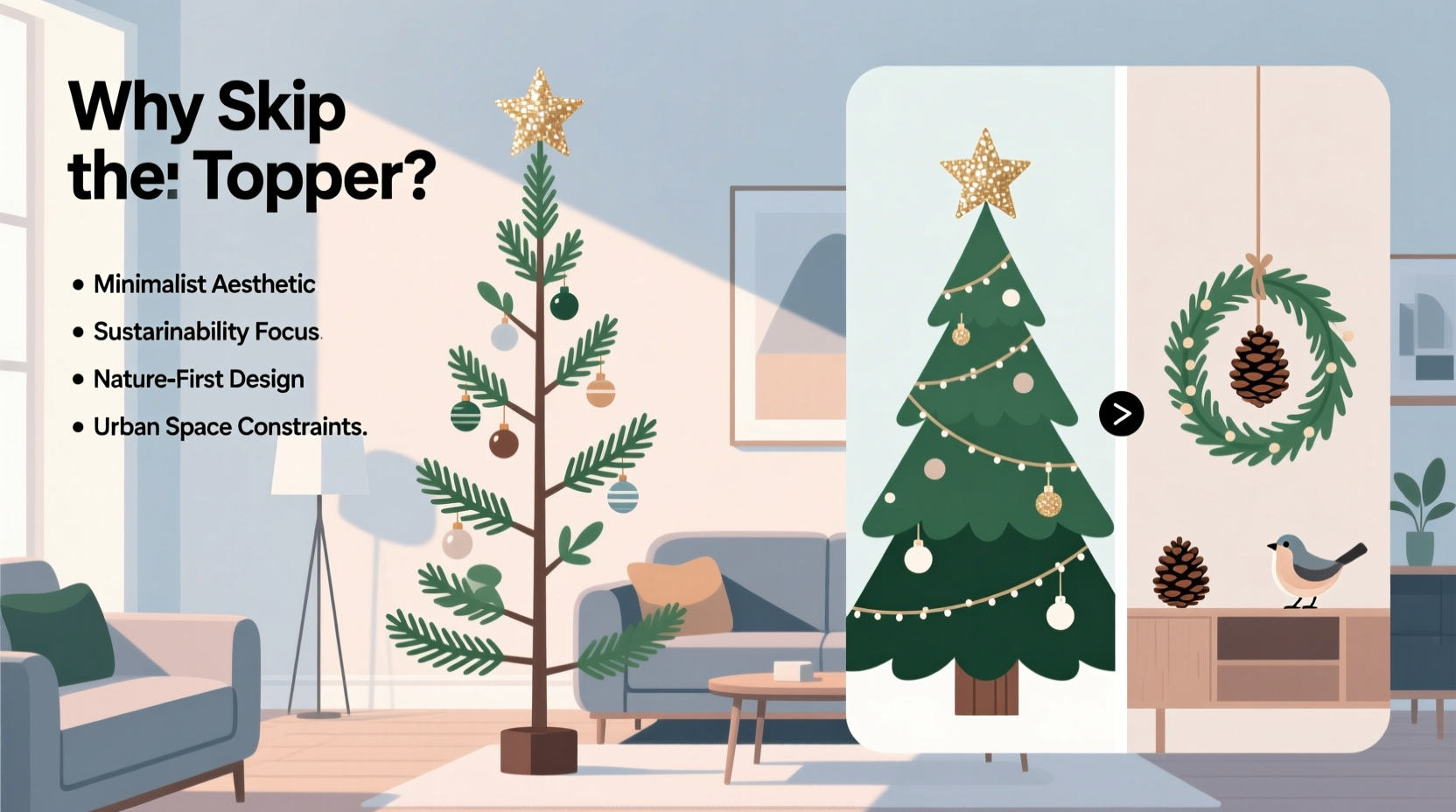
Minimalism in holiday decor has matured beyond simple “less is more” aesthetics. Today’s minimalism is narrative-driven: every object earns its place through function, resonance, or craftsmanship. A tree topper—often mass-produced, historically symbolic, and visually dominant—increasingly clashes with this ethos. Designers and homeowners alike are asking: Does this piece reflect *my* values? Does it enhance the tree—or compete with it?
Consider the visual weight of a traditional 6-inch gold star. It commands attention, anchoring the eye at the very top. But in a room defined by clean lines, neutral palettes, and organic textures, that same star can read as jarring—a punctuation mark where the sentence was already complete. Trees themselves have become sculptural elements: firs with strong vertical rhythm, spruces with dense, architectural layering, or even dried eucalyptus or olive branches styled as “non-traditional trees.” In such contexts, the topper doesn’t crown—it interrupts.
Sustainability as a Silent Design Principle
Environmental awareness now permeates decorative choices, often quietly but decisively. Tree toppers—especially plastic, battery-operated, or fragile glass versions—are among the least reusable, most landfill-bound holiday items. Many sit unused for 11 months, then break during storage or fail after one season. According to the U.S. Environmental Protection Agency, holiday-related waste increases by over 25% between Thanksgiving and New Year’s—with decorative plastics contributing significantly to non-recyclable streams.
Designers like Elena Ruiz, founder of the sustainable interiors studio Veridian Collective, note a growing client preference for “zero-addition finishing”: “They want the tree to feel like part of the home’s existing ecosystem—not a temporary spectacle. A topper implies disposability. A thoughtfully pruned tip or a single dried citrus slice wired into the highest branch? That feels like stewardship.”
“The most sustainable decoration is the one you never buy. When a tree’s silhouette feels whole, adding a topper isn’t enhancement—it’s extraction.” — Elena Ruiz, Sustainable Interior Designer & Author of Seasonal Living, Not Seasonal Stuff
Cultural Reinterpretation and Symbolic Shifts
The traditional topper carries layered symbolism: the Star of Bethlehem (Christian theology), angelic presence (spiritual guardianship), or even secular motifs like bows (celebration) or snowflakes (winter purity). Yet contemporary households increasingly embrace pluralistic, personalized, or secular interpretations of the season. For families blending traditions, avoiding a theologically specific topper prevents unintentional exclusion. For atheists or agnostics, a religious symbol may feel incongruent—not out of rejection, but out of authenticity. And for many younger adults raising children, there’s a conscious effort to separate festive joy from dogma.
This isn’t about erasure; it’s about recentering. Without a prescribed icon at the apex, attention flows downward—to handmade ornaments, family photos strung as garlands, or nature-based accents like pinecones and cinnamon sticks. The tree becomes a vessel for collective memory rather than doctrinal statement.
Practical Alternatives: What Fills the Void?
Skipping the topper doesn’t mean leaving the top barren—it means choosing alternatives that align with current priorities. Below is a comparison of common approaches, ranked by sustainability impact, visual harmony, and ease of execution:
| Alternative | Sustainability Score (1–5) | Visual Harmony | Execution Ease |
|---|---|---|---|
| Natural branch tip left untrimmed | 5 | High—emphasizes organic form | Effortless |
| Dried citrus wheel + rosemary sprig (wired) | 4 | Warm, textural, seasonal | Low—requires drying time |
| Single oversized wooden bead or ceramic disc | 4 | Modern, tactile, grounded | Moderate—needs secure wiring |
| Small potted succulent nestled into top branches | 3 | Unexpected, living, conversation-starting | Moderate—requires watering plan |
| No addition (intentional negative space) | 5 | Strongest for minimalist spaces | Effortless |
Note: “Sustainability Score” accounts for material origin (renewable vs. synthetic), lifespan (reusable across years), and end-of-life (compostable, recyclable, or landfill-bound).
A Real-World Shift: The Case of the Brooklyn Loft
In 2022, Maya Chen, a graphic designer and mother of two, renovated her 1920s Brooklyn loft with reclaimed wood floors, matte black fixtures, and a palette of oat, charcoal, and sage. Her first holiday season there, she hung her childhood angel topper on the Douglas fir—only to feel immediate dissonance. “It looked like it belonged in a different century,” she recalls. “The gold wings clashed with the raw steel beams. The porcelain face felt too precious next to the rough-hewn mantel.”
She removed it. Then, she stepped back. For three days, the tree stood bare at the top. She photographed it from multiple angles. She asked friends what they noticed first. Consistently, they commented on the “calm height” of the tree, the way light caught the uppermost needles, and the sense of “breathing room.” By Christmas Eve, Maya had wired a single, sun-dried orange slice—its edges curled and darkened—into the highest fork. It stayed there for six weeks, releasing a subtle citrus aroma before being composted. “It wasn’t about rejecting tradition,” she says. “It was about honoring the space I’d built—and letting the tree speak for itself.”
Five-Step Guide to Deciding Whether to Skip Your Topper
- Assess your tree’s natural form. Is the apex full and symmetrical? Does it taper cleanly? If yes, the shape may need no embellishment.
- Review your room’s dominant aesthetic. In highly textured, layered, or maximalist spaces, a topper can anchor the composition. In minimalist, monochromatic, or biophilic settings, it often competes.
- Interrogate the topper’s origin and longevity. Was it bought new this year? Does it contain batteries, plastic, or fragile components? If it’s unlikely to be reused in 3+ years, reconsider its role.
- Consult household meaning-makers. Ask children, partners, or elders: “What does the top of our tree represent to you?” Their answers may reveal whether symbolism still resonates—or feels inherited rather than chosen.
- Test the void for 48 hours. Remove the topper. Live with the bare apex. Note your emotional response—not just “Is it pretty?” but “Does it feel complete? Calm? Authentic?” Trust that data over habit.
FAQ
Isn’t skipping the topper just following a trend? Won’t it feel dated in a few years?
Not necessarily. While fashion cycles influence color palettes and materials, the underlying drivers—sustainability consciousness, spatial mindfulness, and personalization—are long-term societal shifts. A 2023 National Retail Federation survey found 68% of consumers aged 25–44 prioritize “meaningful simplicity” over ornamental excess in home decor—a figure projected to rise. The choice to omit reflects values, not just visuals.
What if my tree looks “unfinished” without a topper?
That perception often stems from decades of cultural conditioning. Try reframing: instead of “unfinished,” consider “unadorned,” “resolved,” or “self-contained.” Trim lower branches to emphasize verticality. Use ribbon or garland that extends slightly beyond the top tier to create a soft, intentional termination. Or—most powerfully—allow the tree’s natural apex to be the focal point. Nature rarely needs a capstone.
Can I still honor tradition without a physical topper?
Absolutely. Ritual lives beyond objects. Light the topmost candle on your advent wreath while placing the first ornament. Recite a family poem as you step back from the finished tree. Hang a small framed photo of loved ones in the top branches. These acts carry deeper resonance than any store-bought symbol—and they’re infinitely more adaptable across changing beliefs and circumstances.
Conclusion
Skipping the tree topper is neither a rejection of tradition nor a surrender to minimalism as austerity. It is, fundamentally, an act of curation—an assertion that meaning resides not in inherited symbols, but in conscious choices. It acknowledges that beauty can live in negative space, that sustainability is a design language, and that the most powerful decorations are those that reflect who we are *now*, not who we were told to be.
Your tree doesn’t need a crown to command reverence. Its quiet height, its scent of pine or cedar, the way light filters through its branches—these are sovereign qualities. When you choose to leave the apex open, you’re not removing something. You’re making room—for breath, for reflection, for the unscripted moments that define real celebration.




 浙公网安备
33010002000092号
浙公网安备
33010002000092号 浙B2-20120091-4
Comments
No comments yet. Why don't you start the discussion?