
Imagine stepping outside on a bright morning, sunlight hitting your face just right—and suddenly, you sneeze. Not because of dust or allergies, but simply from seeing the light. If this sounds familiar, you're not alone. Around 18% to 35% of the population experiences this phenomenon, known as the photic sneeze reflex (PSR), or more formally, Autosomal Dominant Compelling Helio-Ophthalmic Outburst (ACHOO) syndrome. While it may seem like a quirky bodily quirk, there’s a well-documented neurological and genetic basis behind it. This article explores the science behind why certain individuals sneeze in response to bright light, how it works in the brain, its evolutionary implications, and practical considerations for those affected.
What Is the Photic Sneeze Reflex?
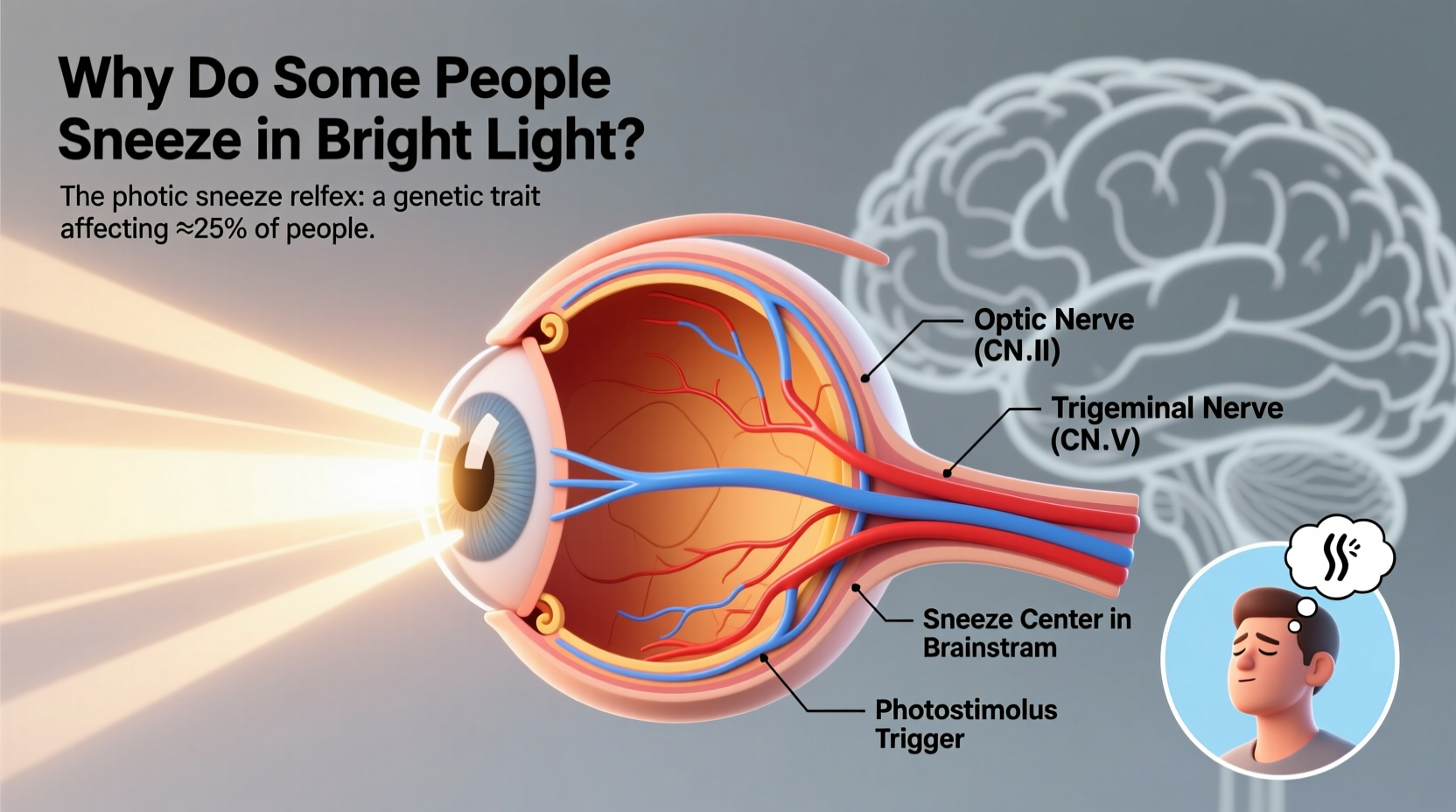
The photic sneeze reflex is an involuntary response where exposure to sudden bright light—especially sunlight—triggers a sneeze or a series of sneezes. It typically occurs when someone moves from a dim environment into bright daylight, such as exiting a building or driving out of a tunnel. The reflex is not caused by irritation in the nasal passages but rather by a miscommunication in the nervous system.
This condition is genetically inherited in an autosomal dominant pattern, meaning that only one parent needs to carry the gene for a child to have a 50% chance of inheriting the trait. Despite being harmless for most, the reflex can pose risks in specific high-stakes situations, such as during surgery, piloting aircraft, or operating heavy machinery.
How Does the Brain Trigger a Sneeze from Light?
To understand the mechanism, we need to examine two key cranial nerves located close together in the brainstem: the optic nerve (responsible for vision) and the trigeminal nerve (which controls facial sensations and the sneeze reflex).
When bright light enters the eyes, it stimulates the optic nerve, sending signals to the brain to adjust pupil size and process visual information. In individuals with the photic sneeze reflex, researchers believe there is a form of \"cross-talk\" or neural crosstalk between the optic and trigeminal nerves. Essentially, the electrical signal from the optic nerve inadvertently spills over into the nearby trigeminal nerve, which interprets this stimulation as an irritant in the nasal cavity—even though no physical irritant exists.
The brain then responds by initiating a protective reflex: the sneeze. This is the body’s way of expelling perceived threats from the airway, even if the threat is entirely imagined due to faulty wiring.
“Photic sneezing is a fascinating example of neural proximity leading to sensory confusion. It shows how closely packed nerves can sometimes interfere with each other’s signals.” — Dr. Lena Peterson, Neurophysiologist, Stanford School of Medicine
Genetic Basis of ACHOO Syndrome
The photic sneeze reflex is linked to a specific genetic variation. Studies suggest that a single nucleotide polymorphism (SNP) near the *PLCH1* gene—involved in cell signaling in the nervous system—plays a significant role. This gene variant appears to influence how neurons develop and communicate, particularly in regions where sensory inputs converge.
Because it follows an autosomal dominant inheritance pattern, the trait often runs in families. For example, if one grandparent and a parent both sneeze in sunlight, there's a strong likelihood that their children will too. However, expression can vary widely—some people sneeze once, others multiple times, and some only under very intense light conditions.
Interestingly, the same gene region has been associated with other sensory crossover phenomena, suggesting that PSR might be part of a broader category of neurological sensitivities.
Prevalence and Demographics
Estimates suggest that between one-fifth and one-third of the global population experiences the photic sneeze reflex, though exact numbers vary by study and region. It appears across all ethnic groups but may be slightly more common in people of European descent.
There is no significant gender bias; men and women are equally likely to inherit the trait. Onset typically occurs in childhood or adolescence, and the reflex tends to persist throughout life, although sensitivity may decrease slightly with age.
| Population Segment | Estimated Prevalence | Notes |
|---|---|---|
| Global Average | 18–35% | Varies by study methodology |
| European Descent | Up to 34% | Slightly higher observed frequency |
| Asian Populations | ~20% | Preliminary data suggests lower rates |
| Children | Onset by age 10–14 | Rare before puberty |
Real-World Implications: When Sneezing Can Be Dangerous
While generally harmless, the photic sneeze reflex can become a safety concern in certain scenarios. Consider the following real-world example:
Mini Case Study: Pilot Safety and Sunlight-Induced Sneezing
In 2017, a commercial pilot undergoing routine training reported experiencing uncontrollable sneezing episodes during takeoff on clear mornings. After investigation, it was determined that rapid exposure to unfiltered sunlight during ascent triggered his photic sneeze reflex. Though he had never considered it problematic before, repeated sneezing during critical flight phases posed a distraction risk.
Aviation medical examiners now routinely screen for PSR during evaluations, especially for military and private pilots. Some aviation authorities recommend that pilots prone to photic sneezing use tinted visors or schedule flights to avoid direct sunrise exposure when possible.
Similarly, surgeons who are sensitive to bright operating lights may experience intraoperative sneezing, which can compromise sterility. One documented case involved a neurosurgeon who began sneezing mid-procedure upon repositioning under surgical lamps. Since then, awareness of PSR has grown within medical communities, prompting discussions about pre-surgical screening and adaptive lighting solutions.
Do’s and Don’ts for Managing the Photic Sneeze Reflex
For most people, photic sneezing is a minor inconvenience. But knowing how to manage it can improve comfort and safety. Below is a practical checklist:
- Do wear UV-protective sunglasses when moving outdoors.
- Do allow your eyes to gradually adjust to bright light by pausing briefly in shaded areas.
- Do inform healthcare providers or instructors if you’re undergoing procedures involving bright lights.
- Don’t drive through tunnels without adjusting mirror angles or wearing transitional lenses.
- Don’t ignore repeated sneezing during activities requiring focus, such as operating machinery.
- Don’t assume it’s an allergy—no histamine release is involved in PSR.
Step-by-Step Guide to Minimizing Light-Induced Sneezing
If you're affected by the photic sneeze reflex, follow these steps to reduce its impact:
- Anticipate exposure: Before leaving a dark room or vehicle, mentally prepare for sunlight and consider shielding your eyes preemptively.
- Use eye protection: Wear polarized sunglasses that block glare and reduce sudden luminance changes.
- Adjust head position: Tilt your head slightly downward and let your eyes adapt before looking straight ahead.
- Breathe steadily: Some report that controlled breathing helps suppress the urge to sneeze by calming the nervous system.
- Close one eye: Closing one eye while exposing the other gradually may reduce the neural surge that triggers sneezing.
- Consult a specialist: If sneezing interferes with work or daily function, discuss it with a neurologist or ophthalmologist.
Debunking Common Myths About Sunlight Sneezing
Over the years, several misconceptions have surrounded the photic sneeze reflex. Let’s clarify them:
- Myth: It’s caused by allergies to sunlight.
Truth: No allergens are involved. It’s a neurological reflex, not an immune response. - Myth: Everyone sneezes in the sun eventually.
Truth: Only genetically predisposed individuals exhibit this reflex. - Myth: It can be “trained” away.
Truth: There’s no evidence that behavioral conditioning eliminates PSR, though coping strategies can reduce frequency. - Myth: It’s related to migraines.
Truth: While some migraine sufferers also have PSR, the two conditions are not directly linked.
Frequently Asked Questions (FAQ)
Can the photic sneeze reflex be cured?
No, there is no cure because it’s a genetic neurological trait, not a disease. However, symptoms can be managed effectively with preventive measures like wearing sunglasses and avoiding sudden light transitions.
Is photic sneezing dangerous?
Generally, no. But it can be hazardous during activities requiring sustained attention—such as driving, flying, or performing surgery—where an unexpected sneeze could lead to errors or accidents.
Why does sunlight specifically trigger sneezing and not other bright lights?
Sunlight is the most intense natural light source humans regularly encounter. Its broad spectrum and high luminance create a stronger stimulus than artificial lights. That said, some people report similar reactions under bright halogen or LED surgical lamps.
Conclusion: Understanding a Quirky Yet Insightful Human Trait
The photic sneeze reflex is more than just a curious bodily oddity—it’s a window into how our nervous system processes sensory input and how genetic variations shape individual experiences. From ancient philosophers wondering at the phenomenon to modern geneticists mapping its origins, sunlight-induced sneezing continues to fascinate scientists and laypeople alike.
Understanding why some people sneeze when they look at the sun isn’t just about solving a mystery; it’s about appreciating the complexity of human biology. Whether you’re someone who experiences PSR or simply intrigued by it, recognizing its mechanisms empowers you to respond wisely in daily life and professional settings.




 浙公网安备
33010002000092号
浙公网安备
33010002000092号 浙B2-20120091-4
Comments
No comments yet. Why don't you start the discussion?