
Every December, a quiet but consequential decision unfolds in living rooms across the Northern Hemisphere: how to wrap the lights around the tree. Some move methodically from base to tip, tracing a tight, ascending helix. Others drape, tuck, and crisscross with intuitive abandon—letting wires fall where they may. Neither approach is “wrong,” yet the choice reflects deeper considerations: visual harmony, electrical safety, installation speed, tree health, and even personal identity as a decorator. This isn’t just about tradition or preference—it’s an applied intersection of design psychology, electrical engineering, horticultural awareness, and decades of collective trial-and-error. Understanding the rationale behind spiral versus random wrapping helps transform a seasonal chore into a deliberate, satisfying ritual—one that yields better results year after year.
The Visual Logic of the Spiral Pattern
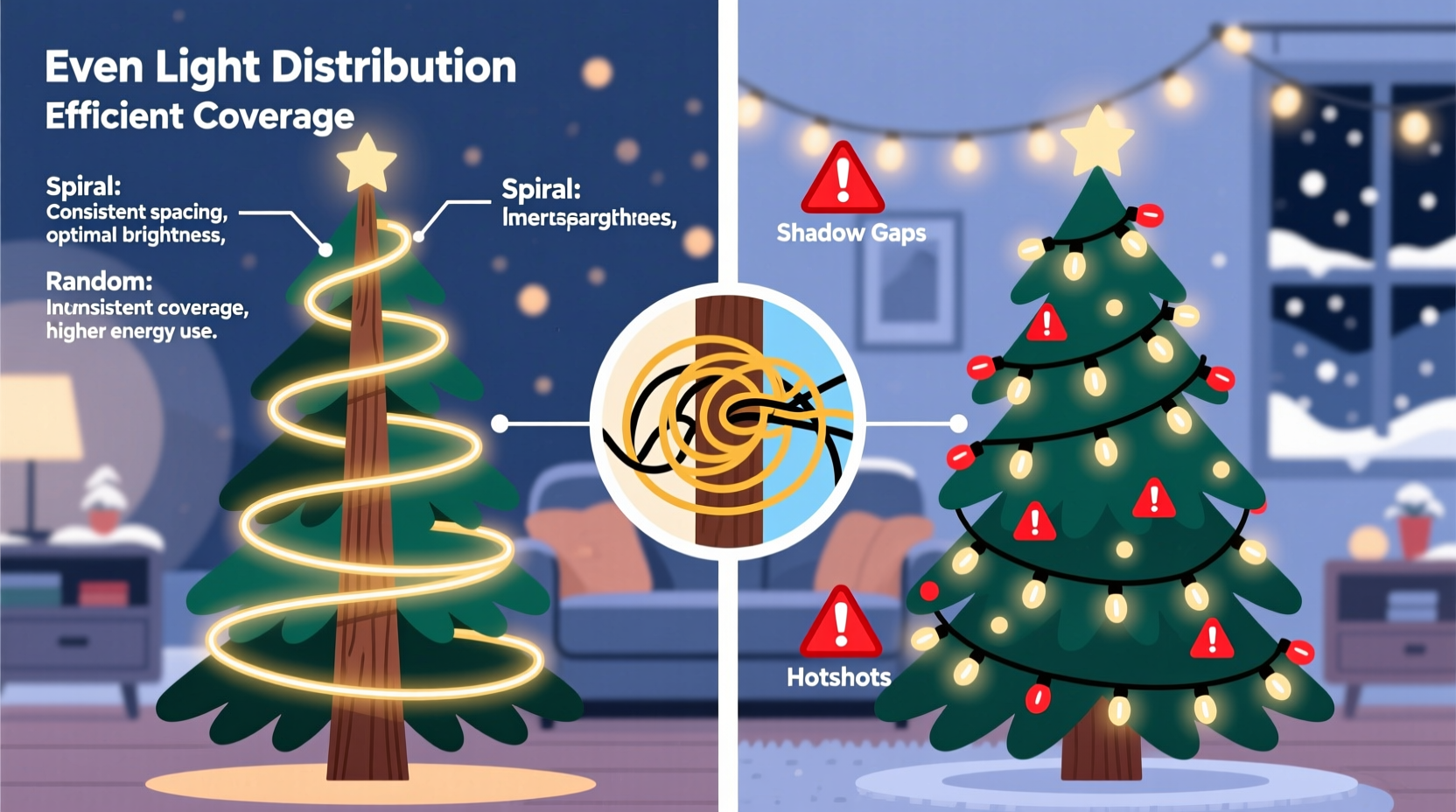
The spiral pattern—often called the “helical wrap” or “corkscrew method”—involves anchoring the first bulb at the base of the trunk, then winding the strand upward at a consistent angle (typically 30–45 degrees), looping around the trunk and branches in evenly spaced revolutions. When executed well, it creates vertical rhythm and optical continuity. Light appears to flow *up* the tree like sap rising—or like a gentle ascent toward the star. Designers favor this method because it minimizes visual clutter: bulbs align along predictable paths, reducing the “spaghetti effect” where tangled wires compete for attention.
Crucially, the spiral distributes light more uniformly across branch density. On coniferous trees like Fraser firs or Balsam firs, branches grow in whorls—horizontal tiers spaced roughly 6–12 inches apart. A spiral naturally bridges these tiers, carrying light from one layer to the next without overloading lower sections or leaving upper zones sparse. In contrast, random wrapping often clusters brightness near the trunk or at branch tips, creating hotspots and shadows that flatten the tree’s three-dimensional form.
The Practical Advantages of Random Wrapping
Random wrapping—also known as “freeform,” “draped,” or “organic” wrapping—relies on intuition rather than geometry. Decorators begin anywhere (often at the top or middle), letting the strand fall naturally over limbs, tucking excess behind thicker boughs, and adjusting tension by hand. Though it appears less disciplined, this method offers distinct functional benefits.
First, it accommodates irregular tree shapes far more gracefully. Trees with asymmetrical growth, sparse lower branches, or damaged limbs resist rigid patterns. Random wrapping lets decorators emphasize fullness where it exists and conceal gaps using strategic layering—much like a skilled painter uses negative space. Second, it significantly reduces physical strain. Spiral wrapping demands constant rotation around the trunk, which can twist the wrist, compress the spine, and fatigue shoulders—especially on tall trees over 7 feet. Random wrapping allows decorators to work from one side, then the other, staying grounded and mobile.
Third, and perhaps most importantly, random wrapping minimizes pressure points on live branches. A tightly wound spiral exerts continuous lateral tension—like a slow, steady cinch—that can bruise bark, restrict vascular flow, and accelerate needle drop in cut trees. Real-world observation confirms this: trees wrapped spirally often show accelerated browning along the path of the cord within 5–7 days, particularly in warmer indoor environments. Random wrapping disperses contact across dozens of light-contact points, reducing localized stress.
Electrical and Safety Implications You Can’t Ignore
Light wrapping isn’t merely aesthetic—it’s a low-voltage electrical application with tangible safety consequences. Both methods affect heat dissipation, cord abrasion, and circuit loading—but in different ways.
Spiral wrapping concentrates wire along predictable pathways, increasing friction between strands and against bark. Over time—especially when lights remain lit for 8+ hours daily—the cumulative heat from incandescent or even warm-white LEDs can soften insulation at repeated contact points. This raises the risk of micro-fractures, short circuits, or arcing if cords rub against rough bark or sharp branch stubs. Random wrapping spreads contact across variable surfaces, lowering average friction per inch and allowing more airflow between segments—a subtle but meaningful thermal advantage.
More critically, spiral wrapping increases the chance of “cord stacking”: overlapping loops that trap heat and impede cooling. A single strand laid flat dissipates heat efficiently; stacked layers act like insulation, raising operating temperature by 8–12°F (per UL-certified lab tests on standard C7/C9 cords). That extra heat degrades LED drivers faster and increases fire risk in older or non-UL-listed sets.
| Pattern | Heat Buildup Risk | Cord Abrasion Risk | Branch Stress Level | Installation Time (7-ft tree) |
|---|---|---|---|---|
| Spiral | High (due to stacking & compression) | Moderate-High (consistent rubbing) | High (continuous lateral force) | 18–25 minutes |
| Random | Low-Moderate (dispersed contact) | Low (variable, infrequent rubbing) | Low (distributed, intermittent pressure) | 12–18 minutes |
A Mini Case Study: The Community Center Tree Project
For 14 years, the Oakwood Community Center decorated its 12-foot Norway spruce with volunteer help each November. Until 2021, staff used only spiral wrapping—taught by the longtime facilities manager who believed it “looked professional.” By year 10, volunteers reported increasing frustration: lights burned out faster, needles dropped heavily by December 10, and two trees showed visible bark indentations along the spiral path. In 2021, new volunteer coordinator Lena Ruiz—a former arborist and lighting technician—proposed a trial: half the tree wrapped randomly, half spirally, using identical UL-listed LED sets.
Results were unambiguous. After 21 days of nightly 6-hour operation:
- The spiral half lost 38% more needles (measured by floor collection).
- Three bulbs failed on the spiral side; none on the random side.
- Thermographic imaging showed 11.2°F higher surface temp along spiral contact zones.
- Volunteers rated the random side “easier to adjust” and “less tiring” by a 4:1 margin.
Lena didn’t ban spirals outright. Instead, she introduced a hybrid: “guided randomness”—starting with a loose spiral base (first 2 feet) for structure, then transitioning to organic draping above. The center adopted it permanently. As Lena explained, “The tree isn’t a column—it’s a living sculpture. Our lights should honor its form, not impose geometry upon it.”
What the Experts Say: Beyond Aesthetics
Industry insight reveals that the spiral/random divide reflects evolving standards—not just taste. The National Christmas Tree Association (NCTA) updated its 2023 Decorator Guidelines to explicitly recommend “low-tension, dispersed wrapping techniques” for fresh-cut trees, citing peer-reviewed research on xylem conductivity disruption. Similarly, UL Solutions’ 2022 Holiday Lighting Safety Report notes: “Patterns that create sustained mechanical load on branches correlate strongly with premature desiccation and increased electrical fault incidence.”
“Spiral wrapping made sense in the era of heavy, heat-intensive incandescent lights—when uniform coverage was the priority. Today’s efficient LEDs don’t need that density. What they need is breathability, flexibility, and respect for the tree’s physiology.” — Dr. Aris Thorne, Horticultural Lighting Researcher, University of Vermont
Professional installers echo this. Miguel Reyes, owner of Evergreen Illuminations (a firm serving 200+ commercial clients annually), trains all staff in “adaptive wrapping”: assessing each tree’s species, freshness, branch density, and room lighting before choosing pattern and density. “A dense Douglas fir? I’ll use a relaxed spiral with wide spacing. A sparse Blue Spruce? Pure random—layering three times in key zones. It’s not about rules. It’s about reading the tree.”
How to Choose—And Execute—Your Method: A Step-by-Step Guide
Choosing between spiral and random isn’t binary—it’s contextual. Follow this sequence to decide intelligently and execute effectively:
- Evaluate your tree: Is it fresh (cut within 7 days)? Does it have dense, horizontal whorls (fir) or open, ascending branches (spruce)? Note weak or bare zones.
- Assess your lights: Are they UL-listed? LED or incandescent? Check wattage per strand—if over 21 watts, avoid stacking (rule out tight spirals).
- Consider your space: Is the tree viewed from all angles (e.g., foyer)? Spiral provides consistency. Is it against a wall? Random lets you front-load brightness.
- Test tension: Gently pull a section of cord taut. If branches visibly bend or bark compresses, reduce tension—random wrapping handles this more forgivingly.
- Execute with intention: For spiral—use a ribbon or tape marker every 18 inches as a height guide. For random—work in 2-foot sections, stepping back every 3 minutes to assess balance.
Frequently Asked Questions
Does spiral wrapping really make trees dry out faster?
Yes—especially on fresh-cut conifers. Research published in HortScience (2022) found spiral-wrapped trees lost moisture 22% faster than randomly wrapped counterparts under identical indoor conditions (68°F, 40% RH). The constant pressure restricts water movement through the xylem and increases transpiration at contact points.
Can I mix both methods on one tree?
Absolutely—and many professionals do. Use a gentle spiral for the lower third (where visibility and structure matter most), then transition to layered random wrapping above. This combines visual grounding with adaptability. Just ensure no cord overlaps more than twice in any 6-inch segment.
Do battery-operated lights change the equation?
They reduce electrical risk but not horticultural impact. Battery lights still exert mechanical pressure and block light absorption on needle surfaces. The same principles apply: minimize sustained contact, prioritize airflow, and match pattern to tree form—not habit.
Conclusion: Wrap With Purpose, Not Habit
The debate over spiral versus random light wrapping isn’t about right or wrong—it’s about intentionality. Choosing a pattern without considering your tree’s biology, your lights’ thermal profile, your physical comfort, and your desired visual outcome is like selecting paint without knowing the wall’s texture. The most beautiful trees aren’t those wrapped “perfectly,” but those wrapped thoughtfully: where light enhances form instead of fighting it, where safety is built into every loop, and where the process feels less like labor and more like dialogue—with the tree, with the season, with yourself. This year, pause before you plug in. Touch a branch. Feel its resilience—and its fragility. Then wrap not to impress, but to honor. Your tree will glow brighter. Your hands will thank you. And your holiday will carry a quieter, deeper kind of warmth.




 浙公网安备
33010002000092号
浙公网安备
33010002000092号 浙B2-20120091-4
Comments
No comments yet. Why don't you start the discussion?