
Fragrance is one of the most personal accessories you can wear—often remembered long after a person has left the room. Yet many people have experienced the frustration of buying a perfume they loved in the bottle, only to find it smells completely different—or even unpleasant—on their skin. This isn’t a flaw in the fragrance; it’s a natural interaction between chemistry and scent. Understanding this phenomenon is the first step toward finding a perfume that doesn’t just sit on your skin but becomes a seamless extension of your identity.
The Science Behind Skin Chemistry and Scent
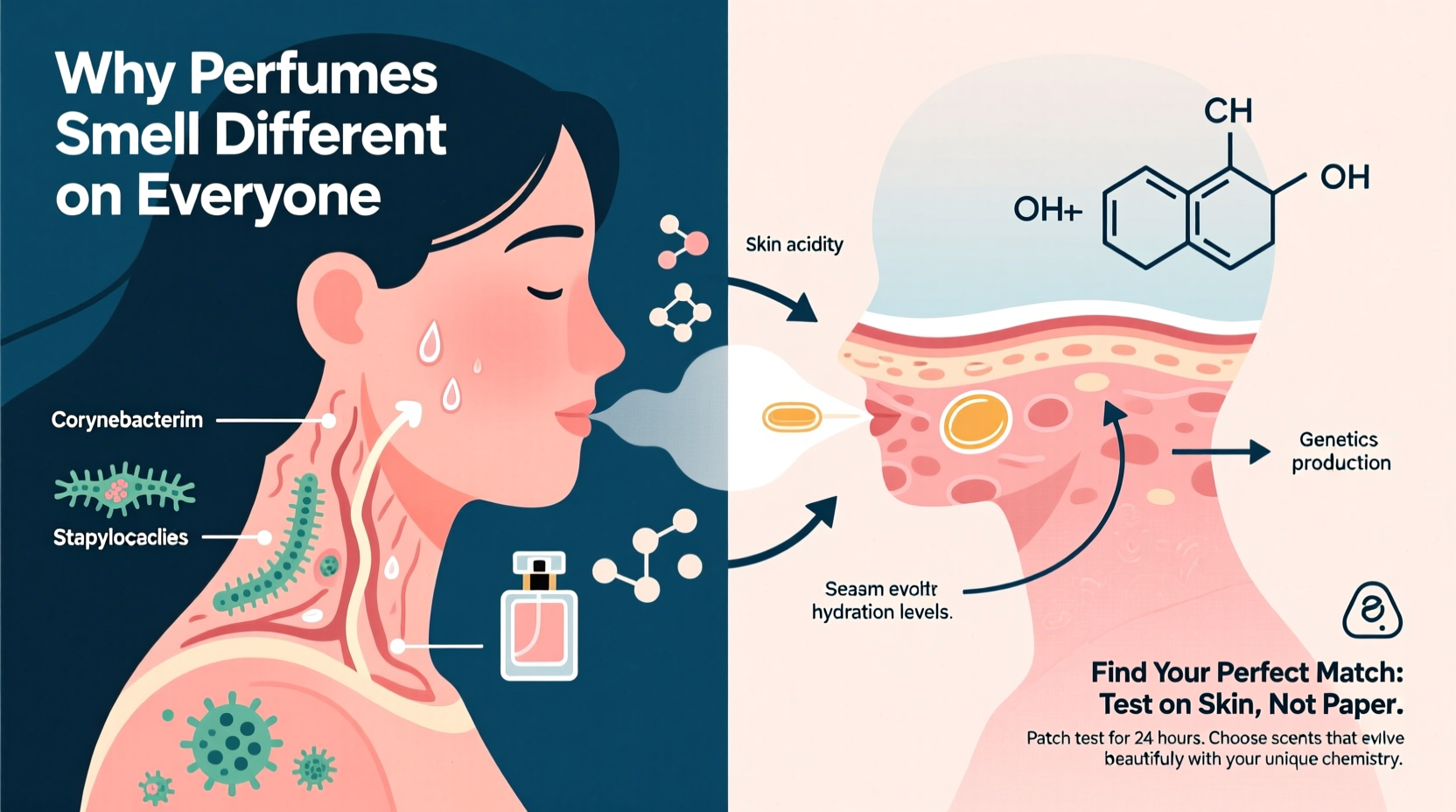
Perfume doesn't exist in isolation. Once applied, it interacts with your body's unique biochemistry, which includes pH levels, sebum (skin oil) production, hydration, diet, hormones, and even medication. These factors influence how fragrance molecules evaporate and bind to your skin, altering the way the scent develops over time—a process known as “sillage” and “dry-down.”
Your skin acts like a canvas for fragrance. A perfume that blooms richly on oily skin may fade quickly on dry skin due to lack of moisture retention. Similarly, acidic skin can amplify certain notes—like making vanilla cloying or citrus overly sharp—while alkaline skin might mute floral accords.
“Fragrance is not just about the bottle—it’s about the dialogue between the scent and the wearer’s biology.” — Dr. Laura Sgroi, Olfactory Chemist and Perfume Formulator
Even subtle differences in body temperature affect evaporation rates. Warmer skin tends to project scent more strongly, while cooler skin holds onto base notes longer, creating a more intimate aroma.
Why Your Best Friend Loves What You Hate
It’s common to borrow a friend’s signature scent, spray it on, and wonder: “Why does this smell so different?” The answer lies in biological individuality. Two people wearing the same eau de parfum may emit entirely different olfactory profiles.
- Diet: High-protein diets can intensify musky notes, while spicy foods may make warm ambers more prominent.
- Hormones: Menstrual cycles, pregnancy, and menopause alter skin chemistry, sometimes changing how a long-time favorite perfume behaves.
- Medications: Antibiotics, antidepressants, and hormonal treatments can temporarily shift your skin’s pH and oil balance, affecting scent longevity and tone.
- Skin Type: Oily skin retains fragrance longer and amplifies base notes; dry skin may struggle to hold top notes, leading to rapid dissipation.
This variability explains why sampling is non-negotiable. No amount of online reviews or celebrity endorsements can replace the real-world test on your skin.
How to Find Your Perfect Fragrance Match: A Step-by-Step Guide
Finding your ideal scent isn’t about trends or popularity—it’s about alignment with your chemistry, lifestyle, and emotional response. Follow this methodical approach to discover a fragrance that feels inherently yours.
- Identify Your Scent Preferences
Start by reflecting on scents you naturally gravitate toward: fresh laundry, blooming gardens, leather books, citrus fruits, or baked goods. These associations reveal your subconscious olfactory inclinations. - Understand Fragrance Families
Familiarize yourself with core categories:- Floral: Rose, jasmine, peony—elegant and romantic.
- Woody: Sandalwood, cedar, patchouli—warm and grounding.
- Citrus: Bergamot, lemon, grapefruit—bright and energizing.
- Oriental/Amber: Vanilla, cinnamon, incense—rich and sensual.
- Fougère: Lavender, oakmoss, coumarin—classic and balanced, often in men’s fragrances.
- Gourmand: Caramel, chocolate, almond—sweet and edible.
- Test One Scent at a Time
Visit a store with knowledgeable staff. Spray only one fragrance per wrist. Avoid sniffing multiple scents simultaneously, as this dulls your sense of smell. - Wait and Observe
Give the fragrance 20–30 minutes to react with your skin. Note how the top, middle (heart), and base notes evolve. Does it become warmer? Softer? More complex? - Test in Context
Wear the sample during a normal day—at work, on a walk, in an air-conditioned room. Assess its performance in real conditions. - Repeat Across Days
Test the same fragrance on different days. Your skin chemistry varies daily, and consistency across multiple trials confirms compatibility. - Narrow and Commit
Once you’ve shortlisted 2–3 options, compare them side by side. Choose the one that feels most authentic—not just pleasant, but *true* to who you are.
Do’s and Don’ts When Choosing a Perfume
| Do’s | Don’ts |
|---|---|
| Apply perfume to pulse points (wrists, neck, behind ears) | Rub your wrists together after spraying—this breaks down delicate top notes |
| Layer with matching unscented moisturizer or body oil to boost longevity | Use heavily scented lotions underneath—competing aromas distort the fragrance |
| Store perfumes away from light and heat to preserve integrity | Keep bottles in the bathroom—humidity and temperature swings degrade formulas |
| Reapply lightly throughout the day if needed | Over-spray—less is more when it comes to projection and social etiquette |
| Consider the season—lighter scents for summer, richer ones for winter | Stick to one fragrance year-round regardless of weather or occasion |
Real-Life Example: From Frustration to Perfect Match
Sophie, a graphic designer in her early 30s, had always avoided perfume. She tried several popular floral scents, only to find they turned sour or overly sweet within hours. “One smelled like burnt sugar on me,” she recalls. “Another made my coworkers ask if I was feeling unwell.”
After learning about skin chemistry, she visited a niche perfumery and worked with a consultant. Instead of florals, she tested a vetiver-based fragrance with hints of grapefruit and musk. On her skin, the sharp citrus softened into a clean, earthy warmth that lasted all day. “It didn’t announce itself,” she says. “It just felt like me—only better.”
Sophie now rotates two scents: a green, aromatic blend for daytime and a spiced amber for evenings. Her confidence grew not just from smelling good, but from wearing something that felt deeply personal.
Checklist: How to Ensure You’re Choosing the Right Perfume
- ☐ Test the fragrance on your skin, not just paper.
- ☐ Wait at least 30 minutes before judging the scent.
- ☐ Try it on multiple days to account for skin variations.
- ☐ Wear it during a typical day to assess real-world performance.
- ☐ Evaluate longevity and sillage—does it last? Is it too strong or too faint?
- ☐ Consider the season and your wardrobe—does it complement your lifestyle?
- ☐ Ask trusted friends for honest feedback—sometimes others notice what you don’t.
- ☐ Buy a decant or sample first, if possible, before committing to a full bottle.
Frequently Asked Questions
Can a perfume smell bad on me even if it’s high quality?
Absolutely. Even the most expensive, expertly crafted perfumes can clash with your skin chemistry. Quality doesn’t guarantee compatibility. A $300 niche fragrance might turn metallic or sour on one person, while a $50 drugstore scent blossoms beautifully on another. It’s not about price—it’s about synergy.
Why does my perfume disappear after an hour?
This usually indicates poor skin adherence. Dry skin lacks the natural oils to hold fragrance. Try applying an unscented moisturizer or petroleum jelly to pulse points before spraying. Alternatively, opt for eau de parfum or parfum concentrations, which contain more oil and last longer than eau de toilette.
Should I stick to one signature scent or switch it up?
There’s no rule. Some people build a recognizable identity around one fragrance. Others prefer rotating scents based on mood, season, or occasion. Many find that having a small collection—say, three complementary scents—offers flexibility without confusion. The key is intentionality: choose scents that reflect who you are in each context.
Expert Insight: The Emotional Dimension of Scent
Beyond chemistry, fragrance is deeply tied to memory and emotion. The limbic system, which governs feelings and recollection, processes smell more directly than any other sense. A single whiff can transport you to childhood summers, a first date, or a loved one’s embrace.
“The right fragrance doesn’t just smell good—it feels like home, even when you’re far from it.” — Clara Nguyen, Aromatherapist and Scent Consultant
This emotional resonance is why the search for your match isn’t purely technical. It’s also intuitive. You’ll know you’ve found “the one” when the scent doesn’t feel applied, but revealed—when people say, “You always smell amazing,” not because you’re dousing yourself, but because something about you feels complete.
Final Thoughts: Your Scent, Your Story
Finding a perfume that works for you isn’t about chasing trends or impressing others. It’s about discovering a silent companion—one that moves with you, adapts to your rhythm, and quietly affirms your presence. The fact that fragrances behave differently on each person isn’t a flaw; it’s a gift. It means scent remains one of the last truly personalized forms of self-expression in an increasingly mass-produced world.
Take your time. Be curious. Trust your nose and your instincts. Whether you're drawn to crisp citrus mornings or smoky vanilla nights, the right fragrance will meet you where you are—and elevate you further.




 浙公网安备
33010002000092号
浙公网安备
33010002000092号 浙B2-20120091-4
Comments
No comments yet. Why don't you start the discussion?