
Christmas trees are festive centerpieces—but for many pet owners, they double as seasonal stress triggers. One dog may nap peacefully beneath the branches while another barks, paces, or tries to scale the trunk. A cat might bat gently at ornaments one moment and bolt from the room the next. These stark differences aren’t random quirks; they reflect deep-rooted variations in sensory perception, early experience, neurological wiring, and learned associations. Understanding *why* pets respond so differently isn’t just fascinating—it’s essential for preventing injury, reducing anxiety, and preserving both pet well-being and holiday peace.
The Science Behind the Split: Why Reactions Vary So Widely
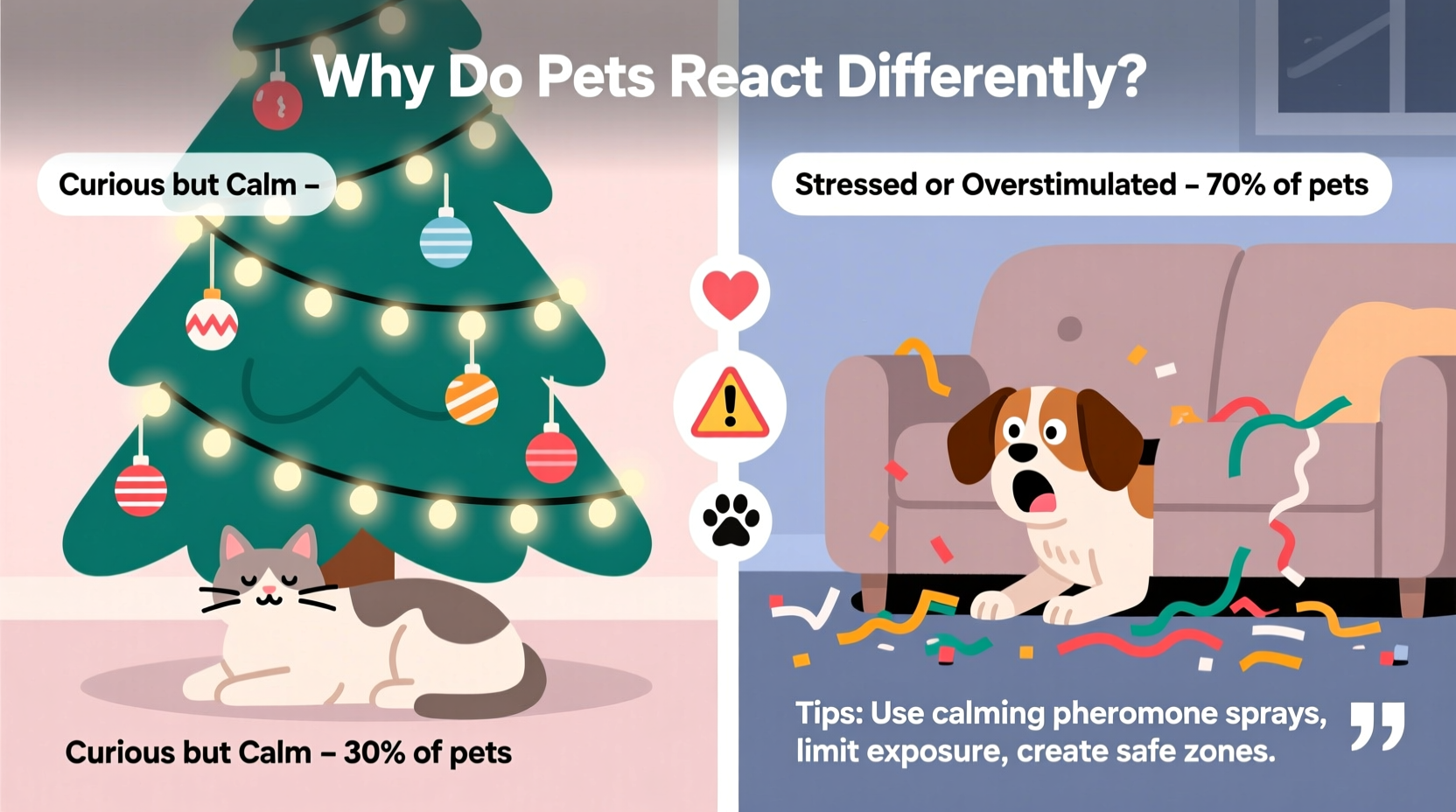
Pet responses to Christmas trees stem from a convergence of biological and environmental factors—not personality alone. Dogs and cats process novelty through three primary filters: olfactory input, auditory sensitivity, and visual motion detection. A real pine tree emits volatile organic compounds (terpenes like pinene and limonene) that humans find “fresh,” but dogs—whose olfactory receptors outnumber ours 40-to-1—experience them as intense, even overwhelming. For a dog with a history of mild respiratory irritation or prior exposure to strong scents during stressful events, the tree’s aroma can trigger a low-grade alarm state before any visual cue registers.
Cats, meanwhile, are exquisitely attuned to micro-movements. The subtle sway of tinsel in airflow, reflections dancing across glass baubles, or even the faint hum of LED lights (inaudible to us but perceptible up to 65 kHz in felines) can activate their predatory or defensive circuits. Yet not all cats react. Those raised in homes with consistent environmental enrichment—and crucially, those exposed to novel objects *before* 14 weeks of age—develop greater neural flexibility. Their brains file the tree under “non-threatening novelty” rather than “potential threat.”
Genetics also play a documented role. A 2022 study published in Applied Animal Behaviour Science found that Border Collies and German Shepherds showed significantly higher baseline vigilance toward static vertical objects compared to Bichon Frises or Ragdolls—suggesting breed-typical neurochemistry influences how novelty is appraised.
Four Key Risk Factors That Predict Panic (Not Just Curiosity)
While every pet is unique, certain patterns reliably correlate with heightened distress around Christmas trees. Recognizing these helps shift focus from “What’s wrong with my pet?” to “What does my pet need right now?”
- History of startle sensitivity: Pets who flinch at sudden noises (e.g., vacuum cleaners, thunder), avoid new people or objects without time to investigate, or retreat when furniture is rearranged often lack the confidence buffer needed for unpredictable stimuli like a decorated tree.
- Limited early socialization: Puppies and kittens not exposed to varied textures, heights, lighting effects, and gentle human-led exploration between 3–14 weeks are statistically more likely to perceive novelty as threatening later in life.
- Chronic low-grade anxiety: Subtle signs—excessive licking, delayed settling after minor disruptions, panting in non-warm environments, or avoidance of certain rooms—often precede acute reactions to major changes like tree installation.
- Previous negative association: A single incident—such as being startled by a falling ornament, receiving a correction near the tree, or associating its setup with owner absence (e.g., holiday travel prep)—can create lasting negative conditioning.
“Panic isn’t disobedience—it’s a physiological cascade. Cortisol spikes, heart rate accelerates, and the prefrontal cortex—the part responsible for rational assessment—goes offline. Our job isn’t to ‘train away’ fear, but to rebuild safety signals step by step.” — Dr. Lena Torres, DVM, DACVB, Veterinary Behaviorist and Co-Director of the Pacific Animal Wellness Institute
Practical, Evidence-Based Behavior Tips (Not Just “Distract and Hope”)
Effective intervention starts *before* the tree goes up—not during the first night of panicked pacing. These strategies are grounded in desensitization protocols used successfully in veterinary behavior clinics and shelter rehabilitation programs.
Step-by-Step Calming Protocol (Start 10 Days Before Tree Setup)
- Baseline Observation (Days 1–2): Note your pet’s typical resting zones, favorite toys, and go-to calming behaviors (e.g., licking a mat, napping in a crate). This establishes normalcy.
- Neutral Object Exposure (Days 3–4): Place an empty tree stand in the intended location. Let your pet investigate freely—no coaxing, no treats yet. Record duration and body language (relaxed tail? ears forward? lip licking?).
- Controlled Scent Introduction (Days 5–6): Rub a clean cloth on a fresh pine branch, then place it near—but not inside—their bed. Pair with quiet, positive interaction (gentle brushing, soft talk). Never force sniffing.
- Gradual Visual Buildup (Days 7–9): Add the tree (real or artificial) without decorations. Keep lights off. Sit nearby reading quietly for 10 minutes, 2x/day. Drop treats *away* from the tree if your pet chooses to stay in the room.
- Light & Texture Integration (Day 10 onward): Turn on lights for 5 minutes, then increase by 5 minutes daily. Introduce one ornament at a time—start with matte, non-reflective spheres. Monitor closely for whale eye, flattened ears, or sudden stillness (freeze response).
Do’s and Don’ts: A Safety & Stress-Reduction Checklist
| Category | Do | Don’t |
|---|---|---|
| Tree Placement | Position in a low-traffic zone with clear escape routes (e.g., not blocking doorways or litter box access); anchor securely to wall with rated hardware. | Place near windows where reflections intensify glare; position directly in front of your pet’s primary sleeping area or food station. |
| Ornament Selection | Use shatterproof, matte-finish ornaments; hang heavier items on lower branches only if pet is fully habituated and supervised. | Hang glass, tinsel, or edible decorations (candy canes, popcorn strings); use ribbons or cords longer than 6 inches (choking/entanglement risk). |
| Response Management | Redirect calmly with a known cue (“touch” or “find it”) if anxiety begins; offer lick mats or stuffed Kongs *near but not at* the tree during calm sessions. | Yell, punish, or physically restrain near the tree; carry or drag your pet toward it “to get used to it”; ignore escalating signs like trembling or panting. |
| Long-Term Support | Maintain routine feeding, walks, and play—even during holiday bustle; consider pheromone diffusers (Feliway for cats, Adaptil for dogs) placed *away* from the tree to avoid scent competition. | Alter sleep schedules or skip enrichment to accommodate guests; rely solely on sedatives without concurrent behavior work (unless prescribed and monitored by a vet). |
A Real Example: How Maya’s Cat Learned to Coexist With the Tree
Maya adopted Luna, a 2-year-old rescue tabby, six months before her first Christmas in a new apartment. Luna had previously lived in a quiet studio with minimal decor. When Maya brought home a 6-foot artificial tree, Luna froze at the doorway, pupils dilated, tail low and twitching. She refused to enter the living room for two days.
Instead of forcing exposure, Maya followed the staged protocol: she set up the bare stand for three days, then added the tree sans lights. She placed Luna’s favorite cardboard box *beside* the stand—not in front—and dropped small pieces of tuna inside whenever Luna approached the threshold. By Day 7, Luna would sit in the box and watch the unlit tree. On Day 9, Maya introduced a single matte-blue ball ornament—hanging it high, out of reach. Luna watched intently but didn’t flee. By Christmas Eve, Luna napped in her box *next to* the fully decorated tree, occasionally batting gently at a dangling ribbon—clearly engaged, not alarmed.
The difference wasn’t tolerance—it was earned predictability. Luna never loved the tree, but she no longer perceived it as a source of danger. Her stress markers (excessive grooming, nighttime yowling) vanished entirely that season.
FAQ: Addressing Common Concerns
My dog only barks at the tree when guests are over. Is it the tree—or the people?
It’s almost certainly the combination. Trees amplify guest-related stressors: unfamiliar scents on coats, increased movement near the tree, and redirected attention away from your dog. The tree becomes a contextual cue for “guest chaos.” Address this by reinforcing calm behavior *before* guests arrive (e.g., a long-lasting chew in a separate room) and maintaining your dog’s routine—even when hosting.
Can I use calming supplements or CBD oil to help?
Some evidence supports specific, third-party-tested products (e.g., L-theanine + alpha-casozepine blends for dogs; Feliway oral spray for cats) when paired with behavioral work. However, CBD remains poorly regulated, with inconsistent dosing and unknown long-term effects in pets. Always consult your veterinarian first—and never substitute supplements for environmental management. Supplements support, but don’t replace, behavior modification.
What if my pet knocks the tree over? Should I punish them?
No. Punishment increases fear and erodes trust. Instead, reinforce alternative behaviors *before* the incident occurs: teach “leave it” with safe objects, practice impulse control games, and secure the tree properly. If a knock-down happens, calmly redirect to a known activity (e.g., “go to mat”) and assess whether the environment was too stimulating or insufficiently anchored.
Conclusion: Safety, Respect, and Quiet Joy
A Christmas tree doesn’t need to be a battleground. When we move past labeling pets as “stubborn” or “overreactive” and instead honor their sensory realities, we open space for genuine coexistence. Ignoring the tree isn’t indifference—it may reflect secure attachment and low threat perception. Panicking isn’t defiance—it’s a cry for help rooted in biology and biography. The most meaningful holiday gift you can give your pet isn’t a toy under the tree, but the unwavering consistency of safety, the patience of incremental trust-building, and the humility to adjust *your* expectations—not theirs.
This season, observe closely. Pause before reacting. Choose curiosity over correction. Anchor your tree—and your pet’s world—with care, not convenience. Because peace isn’t the absence of novelty; it’s the presence of predictable safety.




 浙公网安备
33010002000092号
浙公网安备
33010002000092号 浙B2-20120091-4
Comments
No comments yet. Why don't you start the discussion?