
The holiday season brings joy, warmth, and, for many households, a freshly cut or artificial Christmas tree. While families gather around its twinkling lights, not all members of the household share the festive spirit—especially our four-legged companions. Some dogs curl up beneath the tree as if it’s just another piece of furniture. Others bolt at the sight of tinsel. Cats might treat ornaments like prey, while some slink away entirely. Why such vastly different reactions?
The answer lies in a combination of biology, environment, personality, and species-specific instincts. Understanding why pets react so differently to Christmas trees isn’t just fascinating—it’s essential for ensuring their safety and comfort during a potentially stressful time.
The Role of Species and Natural Instincts
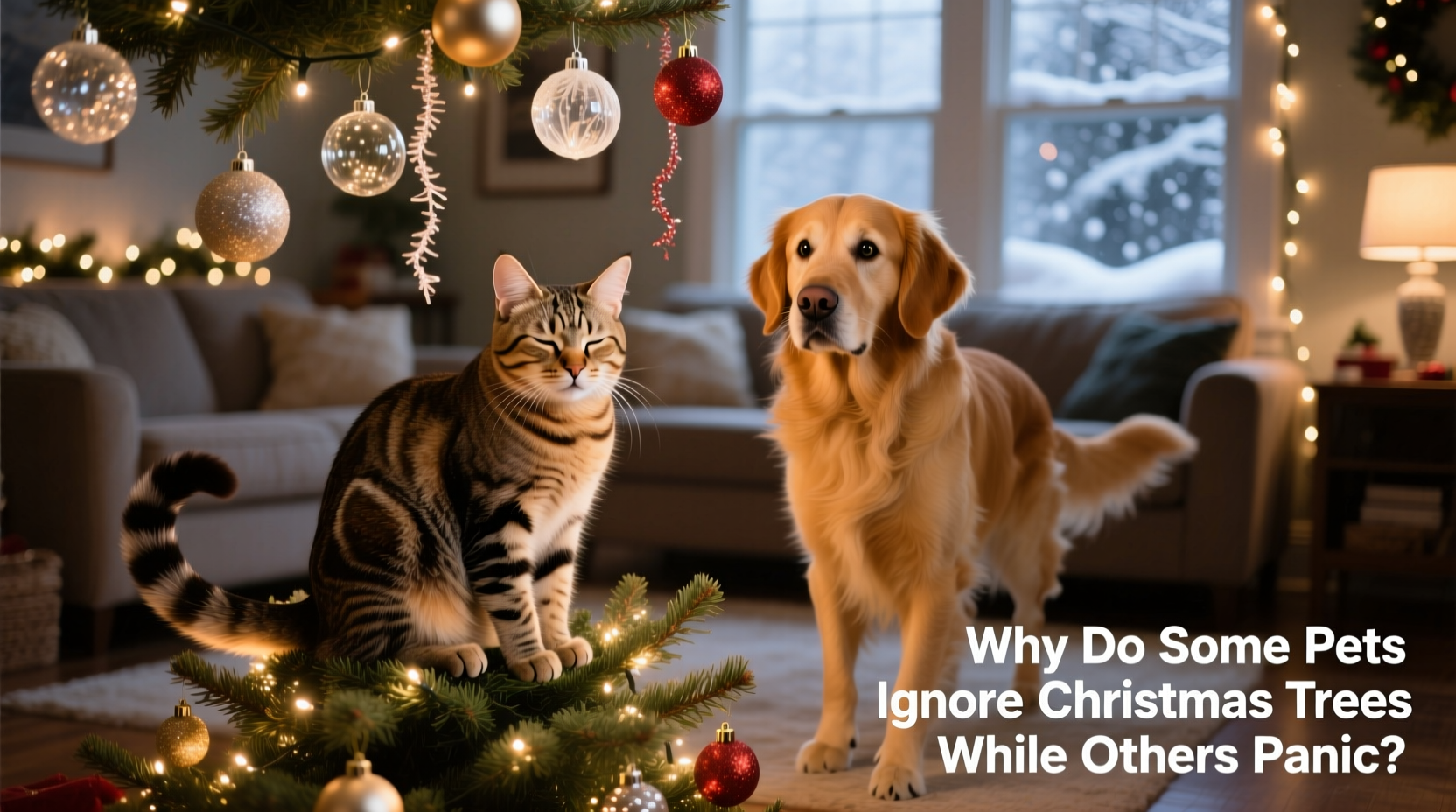
Dogs and cats evolved with very different sensory priorities and survival mechanisms. These foundational instincts shape how they interpret novel objects like Christmas trees.
Dogs, descended from pack hunters, are generally more social and adaptable. Many breeds have been selectively bred for centuries to coexist closely with humans, making them more tolerant of environmental changes. A well-socialized dog may view the tree as part of the home’s seasonal decor—something new but not threatening.
Cats, on the other hand, are solitary predators with strong territorial instincts. They rely heavily on routine and scent marking. A sudden addition to their space—especially one that smells of pine resin, emits unfamiliar noises from lights or music, and disrupts their usual pathways—can trigger anxiety. The tree’s movement (from ornaments swaying) may resemble prey, prompting curiosity or overstimulation. Alternatively, the sheer novelty can be perceived as an intrusion.
“Cats are highly sensitive to environmental shifts. Even subtle changes in layout or smell can affect their stress levels.” — Dr. Lena Torres, Veterinary Ethologist
Birds, rabbits, and small mammals also respond uniquely. Birds may become agitated by reflective ornaments or flashing lights, which they interpret as threats or rivals. Rabbits, being prey animals, can go into freeze-or-flee mode when faced with unpredictable stimuli like falling pine needles or loud decorations.
Sensory Overload: Lights, Smells, and Sounds
A Christmas tree is a multisensory event for pets. What looks festive to us can be overwhelming to animals with heightened senses.
- Hearing: Many light sets emit a faint buzzing or humming sound. Dogs and cats hear frequencies far beyond human range, so even “silent” electronics may produce high-pitched noise that irritates them.
- Smell: Real trees release terpenes—aromatic compounds that give pine its scent. While pleasant to humans, these odors can be overpowering to pets with up to 300 million olfactory receptors (compared to our 6 million).
- Sight: Flashing lights mimic erratic movement, which may trigger predatory focus in cats or fear in nervous animals. Reflective surfaces distort vision, creating illusions of motion.
- Touch: Tinsel, ribbons, and soft branches invite pawing and chewing—behaviors rooted in exploration but potentially dangerous.
Breed and Temperament Differences
Not all pets within a species react the same way. Individual temperament and genetic predisposition play major roles.
Consider two dogs: a confident Golden Retriever raised in a bustling family home versus a shy Shih Tzu adopted from a shelter. The Retriever may greet the tree with mild curiosity, then settle nearby. The Shih Tzu, already prone to anxiety, may whine, hide, or refuse to enter the room.
Likewise, certain cat breeds are more reactive. Siamese and Orientals tend to be vocal and sensitive to change, while British Shorthairs are often more stoic and less disturbed by decor shifts.
A 2021 study published in *Applied Animal Behaviour Science* found that dogs classified as “high-reactivity” based on temperament testing were significantly more likely to show avoidance or agitation toward novel household items, including decorated trees, than low-reactivity individuals—even when introduced gradually.
| Pet Type | Typical Reaction | Influencing Factors |
|---|---|---|
| Dogs (confident breeds) | Curious, indifferent | Socialization, past experiences |
| Dogs (anxious breeds) | Withdrawn, trembling | Fear of novelty, noise sensitivity |
| Cats (outdoor-experienced) | Alert, investigative | Prey drive, territory awareness |
| Cats (indoor-only) | Stressed, hiding | Routine disruption, scent changes |
| Birds | Agitated or silent | Light reflections, sudden movements |
Environmental Management: Creating a Safe Holiday Space
You don’t need to skip the tree to protect your pet. With thoughtful planning, you can celebrate safely.
The key is gradual exposure and environmental control. Start setting up decorations days before adding lights or placing the tree. Allow pets to investigate components in a controlled way—under supervision—so novelty decreases before full assembly.
Physical barriers help. Baby gates or pet enclosures can restrict access without isolating the animal completely. Alternatively, dedicate a quiet room as a “safe zone” equipped with familiar bedding, toys, and calming pheromone diffusers (like Feliway for cats or Adaptil for dogs).
“Introduce the tree like you would a new pet. Slowly, respectfully, and with positive reinforcement.” — Dr. Marcus Bell, Certified Animal Behaviorist
If using a real tree, secure it firmly. Pine needles and sap are mildly toxic if ingested, and water additives (like fertilizers) can be harmful. Artificial trees pose fewer chemical risks but still present choking hazards from broken ornaments or tinsel—a substance particularly dangerous for cats, known to cause linear foreign body obstructions.
Step-by-Step: Introducing Your Pet to the Christmas Tree
- Day 1–2: Assemble the tree stand and let your pet sniff it. Offer treats nearby to build positive association.
- Day 3: Add the tree (unlit, undecorated). Allow supervised investigation. Reward calm behavior.
- Day 4–5: Add lights only. Turn them on briefly while your pet is present. Monitor reaction.
- Day 6: Add a few non-breakable ornaments at higher levels. Continue short, positive sessions.
- Day 7: Complete decorating. Keep lower branches clear. Use pet-safe, lightweight ornaments.
- Ongoing: Supervise interactions. Reassure anxious pets; redirect curious ones gently.
Real-Life Example: Bella the Rescue Cat
Bella, a three-year-old domestic shorthair adopted from a rural shelter, had lived in a quiet apartment for six months before her owners decided to put up a Christmas tree. Previously fearless, she refused to enter the living room once the tree was assembled.
Her owners noticed she’d pace outside the doorway, ears flattened, tail low. After consulting a veterinary behaviorist, they learned Bella associated the tree’s scent with a traumatic experience—she had been found near a logging site where pine trees were abundant.
They dismantled the tree temporarily and reintroduced it over two weeks, pairing each stage with high-value treats and calming music. They used a fake spruce-scented spray (without chemicals) in neutral areas first to desensitize her. By Christmas Eve, Bella was sleeping three feet from the tree—still cautious, but no longer panicked.
This case illustrates that reactions aren’t always about the object itself, but what it symbolizes through past experience.
Checklist: Pet-Safe Christmas Tree Preparation
- ✅ Secure the tree to a wall or ceiling to prevent tipping
- ✅ Use shatterproof ornaments, especially below pet eye level
- ✅ Avoid tinsel, ribbons, and small decorative items that can be swallowed
- ✅ Choose cool-burning LED lights and tape down cords
- ✅ Skip toxic water additives in real tree stands
- ✅ Create a safe retreat space away from the tree
- ✅ Supervise all pet-tree interactions, especially initially
- ✅ Consider a pet-free zone if anxiety persists
Frequently Asked Questions
Can I train my pet to stop climbing the Christmas tree?
Yes, but prevention works better than correction. Use deterrents like double-sided tape on the trunk or motion-activated air sprays. Redirect climbing behavior to a cat tree or designated play area. Positive reinforcement for staying away from the tree is more effective than punishment.
Is it okay to use essential oils near the tree if I have pets?
No. Many holiday scents—such as pine, citrus, cinnamon, and clove—are toxic to cats and dogs when diffused. Even small amounts can cause respiratory distress or liver damage. Opt for pet-safe alternatives or avoid aromatherapy altogether during the holidays.
My dog barks at the tree every time the lights turn on. How can I stop this?
This is likely a startle or alert response. Try turning the lights on gradually while your dog is eating or playing with a favorite toy to create a positive distraction. You can also practice “lights on” sessions during the day at low brightness. Over time, the association shifts from alarm to neutrality.
Conclusion: Respecting Your Pet’s Experience
The contrast between pets who ignore Christmas trees and those who panic isn’t random—it reflects deep-seated instincts, individual histories, and sensory realities. Recognizing this difference allows us to celebrate the season without compromising our pets’ well-being.
Whether your companion curls up under the tree or needs a quiet corner away from the lights, their reaction is valid. With patience, preparation, and empathy, you can honor both holiday traditions and your pet’s emotional needs.




 浙公网安备
33010002000092号
浙公网安备
33010002000092号 浙B2-20120091-4
Comments
No comments yet. Why don't you start the discussion?