
As holiday decorating evolves, smart Christmas lights have become more than just festive strings of bulbs—they’re now programmable, color-shifting, music-syncing elements of the modern home. But when shopping, you’ll quickly notice a key difference: some models connect directly through Bluetooth, while others demand a separate hub. This isn’t arbitrary design—it reflects deeper technical, functional, and strategic choices made by manufacturers. Understanding this distinction helps you choose the right lights for your needs, avoid frustrating setup issues, and ensure long-term reliability.
Understanding Connectivity: Bluetooth vs. Hub-Based Systems
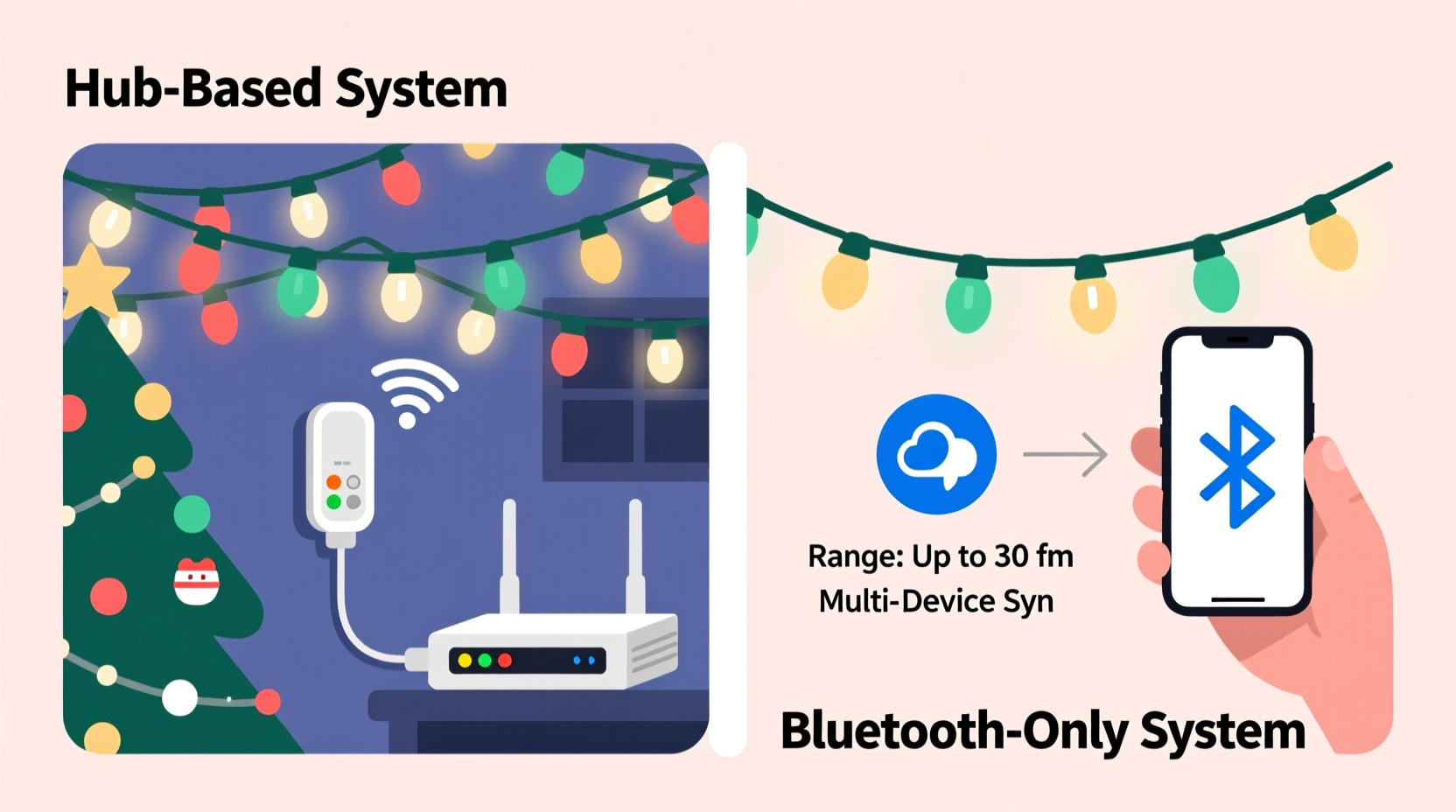
The core difference lies in how the lights communicate with your smartphone or home automation system. Bluetooth-enabled smart lights use short-range wireless communication to pair directly with your phone. You open an app, select the lights, and adjust colors, brightness, or patterns—all without additional hardware. This simplicity appeals to casual users who want quick setup and basic control.
In contrast, hub-dependent lights rely on a central device—usually connected to your Wi-Fi router—that acts as a bridge between the internet and the lights themselves. The hub receives commands from your app (via cloud servers) and relays them to the lights using a different protocol like Zigbee or Z-Wave. This architecture enables features that Bluetooth alone cannot support reliably.
“Bluetooth is great for proximity-based control, but hubs unlock scalability, remote access, and integration with voice assistants.” — David Lin, IoT Product Architect at HomeTech Labs
Range and Network Stability: The Hidden Limitations of Bluetooth
Bluetooth has a typical range of 30 to 50 feet under ideal conditions. However, walls, furniture, and even weather can reduce that distance significantly. If your smart lights are installed outdoors—say, along gutters or across a yard—you may lose connection when stepping inside or moving beyond line-of-sight.
Hub-based systems bypass this issue entirely. Since the hub connects to your home Wi-Fi network, you can control your lights from anywhere in the world as long as you have internet access. Whether you're turning them on before arriving home or checking if they were left running during vacation, remote functionality depends on a stable, always-on connection that Bluetooth cannot provide.
Additionally, Bluetooth connections are point-to-point—one device talks to another. When managing multiple light strands, especially across large displays, maintaining individual connections becomes cumbersome. Hubs, however, act as network coordinators, allowing dozens of devices to coexist on a single mesh network without interference.
Integration with Smart Home Ecosystems
One of the most compelling reasons to opt for hub-based smart lights is seamless integration with platforms like Amazon Alexa, Google Assistant, Apple HomeKit, or Samsung SmartThings. While some Bluetooth-only lights offer limited voice control, full interoperability requires deeper system-level access.
Hubs translate commands across protocols. For example, when you say, “Alexa, dim the Christmas lights,” the request travels from Alexa’s cloud to your Wi-Fi, then to the hub, which sends a signal via Zigbee to the lights. Without a hub, that chain breaks down. Bluetooth lacks the infrastructure to maintain persistent background connections needed for real-time responses.
Moreover, advanced automations—such as scheduling lights to turn on at sunset, syncing with music, or reacting to motion sensors—are nearly impossible over standard Bluetooth. These functions demand constant monitoring and low-latency communication, which only a dedicated hub can deliver efficiently.
Security and Firmware Updates
Another often-overlooked advantage of hub-based systems is enhanced security. Bluetooth connections are generally less secure than encrypted mesh networks like Zigbee or Thread, which use AES-128 encryption and authenticated pairing. A malicious actor within Bluetooth range could potentially intercept signals or spoof device identity—especially with older Bluetooth versions.
Hubs also serve as centralized update managers. When a manufacturer releases a firmware patch—say, to fix a bug or improve energy efficiency—the hub downloads the update once and distributes it securely to all connected lights. In contrast, Bluetooth-only devices require manual updates through an app, one at a time, increasing the chance that critical patches go unapplied.
| Feature | Bluetooth-Only Lights | Hub-Dependent Lights |
|---|---|---|
| Setup Complexity | Simple, plug-and-play | Moderate, requires hub configuration |
| Remote Access | No (limited to local control) | Yes (via internet/cloud) |
| Voice Assistant Support | Limited or partial | Full integration |
| Network Range | Up to 50 ft (line-of-sight) | Whole-home coverage |
| Firmware Updates | Manual per device | Centralized via hub |
| Multi-Device Management | Clunky with >2 devices | Smooth, scalable |
| Security | Basic (device pairing) | Advanced (encrypted mesh) |
Power Efficiency and Latency Trade-offs
Bluetooth Low Energy (BLE), used by most Bluetooth-only smart lights, is designed to minimize power consumption. This makes it ideal for battery-powered devices or installations where energy savings matter. However, BLE achieves efficiency by entering sleep modes frequently, which introduces latency. Turning on a strand might take 2–3 seconds—not ideal for synchronized displays.
Hubs, particularly those using Zigbee or Thread, maintain low-power operation while keeping devices responsive. These protocols allow lights to stay in a semi-active state, ready to receive commands instantly. For dynamic effects like chasing patterns or sound-reactive lighting, this responsiveness is essential.
Consider a scenario where you host a neighborhood holiday party and want your lights to pulse with holiday music playing outdoors. A hub-based system can sync dozens of lights precisely because each unit receives timing data simultaneously. With Bluetooth, staggered connections cause noticeable delays, breaking the illusion of cohesion.
Mini Case Study: The Johnson Family’s Holiday Display Upgrade
The Johnsons started with two sets of Bluetooth-controlled Christmas lights wrapped around their porch railing. Each strand worked fine individually, controlled easily from their phones. But when they expanded to include roof outlines, tree wraps, and driveway markers—totaling eight strands—they hit a wall. Their phones couldn’t maintain stable connections to all devices at once, and voice commands failed regularly.
After researching options, they invested in a hub-compatible system using Philips Hue Outdoor Lights and a Hue Bridge. Within an hour, all lights were grouped into scenes labeled “Cozy Night,” “Festive Flash,” and “Off.” Now, they activate entire displays with a single voice command or schedule changes based on sunset times. They even set up geofencing so the lights turn on automatically when family members approach home after dark.
The initial cost was higher, but the improved reliability, remote access, and automation capabilities transformed their holiday experience.
Choosing Based on Your Needs: A Practical Checklist
Not every user needs a hub. Here’s how to decide what’s right for your situation:
- Choose Bluetooth-only if:
- You only need basic color and brightness control.
- Your lights are within close proximity to your phone.
- You don’t plan to integrate with other smart home devices.
- You prefer minimal setup and lower upfront cost.
- You’re using lights temporarily or seasonally.
- Opt for a hub-based system if:
- You have a large or multi-zone display.
- You want remote access from outside the home.
- You use voice assistants daily.
- You value automation (e.g., schedules, triggers).
- You expect to expand your smart lighting ecosystem.
Future Trends: The Rise of Matter and Unified Protocols
The divide between Bluetooth-only and hub-reliant systems may narrow in coming years thanks to **Matter**, a new open-source smart home standard backed by Apple, Google, Amazon, and the Connectivity Standards Alliance. Matter runs over Wi-Fi and Thread (not Bluetooth) and allows devices to work seamlessly across ecosystems—with or without a hub, depending on implementation.
Some newer smart Christmas lights now support Matter over Thread, meaning they can be controlled remotely, integrated broadly, and updated securely—without requiring a proprietary hub. Instead, any Matter-compatible border router (like an Apple TV, HomePod, or Echo device) can serve as the gateway.
This evolution suggests a future where consumers get the best of both worlds: simple setup and broad compatibility, without sacrificing performance. Until then, understanding today’s trade-offs remains crucial.
Frequently Asked Questions
Can I use Bluetooth smart lights with Alexa or Google Assistant?
Yes, but with limitations. Some Bluetooth lights support basic voice control if your assistant device is within range. However, these connections are often unstable and lack advanced features like grouping or scheduling. For reliable integration, a Wi-Fi-connected or hub-based system is recommended.
Do I need a separate hub for each brand of smart lights?
Typically, yes. Most hubs are brand-specific—Hue lights need a Hue Bridge, Lutron Caseta requires its own smart bridge, etc. However, universal platforms like Samsung SmartThings or Home Assistant can consolidate multiple brands into one interface, reducing fragmentation.
Are hub-based lights harder to install?
Slightly. Installing a hub involves connecting it to your router via Ethernet and pairing it with an app. Once configured, adding new lights is usually straightforward. Many manufacturers provide step-by-step wizards to guide users. The extra effort pays off in functionality and scalability.
Conclusion: Make an Informed Decision for Smarter Holidays
The choice between hub-required and Bluetooth-only smart Christmas lights ultimately comes down to your expectations. If you want simple, temporary decoration with minimal tech overhead, Bluetooth models offer instant gratification. But if you envision a coordinated, intelligent lighting display that integrates with your broader smart home and delivers year-after-year reliability, investing in a hub-based system is worth the effort.
Technology should enhance celebration, not complicate it. By understanding the underlying reasons for these design differences—from range and security to automation and ecosystem compatibility—you position yourself to make smarter purchases and enjoy smoother seasonal setups.




 浙公网安备
33010002000092号
浙公网安备
33010002000092号 浙B2-20120091-4
Comments
No comments yet. Why don't you start the discussion?