
It’s a common but puzzling experience: you’re relaxing under the soft glow of your smart lighting, and suddenly, as the refrigerator kicks in or the air conditioner starts up, the lights flicker and dim. No switch was flipped, no app command sent—yet your carefully curated ambiance has just been disrupted. While this behavior might seem like a glitch in the smart bulb itself, it's often rooted in something far more fundamental: electrical dynamics within your home’s circuitry.
Smart lights are sensitive to voltage changes, and unlike traditional incandescent bulbs, they rely on precise power delivery to function correctly. When large appliances draw significant current upon startup, they create temporary drops in voltage across shared circuits. These dips, though brief, can be enough to trigger a response in LED-based smart lighting systems. Understanding the science behind this phenomenon—and knowing how to address it—can restore stability to your smart home environment.
The Physics Behind Voltage Drops and Light Dimming
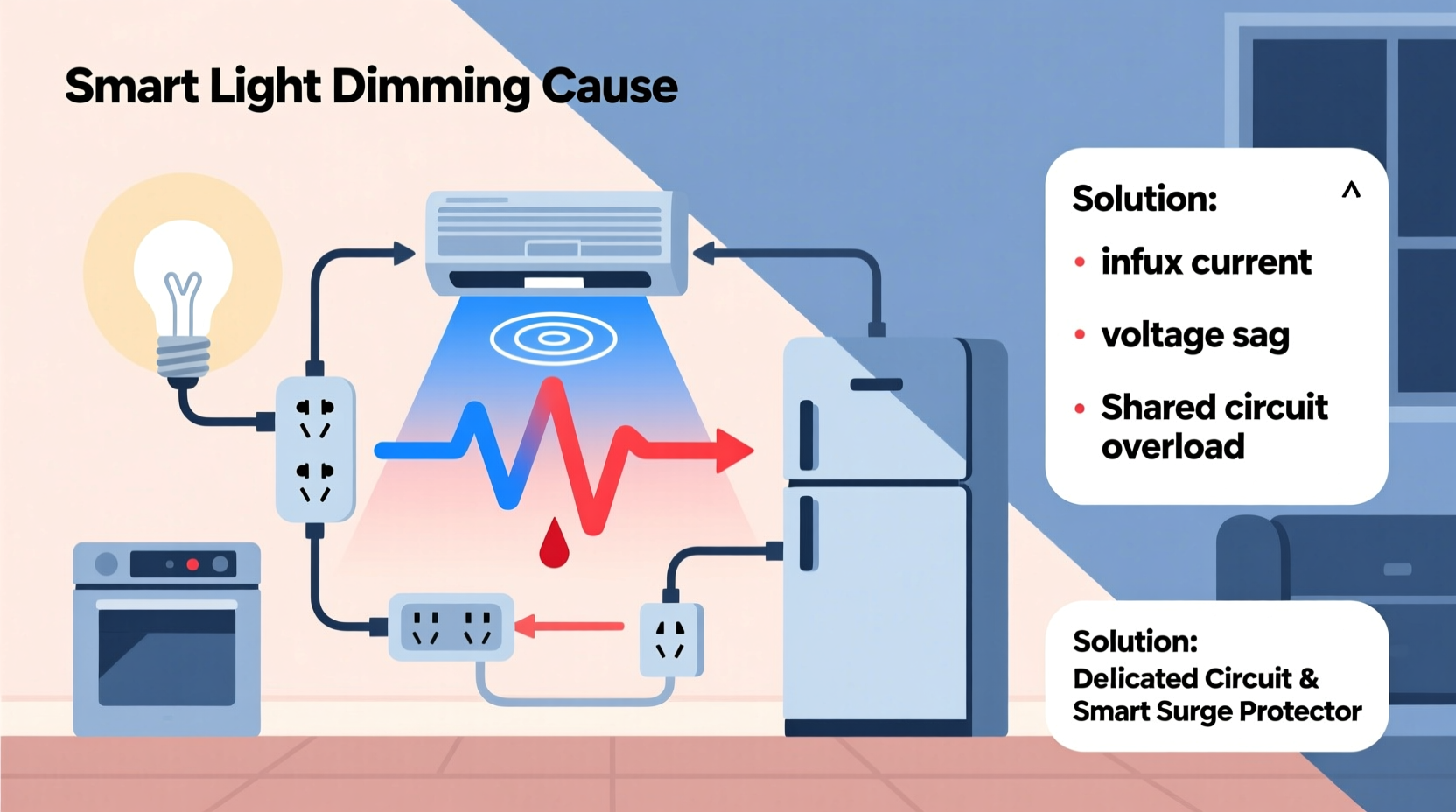
When an appliance such as a microwave, HVAC system, or washing machine powers on, its motor or compressor requires a surge of electricity to overcome inertia. This initial demand, known as inrush current, can be two to six times higher than the appliance’s normal operating current. In homes with older wiring or limited electrical capacity, this sudden draw causes a momentary drop in voltage across the circuit—a condition technically referred to as \"voltage sag.\"
LEDs and smart bulbs operate on low-voltage direct current (DC), which means they use internal drivers to convert household alternating current (AC) into usable power. These drivers are designed for efficiency, not necessarily for resilience against rapid voltage fluctuations. Even a 5–10% dip in line voltage can cause the driver to momentarily reduce output, resulting in visible dimming.
“Voltage sags from high-draw appliances are one of the most frequent yet overlooked causes of smart lighting instability.” — Dr. Alan Reeves, Electrical Systems Engineer, National Home Efficiency Lab
The effect is more pronounced in homes where lighting and major appliances share the same circuit. In modern homes built to code, kitchens and living areas often have dedicated circuits for high-load devices, minimizing interference. However, in older constructions or retrofitted smart homes, multiple loads may coexist on outdated infrastructure, increasing the likelihood of interaction between seemingly unrelated devices.
Common Appliances That Trigger Smart Light Dimming
Not all appliances cause noticeable voltage sags. The ones most likely to affect lighting are those with motors, compressors, or heating elements that require substantial startup energy. Below is a list of typical culprits:
- Refrigerators and freezers – Compressors cycle on and off every few hours.
- Air conditioners and heat pumps – High inrush current, especially during hot weather startups.
- Microwaves – Magnetrons draw heavy power for short bursts.
- Washing machines and dryers – Motors and heaters combine for significant load.
- Sump pumps – Often located in basements with shared lighting circuits.
- Vacuum cleaners and power tools – Portable but powerful enough to affect nearby outlets.
The severity of dimming depends not only on the appliance but also on proximity—both physical and electrical. Lights on the same circuit will react more strongly than those on separate branches, even if physically closer to the appliance.
Diagnosing the Root Cause: A Step-by-Step Guide
Before investing in new hardware or rewiring, conduct a systematic evaluation to confirm whether voltage fluctuation is the true culprit. Follow these steps to identify the source and scope of the problem:
- Observe the pattern: Note which lights dim and which appliances trigger the event. Keep a log over 24–48 hours.
- Check circuit mapping: Locate your home’s electrical panel and trace which breakers control the affected lights and appliances. Many homes have labeling; if not, use a circuit tester.
- Test with isolation: Turn off the suspected appliance at the breaker and observe if dimming stops. Then reverse the test by turning off lighting circuits while running the appliance.
- Use a voltage monitor: Plug a digital multimeter or plug-in voltage logger into an outlet on the same circuit. Measure voltage before, during, and after appliance startup. A drop exceeding 5 volts (from 120V to 115V or lower) indicates a significant sag.
- Evaluate bulb sensitivity: Replace one smart bulb temporarily with an incandescent or halogen. If it doesn’t dim, the issue lies in the smart bulb’s driver sensitivity, not total power loss.
This diagnostic process helps distinguish between systemic electrical issues and device-specific quirks. In some cases, upgrading the smart bulb firmware or switching brands may resolve minor sensitivities without rewiring.
Do’s and Don’ts: Managing Smart Lighting Stability
| Do | Don’t |
|---|---|
| Install smart lights on dedicated lighting circuits whenever possible. | Plug high-wattage appliances into outlets on the same circuit as smart lighting. |
| Use whole-home surge protectors with voltage regulation. | Ignore repeated dimming—it could indicate underlying wiring stress. |
| Upgrade old wiring or add new circuits in frequently affected areas. | Assume all smart bulbs behave the same; models vary widely in voltage tolerance. |
| Choose smart bulbs rated for stable performance under fluctuating loads. | Overload circuits beyond their rated amperage (typically 15–20A). |
Understanding these best practices empowers homeowners to make informed decisions about both product selection and electrical management. Prevention is always more cost-effective than repair, especially when dealing with integrated smart home ecosystems.
Real-World Example: The Case of the Flickering Living Room
In suburban Chicago, homeowner Maria Lopez installed a full suite of smart LED bulbs throughout her first-floor living area. Everything worked perfectly—until she began using her new window-mounted air conditioner during summer. Each time the unit powered on, the overhead lights dimmed for nearly two seconds, resetting connected automations and disrupting movie nights.
Maria initially suspected a defect in the bulbs and contacted customer support. After troubleshooting app settings and replacing two units, the issue persisted. She then hired a licensed electrician who discovered that both the AC unit and the living room lights were fed from the same 15-amp circuit originally intended only for lighting.
The solution involved installing a new 20-amp dedicated circuit for the air conditioner from the main panel. Once completed, the voltage remained stable during startup, and the lights no longer dimmed. Additionally, the electrician recommended switching to smart bulbs with wider input voltage ranges (100–130V), further improving resilience.
This case highlights how modern convenience can expose limitations in legacy infrastructure. What seemed like a software or hardware flaw turned out to be a mismatch between electrical demand and supply capacity.
Expert Solutions and Long-Term Fixes
While temporary workarounds exist, long-term stability requires addressing the root cause. Here are professional-grade solutions used by electricians and smart home integrators:
- Circuit segregation: Dedicate separate circuits for high-load appliances and sensitive electronics. This is especially important in kitchens, laundry rooms, and entertainment spaces.
- Whole-house voltage regulators: Devices like automatic voltage regulators (AVRs) stabilize incoming power, smoothing out sags and surges before they reach end devices.
- Upgraded service panels: Homes with 100-amp services may benefit from upgrading to 200 amps, particularly if adding EV chargers or heat pumps.
- Power conditioners for critical zones: Install localized power conditioning units for home theaters or smart lighting hubs.
- Smart bulb selection: Choose models explicitly tested for voltage fluctuation resistance. Brands like Philips Hue, Lutron Caséta, and Sengled often publish technical specs including input voltage range and ripple current tolerance.
“The future of smart homes depends not just on connectivity, but on clean, reliable power delivery. We’re seeing more clients invest in foundational electrical upgrades before deploying automation.” — Jordan Tate, Smart Home Integration Specialist
Troubleshooting Checklist
- ✅ Confirm which appliances trigger dimming events
- ✅ Map affected lights and appliances to their circuits
- ✅ Measure voltage drop during appliance startup
- ✅ Test with non-smart bulbs to rule out driver sensitivity
- ✅ Inspect for loose wiring or corroded connections at outlets and switches
- ✅ Consider adding a dedicated circuit for high-draw devices
- ✅ Upgrade to smart bulbs with broader voltage tolerance (e.g., 100–130V)
- ✅ Consult a licensed electrician if dimming is severe or widespread
Frequently Asked Questions
Is it dangerous if my smart lights dim when appliances turn on?
Occasional dimming due to minor voltage sags is typically not dangerous. However, frequent or severe dimming can indicate overloaded circuits, poor connections, or aging wiring—all of which pose fire risks over time. If lights dim dramatically or stay dimmed, consult an electrician immediately.
Can firmware updates fix unexpected dimming in smart bulbs?
In rare cases, yes. Some manufacturers release firmware updates that improve power management algorithms or adjust brightness regulation logic. Check your bulb manufacturer’s app or website for available updates. However, firmware cannot compensate for significant voltage drops caused by circuit design flaws.
Will using a UPS (uninterruptible power supply) help stabilize smart lighting?
For individual smart hubs or Wi-Fi routers, a small UPS ensures network continuity. However, powering entire lighting circuits through a UPS is impractical and expensive. Instead, focus on stabilizing the source voltage via proper circuit design or whole-home regulators.
Conclusion: Building a Stable Foundation for Smart Living
Smart lights dimming when appliances turn on isn't magic—or mere coincidence. It's physics meeting infrastructure. As homes become more automated, the demands on electrical systems grow, exposing weaknesses that were negligible in the age of simple on/off switches.
The key to eliminating unexpected dimming lies not in replacing bulbs repeatedly, but in understanding the interplay between power supply, load distribution, and device sensitivity. With careful diagnosis, strategic upgrades, and informed product choices, you can enjoy seamless, flicker-free smart lighting—no matter what else is running in your home.




 浙公网安备
33010002000092号
浙公网安备
33010002000092号 浙B2-20120091-4
Comments
No comments yet. Why don't you start the discussion?