
Smart lighting has transformed homes with convenience, automation, and energy efficiency. From voice-controlled bulbs to color-shifting LEDs, these devices bring modern living into sharp focus. But despite their sophistication, many smart lights are surprisingly vulnerable to a common household threat: power surges. Unlike traditional incandescent or even basic LED bulbs, smart lights contain sensitive microelectronics that can be permanently damaged when voltage spikes occur. Understanding why this happens—and how to prevent it—is essential for protecting your investment and ensuring long-term reliability.
The Hidden Vulnerability of Smart Lighting
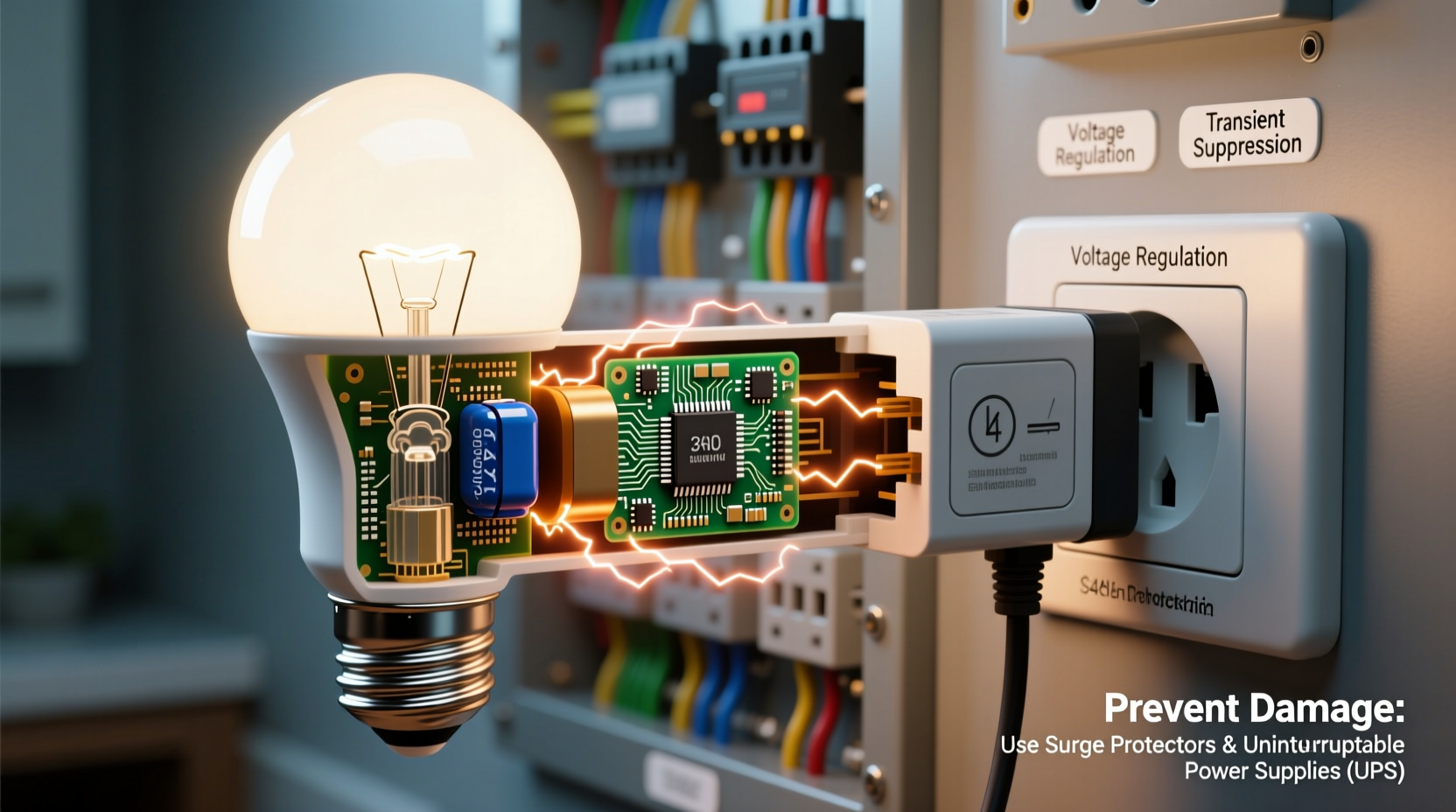
At first glance, a smart bulb looks no different from a standard LED. However, inside the compact housing lies a complex network of components: wireless radios (like Wi-Fi, Zigbee, or Bluetooth), microcontrollers, firmware, and circuitry designed to interpret commands and regulate light output. These parts operate on low-voltage direct current (DC), typically between 3V and 5V. When electricity enters the bulb from your home’s alternating current (AC) supply—usually 120V in North America or 230V in Europe—it must be stepped down precisely by internal drivers and regulators.
During a power surge—whether from lightning strikes, grid switching, or large appliances cycling on and off—voltage can spike dramatically, sometimes exceeding thousands of volts for milliseconds. While most household wiring is rated for brief fluctuations, smart bulbs lack robust overvoltage protection. Their small size limits space for protective components like transient voltage suppression (TVS) diodes or metal oxide varistors (MOVs). As a result, even minor surges can overwhelm the delicate electronics, leading to immediate failure or gradual degradation.
“Many smart lighting manufacturers prioritize cost and size over surge resilience. The trade-off is increased fragility in real-world electrical environments.” — Dr. Alan Reeves, Electrical Systems Engineer at MIT Lincoln Laboratory
Common Causes of Power Surges That Affect Smart Lights
Not all surges come from dramatic events like thunderstorms. In fact, most originate within the home itself. Internal surges account for up to 80% of electrical disturbances, according to the National Fire Protection Association (NFPA). Here are the primary sources:
- Large appliance operation: HVAC systems, refrigerators, washing machines, and power tools draw high current when starting up, creating momentary dips and spikes across circuits.
- Lightning strikes: Even distant strikes can induce high-voltage currents in nearby power lines, traveling into homes through utility connections.
- Utility grid switching: Power companies routinely reconfigure grids, which can cause sudden voltage shifts.
- Faulty wiring: Loose connections, outdated panels, or overloaded circuits increase resistance and instability, making surges more likely.
- Downed power lines: Storms or accidents that disrupt overhead lines often lead to erratic voltage delivery before service is restored.
Because smart lights remain powered whenever they’re screwed into a socket—even when “off” via app or switch—they are constantly exposed to line voltage. This continuous connection increases their risk compared to devices that are unplugged or isolated.
How Surge Damage Manifests in Smart Lights
Surge-related failures don’t always result in complete burnout. Instead, symptoms vary based on the intensity and duration of the spike:
- Complete failure: The bulb won’t turn on at all, showing no signs of life. This usually indicates fried driver circuitry or a blown capacitor.
- Intermittent operation: The light flickers, fails to respond to commands, or drops off the network repeatedly. Partial damage may corrupt firmware or weaken signal reception.
- Color distortion: RGB or tunable white bulbs may display incorrect hues or fail to shift temperature properly due to damaged control chips.
- Wi-Fi disconnection: The bulb appears offline despite being powered. Radio modules are particularly sensitive to voltage irregularities.
- Diminished lifespan: Repeated minor surges degrade components over time, shortening expected longevity from years to months.
A 2022 study by Consumer Reports tested 15 popular smart bulb models under simulated surge conditions. Nearly 70% failed after exposure to a 600V spike lasting just 1/100th of a second—well below industrial-grade protection thresholds. Only two models included built-in MOVs, and both survived the test with minimal performance loss.
Effective Ways to Protect Smart Lights from Power Surges
Preventing surge damage doesn’t require expensive retrofits or technical expertise. With strategic planning and affordable solutions, homeowners can significantly reduce risk. Below are proven methods ranked by effectiveness and ease of implementation.
1. Install Whole-House Surge Protectors
The most comprehensive defense is a whole-house surge protection device (SPD) installed at your main electrical panel. These units intercept high-voltage transients before they enter your home’s circuits. They typically clamp voltages above 400V and divert excess energy to ground, reducing downstream spikes to safe levels.
While professional installation is required, the long-term benefits extend beyond lighting: HVAC systems, entertainment centers, and kitchen appliances also gain protection. According to the Insurance Institute for Business & Home Safety (IBHS), homes with SPDs experience 75% fewer electrical fire claims.
2. Use Point-of-Use Surge Protectors
For rooms with multiple smart devices—such as living rooms or home offices—plug lamps and smart strips into UL-listed surge-protected power strips. Look for models with a joule rating of at least 1,000 and indicator lights that show when protection is active.
Note: Never daisy-chain surge protectors, and avoid using extension cords with high-draw devices. Also, remember that most power strips don’t protect hardwired fixtures like ceiling-mounted smart bulbs.
3. Employ Dedicated Circuits for Sensitive Devices
If possible, have an electrician assign smart lighting to a separate circuit from major appliances. This minimizes exposure to internally generated surges caused by motors or compressors. For new builds or renovations, specifying dedicated low-voltage lighting circuits enhances both safety and performance.
4. Choose Bulbs with Built-In Surge Resistance
Some manufacturers design for durability. Brands like Lutron, Philips Hue (in newer models), and Sengled have begun incorporating basic surge suppression. Check product specifications for terms like “overvoltage protection,” “surge-rated,” or “meets IEC 61000-4-5 standards.”
5. Utilize Smart Plugs Instead of Direct Bulb Installation
For table or floor lamps, use smart bulbs in conjunction with smart plugs that offer surge filtering. This adds a layer of isolation. You can also schedule the plug to cut power overnight or during storms, giving full control over electrical exposure.
“Layering protection—starting from the utility feed down to individual outlets—creates a ‘defense-in-depth’ strategy that’s far more effective than relying on any single solution.” — Maria Chen, Certified Electrician and Smart Home Consultant
Comparison Table: Protection Methods Overview
| Method | Effectiveness | Cost Range | Installation Difficulty | Lifespan |
|---|---|---|---|---|
| Whole-House Surge Protector | ★★★★★ | $200–$500 | High (requires electrician) | 5–10 years |
| Surge-Protected Power Strip | ★★★★☆ | $20–$100 | Low | 2–5 years |
| Dedicated Circuit | ★★★★☆ | $300–$800 (retrofit) | High | Indefinite |
| Bulbs with Surge Protection | ★★★☆☆ | $15–$50 per bulb | Low | Varies |
| Smart Plug + Standard Bulb | ★★★☆☆ | $25–$60 | Low | 3–7 years |
Real-World Example: A Case of Preventable Failure
In suburban Chicago, homeowner Lisa Tran installed a full suite of smart lighting—32 bulbs across her home—in 2021. Within 18 months, nine bulbs failed without clear explanation. After consulting an electrician, she discovered her HVAC unit was generating consistent 150V+ spikes every time it cycled on. Her home lacked surge protection, and the proximity of lighting circuits to the furnace exacerbated the issue.
The electrician installed a whole-house SPD and relocated two key lighting circuits. Tran replaced failed bulbs with Philips Hue models known for better internal regulation. Over the next two years, no further failures occurred. Her electricity bill also dropped slightly due to improved power stability.
This case illustrates how internal surges—often overlooked—can silently damage smart devices. It also shows that combining professional assessment with targeted upgrades delivers lasting results.
Step-by-Step Guide to Safeguarding Your Smart Lighting
Follow this sequence to systematically reduce surge risks:
- Assess your home’s electrical environment: Note recent outages, flickering lights, or tripped breakers. Are storms common? Do large appliances share circuits with lights?
- Inventory your smart lights: List brands, models, locations, and purchase dates. Identify patterns in past failures.
- Check existing protection: Do you have surge-protected outlets or power strips? Is your electrical panel older than 10 years?
- Consult a licensed electrician: Request evaluation of your panel and discuss installing a Type 1 or Type 2 SPD.
- Upgrade critical circuits: Prioritize areas with high concentrations of smart devices or outdoor lighting.
- Replace vulnerable bulbs: Phase in models with known surge tolerance or use smart switches instead of bulbs where feasible.
- Implement monitoring: Use smart plugs with energy tracking to detect abnormal draws or spikes.
- Maintain awareness: Turn off non-essential smart lights during storms using schedules or manual switches.
Frequently Asked Questions
Can a UPS protect smart lights?
Uninterruptible power supplies (UPS) are designed for computers and networking gear, not lighting loads. Most consumer UPS units aren’t rated for inductive loads or sustained output needed for multiple bulbs. While technically possible, it’s inefficient and costly. Use UPS only for hubs or routers that control smart lights—not the lights themselves.
Do smart lights need surge protectors even if they’re on a dimmer?
Yes. Traditional dimmers don’t offer surge protection; in fact, some older models can worsen electrical noise. Only dimmers specifically labeled as “surge-protected” or “smart-compatible with filtering” provide added defense. Always verify compatibility with your bulb brand.
Is turning off the switch enough protection during a storm?
Partially. A physical wall switch breaks the live wire, cutting power to the fixture. However, if the switch only interrupts the hot wire and there’s backfeed or induced current (e.g., from nearby lightning), residual voltage may still reach the bulb. For maximum safety, combine switch-off with whole-house protection.
Final Checklist: Protecting Your Smart Lighting Investment
- ☑ Assess your home’s surge risk level (climate, age, appliance load)
- ☑ Install a whole-house surge protector if none exists
- ☑ Use UL-certified surge-protected power strips for lamp-based setups
- ☑ Choose smart bulbs or switches with documented surge resistance
- ☑ Separate lighting circuits from high-draw appliances
- ☑ Schedule periodic inspection of electrical systems by a professional
- ☑ Manually disconnect non-essential smart lights during severe weather
Conclusion: Build Resilience Into Your Smart Home
Smart lights enhance comfort and efficiency, but their reliance on fragile electronics demands proactive care. Power surges—both dramatic and subtle—are a leading cause of premature failure, yet they’re largely preventable. By understanding the risks and implementing layered protection strategies, you can extend the life of your devices, maintain seamless automation, and avoid repeated replacement costs.




 浙公网安备
33010002000092号
浙公网安备
33010002000092号 浙B2-20120091-4
Comments
No comments yet. Why don't you start the discussion?