
Somewhere between a whisper and a crescendo, a single chord or a sudden vocal run sends a shiver down your spine. Your skin prickles, hairs stand on end, and for a fleeting moment, time seems to pause. This sensation—known as musical frisson—is one of the most visceral and mysterious experiences music can provoke. It’s not just aesthetic appreciation; it’s a full-body neurological event. But why does it happen? And what exactly goes on in the brain when a song gives you chills?
Frisson (from the French word meaning \"aesthetic chills\" or \"thrill\") affects about 50% to 80% of people, depending on the study. While not everyone experiences it, those who do often report profound emotional reactions to music. Scientists have been peeling back the layers of this phenomenon using brain imaging, physiological monitoring, and psychological profiling. What they’ve discovered reveals a complex interplay between expectation, emotion, memory, and neurochemistry.
The Brain’s Reward System Lights Up
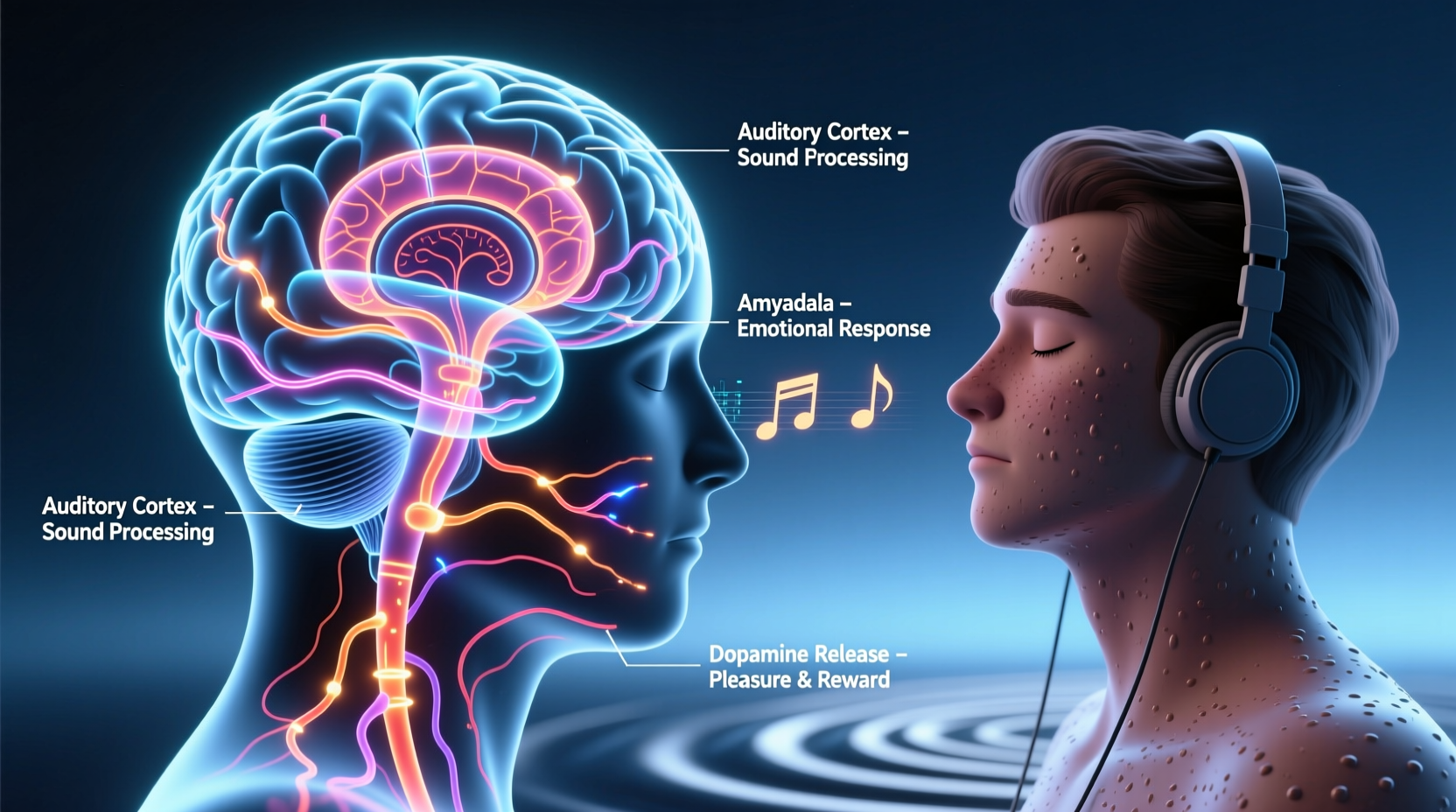
When frisson strikes, it's not just your ears listening—it's your entire nervous system responding. Functional MRI studies show that during moments of intense musical pleasure, key areas of the brain associated with reward and motivation become highly active. The nucleus accumbens, a central hub in the brain’s dopamine-driven reward circuit, surges with activity seconds before and during the peak of a frisson-inducing passage.
Dopamine, the neurotransmitter linked to pleasure, anticipation, and reinforcement learning, is released in two phases: first in anticipation of a rewarding musical moment (like a delayed resolution or a dramatic swell), and again at the moment the expected sound arrives. This dual-phase release mirrors patterns seen in other pleasurable experiences—from eating delicious food to falling in love.
“Music hijacks the brain’s reward pathways in much the same way as survival-related stimuli like food or sex. That’s why certain passages feel so deeply satisfying.” — Dr. Valorie Salimpoor, Cognitive Neuroscientist, McGill University
In a landmark 2011 study led by Dr. Salimpoor, participants who experienced frisson showed significantly higher dopamine release in both the dorsal and ventral striatum during peak emotional moments in music. The brain essentially treats these musical surprises as biologically significant—even though they carry no direct survival benefit.
Expectation, Surprise, and Emotional Payoff
What makes a piece of music capable of triggering frisson? It’s rarely the melody alone. Instead, researchers point to specific compositional techniques that manipulate listener expectations:
- Harmonic surprise: An unexpected chord change that deviates from predicted progressions.
- Dynamic shifts: Sudden changes in volume or instrumentation (e.g., silence followed by a powerful orchestral hit).
- Vocal expressiveness: A singer hitting a high note with raw emotion or vulnerability.
- Rhythmic suspension: Delayed resolution or syncopation that creates tension.
- Timbral contrast: Introduction of a new instrument or texture that stands out dramatically.
These elements work because the brain constantly predicts what comes next in music. When predictions are confirmed, we feel satisfaction. But when they’re subverted in an artful way—especially after building tension—the emotional payoff can be overwhelming. This cognitive-emotional loop is central to frisson.
Who Is More Likely to Experience Musical Frisson?
Not everyone gets chills from music—and individual differences play a big role. Personality traits, particularly those related to openness to experience, strongly correlate with susceptibility to frisson. People who score high on openness tend to seek out novel sensations, appreciate abstract ideas, and engage deeply with art and aesthetics.
A 2014 study published in Psychology of Music found that individuals with higher levels of “cognitive empathy” and “absorption” (the ability to become fully immersed in sensory or imaginative experiences) were more likely to report frisson. These listeners don’t just hear music—they inhabit it.
Interestingly, physiological sensitivity also matters. Some people have more reactive autonomic nervous systems, making them more prone to physical responses like goosebumps, pupil dilation, or changes in heart rate when emotionally stimulated.
Factors Linked to Higher Likelihood of Frisson
| Factor | Description | Impact on Frisson |
|---|---|---|
| Openness to Experience | Personality trait involving curiosity and appreciation for art | Strong positive correlation |
| Empathic Engagement | Tendency to emotionally resonate with others’ feelings | Moderate to strong link |
| Active Listening Habits | Frequent focus on music details rather than background noise | Increases frequency |
| Autonomic Reactivity | Physiological sensitivity to emotional stimuli | Enhances physical response |
| Personal Relevance | Music tied to memories or identity | Amplifies emotional intensity |
The Role of Memory and Personal Meaning
While certain musical structures reliably trigger frisson across listeners, personal history adds another layer. A song may send shivers down your spine not because of its composition alone, but because it’s tied to a pivotal life moment—a first dance, a farewell, a breakthrough.
Neurologically, this involves the hippocampus and medial prefrontal cortex, regions responsible for autobiographical memory and self-referential thought. When music activates these areas in tandem with the reward system, the emotional impact multiplies. The brain isn’t just processing sound; it’s reliving experience.
This explains why frisson-inducing tracks often vary widely between individuals. One person might cry at the opening piano notes of Adele’s “Someone Like You,” while another feels nothing. For the former, those notes may unlock a flood of memories; for the latter, they remain sonically impressive but emotionally neutral.
“I’ll never forget hearing ‘Fix You’ by Coldplay at my brother’s wedding. The organ swelled, the lights dimmed, and suddenly I couldn’t breathe. My arms were covered in goosebumps. It wasn’t just the music—it was knowing how much he’d struggled and how far he’d come.” — Sarah M., teacher and frequent frisson experiencer
This mini case study illustrates how context transforms auditory input into embodied emotion. The same piece of music, heard in a different setting or state of mind, might fail to elicit any physical reaction at all.
How to Increase Your Chances of Experiencing Frisson
While you can’t force frisson on demand, you can create conditions that make it more likely. The following step-by-step guide draws from neuroscience, psychology, and anecdotal reports from frequent experiencers.
- Choose music with dynamic contrasts. Look for pieces that build slowly, use silence effectively, or introduce sudden instrumental layers.
- Listen with focused attention. Avoid multitasking. Close your eyes, reduce distractions, and let yourself be drawn into the sonic landscape.
- Use high-quality audio equipment. Subtle nuances in timbre and spatial mixing can enhance emotional immersion.
- Explore unfamiliar genres. Novelty increases neural engagement. Try post-rock, classical minimalism, or choral works if you usually listen to pop.
- Revisit emotionally significant tracks. Play songs tied to meaningful memories, especially during reflective moments.
- Experiment with headphones vs. speakers. Some people report stronger frisson with binaural cues delivered through headphones.
- Notice your body’s signals. Train yourself to recognize early signs—cooling skin, shallow breathing, tingling—as precursors to full chills.
Checklist: Optimize Your Environment for Musical Frisson
- ☑ Listen in a quiet, uninterrupted space
- ☑ Use noise-isolating headphones or high-fidelity speakers
- ☑ Sit or lie comfortably without distractions
- ☑ Choose music known for emotional dynamics (e.g., builds, drops, vocal climaxes)
- ☑ Allow time for reflection before and after listening
- ☑ Stay hydrated and relaxed—stress dampens emotional responsiveness
- ☑ Try listening in low light to enhance introspection
Common Misconceptions About Musical Frisson
Despite growing scientific interest, several myths persist:
- Myth: Only classical or “serious” music causes frisson.
Reality: Pop, rock, electronic, and even video game soundtracks can trigger it. Examples include Kanye West’s “Runaway,” Sigur Rós’s “Sæglópur,” and the Halo theme. - Myth: Everyone should experience chills from music.
Reality: Up to 20% of people may never experience it—and that doesn’t reflect lower emotional sensitivity. - Myth: Frisson means the music is objectively great.
Reality: It reflects personal neurology and context, not universal quality.
FAQ
Can you train yourself to get chills from music?
While you can't guarantee frisson, you can increase its likelihood by refining your listening habits. Training yourself to notice subtle musical cues—like harmonic tension or vocal inflection—can deepen emotional engagement and make peak moments more impactful over time.
Is musical frisson related to ASMR?
They share similarities—both involve tingling sensations and are triggered by sound—but differ neurologically. ASMR (Autonomous Sensory Meridian Response) typically involves gentle, repetitive stimuli (whispers, tapping) and induces relaxation. Frisson is tied to emotional arousal, surprise, and reward activation, often occurring during intense or dramatic passages.
Why do some songs stop giving me chills after repeated listens?
Familiarity reduces uncertainty. When your brain learns to predict every turn in a song, the element of surprise fades, diminishing dopamine release. This is why live performances or remixed versions of beloved tracks sometimes restore the chills—the novelty reintroduces unpredictability.
Conclusion: Embrace the Shiver
Musical frisson is more than a quirky bodily reaction—it’s evidence of the deep connection between sound, emotion, and cognition. It shows how abstract patterns of vibration can bypass rational thought and strike directly at our nervous system, evoking awe, sorrow, joy, or transcendence.
Understanding the neurology behind the chills doesn’t demystify the experience; it enhances it. Knowing that dopamine surges in anticipation, that your brain thrives on calculated surprise, and that personal meaning amplifies physical response—all of this deepens appreciation for the intricate dance between music and mind.
If you’ve felt those fleeting seconds of electric stillness, you’ve touched something fundamental about being human. The next time a song sends shivers down your spine, don’t brush it off. Lean into it. Notice it. Honor it. Because in that moment, your brain is doing exactly what it evolved to do: respond profoundly to patterns that matter.




 浙公网安备
33010002000092号
浙公网安备
33010002000092号 浙B2-20120091-4
Comments
No comments yet. Why don't you start the discussion?