
In recent years, the popularity of oversized, animated Christmas inflatables has skyrocketed. From dancing snowmen to singing reindeer and flashing light displays, these decorations bring joy to many homeowners and passersby. However, in some towns across the United States and beyond, local governments have begun restricting or outright banning certain types of inflatables—particularly those that produce loud music or repetitive sound effects. The reasons behind these bans are rooted in public nuisance laws, community well-being, and evolving interpretations of residential peace during the holiday season.
The tension arises when festive enthusiasm clashes with neighborly quiet. What one household sees as joyful celebration, another may experience as disruptive noise pollution. As a result, municipalities are stepping in to regulate the volume, timing, and type of holiday displays—especially those involving audio components. Understanding this issue requires examining legal frameworks, social dynamics, and practical solutions that preserve both holiday spirit and community harmony.
The Rise of Noisy Holiday Displays
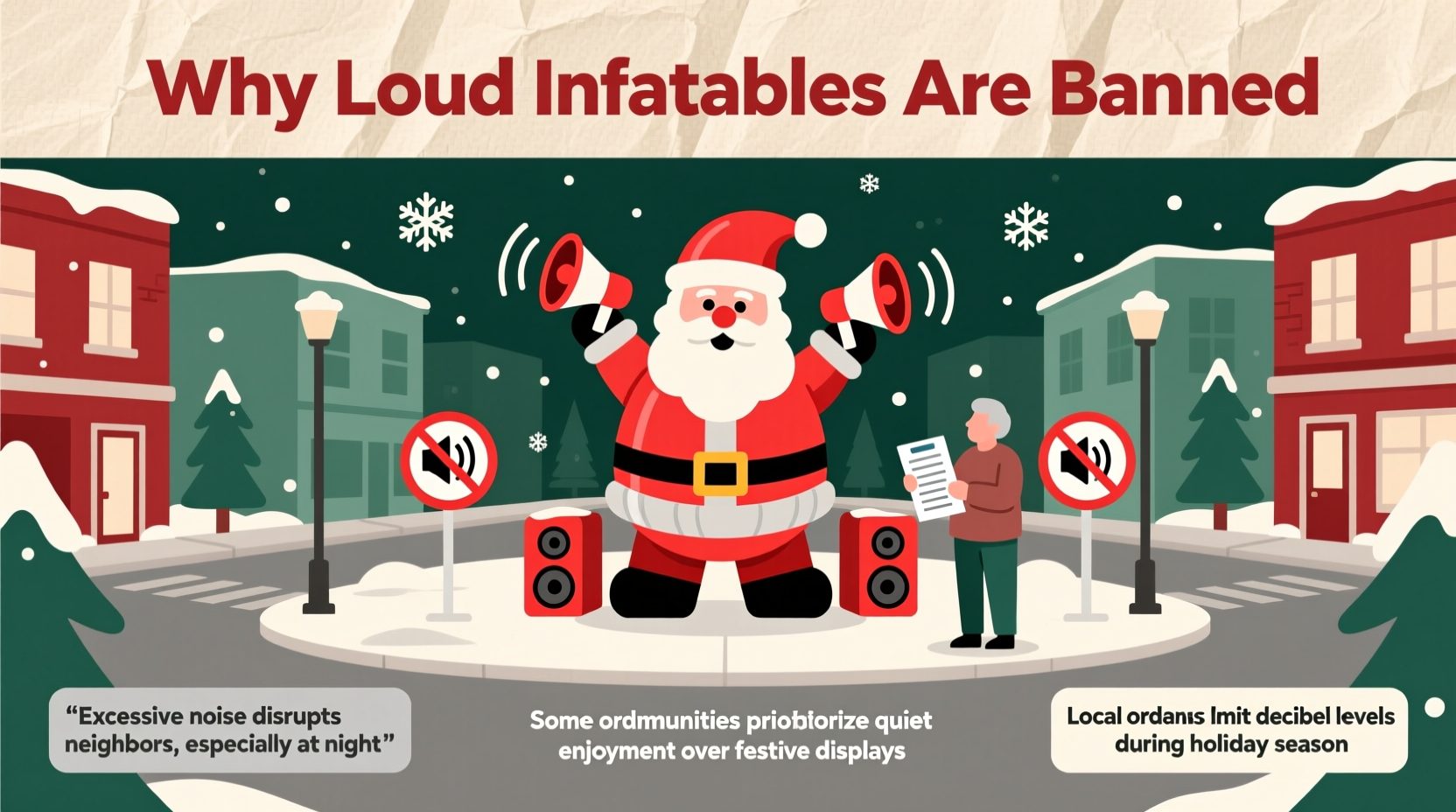
Christmas inflatables first gained widespread popularity in the early 2000s. Lightweight, easy to assemble, and increasingly affordable, they quickly replaced traditional static lawn ornaments for many families. Modern versions often come equipped with motion sensors, synchronized lights, and built-in speakers that play loops of classic carols or humorous sound bites like “Ho ho ho!” or “Jingle all the way!”
While intended to spread cheer, these audio features can become problematic when played at high volumes or on continuous repeat throughout the day and night. A single inflatable might cycle its song every 30 seconds, resulting in hundreds of repetitions daily. In densely populated neighborhoods, such sounds travel easily between homes, especially in areas with minimal natural sound barriers.
Residents who value peace—whether due to work-from-home schedules, medical conditions, or personal preference—often report increased stress and sleep disruption during the holiday season. Complaints to local authorities have led some towns to reevaluate whether unchecked holiday noise constitutes a legitimate public nuisance.
How Noise Laws Apply to Holiday Decorations
Municipal noise ordinances vary widely but generally aim to maintain acceptable sound levels in residential zones. Most cities define permissible decibel limits based on time of day—for example, allowing higher noise during daytime hours (7 a.m. to 10 p.m.) and enforcing stricter standards at night.
These regulations typically apply to all sources of sound, including construction, parties, and even amplified music from vehicles. Increasingly, local governments are interpreting these rules to include holiday inflatables with speakers. If an inflatable exceeds the allowable decibel level at a given time, it may be considered a violation—even if the intent is festive.
For instance, the city of Frisco, Texas, revised its noise ordinance in 2022 to specifically address holiday displays. Under the updated rule, any amplified sound above 65 decibels measured at a property line after 9 p.m. is prohibited. That threshold is roughly equivalent to normal conversation; many musical inflatables exceed it by 10–15 decibels.
“Holiday traditions must coexist with community standards. When one family’s celebration becomes another’s distress, local government has a responsibility to mediate.” — Sarah Lin, Municipal Policy Analyst, National League of Cities
Why Some Towns Choose to Ban Certain Inflatables
Towns implement restrictions not out of disdain for holiday cheer, but to uphold fairness and quality of life for all residents. Key reasons include:
- Preserving Residential Peace: Nighttime noise disrupts sleep, particularly for children, seniors, and individuals with sensory sensitivities.
- Enforceability: General noise complaints are difficult to manage without clear guidelines. Specific rules about holiday displays make enforcement more consistent.
- Neighbor Relations: Unregulated noise can escalate tensions between households, leading to disputes that strain community cohesion.
- Precedent Setting: Allowing exceptions for holidays could open the door to similar requests year-round, undermining existing noise codes.
In some cases, bans target only inflatables with audio components, leaving silent or light-only versions unaffected. Other jurisdictions impose time-based restrictions—such as requiring music to stop by 9 p.m.—rather than issuing full prohibitions.
A Closer Look: Real Example from Springfield, Ohio
In 2023, the small suburban town of Springfield, Ohio, made headlines when it issued warnings to five households over excessively loud Christmas inflatables. One display featured a 12-foot-tall singing Santa that broadcasted “Santa Claus Is Coming to Town” at maximum volume every 45 seconds from dawn until midnight.
Neighbors filed formal complaints citing insomnia and difficulty concentrating while working remotely. The city’s code enforcement team measured the sound at 78 decibels from the adjacent yard—well above the 68-decibel limit allowed after sunset.
After mediation, the homeowner agreed to reduce volume and set a timer to disable audio between 8 p.m. and 7 a.m. The case prompted the city council to draft a seasonal addendum to the noise ordinance, clarifying expectations for holiday displays. Since then, reported noise violations during December have dropped by 40%.
This scenario illustrates how proactive communication and reasonable compromise can resolve conflicts without eliminating festive expression entirely.
Do’s and Don’ts of Holiday Inflatable Use
| Do’s | Don’ts |
|---|---|
| Use timers to limit operation to daylight and early evening hours (e.g., 7 a.m.–9 p.m.) | Run inflatables 24/7, especially with loud music |
| Position speakers facing away from neighboring homes | Place audio-emitting decorations near property lines |
| Opt for lower-volume settings or mute sound entirely | Assume “everyone loves Christmas music” |
| Check local ordinances for seasonal rules | Ignore neighbor feedback or official warnings |
| Choose LED-lit inflatables without sound for quieter charm | Defy municipal orders citing tradition or free speech |
Step-by-Step Guide to Compliant Holiday Decorating
- Review Local Ordinances: Visit your city or county website and search for “noise ordinance” or “holiday display regulations.” Pay attention to decibel limits and curfew times.
- Inspect Your Inflatable: Determine if it has a speaker, volume control, and timer function. Note how frequently it repeats sound.
- Conduct a Sound Test: Set up the inflatable in your yard and measure volume at the property line using a smartphone decibel app (e.g., NIOSH SLM).
- Adjust Settings: Lower the volume, enable mute mode, or connect the unit to a timer that turns off audio at night.
- Notify Neighbors: Politely inform nearby residents of your plans. Offer to adjust if concerns arise.
- Monitor Feedback: Stay attentive to complaints and respond respectfully. Being proactive avoids escalation.
- Remove or Modify if Required: If cited by authorities, comply promptly to avoid fines or legal action.
Expert Insight: Balancing Celebration and Civility
Dr. Alan Prescott, an urban sociologist at the University of Michigan, has studied seasonal behavior in suburban communities. He emphasizes that holiday traditions evolve alongside societal norms.
“The same culture that once tolerated block-wide fireworks on any summer night now regulates them for safety and inclusivity. Similarly, we’re seeing a shift where communal respect tempers individual expression—especially around noise.” — Dr. Alan Prescott, Urban Sociologist
He notes that younger generations are more likely to support balanced regulations, valuing both festivity and mental well-being. “People want magic, not mayhem,” he says. “A twinkling tree or a tasteful inflatable still conveys joy—without the blaring soundtrack.”
Frequently Asked Questions
Can a town legally ban Christmas music from inflatables?
Yes, provided the ban aligns with existing noise ordinances and applies equally to all amplified sound sources. Courts have generally upheld such regulations as reasonable exercises of municipal authority to prevent public nuisance, as long as they don’t target religious expression specifically.
Are there fines for violating holiday noise rules?
Many towns impose fines ranging from $50 to $500 per violation for non-compliance. Repeat offenses may lead to equipment confiscation or ongoing penalties. Some cities issue warnings first, especially during the initial enforcement period.
What if my inflatable doesn’t have a volume control?
If your model lacks adjustable audio, consider covering the speaker with acoustically dampening material (like foam) or disconnecting it entirely. Alternatively, use the inflatable in silent mode and enhance visibility with additional lighting.
Conclusion: Festive Spirit Within Community Bounds
The debate over loud Christmas inflatables reflects a broader cultural conversation about shared spaces and mutual respect. While holiday joy is universal, its expression must adapt to changing neighborhood dynamics and legal standards. Towns aren’t seeking to cancel Christmas—they’re ensuring it remains inclusive, peaceful, and enjoyable for everyone.
Homeowners can still create dazzling, heartwarming displays without relying on disruptive noise. By choosing thoughtful designs, respecting local laws, and listening to neighbors, it’s entirely possible to celebrate the season with both flair and consideration.




 浙公网安备
33010002000092号
浙公网安备
33010002000092号 浙B2-20120091-4
Comments
No comments yet. Why don't you start the discussion?