
If you've ever sat on your porch with a cup of coffee and watched the local wildlife, you’ve likely seen it: two squirrels darting across the lawn, leaping over roots, zigzagging around trees, and running in tight, looping chases that look more like a cartoon than real animal behavior. These high-speed pursuits often appear chaotic, even playful—but there’s method behind the madness. Squirrel chases aren’t random; they’re complex communications encoded in motion. Understanding why squirrels chase each other in circles reveals a fascinating layer of animal behavior happening right in your backyard.
Squirrels are highly intelligent, territorial, and socially nuanced rodents. Their circular chases serve multiple purposes, from asserting dominance to courting mates. While it may look like simple frolicking, these interactions are critical to their survival, reproduction, and social hierarchy. By decoding this behavior, we gain insight not only into squirrel psychology but also into the broader dynamics of urban wildlife adaptation.
The Science Behind the Chase: What Triggers Circular Pursuits?
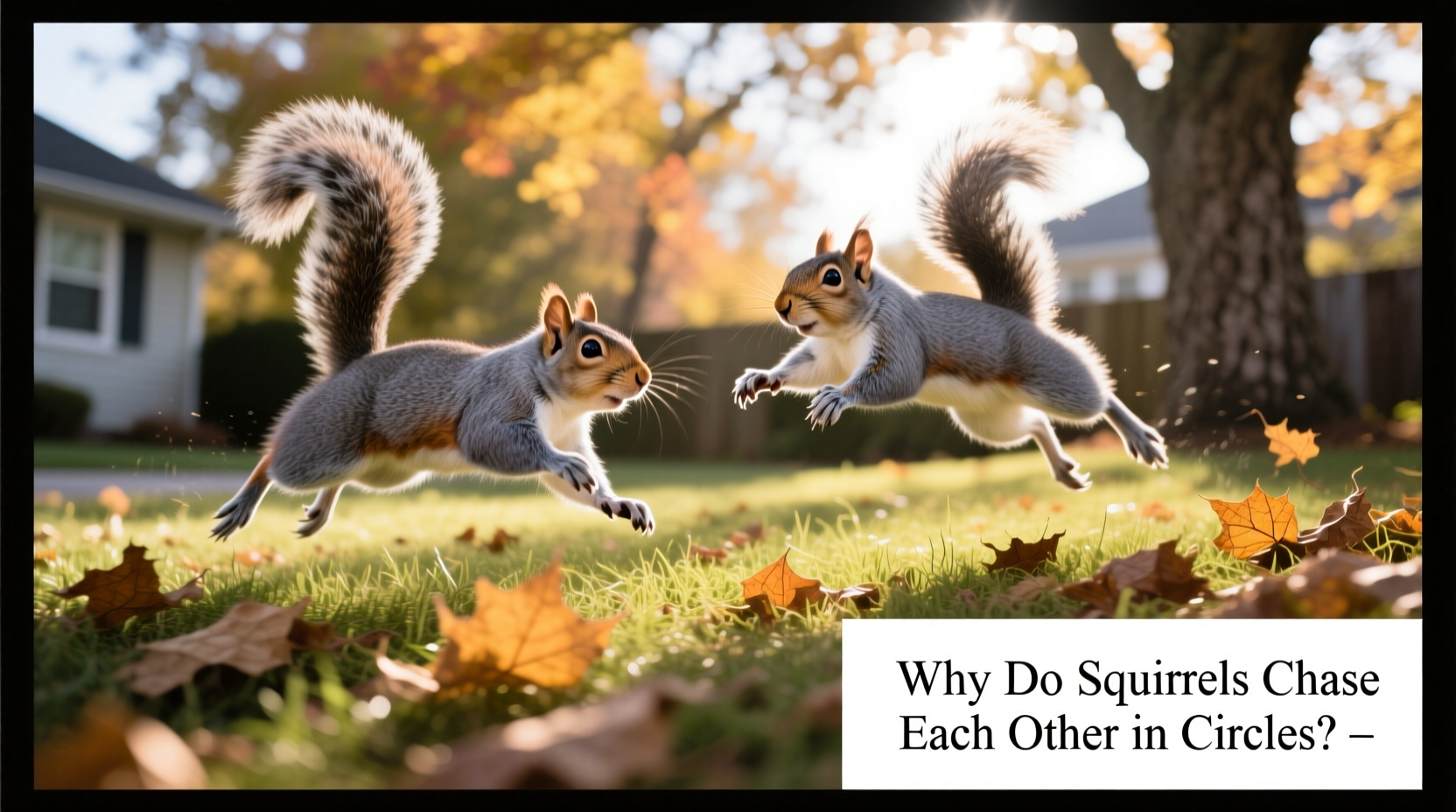
Squirrel chases follow predictable patterns rooted in instinct and environmental stimuli. The most common triggers include territorial disputes, mating rituals, dominance displays, and juvenile play. Each type of chase has distinct characteristics in speed, duration, and body language.
When two squirrels engage in a circular pursuit, they're rarely acting out of aggression alone. Instead, they use movement as a form of non-verbal communication. The lead squirrel often flicks its tail rapidly or emits short alarm calls, signaling either challenge or submission depending on context. The chasing squirrel responds with bursts of speed, attempting to close the gap—not necessarily to attack, but to assert presence.
Biologists studying gray squirrels (*Sciurus carolinensis*) in suburban environments have documented hundreds of chase sequences. In one study conducted by the University of Exeter, researchers found that 68% of observed chases occurred during breeding seasons, while 22% were linked to food source defense, and 10% involved young squirrels practicing social skills.
“Chasing is a low-risk way for squirrels to assess competitors without physical confrontation. It’s a dance of dominance.” — Dr. Lena Peterson, Behavioral Ecologist, University of British Columbia
Mating Rituals: When Chasing Is Courtship
One of the most dramatic reasons for circular chasing occurs during the breeding season, typically in late winter (January–February) and mid-summer (June–July). Female squirrels enter estrus for just a few hours once or twice a year, triggering intense competition among males.
When a receptive female emerges, she releases pheromones detectable by nearby males. Up to ten suitors may converge on her location, initiating a frenzied pursuit known as a “mating chase.” The female leads the pack in erratic loops through trees and along fences, testing stamina and agility. Males jostle for position, sometimes tackling each other mid-leap.
This isn't merely romantic pursuit—it's natural selection in action. The male who stays closest to the female throughout the chase earns mating rights. Studies show that dominant males with superior spatial memory and endurance are more likely to succeed. After mating, the female drives all males away, raising her litter alone.
Territorial Disputes and Resource Defense
Squirrels are fiercely protective of their resources. A single gray squirrel may claim a territory spanning several acres, especially in areas rich in nuts, seeds, and nesting sites. Intrusions by unfamiliar squirrels often provoke immediate response.
Circular chases in this context function as boundary enforcement. The resident squirrel will bolt toward the intruder, initiate pursuit, and drive them out using rapid, looping paths that exploit familiarity with the terrain. These chases tend to be shorter and more aggressive than mating chases, often ending with tail-flagging and vocal scolding.
Nut caches are particularly defended. Squirrels rely on thousands of buried seeds to survive winter, and theft is common. Research shows that squirrels can remember the general locations of up to 90% of their caches—and they’ll chase off anyone suspected of pilfering.
| Chase Type | Average Duration | Key Behaviors | Seasonal Peak |
|---|---|---|---|
| Mating Chase | 15–45 minutes | Group pursuit, female-led, acrobatic leaps | Jan–Feb, Jun–Jul |
| Territorial Chase | 2–10 minutes | Direct pursuit, tail-flicking, vocalizations | Year-round, peaks in fall |
| Play Chase (juveniles) | 5–15 minutes | Rolling, mock biting, frequent pauses | Spring–early summer |
Young Squirrels at Play: Learning Through Motion
Not all chases are serious. Juvenile squirrels, especially those between 8–16 weeks old, engage in what scientists call “locomotor play”—running, jumping, and chasing without apparent purpose. These sessions often resemble circular tag games, complete with sudden stops, reversals, and exaggerated movements.
This play serves a crucial developmental role. It helps young squirrels build muscle coordination, refine escape tactics, and learn social cues. Observations in controlled environments show that squirrels denied play opportunities exhibit poorer decision-making when evading predators later in life.
Mothers tolerate this behavior, though they may intervene if play turns too rough. Unlike adult chases, juvenile versions lack urgency. The movements are bouncier, less direct, and frequently interrupted by grooming or snacking. These sessions usually occur in safe zones near the nest and decline sharply once independence is reached.
“Play-chasing is like flight simulation for squirrels. They’re rehearsing survival moves in a risk-free setting.” — Dr. Alan Reyes, Developmental Zoologist, Cornell Lab of Ornithology
How to Interpret Squirrel Behavior in Your Yard
Understanding what you’re seeing requires attention to detail. Not every chase means the same thing. Here’s how to read the signs:
- Single pursuer vs. multiple chasers: One squirrel chasing another suggests territorial defense. Multiple squirrels following one indicates a mating chase.
- Tail movement: Rapid side-to-side flicks signal agitation or warning. A raised, puffed tail often accompanies territorial displays.
- Vocalizations: Short “kuk” calls mean alarm. A rhythmic “quaa” sound usually follows a chase and may indicate lingering threat awareness.
- Time of year: Spring and summer chases are more likely mating-related. Fall chases often involve food hoarding conflicts.
Mini Case Study: The Oak Street Squirrel Standoff
In a quiet neighborhood in Ann Arbor, Michigan, homeowner Maria Thompson began documenting squirrel behavior after noticing daily chases around her large oak tree. Over six weeks in October, she recorded 27 distinct chases—most occurring between 7–9 AM.
Using binoculars and a voice memo app, she noted that the same two squirrels appeared in 21 of the incidents. One had a distinctive notch in its ear. The chases always started near a bird feeder she’d recently installed. The notched squirrel consistently initiated the pursuit, driving the other away.
After removing the feeder, the chases stopped within three days. A local wildlife biologist reviewed her notes and concluded that the notched squirrel was a dominant resident defending a newly discovered nut cache under the feeder’s platform. The case highlights how human-provided resources can intensify natural territorial behaviors.
Do’s and Don’ts When Observing Squirrel Chases
To respect wildlife and get the most accurate understanding of their behavior, follow these guidelines:
| Do | Don’t |
|---|---|
| Observe from a distance using binoculars | Approach or attempt to touch the animals |
| Record time, duration, and number of squirrels | Intervene in a chase—even if it looks violent |
| Limit feeding to designated times and areas | Leave out food that encourages overcrowding |
| Plant native trees that support natural foraging | Use traps or repellents unless absolutely necessary |
Step-by-Step Guide to Documenting Squirrel Behavior
Want to turn casual observation into meaningful data? Follow this timeline to track squirrel chases in your area:
- Week 1: Baseline Observation
Watch your yard for 20 minutes each morning and evening. Note squirrel presence, but don’t record chases yet. Identify individuals by markings if possible. - Week 2: Start Logging Events
When a chase occurs, write down start time, end time, number of squirrels, direction of travel, and any vocalizations. - Week 3: Map Activity Zones
Sketch your yard and mark where chases begin and end. Look for hotspots near feeders, trees, or burrows. - Week 4: Adjust Variables
Temporarily remove a food source (e.g., birdseed) and observe changes. Does chase frequency decrease? - Week 5: Analyze Patterns
Look for correlations between time of day, weather, and chase types. Share findings with local wildlife groups or citizen science platforms.
Frequently Asked Questions
Do squirrels ever get injured during chases?
Minor injuries like scrapes or fur loss do occur, especially during mating season scrambles. However, serious harm is rare. Squirrels rely on evasion rather than combat, so fights are usually brief and ritualized. Most confrontations end with one squirrel fleeing, avoiding prolonged conflict.
Why do they run in circles instead of straight lines?
Circular or zigzag patterns maximize maneuverability and confuse rivals. Squirrels use their environment—tree trunks, branches, fences—as obstacles to slow pursuers or gain advantage. This path also allows them to keep an eye on their opponent while maintaining speed.
Can I stop squirrels from chasing in my yard?
You can reduce the frequency by minimizing attractants like open food sources, unsecured compost, or dense brush piles that harbor nests. However, chasing is a natural behavior and shouldn’t be suppressed entirely. A balanced ecosystem includes such interactions.
Final Thoughts: Embracing the Wild in Our Backyards
The next time you witness a pair of squirrels spinning in frantic loops across your lawn, resist the urge to dismiss it as nonsense. That chase carries meaning—a declaration of territory, a bid for love, or a lesson in survival. These small mammals navigate complex social landscapes with intelligence and precision, adapting seamlessly to urban environments we’ve built around them.
By learning to interpret their behavior, we deepen our connection to the natural world, even in the most developed neighborhoods. Squirrel chases remind us that wilderness isn’t just preserved in forests and parks—it thrives in our gardens, on our rooftops, and in the spaces between our sidewalks.




 浙公网安备
33010002000092号
浙公网安备
33010002000092号 浙B2-20120091-4
Comments
No comments yet. Why don't you start the discussion?