
If you’ve spent time observing wildlife from your porch or garden, you’ve likely seen two squirrels darting across lawns, leaping between trees, and zigzagging through shrubs in what looks like a high-speed game of tag. At first glance, it may seem playful or chaotic—but these chases are rarely random. Squirrel pursuits are complex behaviors rooted in survival, communication, and reproduction. Understanding why squirrels chase each other reveals a surprisingly intricate social world unfolding right in your backyard.
Squirrels—particularly the eastern gray squirrel (*Sciurus carolinensis*), common across North America—are highly active, intelligent rodents with keen spatial memory and strong territorial instincts. Their chases aren’t just acrobatic displays; they’re purposeful actions shaped by season, gender, age, and environmental pressures. By decoding these behaviors, we gain insight into how animals navigate shared spaces, compete for resources, and reproduce successfully in urban and suburban ecosystems.
The Science Behind Squirrel Chasing: More Than Just Play
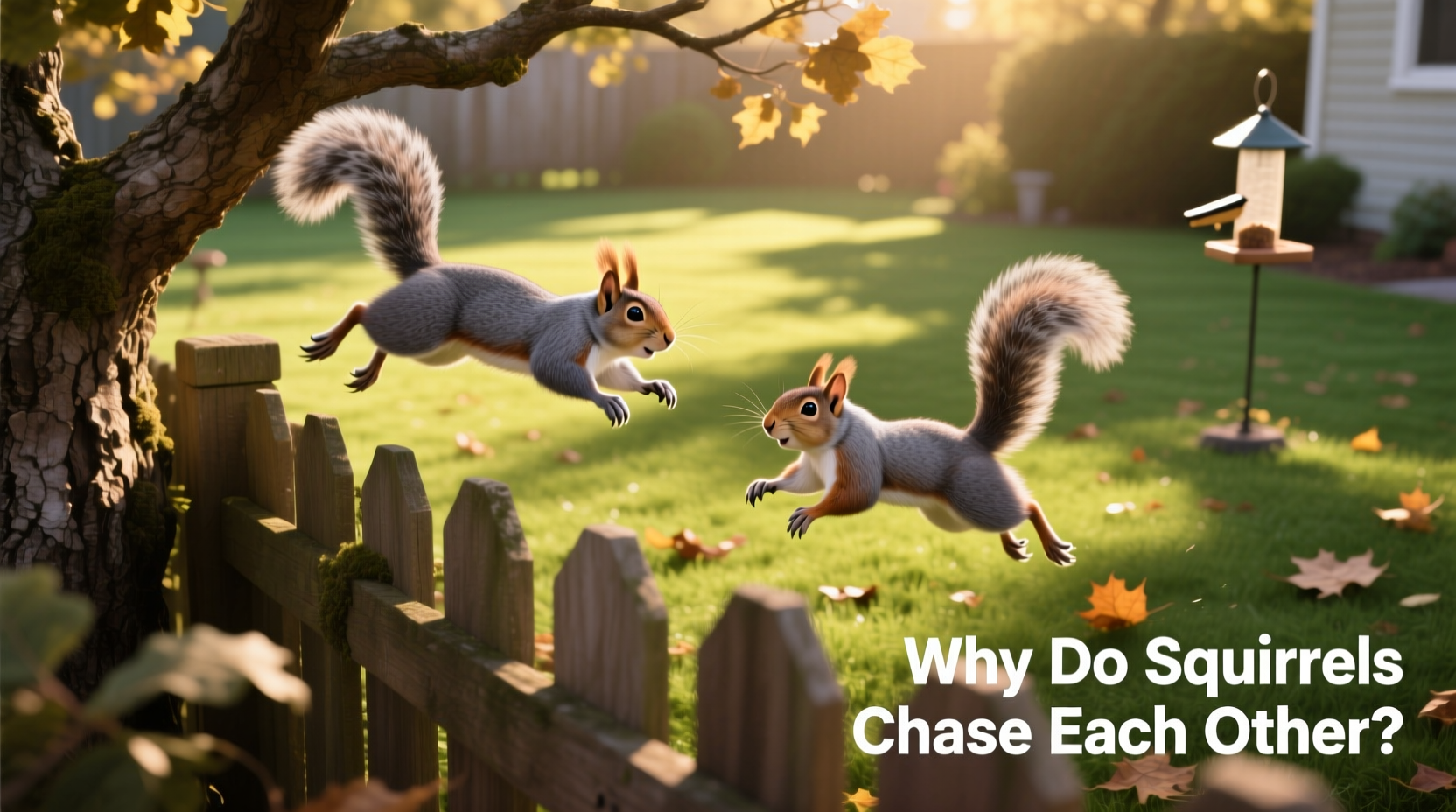
While young squirrels do engage in play-fighting to develop motor skills and social awareness, most adult chases serve specific biological functions. Researchers who study animal behavior classify squirrel chases under several categories: territorial defense, mating competition, dominance assertion, and juvenile learning. The context determines the intensity, duration, and participants involved.
Chasing typically involves one squirrel pursuing another in rapid bursts, often accompanied by vocalizations such as chirps, squeals, or tail flicking. These visual and auditory signals amplify the message being communicated—whether it’s “stay out of my area” or “I’m ready to mate.” Unlike solitary animals that avoid interaction, squirrels live in overlapping home ranges and must constantly negotiate boundaries without direct physical confrontation, which could lead to injury.
Interestingly, not all chases result in clear winners or losers. Some end when the pursued squirrel escapes into a tree cavity or disappears from view. Others conclude with mutual grooming or proximity, suggesting reconciliation or acceptance of hierarchy. This complexity underscores that squirrel interactions are dynamic and context-sensitive—not merely instinctual reflexes.
Common Reasons Squirrels Chase Each Other
Behind every dash through the treetops lies a motivation. Here are the primary drivers of squirrel chasing behavior:
1. Mating Competition (Breeding Season Frenzy)
The most dramatic chases occur during breeding seasons—typically December–February and May–June, depending on climate. Female squirrels enter estrus for just a few hours once or twice a year, triggering intense competition among males. When a receptive female emits pheromones, nearby males detect them and begin trailing her closely.
What follows is a \"mating chase,\" where multiple males pursue a single female in a noisy, winding route through trees and yards. This isn’t courtship—it’s competition. The fastest, most persistent male usually wins mating rights. Biologists have observed that dominant males often guard females before estrus to reduce rival access, but last-minute chases still determine final pairings.
“Mating chases are less about romance and more about reproductive fitness. Only the fittest males succeed in passing on their genes.” — Dr. Laura Bennett, Behavioral Ecologist, University of Vermont
2. Territorial Disputes
Though squirrels don’t maintain strictly defined territories like wolves or birds of prey, they do defend key resource zones—especially those containing food caches, nesting sites, or prime shelter trees. A squirrel that repeatedly visits a bird feeder or buries nuts in a particular flower bed may consider that space semi-exclusive.
When an intruder enters this zone, the resident squirrel may respond with a warning bark or tail flagging. If ignored, pursuit begins. These chases are usually short and targeted, ending once the intruder retreats. In dense neighborhoods, repeated confrontations can establish informal hierarchies, reducing future conflicts.
3. Dominance and Social Hierarchy
Squirrel populations form loose dominance structures, particularly among males. Larger, older individuals tend to dominate younger or smaller ones. Chasing reinforces rank without requiring full combat, conserving energy and minimizing risk.
You might notice a dominant squirrel routinely chasing others away from feeding spots—even when not eating. This behavior asserts control and deters challenges. Juveniles, especially those recently independent from their mothers, often endure frequent chases as they learn their place in the local social order.
4. Play Behavior in Juveniles
Young squirrels (kits) born in spring and summer spend weeks playing with siblings before dispersing. Their chases mimic adult behaviors but lack aggression. They leap, tumble, and mock-pursue each other to build coordination, escape tactics, and social cues.
This play is critical for survival. Kits that engage in frequent social play develop better navigation skills, faster reaction times, and improved predator evasion strategies. While adults may appear to “join in,” most juvenile chases are self-initiated learning exercises rather than responses to external threats.
5. Misdirected Aggression or Disturbance Response
Sometimes, chases erupt due to sudden disturbances—a cat prowling nearby, a loud noise, or even human presence. One squirrel’s panic can trigger a chain reaction, leading to seemingly unprovoked pursuits. In rare cases, redirected aggression occurs: a squirrel chased by a predator may vent frustration by pursuing a neutral individual afterward.
These events are typically brief and disorganized compared to structured mating or territorial chases. Observers may mistake them for random chaos, but they reflect stress responses within a vigilant animal community.
How to Tell What Type of Chase You're Watching
Not all chases look the same. With careful observation, you can distinguish between types based on timing, number of participants, and accompanying behaviors.
| Chase Type | Season | Participants | Key Signs |
|---|---|---|---|
| Mating Chase | Dec–Feb, May–Jun | 1 female + multiple males | Long duration, noisy, circular paths, tail flicking |
| Territorial Chase | Year-round (peaks in fall/winter) | Same sex, often solo vs. solo | Short burst, direct path, ends at boundary |
| Dominance Chase | Late summer to winter | Adult male vs. younger/juvenile | One-sided, repetitive, occurs near feeders |
| Play Chase | July–September | Juveniles (same litter) | Bouncy movement, rolling, no vocal warnings |
| Stress-Induced Chase | Anytime | Unpredictable pairs | Sudden start, erratic path, abrupt end |
Use this guide to log your observations over time. Note the date, time, weather, and any environmental triggers. Over weeks, patterns will emerge that reveal the rhythms of your local squirrel population.
Real Example: A Backyard Observer’s Journal Entry
In early April, Sarah Thompson, a nature enthusiast in suburban Maryland, began documenting squirrel activity after noticing daily chases around her oak tree. For three weeks, she recorded sightings each morning and evening.
Initially, she assumed the chases were territorial. But her notes revealed a shift: by mid-April, the same small group of juveniles engaged in bouncy, looping runs, often tumbling into leaves. No alarm calls were made, and adults largely ignored them.
After consulting a local wildlife guide, Sarah realized she was witnessing post-weaning play behavior. Two of the juveniles had recently dispersed from a nearby nest and were refining their agility. One particularly bold kit consistently initiated games, mimicking adult dominance gestures like tail-flagging—though without aggression.
By June, the chases diminished. The juveniles had established individual ranges. Sarah’s journal not only deepened her understanding but also helped her adjust her yard habits—placing feeders farther apart to reduce conflict.
Step-by-Step: How to Observe and Interpret Squirrel Chases
You don’t need a degree in biology to understand squirrel behavior. Follow these steps to become a skilled backyard naturalist:
- Choose a consistent observation window: Pick a quiet time—early morning or late afternoon—when squirrels are most active.
- Find a fixed vantage point: Sit near a window, porch, or garden bench with a clear view of trees, fences, or feeding areas.
- Note the number and size of squirrels: Adults are larger with fuller tails; juveniles are smaller, sometimes with ragged fur.
- Listen for vocalizations: Sharp barks suggest alarm or territoriality; soft chirps may accompany play.
- Track the chase path: Is it circular (common in mating)? Direct (territorial)? Bouncy (play)?
- Record environmental factors: Presence of predators, food sources, recent weather changes.
- Repeat over multiple days: Look for recurring individuals or seasonal trends.
Within a month, you’ll likely identify regulars in your area—perhaps a dominant male who patrols the bird feeder or a mother teaching her young to forage. These insights foster deeper connection with local wildlife and improve coexistence.
Checklist: Promoting Peaceful Coexistence with Yard Squirrels
While chases are natural, you can minimize stress and conflict in your yard with thoughtful practices:
- ✅ Provide multiple feeding stations to reduce competition
- ✅ Place squirrel baffles on bird feeders to prevent monopolization
- ✅ Avoid feeding squirrels by hand—this encourages dependency and aggression
- ✅ Trim branches near roofs to discourage attic nesting
- ✅ Preserve mature trees—they offer natural shelter and reduce ground-level disputes
- ✅ Never interfere with mating or territorial chases—they’re essential ecological processes
Remember: squirrels are wild animals. Even if they seem tame, they thrive best when allowed to follow natural behaviors without human intervention.
Frequently Asked Questions
Do squirrels ever get injured during chases?
Physical injuries are rare. Most chases are ritualized displays designed to avoid actual combat. However, falls from trees or collisions with windows can occur, especially in urban areas. Predators like hawks or cats pose a greater threat than intra-species chases.
Why do squirrels chase each other in circles around a tree?
Circular chases often occur during mating season, where multiple males follow a female in a rotating pattern. It can also happen during territorial disputes when both squirrels attempt to maintain higher ground—one ascends while the other circles below, trying to cut off escape routes.
Can I tell if a squirrel is male or female during a chase?
Not reliably by sight alone. External differences are minimal. Gender is usually inferred from context—e.g., multiple squirrels chasing one suggests a mating scenario (the pursued is likely female). Otherwise, identification requires close veterinary examination.
Conclusion: Appreciating the Complexity Behind the Chase
The next time you see squirrels darting across your lawn in hot pursuit, pause before dismissing it as mere mischief. That chase could be a high-stakes bid for reproduction, a quiet assertion of territory, or a young squirrel mastering the skills it needs to survive winter. These moments connect us to the subtle rhythms of nature that persist even in developed landscapes.
Understanding animal behavior doesn’t require a lab coat or binoculars—just curiosity and attention. By learning what drives squirrel chases, we cultivate respect for the intelligence and adaptability of urban wildlife. Instead of shooing them away, we begin to see them as neighbors navigating their own social worlds.




 浙公网安备
33010002000092号
浙公网安备
33010002000092号 浙B2-20120091-4
Comments
No comments yet. Why don't you start the discussion?