
Squirrels are a familiar sight in parks, backyards, and urban green spaces across much of the world. Agile, curious, and often bold around humans, they’re known for darting up trees or scurrying across lawns with apparent abandon. Yet, there’s one moment that seems to pause their energy entirely: the sudden freeze. You approach—maybe just walking your dog or stepping onto your porch—and the squirrel stops dead in its tracks, motionless, eyes locked on you. Is this a sign of fear? A malfunction in their nervous system? Or could this be a calculated survival tactic honed by evolution?
The answer lies somewhere between instinct and intelligence. The freezing behavior observed in squirrels isn’t random; it’s a deeply rooted response shaped by millions of years of predator-prey dynamics. While it may look like panic or confusion, freezing is often a deliberate strategy designed to increase their odds of survival. Understanding why squirrels freeze requires exploring animal behavior, sensory perception, and evolutionary biology.
The Science Behind the Freeze Response
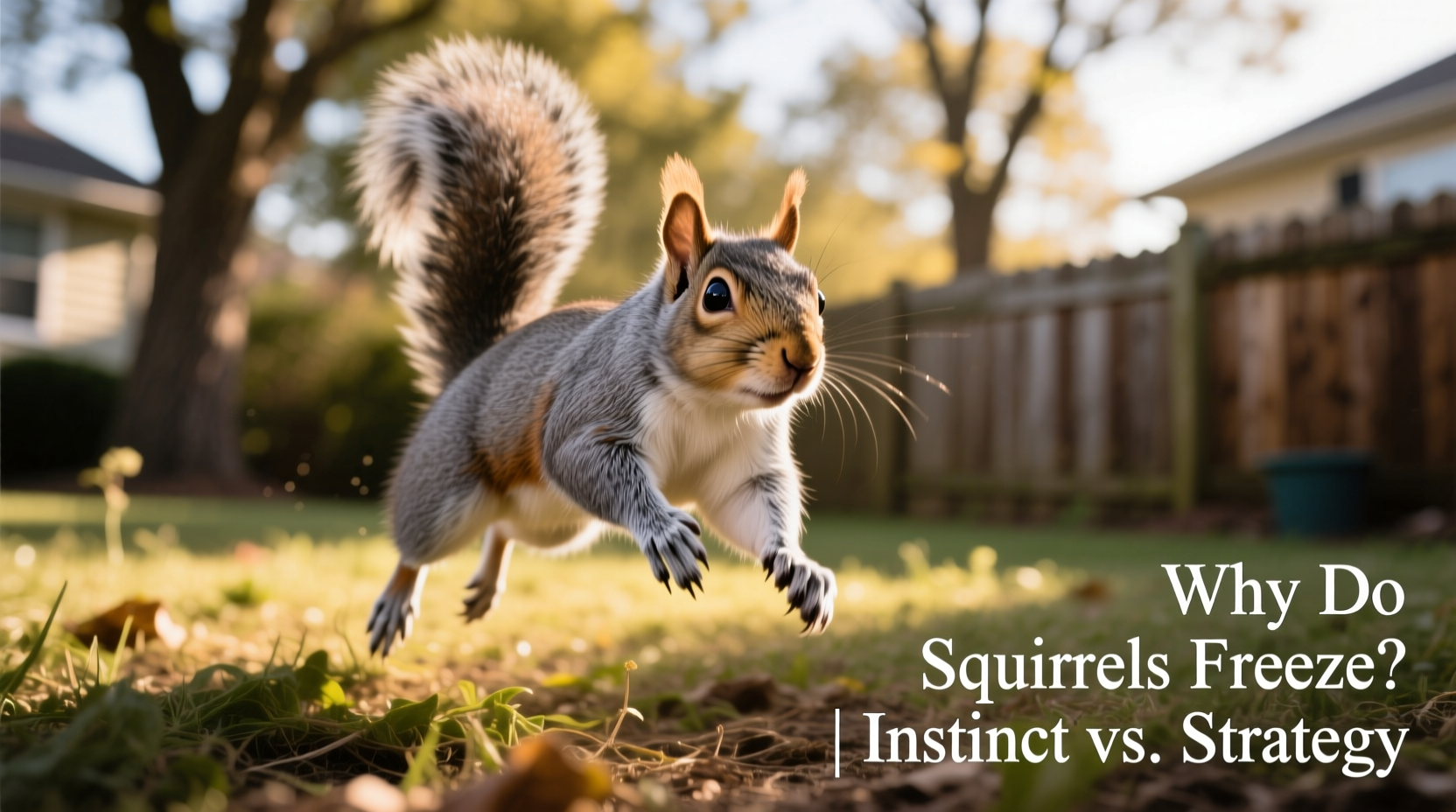
When an animal detects a potential threat, its nervous system activates what’s known as the “freeze-flight-fight” triad—a trio of instinctive reactions. Unlike the more commonly discussed fight-or-flight responses, freezing is less understood but equally vital in nature. In squirrels, this reaction is primarily governed by the amygdala, a region of the brain responsible for processing threats and emotional memory.
Upon detecting movement, sound, or scent associated with danger, the squirrel’s brain rapidly assesses the situation. If escape seems risky (for example, running might draw attention), immobility becomes the preferred initial strategy. By freezing, the squirrel reduces visual cues that predators use to detect motion. Many predators, including hawks, foxes, and domestic cats, rely heavily on movement to locate prey. A motionless squirrel can effectively \"disappear\" against a complex background like leaf litter or tree bark.
“Freezing is not passive fear—it’s active surveillance. The animal is gathering information while minimizing detection.” — Dr. Laura Bennett, Behavioral Ecologist at the University of Alberta
This split-second decision-making process happens almost instantaneously. Squirrels have highly developed peripheral vision and acute hearing, allowing them to monitor the threat without moving their heads. During the freeze, they remain hyper-alert, scanning for changes in your direction, speed, and posture—all critical data points in determining whether to flee, continue freezing, or resume normal activity.
Is It Fear or Strategy? The Dual Nature of Freezing
The question of whether freezing is driven by fear or strategy isn’t an either/or proposition. It’s both. Fear—the physiological arousal triggered by perceived danger—initiates the response. But the continuation and duration of the freeze reflect strategic decision-making based on environmental context.
Fear manifests physically: increased heart rate, muscle tension, and heightened senses. These prepare the squirrel for rapid escape if needed. However, unlike a panicked bolt—which might expose the squirrel to ambush—freezing allows for risk assessment. This duality makes the behavior remarkably efficient: it combines emotional reactivity with cognitive control.
In urban environments where squirrels regularly encounter humans, many appear to habituate over time. That is, they learn through repeated exposure that people rarely pose a direct threat. As a result, urban squirrels tend to freeze less frequently and for shorter durations than their rural counterparts. This adaptation underscores the role of learning in modifying instinctual behaviors.
Environmental and Evolutionary Influences on Freezing Behavior
The frequency and intensity of freezing vary significantly depending on habitat, species, and individual experience. For instance, eastern gray squirrels (Sciurus carolinensis) in city parks may barely flinch at a passing cyclist, whereas a red squirrel in a remote forest might freeze at the distant sound of footsteps.
This variation reflects evolutionary pressures. In areas with high predation, freezing offers a clear survival advantage. Studies show that juvenile squirrels—who are more vulnerable to predators—are more likely to freeze than adults, suggesting that the behavior is especially crucial during early life stages.
Moreover, different squirrel species exhibit distinct anti-predator strategies. Ground squirrels, for example, often combine freezing with alarm calls to warn others in their colony. Tree squirrels, meanwhile, rely more on concealment and quick vertical escapes. The choice between freezing, fleeing, or vocalizing depends on the type of threat, terrain, and social structure.
| Species | Habitat | Freezing Frequency | Common Triggers |
|---|---|---|---|
| Eastern Gray Squirrel | Urban/Suburban | Moderate | Dogs, sudden movements |
| Red Squirrel | Forest/Woodland | High | Predators, loud noises |
| Ground Squirrel | Open Fields | Very High | Aerial predators, vibrations |
| Flying Squirrel | Wooded Areas | Low (nocturnal) | Light, noise at night |
The table above illustrates how ecological niche shapes behavioral tendencies. Ground squirrels, exposed in open terrain, must rely heavily on vigilance and stillness. Flying squirrels, being nocturnal and gliding-capable, face fewer daytime threats and thus display less frequent freezing during human encounters.
How Squirrels Assess Threat Levels: A Step-by-Step Breakdown
The freeze isn’t the end of the story—it’s often the first phase in a dynamic sequence of threat evaluation. Here’s how a typical interaction unfolds from the squirrel’s perspective:
- Initial Detection: The squirrel notices movement, shadow, or sound. Its body tenses immediately.
- Freeze Activation: Motion ceases. The squirrel remains still, relying on camouflage and reduced visibility.
- Sensory Scanning: Without moving its body, it uses wide-set eyes and mobile ears to gather data about the intruder’s distance, direction, and behavior.
- Risk Assessment: If the human (or predator) moves erratically or approaches directly, flight is initiated. If the observer stands still or moves predictably, the squirrel may interpret the threat as lower.
- Action Decision: Based on accumulated input, the squirrel decides to flee (usually in a zigzag pattern), resume foraging, or remain frozen longer.
This entire process can take just seconds, yet it involves complex neurological processing. Remarkably, squirrels can remember specific individuals and locations where threats occurred, adjusting their behavior accordingly in future encounters.
Real Example: The Park Bench Observation
In a documented observation at Central Park, New York, a researcher noted a gray squirrel repeatedly freezing when joggers passed by a certain bend in the path. Over several weeks, the squirrel showed increasing tolerance to pedestrians but continued to freeze sharply whenever a person wore bright red clothing. Further analysis suggested the color resembled the plumage of a hawk seen in the area months earlier—an indication that visual cues can trigger lasting behavioral responses.
This case highlights how past experiences shape present behavior. The squirrel wasn’t merely reacting to motion; it was responding to a learned association between color, movement, and danger. Such adaptive memory enhances survival in unpredictable environments.
Practical Tips for Observing Squirrels Without Causing Stress
If you enjoy watching wildlife in your backyard or local park, understanding squirrel behavior can deepen your appreciation and minimize disturbance. Consider these guidelines when encountering a frozen squirrel:
- Maintain a respectful distance—avoid approaching closer than 10–15 feet.
- Move slowly and predictably. Sudden gestures heighten perceived threat.
- Avoid direct eye contact, which some animals interpret as aggressive.
- Remain quiet. Loud talking or clapping can trigger flight responses.
- Never attempt to feed squirrels during or immediately after a freeze episode—they need time to return to baseline alertness.
Checklist: How to Coexist Peacefully with Urban Squirrels
- ✅ Observe from a distance without encroaching on their space.
- ✅ Avoid feeding them processed human food.
- ✅ Secure trash bins to prevent scavenging-related conflicts.
- ✅ Install squirrel-proof bird feeders if desired.
- ✅ Allow them to retreat without pursuit or loud noises.
- ✅ Respect nesting seasons (spring and late summer) by minimizing tree disturbances.
Frequently Asked Questions
Do squirrels remember people who scare them?
Yes, squirrels have strong spatial and associative memory. They can recognize individual humans based on appearance, behavior, and past interactions. A person who once chased or startled a squirrel may be avoided in future encounters.
Is freezing harmful to squirrels?
Not inherently. Freezing is a natural, adaptive response. However, chronic exposure to stressors—such as constant harassment or habitat disruption—can lead to elevated cortisol levels, weakened immunity, and reduced reproductive success.
Why don’t all squirrels freeze when they see me?
Habituation plays a major role. Squirrels living in high-traffic urban areas often learn that humans are non-threatening. Additionally, individual temperament varies—some squirrels are naturally bolder than others.
Conclusion: Respecting Instincts in Everyday Wildlife
The next time you see a squirrel freeze in your presence, consider it not as a sign of weakness or fear alone, but as a sophisticated survival mechanism refined by evolution. What appears to be a simple pause is, in fact, a complex interplay of sensory input, memory, and risk calculation. These small mammals navigate a world full of dangers with remarkable precision—and their freezing behavior is a testament to nature’s ingenuity.
By recognizing the purpose behind such actions, we foster greater empathy for urban wildlife. Simple choices—like slowing down, avoiding sudden movements, or simply pausing to observe—can make a meaningful difference in how animals experience shared spaces.




 浙公网安备
33010002000092号
浙公网安备
33010002000092号 浙B2-20120091-4
Comments
No comments yet. Why don't you start the discussion?